
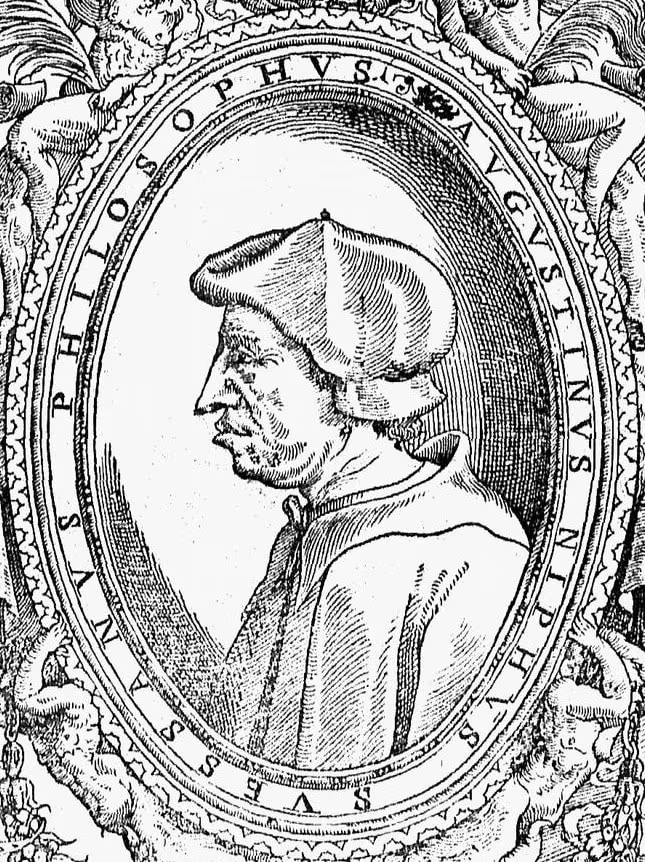
Agostino Nifo
ca. 1469-1538
Biography
Agostino Nifo (Latin Augustinus Niphus, frequently styled Suessanus and, after 1520, Augustinus Niphus de Medicis; Sessa Aurunca, c. 1469–1470 – 18 January 1538) was an Italian philosopher, physician, Aristotelian commentator, and prolific author whose career linked the universities of Padua, Naples, Rome, Pisa, and Salerno with the principal centres of the Renaissance learned book trade. His unusually extensive printed production embraced Aristotle and Averroes, the Greek commentators, logic, psychology, medicine, astrology, zoology, political theory, and the literature of courtly conduct. The succession of editions is inseparable from the development of his thought: texts first written within the Averroist culture of Padua were subsequently revised, repudiated, re-dated, or placed beside new interpretations, while works produced for princely and papal patrons translated university arguments into the genres of controversy and counsel. His reputation depended not upon a single authoritative collection of writings, which was never assembled, but upon the recurring publication of individual treatises and commentaries through successive Venetian, Neapolitan, Florentine, and foreign printing establishments. The relationship between authorial revision, the varying agency of printers and publishing financiers, and the long afterlife of these books makes Nifo a particularly revealing figure for the history of Renaissance philosophy in print.
Nifo was born to Giacomo Nifo and Francesca Galeoni, members of a family of Calabrian origin established at Sessa Aurunca well before his birth. The family’s earlier association with Joppolo contributed to a later tradition that placed his birth in Calabria, sometimes at Joppolo or Tropea, and surrounded his childhood with anecdotes of hardship and flight; the documentary reconstruction instead supports Sessa as his birthplace. After preliminary studies at Sessa and Naples, he moved to Padua, where Nicoletto Vernia introduced him to the Aristotelian commentatorial tradition in which the writings of Averroes retained exceptional authority. Nifo received the doctorate in arts in 1490 and a subordinate extraordinary lectureship in natural philosophy in November 1492. In 1495 he was appointed an ordinary professor teaching in competition with Pietro Pomponazzi, and in 1496 obtained the first-ranking position. The rivalry of simultaneous university lectures, whose audiences could influence the fortunes of individual professors, helped establish the public disputation and defence of interpretative positions as fundamental activities of his scholarly life.
His first substantial editorial undertaking preceded the publication of an independent philosophical treatise. In 1495–1496 he participated in the preparation of a large Latin Aristotle accompanied by the commentaries of Averroes, produced in successive parts at Venice by Giovanni and Gregorio de Gregoriis in connection with the publishing enterprise of Ottaviano Scoto. The separation between the learned editor, the printers responsible for composition and presswork, and the bookseller-publisher who supported distribution is essential. The volumes belonged to a tradition in which the Aristotelian text and its medieval commentary occupied distinct but coordinated portions of the page, making the printed book an instrument of lecture-room interpretation. They also placed Nifo’s name within a widely distributed scholarly corpus before his own exegetical position was fully established. This was a substantial editorial intervention in an inherited textual tradition, not an original translation of the complete works of Aristotle.
The relationship with the Scoto enterprise became more explicit in the 1497 publication of Nifo’s Commentationes in librum Destructio destructionum Averrois, accompanied by his Quaestio de sensu agente. The Venetian edition was printed by Boneto Locatelli for Ottaviano Scoto; a distinction confirmed by bibliographical descriptions of the incunable and essential to the accurate attribution of its manufacture. Averroes’s Destructio destructionum was itself a response to al-Ghazālī’s critique of the philosophers, so that Nifo’s commentary constituted a further layer in a long Arabic-to-Latin history of philosophical argument. The appended question challenged the position of John of Jandun on the activity of the senses and intellect. Nifo dedicated the volume to Cardinal Domenico Grimani and addressed a prefatory assurance of doctrinal orthodoxy to the inquisitor Niccolò Grassetti. These paratexts had a practical purpose, since the bishop of Padua, Pietro Barozzi, had forbidden public discussion of the unity of the intellect in 1489. The accompanying defence of religious conformity did not erase the strong preference for Averroes apparent within the philosophical text.
Nifo’s celebration of Averroes as the privileged interpreter of Aristotle brought him into controversy with the Franciscan Antonio Trombetta, whose Tractatus singularis contra Averroistas appeared at Venice in 1498. His own earlier confrontation with Giovanni Pico della Mirandola, during a Bologna disputation in 1494 concerning the Platonic doctrine of the soul, shows that these disputes formed part of an intellectually diverse field rather than a single quarrel between scholasticism and humanism. Nifo married Angela Landi of Sessa in 1496, and the couple had three children, Domizio, Livia, and Giacomo. Despite attempts to retain him at Padua, he left in 1499, a decision connected with the antagonism provoked by his philosophical positions and with the changing academic circumstances surrounding Pomponazzi. His return to Sessa furnished the opportunity for more sustained study of Greek, an acquisition that profoundly affected the sources cited and the arguments advanced in his later writings.
The decisive evidence of this reorientation lies in two books issued by Pietro Quarengi at Venice in 1503. The Commentatio super tres libros De anima, published in May, reconsidered Aristotelian psychology with access to the Greek text and the Greek exegetical traditions of Alexander of Aphrodisias, Themistius, and Simplicius, without wholly relinquishing Averroes. The Liber de intellectu, published in August, represented a more conspicuous transformation. It reworked material associated with an earlier, unpublished Quaestio de unitate intellectus, replacing an argument sympathetic to the unity of the agent intellect with an examination of the consequences that such a doctrine would have for individual moral responsibility and religious belief. The work gave fresh prominence to Thomas Aquinas, while drawing extensively upon Marsilio Ficino, Proclus, Ammonius, and other Platonizing authorities. It was accompanied by the three books De daemonibus, which defended the existence of demonic beings against restrictive interpretations of Aristotelian cosmology. These were distinct works issued together, and their presence in one volume should not conceal the different problems and textual histories they addressed.
The date attached to the Liber de intellectu is particularly important for its intellectual genealogy. Nifo presented it as having been composed in 1492, before the more controversial formulations printed in 1497, although its published argument belongs to a later phase of reconsideration. The De daemonibus was similarly associated with an early date. His chronology therefore cannot be reconstructed simply by treating every dated authorial subscription as the moment when the surviving text took its final form. Earlier arguments could be substantially recast and then presented as long-standing convictions. This pattern would reappear in his treatment of Aristotelian psychology and the problem of beatitude, indicating that the bibliographical evidence of composition, revision, and publication must be interpreted together rather than collapsed into a single sequence.
From 1501 to 1505 Nifo held a teaching appointment in natural philosophy at Naples, combining academic work with medical service to the Spanish viceroy Gonzalo Fernández de Córdoba. A temporary withdrawal from Sessa during an epidemic in 1503, followed by a request in 1504 for readmission to the Paduan university, did not interrupt his southern intellectual connections. In Naples he encountered the circle associated with Giovanni Pontano, whose humanist engagement with astronomy and astrology supplied a new context for Nifo’s philosophical interests. His De diebus criticis seu decretoriis, printed at Venice by Giacomo Penzio for Alessandro Calcedonio in 1504, examined the supposedly decisive days in the course of illnesses, while De nostrarum calamitatum causis, printed by Boneto Locatelli for the heirs of Ottaviano Scoto in 1505, connected epidemic and historical misfortune with celestial configurations. His medical astrology was not the uncontrolled prediction of events from omens: he sought to distinguish techniques based upon mathematical and Ptolemaic calculation from prognostications he judged methodologically unsound. The assumptions of astral influence nonetheless remained integral to his early explanations of disease.
His continuing commitment to Aristotelian exegesis produced several closely related publications in these years. The Commentarii in duodecimum librum Metaphysices, printed at Venice by Simone da Lovere in 1505 and dedicated to Antonio Giustinian, focused on Aristotle’s treatment of first philosophy and its Averroistic interpretation. The Averroys de mixtione defensio, issued by Locatelli in the same year, defended a theory of mixture through close consideration of the relevant philosophical authorities. In 1506 the Venetian press of Locatelli, working at the expense of the heirs of Ottaviano Scoto, produced Nifo’s translation and exposition of Aristotle’s De generatione et corruptione. Its folio layout placed short sections of the Latin Aristotelian text amid extended commentary, with marginal aids to consultation. The distinction between the original publication and the expanded or corrected form issued in 1526, accompanied by the Quaestio de infinitate primi motoris and further Recognitiones, is central: the later book was not merely another dated copy of the same unchanged text.
Between 1506 and 1507, Nifo taught privately at Sessa, where Galeazzo Florimonte was among his pupils. In 1507 he accepted the invitation of Roberto II Sanseverino, prince of Salerno, to contribute to the intellectual standing of the Salernitan school; after the prince’s death in 1508, he returned to Naples as professor of philosophy and medicine. From this phase came his treatment of Aristotle’s De interpretatione, printed at Venice by Locatelli in 1507, together with expositions of the Physics and Averroes’s De substantia orbis, associated with Venetian printing in 1508. The works enlarged his production from psychology and metaphysics into logic, motion, physical causation, and celestial substance. They also show the recurrent importance of the Venetian scholarly book market to an author whose teaching was now centred in southern Italy. University lectures could be transformed into books in another city through stable relationships with presses equipped for demanding Latin commentaries.
The De beatitudine animae, issued by Locatelli in 1508, provides a further caution about Nifo’s authorial chronology. Although its subscription claimed completion in 1492, modern reconstruction places its composition substantially later, while acknowledging that it incorporated questions raised during his earliest lectures. In the discussion of the supreme happiness of the soul, the Averroistic ideal of the intellect’s conjunction with a separate active principle confronted the Christian account of beatitude through virtue and grace. Nifo attempted to accommodate the disagreement by differentiating the methods and first principles of philosophy and theology, rather than by presenting his two traditions as obviously identical. The book’s early subscription therefore functioned within a retrospective construction of his intellectual development, just as had the dating of the Liber de intellectu.
The maturity of his southern Aristotelian programme is represented by the Metaphysicarum disputationum dilucidarium, printed at Naples by Sigismondo Mayr in 1511. Unlike the earlier concentration upon the twelfth book of the Metaphysics, the Dilucidarium offered a broad examination of metaphysical questions, drawing upon Averroes, Avicenna, Greek exegesis, and Latin scholastic debate. Its appearance at Naples is important in the history of his printing: a major philosophical treatise could now be issued in the city where he exercised much of his academic influence, without relying exclusively on a Venetian shop. Later editions brought this metaphysical material back into the Venetian market and into new combinations with his other expositions; the reappearance of a title on a later frontispiece must therefore be examined in relation to the particular texts and apparatus included, not assumed to constitute a fresh authorial work.
His independent interests in the heavens and their purported influence were developed in Ad Apotelesmata Ptolemaei eruditiones, published at Naples by Pietro Maria de Richis in 1513. Here Nifo commented upon Ptolemy’s astrological teaching and continued the controversy with those, including Pico, who challenged the claims of judicial astrology. The book should be read alongside his earlier medical and astrological writings, rather than as evidence of an abandonment of natural philosophy in favour of prophecy. The scholarly effort was to identify a coherent ancient authority for an interpretative discipline that Nifo nevertheless subjected to argument and differentiation. The contemporaneous preparation of In quattuor libros De coelo et mundo, completed in 1514 but printed at Naples by Sigismondo Mayr in 1517, further demonstrates the distinction between the date at which an extended commentary was finished and the date at which its text entered the book market.
About 1514, Leo X brought Nifo to the Roman Studium, where he occupied an ordinary lectureship in philosophy. His Roman position gave him a prominent role in the controversy that followed Pomponazzi’s Tractatus de immortalitate animae, printed at Bologna in 1516. At the pope’s instigation, following approaches involving Egidio da Viterbo and the Augustinian Ambrogio Fiandino, Nifo undertook a sustained reply. The resulting De immortalitate animae libellus appeared at Venice on 27 October 1518, through the enterprise of Ottaviano Scoto’s heirs. Nifo did not rest his case upon the assertion that the Church required belief in personal immortality. He challenged Pomponazzi’s reading of Aristotle, investigated the relevant passages concerning intellect and soul, and sought additional support from Platonic materials, especially those mediated by **Ficino’s *Theologia platonica***. The book represents a public reconfiguration of problems already visible in his Paduan writings, not an unrelated theological intervention.
The polemic immediately entered a two-sided printed exchange. Pomponazzi replied in the Defensorium adversus Augustinum Niphum of 1519, attacking both the philosophical case and his opponent’s authority as an interpreter. Nifo’s treatise appeared again at Venice in 1521 with adversus Pomponatium made explicit on its title-page, while the text remained essentially unchanged. This difference between the initial title and the subsequent presentation is a particularly clear example of how a printer-publisher could reposition an existing controversial work: the later title identified the adversary for a readership already aware of the dispute. It is not evidence for a revised philosophical argument. The exchange helped secure Nifo’s standing at the papal court and demonstrated that the printed controversial tract could intervene in an argument whose original setting was the university classroom.
In 1519, Nifo accepted the first-ranking professorship of philosophy at Pisa, after earlier negotiations had failed over the remuneration. In July 1520, Leo X created him count palatine, authorizing the use of the Medici name and arms. The resulting signature Augustinus Niphus de Medicis occurs in later books and belongs to the history of their public authorial identity, not to a change of birth family. The Pisan years also brought his work into greater contact with Florentine scholarship and civic discourse. His Dialectica ludicra was printed in August 1520 by the heirs of Filippo Giunta, and was followed by Epitomata rhetorica ludicra, issued at Venice by Francesco Pinzi in 1521, and the Libellus de his quae ab optimis principibus agenda sunt, also published in 1521. These relatively concise books developed an account of argument and public speech attentive to practical life. Their movement between Florence and Venice demonstrates the separate commercial roles of the Giunti heirs and the Venetian houses serving the same scholar.
The De falsa diluvii prognosticatione belongs to a different category of public argument. Completed during his Tuscan period, it was first issued at Naples for Jean Pasquet in December 1519, and was reprinted at Florence by the heirs of Filippo Giunta in 1520. Its subject was the prediction of a universal flood in February 1524, associated with planetary conjunctions in Pisces and with the widely circulated prognostications of Johannes Stöffler and others. Nifo opposed the inference of a catastrophic deluge without abandoning the intellectual framework of Ptolemaic astrology. The work’s immediate circulation extended beyond Italy: a 1520 Augsburg edition was produced in association with Sigmund Grimm and Marx Wirsung, while a printing attributed on typographical evidence to Pierre Vidoue at Paris, datable to 1521, reproduced an earlier Florentine-style colophon. The Parisian book illustrates the danger of treating the date and place stated in the copied paratext as sufficient proof of manufacture. The international demand for a short intervention on a widely advertised calamity also gave Nifo a readership different from that of his large philosophical folios.
The controversy did not end with that initial tract. When Tommaso Giannotti Rangoni renewed the prediction and connected it with further religious and political portents, Nifo responded in De liberatione a metu futuri diluvii contra nonnullos iuniores, printed at Naples in 1523 in the establishment of Caterina de Silvestro. This second intervention should be distinguished from the earlier De falsa diluvii prognosticatione: it addressed new claims within a developing exchange rather than merely reprinting the first refutation. The episode shows how astronomical calculation, polemical pamphleteering, and commercial opportunity could converge in the early sixteenth-century printed market.
Nifo returned to Salerno in 1522 under the patronage of Ferrante Sanseverino, but his publication of Aristotelian commentaries continued through the Venetian Scoto concern. The Collectanea ac commentaria in libros De anima, printed there in May 1522, had been substantially reworked at Pisa and was dedicated to Cardinal Giulio de’ Medici. It was not simply a repeat of the Commentatio issued by Quarengi in 1503: Nifo explicitly distanced himself from the earlier doctrine and claimed that the first commentary had been printed without his consent. That declaration itself belongs to his attempt to control his intellectual record and cannot be treated as an independently demonstrated account of the circumstances of the 1503 printing. The new edition establishes the existence of a later recension addressing the same Aristotelian books through altered philosophical commitments. The Commentaria in libros Posteriorum Aristotelis followed in January 1523, and the Parva naturalia in March, both continuing the production of comprehensive university exegesis through a press whose catalogue could sustain the repeated appearance of closely related learned titles.
The most controversial publication of his career was De regnandi peritia, completed at Sessa on 3 October 1522 and printed at Naples on 26 March 1523 in the establishment of Caterina de Silvestro, widow of the printer Cristoforo Mayr. The book was dedicated to Emperor Charles V and drew extensively upon Machiavelli’s *Principe***, then circulating in manuscript and not printed under Machiavelli’s name until **1532. It is consequently among the earliest substantial transmissions in print of material derived from that foundational political treatise. The question of how Nifo obtained his manuscript exemplar remains unresolved; the possible involvement of Medicean or Roman intermediaries cannot be converted into a documented commission. Nor was his book an authorized Latin edition of Machiavelli. The dependence is unmistakable, but the form and conclusions of the printed work result from Nifo’s own systematic intervention.
The De regnandi peritia recast Machiavelli’s argument in five books under the categories of a Peripatetic political science. The first examined acquisition of power, the second military strength, the third the measures required to preserve dominion, the fourth problems relevant to princes and tyrants alike, and the fifth the conduct of a legitimate and virtuous ruler. Nifo rearranged chapters, replaced direct prescriptions with questions and examples, and omitted altogether material corresponding to several chapters of the Principe, including the programmatic discussion of effective political truth and the concluding appeal concerning Italy. The fifth book supplied a sustained positive definition of good government largely absent from his source. He made a stricter distinction between king and tyrant and rejected the instrumental treatment of religion and deception characteristic of particularly provocative passages of Machiavelli. The book therefore combines unattributed appropriation with systematic criticism; neither the word plagiarism alone nor an account of wholly independent Aristotelian political theory adequately describes its textual relationship to the still-unprinted Italian work.
The material circumstances of the 1523 edition reinforce this intellectual distinction. Its imprint names a woman operating a Neapolitan printing house, a circumstance too often concealed by describing the production generically as that of “Mayr” after Cristoforo’s death. It addressed a political readership through a relatively concise Latin book rather than one of Nifo’s enormous philosophical commentaries. Its appearance before the first authorized and posthumous printed versions of Machiavelli means that the history of the Principe in print cannot be confined to editions bearing Machiavelli’s name. The text was subsequently incorporated into Gabriel Naudé’s Parisian Opuscula moralia et politica of 1645, and its modern critical recovery has required comparison with the different versions and arrangements of the Machiavellian source. These changes of context altered its function from a topical intervention addressed to Charles V into evidence of early Machiavellian reception and Renaissance political Aristotelianism.
Nifo’s renewed association with Salerno was formalized in 1525, when he occupied the chairs of philosophy and medicine and exercised privileges relating to the conferral of degrees. Ferrante Sanseverino granted him an annual pension, while Nifo declined a lucrative invitation to Bologna. During the same period he composed or issued short treatments of princely conduct, ethical debate, and public life. The De rege et tyranno was printed at Naples by Evangelista Presenzani in 1526, while the De armorum litterarumque comparatione, issued there in the same year, intervened in a contemporary dispute over the relative dignity of arms and letters. Nifo’s defence of military prowess reminds us that his courtly writing did not constitute a uniform celebration of scholarship to the exclusion of aristocratic and martial values. Other associated pieces and apologies reflected the same movement toward compact works intended for an audience extending beyond the university.
Philosophical production remained substantial alongside these public controversies. The 1526 Venetian reworking of De generatione et corruptione brought together the earlier commentary with further corrections and a separate inquiry into the infinity of the first mover; the Prior Analytics was expounded in a Neapolitan edition of the same period. The De figuris stellarum Helionoricis, printed at Naples by the Pasquet enterprise in 1526, returned to celestial configurations through a work begun many years earlier. The variety of dates at which passages were composed, revised, and printed is especially marked in this phase. Nifo was publishing the results of older lectures and studies while writing new works for changing patrons. The chronological order of title-pages therefore supplies only part of the intellectual chronology and must be supplemented by dedications, subscriptions, and internal references.
His engagement with courtly aesthetics found its most distinctive form in De pulchro et amore, completed in November 1529 and first printed at Rome by Antonio Blado in 1531. The distinction is necessary because references to the work under 1529 have sometimes converted the date of composition into an alleged date of publication. The two-part treatise, De pulchro followed by De amore, was addressed to Giovanna d’Aragona, wife of Ascanio Colonna, celebrated for her beauty and prominence in aristocratic society. She must not be confused with Isabella Villamarino, wife of Nifo’s patron Ferrante Sanseverino. Nifo approached beauty and love through Aristotle, medical accounts of sensation, and the tradition of philosophical dialogue, engaging with the legacy of Ficino and with the more bodily account of love advanced by his friend Mario Equicola. The inseparability of bodily pleasure and intellectual response distinguished his account from idealizations in which physical beauty served only as an inferior step toward purely spiritual contemplation.
The book’s subsequent publishing history confirms its appeal to readers outside the immediate Neapolitan and Roman courtly environment. The treatise appeared at Lyon in 1549 through the Beringos brothers, and it circulated in later seventeenth-century editions, including publications at Leiden in 1641 under David Lopes de Haro. Some later collections joined the discussions of beauty and love with ancillary literary texts or presented the two treatises under changing titles. Their transmission therefore cannot be summarized as the repeated printing of an identical pair of books. The first Roman edition’s courtly dedication, the Lyonnais commercial reprinting, and the smaller northern European editions addressed overlapping but historically distinct readerships. The later French scholarly interest in De pulchro has further clarified its position in the Renaissance discussion of beauty and sensation.
The practical arts of prediction continued to occupy him in the De auguriis libri duo, printed at Bologna by the heirs of Girolamo Benedetti in 1531 and dedicated to the military commander Guido Rangoni. This treatise examined augury and the interpretation of signs through ancient testimony and philosophical argument. It did not simply duplicate his Ptolemaic writings on astrology, but explored another part of the disputed boundary between natural knowledge, inherited divinatory practices, and credulity. The book subsequently entered the transalpine market through a Basel edition of 1534 and a French translation published at Lyon by Jean de Tournes in 1546, later reprinted. That translation constitutes a different kind of reception from the predominantly Latin reprints of his Aristotelian commentaries: a treatise of learned divination could become accessible to a wider vernacular readership, whereas the extensive university expositions largely retained their original linguistic and institutional setting.
Nifo’s interest in practical judgment and human conduct culminated in the De re aulica ad Phausinam libri duo, printed at Naples by Giovanni Antonio da Caneto in 1534. Its conception belonged to the social environment of the Salernitan court, closely associated with Ferrante Sanseverino and Isabella Villamarino, even as its title invoked Phausina. The work analysed the tasks, virtues, dependencies, and dangers of life at court through a series of distinctions that differed markedly from the dramatic ideal of the perfect courtier developed in Baldassarre Castiglione’s Libro del cortegiano (1528). Nifo separated the counsellor, the learned entertainer, and the servant into different functional positions and paid close attention to flattery, obligations, and the vulnerability of those who depended upon princely favour. Its transformation into Italian was undertaken by Francesco Baldelli, whose free translation, Il cortegiano del Sessa, appeared at Venice with Girolamo Scoto in 1560. The vernacular title explicitly associated Nifo’s treatise with the flourishing literature of courtly behaviour, but the translator’s intervention should not be mistaken for a text written by Nifo in Italian.
His later philosophical books also display the consolidation of earlier lecture material. Commentaries on Aristotle’s Meteorology appeared at Venice in 1531, while Sophistical Refutations and the Topics were issued through the Venetian Scoto establishment in 1534 and 1535 respectively. The accumulation of works on logic and scientific method made a substantial portion of the Aristotelian curriculum available through commentaries bearing the name of one philosopher. Their later reprints are significant because a printed exposition could become a source for readers no longer attending its author’s lectures. Variants in title-pages and the recurring advertisement of correction, additions, or new indexes require the comparison of individual editions. A later date alone does not establish the introduction of a new recension; nor can declarations that texts had been newly revised by their author be accepted literally when they appear in editions produced after his death.
The Prima pars opusculorum, printed at Venice by Pietro Nicolini in 1535, gathered five moral treatises: De vera vivendi libertate, De divitiis, De iis qui apte possunt in solitudine vivere, De sanctitate atque profanitate, and De misericordia. Composed chiefly between 1531 and 1533, they considered freedom, wealth, solitude, holiness, and mercy within a broadly Aristotelian ethical framework enriched by other ancient and medieval sources. Their grouping created a coherent book of moral philosophy out of writings addressing different problems and occasions. This Prima pars was not a complete collection of Nifo’s philosophical or political writings; its later reception was decisively affected by a seventeenth-century editor who enlarged the original selection and gave it a more programmatic identity.
Nifo received honorary citizenship of Naples in 1528, taught there again in 1531–1532, and declined Paul III’s invitation to return to the Roman Studium in 1535. Elected to civic office among the nobles of Sessa, he participated in the ceremonial reception of Charles V on 24 March 1536. He died at Sessa on 18 January 1538 and was buried in the Dominican convent, where his former pupil Galeazzo Florimonte commemorated him in an epitaph. His remains were transferred to the church of Sant’Agostino in 1900. The date of death is supported by contemporary testimony and is preferable to the later dates sometimes repeated in older dictionaries and bibliographies. At his death, some substantial writings had been completed without yet entering print, leaving a publication history that continued through the offices of his former Venetian and Neapolitan publishers.
The first of the major posthumous works was De verissimis temporum signis commentariolus, published at Venice by Girolamo Scoto in 1540. Its account of weather signs drew upon Aristotle’s successors, Theophrastus, Pliny, and other ancient and medieval authorities, gathering indications concerning fair weather, rain, snow, hail, winds, floods, and fertility. It differed from the public polemic surrounding the flood of 1524, although both works illuminate Nifo’s concern with the evidence on which natural forecasts might rest. The 1540 edition’s compact form and limited illustrative material suited a treatise of practical reference rather than the large annotated format of his Aristotelian folios. It preserved a work completed during his lifetime but given its public readership only after the author’s death.
A far larger enterprise appeared at Venice in 1546 through Girolamo Scoto: the Expositiones in omnes Aristotelis libros De historia animalium, De partibus animalium ac De generatione animalium, completed at Salerno in 1534. The volume brought Nifo’s study of Aristotelian zoology into a single substantial publication, with a continuous analytical apparatus of explanations, questions, and references to other authorities. His editorial work upon the Latin translations is particularly revealing. He did not merely reproduce Theodore Gaza’s humanist translation: modern analysis has shown that he revised it in light of the Greek and sometimes restored formulations related to William of Moerbeke’s medieval version. The interaction of Greek text, different Latin translations, and the scholastic commentary tradition made the book an experiment in reconciling philology with inherited philosophical techniques. Newly described animals did not necessarily force him to abandon Aristotelian zoology; he sought to accommodate additional information within its explanatory categories. The 1546 publication is thus a significant witness to sixteenth-century natural history precisely because it preserves the active negotiation between observation, textual authority, and systematic classification.
In 1551, De ratione medendi libri quatuor, composed in 1528, was issued posthumously at Naples by Mattia Cancer. It gave a systematic account of medical reasoning and therapy, drawing heavily upon Galenic humoral medicine. Its method differed from the strong astrological emphasis of the De diebus criticis: the analysis of symptoms and the choice of treatment were organized around bodily constitutions, causes, and diagnostic discrimination rather than the calculation of planetary influences. The work therefore belongs to the history of Nifo’s changing medical explanations, not merely to a list of writings added to his philosophical corpus. An unpublished commentary on Hippocrates’ *Aphorisms*** survives in **Rome, Biblioteca Lancisiana, manuscript 158, fols. 55r–136v, while the Vatican Library, Vat. lat. 5307, preserves Pierantonio Paltroni’s Italian translation of part of Nifo’s paraphrase of the Nicomachean Ethics. Such manuscripts document intellectual activity whose transmission cannot be reconstructed from surviving printed editions alone.
Later Venetian publishers repeatedly brought Nifo’s philosophical material into circulation. The 1554 edition of the De intellectu libri sex* and *De daemonibus libri tres, issued by Girolamo Scoto, included a new index and advertised renewed correction; its title-page gives 1554, while its colophon is dated 1553. These different dates are features of the same bibliographical object and should not be converted automatically into two editions. In other Scoto publications, editions of the Metaphysics and Meteorology appeared with 1559 and 1560 title or colophon variants, again requiring comparison before distinct settings can be asserted. The continuing importance of indexes, revised presentation, and the reuse of the Scoto publishing identity shows how a university commentator’s books could remain commercially active through the organization of an inherited stock of texts long after the author had ceased to supervise their production. The actual extent of textual revision in any such printing must be assessed from the book, rather than inferred from words such as recognita or repurgata on its title-page.
An especially consequential change in Nifo’s reputation resulted from Gabriel Naudé’s *Opuscula moralia et politica, published at Paris in 1645. Naudé enlarged the selection previously represented by the Prima pars opusculorum, incorporating other writings, including the De pulchro et amore and the De regnandi peritia. He introduced the collection with his De Augustino Nipho iudicium, which offered a strong interpretative portrait of the philosopher. By gathering together writings of moral, courtly, and political interest, Naudé shifted attention away from the large expository commentaries that had established Nifo’s professional authority. His account, reinforced by anecdotes transmitted through Paolo Giovio, helped fashion the image of a sceptical, worldly, and potentially impious Aristotelian associated with learned libertinism. That retrospective identity was in tension with the repeated attempts of the historical Nifo to establish the doctrinal acceptability of his interpretations of soul, intellect, and divine agency. The Parisian collection is therefore an intervention in the reception of Nifo, not a neutral reproduction of his complete works.
The writings of his former pupil Galeazzo Florimonte furnish a contrasting kind of posthumous reception. The Ragionamenti di M. Agostino da Sessa sopra l’Etica d’Aristotele, published at Venice in 1554, placed the deceased teacher in a dialogic exchange with Ferrante Sanseverino and offered a largely orthodox presentation of moral philosophy. Its relationship to Nifo is not that of a book written and prepared by him: it is the literary reconstruction of a master’s teaching by a former student. The work belongs beside the surviving manuscript paraphrase and the ethical tractates as evidence for the range of his interests, but cannot be taken as a direct transcript of his lectures. The contrast between Florimonte’s respectable philosophical figure and Naudé’s provocative Averroist shows how subsequent editorial projects could make different elements of a complex intellectual career seem definitive.
The modern reconstruction of Nifo’s corpus has relied upon the examination of title-pages, colophons, dedicatory letters, internal dates, and the relationships between repeated printings. The bibliographical census undertaken by Ennio De Bellis, alongside the historical and philosophical investigations of Edward P. Mahoney, Stefano Perfetti, and other scholars, has made it possible to distinguish Nifo’s changing arguments from the editorial succession by which they reached readers. The early Greek and Latin commentaries, the Venetian reworkings of psychological and natural-philosophical texts, the Neapolitan interventions in princely politics, and the posthumous medical and zoological folios belong to connected but distinct phases of authorship and publication. His work occupies a position in Renaissance thought that can be understood only through those changes: the author who initially privileged Averroes later attacked some Averroistic conclusions, the physician attentive to astrological calculation also developed a non-astrological therapeutic programme, and the commentator of Aristotle could appropriate and contest a modern political treatise before that treatise had itself been printed. The persistent return of his writings to the press, in revised and newly assembled forms, made those differences an enduring part of the material history of European learned books.
Bibliography
Fiorentino, Francesco. “Del Principe del Machiavelli e di un libro di Agostino Nifo.” Giornale napoletano di filosofia e lettere, scienze morali e politiche, n.s., 1 (1879): 94–114.
Tuozzi, Pasquale. “Agostino Nifo e le sue opere.” Atti e memorie della R. Accademia di scienze, lettere ed arti in Padova, n.s., 20 (1903–1904): 63–86.
Cassese, Leopoldo. “Agostino Nifo a Salerno.” Rassegna storica salernitana 19 (1958): 3–17.
Mahoney, Edward P. “Nicoletto Vernia and Agostino Nifo on Alexander of Aphrodisias: An Unnoticed Dispute.” Rivista critica di storia della filosofia 23 (1968): 268–296.
Mahoney, Edward P. “Agostino Nifo’s Early Views on Immortality.” Journal of the History of Philosophy 8, n. 4 (1970): 451–460.
Mahoney, Edward P. “Pier Nicola Castellani and Agostino Nifo on Averroes’ Doctrine of the Agent Intellect.” Rivista critica di storia della filosofia 25 (1970): 387–409.
Mahoney, Edward P. “Agostino Nifo’s De sensu agente.” Archiv für Geschichte der Philosophie 53 (1971): 119–142.
Zambelli, Paola. “I problemi metodologici del necromante Agostino Nifo.” Medioevo 1 (1975): 129–171.
Mahoney, Edward P. “Antonio Trombetta and Agostino Nifo on Averroes and Intelligible Species: A Philosophical Dispute at the University of Padua.” In Storia e cultura al Santo fra il XIII e il XX secolo, a cura di Antonino Poppi, 289–301. Vicenza: Neri Pozza, 1976.
Schmitt, Charles B. “Renaissance Averroism Studied through the Venetian Editions of Aristotle–Averroes (with Particular Reference to the Giunta Edition of 1550–2).” In L’Averroismo in Italia: Convegno internazionale, a cura di Enrico Cerulli, 121–142. Roma: Accademia Nazionale dei Lincei, 1979.
Jardine, Lisa. “Dialectic or Dialectical Rhetoric? Agostino Nifo’s Criticism of Lorenzo Valla.” Rivista critica di storia della filosofia 36, n. 3 (1981): 253–270.
Haywood, Eric. “A Curious Renaissance Dispute on Arms and Letters: Agostino Nifo and Luca Prassicio.” Italian Studies 41, n. 1 (1986): 62–81.
Larivaille, Paul. “Nifo, Machiavelli, principato civile.” Interpres 9 (1989): 150–195.
Pattin, Adriaan. “Un grand commentateur d’Aristote: Agostino Nifo.” In Historia philosophiae Medii Aevi: Studien zur Geschichte der Philosophie des Mittelalters, a cura di Burkhard Mojsisch e Olaf Pluta, vol. 2, 787–803. Amsterdam–Philadelphia: B. R. Grüner, 1991.
Kuhn, Heinrich C. “Die Verwandlung der Zerstörung der Zerstörung: Bemerkungen zu Augustinus Niphus’ Kommentar zur Destructio destructionum des Averroes.” In Averroismus im Mittelalter und in der Renaissance, a cura di Friedrich Niewöhner e Loris Sturlese, 291–308. Zürich: Spur, 1994.
Perfetti, Stefano. “Metamorfosi di una traduzione: Agostino Nifo revisore dei De animalibus gaziani.” Medioevo 22 (1996): 259–301.
De Bellis, Ennio. Il pensiero logico di Agostino Nifo. Galatina: Congedo, 1997.
Perfetti, Stefano. “Le expositiones zoologiche di Agostino Nifo tra esegesi scolastica ed enciclopedismo erudito.” Schola Salernitana: Annali 3–4 (1998–1999): 95–123.
Mahoney, Edward P. Two Aristotelians of the Italian Renaissance: Nicoletto Vernia and Agostino Nifo. Aldershot: Ashgate, 2000.
Perfetti, Stefano. Aristotle’s Zoology and Its Renaissance Commentators (1521–1601). Leuven: Leuven University Press, 2000.
De Bellis, Ennio. Nicoletto Vernia e Agostino Nifo: aspetti storiografici e metodologici. Galatina: Congedo, 2003.
De Bellis, Ennio. Bibliografia di Agostino Nifo. Firenze: Leo S. Olschki, 2005.
Spruit, Leen. “Agostino Nifo’s De intellectu: Sources and Issues.” Bruniana & Campanelliana 13, n. 2 (2007): 625–639.
Machiavel, Nicolas, e Agostino Nifo. Le Prince / Il Principe, suivi de L’Art de régner / De regnandi peritia d’Agostino Nifo. Testi a cura di Mario Martelli e Simona Mercuri, commento di Jean-Jacques Marchand, traduzione di Paul Larivaille. Paris: Les Belles Lettres, 2008.
Nifo, Agostino. La filosofia nella corte. Testo latino a fronte, monografia introduttiva, traduzione, note e apparati di Ennio De Bellis. Milano: Bompiani, 2010.
Nifo, Agostino. De intellectu. A cura di Leen Spruit. Leiden–Boston: Brill, 2011.
Holland, Nicholas. “The Transmutations of a Young Averroist: Agostino Nifo’s Commentary on the Destructio Destructionum of Averroes and the Nature of Celestial Influences.” In Renaissance Averroism and Its Aftermath: Arabic Philosophy in Early Modern Europe, a cura di Anna Akasoy e Guido Giglioni, 99–123. Dordrecht: Springer, 2013.
Spruit, Leen. “Intellectual Beatitude in the Averroist Tradition: The Case of Agostino Nifo.” In Renaissance Averroism and Its Aftermath: Arabic Philosophy in Early Modern Europe, a cura di Anna Akasoy e Guido Giglioni, 125–144. Dordrecht: Springer, 2013.
Palumbo, Margherita. “Nifo, Agostino.” In Dizionario Biografico degli Italiani, vol. 78. Roma: Istituto della Enciclopedia Italiana, 2013.
Larivaille, Paul. “Nifo, Agostino.” In Enciclopedia machiavelliana. Roma: Istituto della Enciclopedia Italiana, 2014.
Hasse, Dag Nikolaus. “Averroes’ Critique of Ptolemy and Its Reception by John of Jandun and Agostino Nifo.” In Averroes’ Natural Philosophy and Its Reception in the Latin West, a cura di Paul J. J. M. Bakker, 69–88. Leuven: Leuven University Press, 2015.
Strohschneider, Anna-Katharina. “Metaphysics Last: Agostino Nifo on Averroes, Avicenna, and the Order of the Theoretical Sciences.” In Averroism between the 15th and 17th Century, a cura di Józef Matula, 152–187. Nordhausen: Traugott Bautz, 2020.
Beyond the names: biographies and bibliographies on this page are curated by Abu, the AI scholar crafted by Buonvecchio exclusively for Govi Rare Books.