
Filippo Giunta
ca. 1450 - 1517
Biography
Filippo Giunta, conventionally distinguished as Filippo Giunta the Elder (Florence, c. 1450 or 1456–16 September 1517), was a bookseller, publisher, and printer who established the Florentine branch of the Giunti enterprise. His career connects the manuscript-oriented stationery trade of fifteenth-century Florence with the increasingly competitive market for printed classical and vernacular literature. Traditional annals enumerate a little over a hundred editions under his name, encompassing publications of widely differing scale and ambition. The distinctive character of his production emerged through successive undertakings: early Greek editions, compact Latin and Italian books in italic, contemporary humanist publications, illustrated technical texts, and a renewed programme of Greek scholarship during his final years. These activities depended upon relationships with editors and other craftsmen whose contributions were essential to the identity of the individual books.
Filippo was the son of Giunta di Biagio and a woman known as Pippa, and belonged to a family rooted in the Florentine wool trades. The name Giunta was originally a patronymic rather than an established dynastic surname; the later predominance of the plural form Giunti should not obscure the meaning of signatures such as Philippus de Iunta. A household declaration of 1480 records his previous employment in the workshop of Antonio del Pollaiolo, although it does not specify his duties. This experience makes an acquaintance with fine metalworking plausible, but does not prove that he personally designed, cut, or cast the types subsequently used in his books. His technical formation and the authorship of individual typefaces are separate historical questions.
He was already selling books by 26 August 1485, when Bernardo Machiavelli, Niccolò’s father, recorded a purchase from his shop. In 1487 he married Lucrezia, daughter of the wool merchant Benedetto di Michele di Zanobi, whose dowry amounted to five hundred florins. The lease obtained from the Badia Fiorentina in 1489 placed his stationery business at the corner of Via del Proconsolo and Via dei Pandolfini, within a district populated by practitioners of the book trades. Abbey accounts record the provision of illumination and bindings in 1490. His initial business therefore embraced bookselling and the finishing of books before it became an identifiable publishing programme. Printed sheets could enter this existing organization of binding, decoration, and retail, rather than requiring an entirely new commercial structure.
The partnership concluded with his brother Lucantonio in 1491 gave that business an interurban dimension. Lucantonio had established himself in Venice, where the scale of production and access to trading routes made possible a much larger publishing operation. The initial agreement joined equal contributions of 2,250 florins, but commercial leadership increasingly belonged to the Venetian brother. Filippo’s responsibilities included selling in Florence books financed or produced through Lucantonio. The association’s recorded capital had reached 11,032 florins by 1499. Its significance extended beyond shared investment: distribution could be organized through a family relationship while the two centres developed different publishing interests. Filippo’s subsequent Florentine editions should consequently be distinguished from Venetian books merely supplied through his shop, and from the much wider production of the family in later generations.
The first securely identifiable publication issued at Filippo’s expense was the Greek epitome of the proverbs of Zenobius in 1497, with a dedication by Benedetto Riccardini, or Benedictus Philologus, dated 23 September. The Greek material belonged to an existing Florentine typographical tradition rather than a newly invented alphabet. Attribution of the actual printing has varied: older accounts named Bartolomeo de’ Libri, while other catalogues associated the work with Riccardini. The latter’s documented editorial participation does not establish that he operated the press. William Pettas’s examination cautions particularly against converting the corrector into a printer. The evidence securely identifies a Giunta publishing undertaking, but does not resolve every detail of its manufacture. The qualification matters because this small Greek book has often been treated as an uncomplicated starting point for a fully constituted independent printing office.
The Greek collection issued on 19 September 1500 supplied a more substantial continuation. It brought together the Argonautica and Hymni attributed to Orpheus, followed by the Hymni of Proclus, under Riccardini’s editorial care. This quarto introduced the Orphic collection into print, bringing together texts associated with mythic antiquity and late antique religious poetry. Its Greek typography and ornamental elements printed in red connected scholarly content with a deliberately distinguished visual presentation. The combination of mythological narrative and hymnic poetry gave the collection a purpose different from the practical repertory of proverbs with which the publishing programme had begun. At this stage Greek learning was a conspicuous element of his programme, even though it would not immediately produce an uninterrupted succession of comparable editions.
A different and more sustained direction became apparent in 1503, when Filippo adopted the compact literary book in italic associated with Aldus Manutius. The volume of Catullus, Propertius, and Tibullus, completed on 5 August 1503, followed the Aldine collection of 1502; Riccardini’s preliminary address openly acknowledged the Venetian example. The Florentine publisher presented his own edition, with biographical contributions drawn from Pietro Crinito, within a recognizable format already established by a competitor. The innovation consisted in making such books a recurrent part of Florentine production, not in inventing either the octavo format or italic typography. The combination accommodated substantial literary texts without the extensive page architecture of a large commentary edition, while retaining selected aids to interpretation.
The same year, Francesco Cei’s Sonecti, capituli, canzone, sextine, stanze et strambocti … in laude di Clitia demonstrated that this programme included living vernacular writers. The 1503 princeps, an italic octavo, presented a poet formed by the Florentine culture of Poliziano and Luigi Pulci, but also responsive to Petrarchism, comic writing, and contemporary lyric fashions. Its importance to Giunta’s history lies in the conjunction of a new book format with recent local literature: the model served recent Florentine poetry alongside established ancient classics. The volume preserves a particular printed redaction of Cei’s poetry, which modern textual research has distinguished from an alternative manuscript version. It subsequently generated numerous reprints, although those later publications must not all be assigned to Filippo’s own workshop.
The first Giuntine Petrarch followed in 1504. Its colophon gives 10 March 1503, a date expressed according to the Florentine year beginning on 25 March and therefore corresponding to 1504 in modern reckoning. Entitled Le cose volgari di Francesco Petrarcha, the edition was prepared by Francesco Alfieri and followed the textual model established by the 1501 Aldine Petrarch, edited by Pietro Bembo. Alfieri’s address nevertheless presented the Florentine undertaking as a restoration appropriate to the poet’s Tuscan identity. That juxtaposition of textual dependence and local cultural authority was characteristic of the competitive language surrounding vernacular editions. The subsequent printing of 17 August 1510 largely repeated the earlier Giuntine text, adding two poems outside the principal sequence rather than constituting a wholesale new recension.
Filippo’s relationship with Pietro Crinito, a disciple of Poliziano, was more directly productive of new humanist books. On 1 December 1504 he issued De honesta disciplina, a twenty-five-book miscellany that assembled historical, literary, linguistic, and antiquarian observations. Crinito’s biographies of Latin poets, portions of which had already accompanied Giuntine classical editions, subsequently appeared as Libri de poetis Latinis. Its colophon reads 1 February 1505, but the dedication dated November 1505 establishes that this too is a Florentine-style date: the publication belongs to February 1506. Unlike the compact poetic texts, it was a folio in roman type. The relationship between the earlier individual lives and the collected work shows how preliminary material in one publication could introduce readers to a larger scholarly project, while the change of format gave that project a different physical and intellectual presence.
The 1505 Terence, entitled Terentius in sua metra restitutus, makes particularly clear that a small-format edition need not dispense with scholarly apparatus. Riccardini’s work concerned the restoration and presentation of the metres, and the book included introductory discussions of comedy and versification, material associated with Donatus, the verse summaries of Sulpicius Apollinaris, and Crinito’s life of the dramatist. Its educational usefulness depended upon this organization as well as upon portability. A vellum copy survives in the Bibliothèque nationale de France, showing that the same typographical format could also serve an exceptional, materially distinguished presentation. Ordinary paper copies and such luxury exemplars belonged to the same editorial undertaking.
Competition with Aldus became especially visible in Bembo’s Gli Asolani. Filippo’s edition, completed on 14 July 1505, followed the Aldine publication of March, including its prefatory material, but reduced the Venetian quarto to an octavo. The alteration was commercially and materially consequential even where the text was closely dependent upon its predecessor. The Aldine edition carried a twenty-year Venetian privilege, whose territorial limits must be distinguished from a general prohibition binding every Italian press. Giunta printed under his own name, rather than falsely presenting the book as a product of Aldus’s establishment. The episode belongs to the history of competing editions and jurisdictionally limited protection, not automatically to that of fraudulent imprints.
A more substantial alteration of an Aldine model appeared in Dante’s Commedia, completed on 20 August 1506. Prepared by Girolamo Benivieni, the octavo supplemented the poem with a dialogue expounding Antonio Manetti’s reconstruction of the form, dimensions, and geographical disposition of Hell. Benivieni organized the discussion around the deceased Manetti’s arguments, giving the supplementary work the form of an authored dialogue. Its woodcut diagrams enabled the reader to follow spatial relationships that the poem’s verbal descriptions did not make immediately transparent. Compared with the compact Aldine Dante of 1502, the Giuntine edition therefore offered a distinct apparatus of mathematical and topographical interpretation. It brought a specifically Florentine discussion into the portable text and made illustration an instrument of exegesis rather than an ornamental addition.
The Benivieni relationship also extended the press’s interests into medicine. In 1507, Filippo published Antonio Benivieni’s De abditis nonnullis ac mirandis morborum et sanationum causis, a posthumous collection prepared through the efforts of the physician’s brother Girolamo and Giovanni Rosati. Its 111 chapters assembled observations of disease, unusual symptoms, treatment, and findings obtained through the examination of bodies. The conjunction of narrative case histories, therapeutic experience, and post-mortem observation gives the publication its particular place in the early literature of pathological investigation. For Giunta it represented another use of a local scholarly network: papers left by a deceased practitioner were selected and prepared by others for a specialized readership. The selection and preparation of the surviving material were integral to the form in which the physician’s work reached its readers.
Classical production continued through changes in editorial personnel. The work of Riccardini, who died in 1506, was followed by that of the friar Luca della Robbia, associated with the 1508 Caesar; research on subsequent editions has shown the importance of this Florentine text for the Venetian printing of 1511. In the 1510 Virgil, material inherited from Riccardini remained in use alongside an address by Mariano Tucci. That volume included Maffeo Veggio’s thirteenth book of the Aeneid, minor poems, and the Priapeia, preserving a Renaissance configuration of the Virgilian corpus rather than restricting the book to the works now generally accepted as authentic. In these editions the publisher’s continuity outlasted individual collaborators, while inherited prefaces and supplementary texts could remain active components of a new setting.
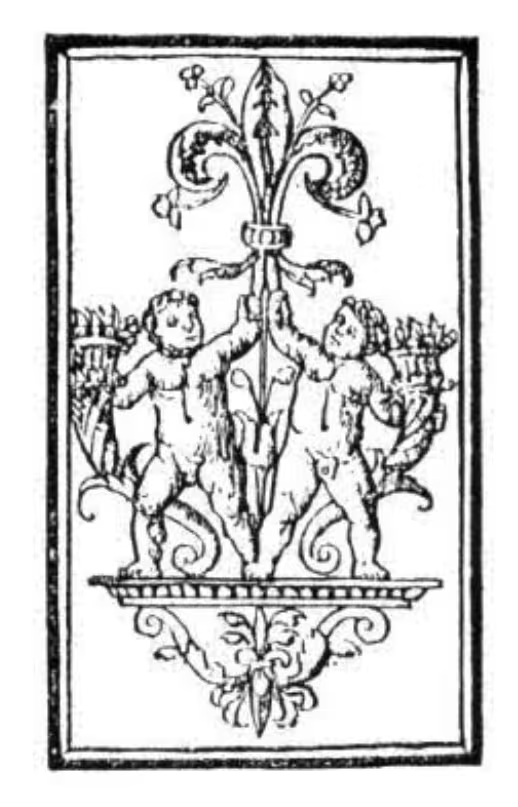
The press’s philosophical range is represented by Lucretius’s De rerum natura of 1512, prepared by Pietro Candido. The compact italic volume extended the series beyond lyric poetry and moral instruction to a sustained ancient account of nature, perception, and the physical universe. The same year marks the appearance of the familiar Florentine lily supported by two putti in Giunta’s device. The emblem supplied a durable visual identity across different subjects and formats. Its later forms should nevertheless be dated: the initials F. G. occur in 1517, whereas the motto Nil candidius, added in 1522, belongs to the activity of Filippo’s heirs.
Typographical development did not stop with the adoption of the early Aldine model. A new italic appearing in 1513 has been tentatively connected by Luigi Balsamo and Alberto Tinto with Francesco Griffo, the punchcutter responsible for Aldus’s first italic. The attribution remains a scholarly reconstruction, not a documented commission that can be asserted without qualification. It nevertheless directs attention towards specialist production and the possible movement of skills between enterprises. The press’s achievement cannot be explained by imagining Filippo personally performing every technical operation. Nor did its association with humanists guarantee uniform correction: Agostino Vespucci’s criticism in 1506 of cramped and faulty Giuntine printing records a contemporary judgment very different from the unqualified praise later attached to the family name.
The Vitruvius of October 1513, accompanied by Frontinus’s De aquaeductibus, was the first pocket-format edition of the architectural treatise and one of Filippo’s most consequential illustrated publications. Its relationship to Fra Giocondo’s Venetian edition of 1511 went beyond reduction to an italic octavo. An annotated copy of the earlier edition, preserved at the Centro Internazionale di Studi di Architettura Andrea Palladio, demonstrates Giocondo’s participation in preparing the new one. Corrections were incorporated, the index was reorganized, chapter division was adjusted, and four additional illustrations were planned alongside reduced versions of the earlier figures. The dedication to Julius II, who had died in February 1513, was replaced by one to Giuliano de’ Medici. This is a documented instance of renewed editorial supervision: the small Giuntine book transmitted a revised illustrated text, not merely a mechanically diminished copy of its Venetian predecessor.
The election of Leo X brought the rivalry over italic printing into a new political setting. A papal privilege obtained by Aldus in 1513 threatened the continuation of a commercially important part of Giunta’s programme. Filippo appealed through the Florentine authorities, and the Otto di Pratica instructed the ambassador Francesco Vettori to intervene. The arguments advanced on behalf of the Florentine press were interested representations of commercial rights and should not be accepted as independent proof of typographical priority. On 15 February 1516, Filippo and his sons received a ten-year papal privilege of their own. This conflict reveals the interaction of printing, territorial government, and personal access to the papal court, rather than the operation of a single, consistently enforced system of European copyright.
Meanwhile the Caesar of August 1514 explicitly advertised a further examination of a text previously published by Giocondo, claiming to remedy errors left by printers. The professed correction of printers’ errors made the title itself an argument for choosing this version in a market already supplied with editions of the author. A more sustained series of editorial collaborations developed with Niccolò Angeli da Bucine, whose work included Plautus in 1514, Quintilian, Macrobius, and Ciceronian texts in 1515, and further Ciceronian publication in 1516. The 1515 collection of Latin agricultural writers, bringing together Cato, Varro, Columella, and Palladius, similarly combined an established corpus with correction and aids to consultation. This programme addressed the practical use of classical books by readers who needed introductions, textual guidance, and reference tools as well as access to the principal work.
Greek printing had already resumed by 1514, before Aldus’s death in February 1515. A grammatical collection associated with Manuel Chrysoloras and the work of Bartolomeo Zanetti demonstrates that the renewed programme included elementary instruction as well as ambitious editions of authors. Its pagination followed an Aldine precedent of 1512, just as a Giuntine edition of Pliny’s letters in 1515 adopted pagination from the Aldine edition of 1508. Such choices carried recognizable conventions of consultation from one publication into another, extending the adaptation of Aldine practice from type and format to the organization of the reader’s access to the text.
The vernacular programme was likewise being revised rather than merely repeated. The April 1515 Canzoniere et Triomphi retained Alfieri’s association with Petrarch but expanded the textual surroundings of the principal works. It included additional poems, verses addressed to Petrarch by correspondents, and canzoni by Guido Cavalcanti, Dante, and Cino da Pistoia. References directed readers from a correspondent’s poem to Petrarch’s reply, integrating the additional material into the use of the volume. The architectural title border and six full-page woodcuts also distinguished it from the earlier Giuntine Petrarchs. Most of the illustrations introduced the triumphs, but the expected representation of Time was replaced by a scene of Petrarch receiving the laurel. The additional matter situated Petrarch within a wider poetic exchange, while the illustrations and title-page gave his literary identity a more elaborate visual presentation.
In July 1515, Filippo issued the Greek Halieutica of Oppian, edited by Marco Musuro, or Marcus Musurus. The five-book poem on fishing and marine life appeared as a compact Greek octavo of seventy-two leaves. Its priority must be stated precisely: this was the first printing of the Greek text, whereas Lorenzo Lippi’s Latin verse translation had appeared at Colle di Val d’Elsa in 1478. The Aldine publication of 1517 subsequently brought the fishing poem together with the hunting poem traditionally associated with Oppian. Musuro’s participation is especially instructive because of his close association with Aldus: scholarly collaboration could cross the commercial boundary between the Venetian and Florentine enterprises. The two houses were rivals, but their editorial histories did not develop in mutually exclusive intellectual circles.
An even more substantial addition to the Greek literary canon resulted from the Aristophanes project of 1515–1516. The first volume, issued in September 1515, contained the nine comedies already printed by Aldus in 1498, now offered in octavo without the earlier edition’s extensive scholia. A separately printed supplement supplied the first editions of Lysistrata and Thesmophoriazusae. Although frequently assigned to 1515, the supplement belongs to 1516 in modern reckoning. It was prepared by Eufrosino Bonini from the manuscript now preserved at Ravenna as Classense 429, then obtained from the Urbino library. Bernardo Giunta’s preface explicitly described the acquisition of the ancient exemplar, its damaged readings, and the difficulty of correction. The complete sequence of eleven surviving plays therefore emerged through two publications, not through an initially complete single volume. Here the Giuntine contribution was the recovery of texts absent from the Aldine collection, and Bernardo’s participation is documented before his father’s death.
The Xenophon completed on 29 May 1516 was a different kind of undertaking: a substantial Greek folio assembling the Cyropaedia, Anabasis, Memorabilia, Hellenica, and several shorter writings, with a dedication by Bonini. It was the first collected Greek edition, not the first appearance in print of every work it contained, and it was not complete: Agesilaus, the Apology of Socrates, and Ways and Means were absent. These qualifications identify its actual achievement more accurately than the conventional description of a complete Opera omnia. Bringing military narrative, history, Socratic recollection, household management, and political writings together allowed the author to be consulted across subjects previously encountered in different textual settings. The folio also demonstrates that the late Giuntine Greek programme was not confined to portable editions.
Filippo’s first edition of Boccaccio’s Decameron, completed on 29 July 1516, was produced as a quarto gathered in eights. Its italic text was accompanied by a larger image of the storytellers and ninety-six smaller woodcuts, including a repetition. These were reduced, reversed adaptations of the illustrations in the Venetian edition of 1492, not simply the same physical blocks transferred to Florence. The pictured company and successive narrative scenes supplied a visual accompaniment quite different from the interpretative diagrams of the Dante. An address placed in Boccaccio’s own voice praised printing and promoted the superiority of the Giuntine edition. The fictional return of the author served as publishing advertisement: his supposed endorsement belonged to the new edition’s apparatus, not to the medieval text. The combination of a recut illustrative tradition and newly devised prefatory promotion gave this familiar work a distinct presentation.
The final year brought major Greek folios. Aelius Aristides’s Orationes, completed on 20 May 1517 under Bonini’s editorial care, provided the first substantial collected edition of the rhetorician. It followed the printing of two speeches in the 1513 Aldine Isocrates and still did not contain every surviving oration. Its importance lies in the much wider access it afforded to a corpus previously transmitted through Byzantine manuscripts, including ceremonial and political rhetoric and writings associated with the author’s religious experience. Its textual arrangement and readings reflected the manuscript witnesses available to the editor. Alongside historical narrative and comedy, the press was making a substantial contribution to the printed transmission of imperial Greek rhetoric.
The Greek Lives of Plutarch, completed on 27 August 1517, was among the most consequential books to appear shortly before Filippo’s death. Its forty-nine lives formed the first printed Greek collection of the biographical corpus, long familiar to Western readers through Latin translations. The volume carried a dedication in Filippo’s name to the Florentine scholar and chancellor Marcello Virgilio Adriani, while Bonini is associated with its editorial preparation. The availability of the Greek made possible direct examination of the language behind a biographical tradition already influential in Latin. It also preceded the Aldine edition of 1519, prepared by Francesco Torresano, or Franciscus Asulanus. The sequence reverses the familiar direction of borrowing: in this important part of Greek publishing, the Florentine volume came before the corresponding Aldine edition.
Filippo died in Florence on 16 September 1517. The financial settlement of his earlier partnership with Lucantonio had extended into this final year, long after the original association had been dissolved. His name nevertheless continued to appear on projects completed after his death. The Greek collection of Philostratus and Callistratus, dated October 1517, carried a preface by Bernardo and was also combined with surviving sheets of Lucian’s Florentine edition of 1496, originally printed by Lorenzo de Alopa. A volume catalogued as a Giuntine Lucian of 1517 may therefore contain a newly issued combination of old and new sheets rather than a completely reset edition of Lucian. The distinction concerns both attribution and material history: a posthumous imprint in the founder’s name can preserve a project whose manufacture spans different workshops and more than twenty years.
The Florentine business continued under his sons, particularly Bernardo and Benedetto, using the collective designation Haeredes Philippi de Giunta and, subsequently, individual names. Their books extended programmes developed under their father without all belonging to his personal achievement. The renewed Vitruvius of 1522, the celebrated 1527 Decameron, and the same year’s Giuntina di rime antiche belong to this subsequent editorial history. So do the major Giuntine publications of Machiavelli, including the Arte della guerra in 1521 and the Principe in 1532. Their existence demonstrates the institutional durability of the house, but assigning them to Filippo would erase the choices, collaborations, and political circumstances of his successors. The later Florentine Filippo Giunti, Bernardo’s son, must likewise be distinguished from the founder.
Surviving copies provide concrete evidence that the founder’s editions reached readers beyond Florence. The 1516 Xenophon now at Eton bears the ownership inscription of Nicolaus Episcopius dated 1520; an Eton copy of the 1515 Oppian records its gift by Edmund Bonner to Hadrianus Junius. These inscriptions connect particular Giuntine books with the northern European learned world and give names and dates to their movement between readers. Taken alongside the business relationship with Venice, they help explain how a programme grounded in Florentine collaborators could circulate internationally without reproducing the scale or the subject priorities of Lucantonio’s establishment.
Bibliography
Bandini, Angelo Maria. De Florentina Iuntarum typographia eiusque censoribus, ex qua Graeci, Latini, Tusci scriptores ope codicum manuscriptorum a viris clarissimis pristinae integritati restituti in lucem prodierunt. Accedunt excerpta uberrima praefationum libris singulis praemissarum. 2 parti. Lucca: Typis Francisci Bonsignori, 1791.
Marzi, Demetrio. Una questione libraria fra i Giunti ed Aldo Manuzio il Vecchio. Contributo alla storia dell’arte della stampa. Milano: Tipografia Francesco Pagnoni, 1896.
Kristeller, Paul. Early Florentine Woodcuts: With an Annotated List of Florentine Illustrated Books. London: Kegan Paul, Trench, Trübner & Co., 1897.
Proctor, Robert. The Printing of Greek in the Fifteenth Century. Oxford: Printed for the Bibliographical Society at the Oxford University Press, 1900.
Norton, Frederick John. Italian Printers 1501–1520: An Annotated List, with an Introduction. London: Bowes and Bowes, 1958.
Ridolfi, Roberto. La stampa in Firenze nel secolo XV. Firenze: Leo S. Olschki, 1958.
Balsamo, Luigi, e Alberto Tinto. Origini del corsivo nella tipografia italiana del Cinquecento. Milano: Il Polifilo, 1967.
Di Filippo Bareggi, Claudia. “Giunta, Doni, Torrentino: tre tipografie fiorentine fra repubblica e principato.” Nuova rivista storica 58 (1974): 318–348.
Pettas, William A. “An International Renaissance Publishing Family: The Giunti.” The Library Quarterly 44, n. 4 (1974): 334–349.
Decia, Decio, e Luigi Silvestro Camerini. I Giunti tipografi editori di Firenze, 1497–1570. Parte prima: Annali 1497–1570, di Decio Decia, a cura e con un saggio introduttivo di Renato Delfiol; parte seconda: Commentario agli Annali 1497–1570, “Giunta” e correzioni, con una appendice sulle filigrane delle edizioni giuntine del primo trentennio, di Luigi Silvestro Camerini. Firenze: Giunti-Barbèra, 1978.
Dionisotti, Carlo. “Stampe giuntine.” In Machiavellerie. Storia e fortuna di Machiavelli, 177–192. Torino: Einaudi, 1980.
Pettas, William A. The Giunti of Florence: Merchant Publishers of the Sixteenth Century, with a Checklist of All the Books and Documents Published by the Giunti in Florence from 1497 to 1570, and with the Texts of Twenty-Nine Documents, from 1427 to the Eighteenth Century. San Francisco: Bernard M. Rosenthal, 1980.
Rhodes, Dennis E. Gli annali tipografici fiorentini del XV secolo. Prefazione di Roberto Ridolfi. Firenze: Leo S. Olschki, 1988.
Richardson, Brian. Print Culture in Renaissance Italy: The Editor and the Vernacular Text, 1470–1600. Cambridge: Cambridge University Press, 1994.
Ceresa, Massimo. “Giunti (Giunta), Filippo, il Vecchio.” In Dizionario biografico degli Italiani, vol. 57, 87–89. Roma: Istituto della Enciclopedia Italiana, 2001.
Nuovo, Angela. The Book Trade in the Italian Renaissance. Traduzione di Lydia G. Cochrane. Leiden–Boston: Brill, 2013.
Pettas, William A. The Giunti of Florence: A Renaissance Printing and Publishing Family. A History of the Florentine Firm and a Catalogue of the Editions. New Castle, DE: Oak Knoll Press, 2013.
Yukishima, Koichi. “Pagination Printed by Aldus Manutius.” Bibliothecae.it 9, n. 1 (2020): 11–31.
Ottone, Andrea. “The Giunta’s Publishing and Distributing Network and Their Supply to the European Academic Market.” In Publishing Sacrobosco’s De sphaera in Early Modern Europe, a cura di Matteo Valleriani e Andrea Ottone, 255–288. Cham: Springer, 2022.
Beyond the names: biographies and bibliographies on this page are curated by Abu, the AI scholar crafted by Buonvecchio exclusively for Govi Rare Books.