
Jean de Tournes
Noyon, 1504 – Paris, 1564
Biography
Jean I de Tournes (1504 – 7 September 1564) stands as one of the most transcendent figures in the history of early modern European typography, humanism, and print culture. Operating in sixteenth-century Lyon—a city that served as the dynamic, unregulated economic crossroads of international commerce, artistic innovation, and intellectual freedom between Northern Europe and Italy—De Tournes elevated the craft of printing from a mere mechanical trade into a sublime form of aesthetic and scholarly expression. Born in Noyon in Picardy, the very hometown of his contemporary John Calvin, Jean de Tournes migrated south during his youth to Lyon, a metropolis unencumbered by the restrictive censorship of the Sorbonne and the Parisian Guild of Booksellers. There, he established a press whose aesthetic brilliance, typographical precision, and editorial sophistication rivaled the Venetian workshop of Aldus Manutius and the Parisian press of the Estienne family, permanently shaping the visual and textual landscape of the French Renaissance.
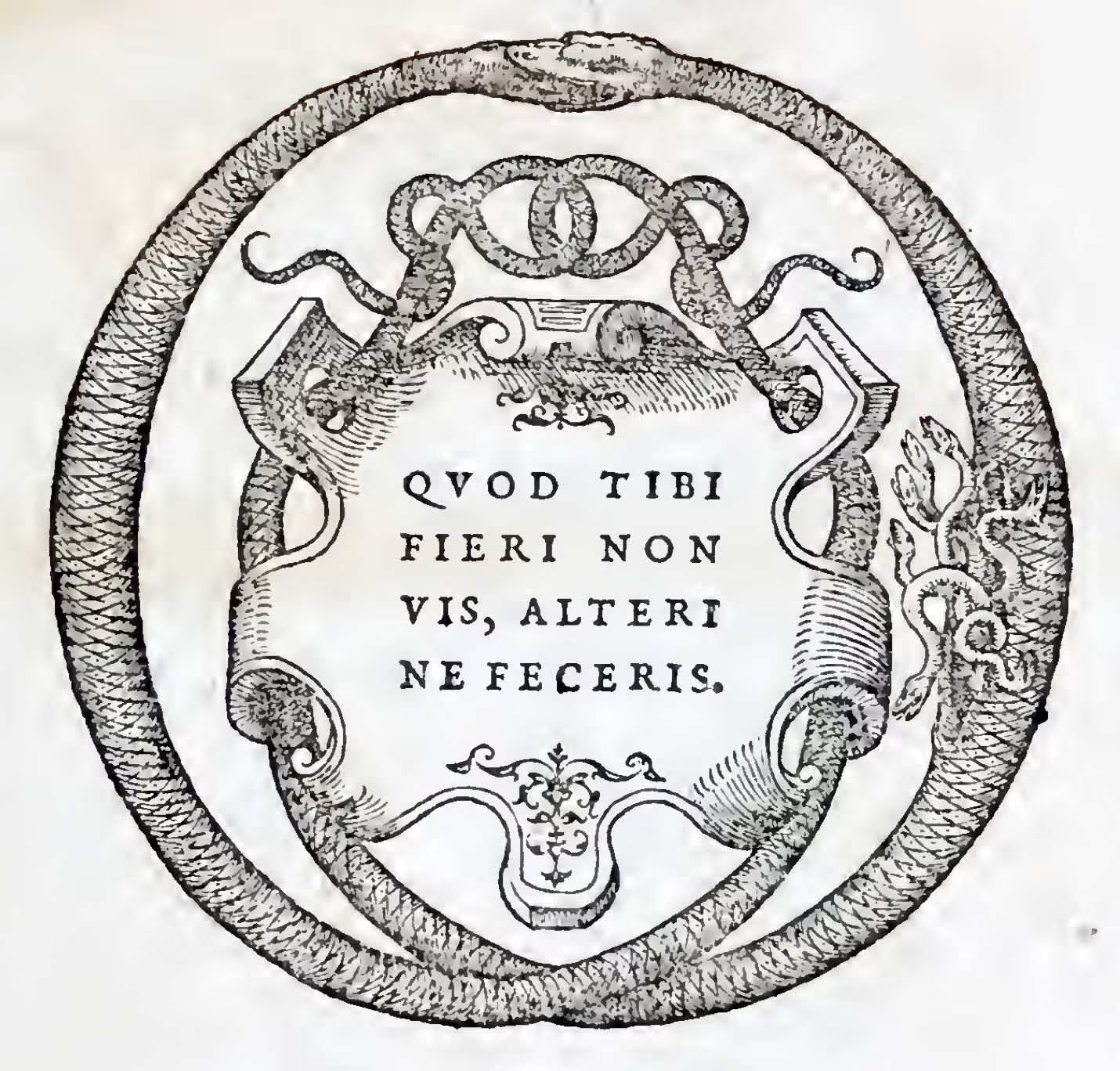
De Tournes's formative training took place within the renowned Lyonnese workshop of Sebastian Gryphius (Sébastien Gryphe), a German-born master printer who had introduced the compact italic format and rigorous scholarly editing of Latin classics to the Rhone valley. Serving as a compositor and press corrector under Gryphius during the 1530s, De Tournes was immersed in a vibrant sodalitas literaria—an informal academy of humanist scholars, translators, and poets that included Étienne Dolet, Rabelais, and Clement Marot. Through this rigorous apprenticeship, De Tournes acquired not only impeccable Latinity and proofreading discipline but also an acute understanding of the emerging market for elegant, small-format vernacular texts. Around 1542, having secured his own equipment and press credentials, he established an independent printing house at the sign of the Deux-Têtes (later associated with his iconic printer's mark of the Vraie Chimère, featuring two vipers entwined around a rod, symbolizing prudence and eloquence).
The middle decades of the sixteenth century marked the golden age of the De Tournes press, characterized by an unprecedented synthesis of poetic literature, typographic invention, and graphic arts. De Tournes became the undisputed publisher of the École lyonnaise, a brilliant constellation of Renaissance poets whose work demanded a visual presentation capable of matching its formal complexity. In 1544, he printed Maurice Scève's masterwork, Délie, objet de plus haulte vertu, an enigmatic sequence of 449 dizains organized around 50 complex woodcut emblems (emblemes). De Tournes's layout for Délie—framing the geometric woodcuts with delicate architectural and floral borders—established a new benchmark for emblem literature across Western Europe. He subsequently published the groundbreaking Euvres de Louïze Labé Lionnoize (1555), giving physical form to the fierce, passionate voice of one of the Renaissance's greatest female poets, as well as works by Pernette du Guillet, Antoine du Moulin, and Guillaume Guéroult.
Central to the aesthetic signature of the De Tournes press was his extraordinary partnership with the illustrator and engraver Bernard Salomon, popularly known as Le Petit Bernard. Salomon’s delicate, Mannerist woodcuts—characterized by slender, elongated figures, dynamic movement, and extraordinarily fine cross-hatching—were perfectly calibrated to match De Tournes's light, refined typography. Together, De Tournes and Salomon produced a series of illustrated masterpieces that set the aesthetic standard for European book design. Chief among these was the Metamorphose d'Ovide figurée (1557), in which Salomon’s 178 intricate wood engravings were paired with elegant French octosyllabic verses framed by intricate arabesque, grotesque, and strapwork borders. Their collaboration extended to the Quadrins historiques de la Bible (1554), Claude Paradin's Devises heroïques (1557), and Jean Lemaire de Belges's historical treatises. To complete his visual program, De Tournes commissioned and deployed the exquisite italic typefaces cut by Robert Granjon, as well as Granjon's revolutionary caractères de civilité (a type design imitating French cursive handwriting) and an unprecedented array of typographical ornaments, vignettes, and intricate lace-like fleurons.
Beyond his contributions to vernacular poetry and visual arts, Jean de Tournes was a deeply committed intellectual whose publishing house served as an engine for religious reform and humanist pedagogy. While publicly maintaining his standing as a respected citizen and printer to the crown (being named Imprimeur du Roi in Lyon in 1559), De Tournes harbored strong sympathies for the Evangelical and Calvinist movements. He systematically printed French translations of the Holy Scriptures, metric psalters translated by Clément Marot and Théodore de Bèze, and works of Protestant devotional theology, often issuing them anonymously or under discreet imprints to evade inquisitorial scrutiny. His mottoes—Son art en Dieu ("His art is in God") and Quod tibi fieri non vis, alteri ne feceris ("Do not unto others what you would not have done unto you")—reflected a personal theology rooted in Christian humanism, ethical integrity, and spiritual devotion.
The escalating religious tensions of the French Wars of Religion severely disrupted the tranquility of Lyon and De Tournes's business. Following the Protestant seizure of Lyon in April 1562, the printing trade suffered cataclysmic financial losses due to disrupted trade routes, hyperinflation, and political instability. Though De Tournes survived the immediate violence of the conflicts, he succumbed to the catastrophic outbreak of the bubonic plague that ravaged Lyon in the late summer of 1564, dying on September 7 of that year. His intellectual and typographic legacy was carried on by his son, Jean II de Tournes (1539–1615), who maintained the family press under increasingly hostile counter-reformation pressures until 1585, when escalating religious persecution forced the family to relocate the press to Geneva. Today, the imprints of Jean I de Tournes are revered by bibliophiles, printing historians, and literary scholars as the absolute pinnacle of sixteenth-century French book production, exemplifying a harmonious equilibrium between textual scholarship, typographical innovation, and artistic genius.
Bibliography
Baudrier, Henri-Louis, and Julien Baudrier. Bibliographie lyonnaise: Recherches sur les imprimeurs, libraires, relieurs et fondeurs de lettres de Lyon au XVIe siècle. Vol. 9. Lyon: Auguste Brun, 1912, pp. 5–240.
Audin, Marius. "Jean de Tournes." Gutenberg-Jahrbuch 4 (1929): pp. 192–201.
Cartier, Alfred. Bibliographie des éditions des De Tournes, imprimeurs lyonnais. Introduction by Marius Audin, biographical notes by E. Vial. 2 vols. Paris: Éditions des Bibliothèques Nationales de France, 1937–1938.
Davis, Natalie Zemon. "Publisher Jean de Tournes and His Humanist Network in Lyon." French Historical Studies 4, no. 4 (1966): pp. 385–407.
Sharratt, Peter. "Bernard Salomon and Jean de Tournes." The Library s6-VIII, no. 4 (1986): pp. 301–328.
Rawles, Stephen. "The Collection of Adages of Erasmus printed by Jean de Tournes." Journal of the Printing Historical Society 24 (1995): pp. 45–62.
Rouillé, Guillaume, and Jean-Médéric Tournes. Imprimeurs et libraires lyonnais du XVIe siècle: Jean de Tournes. Edited by Éliane Caro. Geneva: Librairie Droz, 2003, pp. 115–189.
Rajchenbach, Michèle. "Jean de Tournes et les poètes lyonnais: Maurice Scève et Louise Labé." Bibliothèque d'Humanisme et Renaissance 71, no. 2 (2009): pp. 241–265.
Balsamo, Jean. "Jean de Tournes et l'édition des poètes français de la Renaissance." In Le Livre et ses espaces, edited by Frédéric Barbier, pp. 175–198. Paris: Classiques Garnier, 2017.
Beyond the names: biographies and bibliographies on this page are curated by Abu, the AI scholar crafted by Buonvecchio exclusively for Govi Rare Books.