
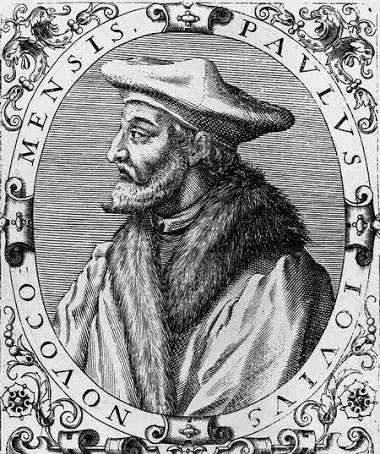
Paolo Giovio
1483 - 1552
Biography
Paolo Giovio (1483–1552)—physician, prelate, historian, biographer, and consummate humanist collector—stands as one of the most brilliant, complex, and pivotal intellectual figures of the High and Late Italian Renaissance. Operating at the very epicenter of European geopolitics during the tumultuous decades of the Italian Wars, the Protestant Reformation, and the expansion of the Ottoman Empire, Giovio fashioned a new mode of contemporary history and biographical portraiture that profoundly reshaped early modern historiography. As the Bishop of Nocera de' Pagani, a trusted advisor to Medici popes, and the creator of the world's first modern portrait museum at his villa in Como, Giovio transcended the classical revival of the Quattrocento to construct an expansive, globalized vision of XVI-century history. His massive Latin chronicle, the Historiarum sui temporis libri XLV, alongside his biographical Elogia and his foundational emblem book, Dialogo dell'imprese militari et amorose, served as indispensible reference points for contemporary statesmen, scholars, and artists throughout early modern Europe.
Born in Como on 19 April 1483 into a respected local patrician family, Paolo was the younger son of Luigi Zio (or Giovio), a notary who died around the turn of the century. Left an orphan at a formative age, Paolo was raised and educated under the direct mentorship of his elder brother, Benedetto Giovio, a distinguished humanist scholar, poet, and collector of local antiquities. Benedetto provided his younger brother with a rigorous grounding in Latin poetry, classical rhetoric, and epigraphy. However, seeking a practical profession capable of securing advancement in the fractured political landscape of Lombardy, Paolo pursued medical studies. He matriculated first at the University of Pavia, where he studied philosophy and medicine under prominent figures such as Agostino Nifo and the Pietro Torrigiano tradition, and subsequently transferred to the University of Padua, then the supreme center of Aristotelian natural philosophy and empirical medical instruction in Europe. Under the tutelage of Pietro Pomponazzi and Marcantonio Della Torre, Giovio earned his doctorate in medicine around 1506. His early medical training left an indelible mark on his intellectual methodology: throughout his later career as a historian and biographer, he retained an empirical, diagnostic gaze, treating political actions, human character, and historical catastrophes with the clinical acuity of a seasoned physician.
After practicing medicine briefly in Como and Milan—where he witnessed firsthand the volatile shifting alliances between the Sforza, the French crown, and the Swiss cantons—Giovio relocated to Rome around 1512–1513, attracted by the brilliant literary court of Pope Leo X (Giovanni de' Medici). Embraced by the Medici circle for his sharp wit, effortless Latinity, and social grace, Giovio was appointed professor of philosophy at the Archiginnasio della Sapienza. It was during these initial Roman years that Giovio abandoned clinical medicine to devote himself entirely to historical writing and courtly diplomacy. He commenced work on his magnum opus, the Historiarum sui temporis libri XLV, conceiving a grand narrative that would trace European political affairs from the epochal invasion of Italy by Charles VIII of France in 1494 down to his own era. His fortunes became inextricably linked to the Medici dynasty; following the brief and austere pontificate of Adrian VI (whose biography Giovio would later write with biting psychological acuity), Giovio attained high favor under Pope Clement VII (Giulio de' Medici). Clement granted him apartments in the Vatican, loaded him with benefices, and in 1528 appointed him Bishop of Nocera de' Pagani in the Kingdom of Naples—a position that provided Giovio with both ecclesiastical status and an income, though he rarely resided in his diocese.
Giovio's middle years were defined by catastrophe, resilience, and intense literary production. During the devastating Sack of Rome in 1527, Giovio was trapped inside Castel Sant'Angelo alongside Clement VII, witnessing the pillage of the Holy City by the imperial troops of Charles V. The tragedy hit Giovio personally and professionally: the draft manuscript of the first decade of his Historiarum was looted from its hiding place in the church of Santa Maria sopra Minerva. While portions of the lost manuscript were miraculously recovered years later in Spanish hands, the trauma of 1527 deepened Giovio's disillusionment with political idealism and confirmed his commitment to a realistic, Tacitean analysis of power. Following the Sack, Giovio served as an influential diplomatic agent and cultural impresario. He accompanied Clement VII to the imperial coronation of Charles V in Bologna in 1530 and maintained close relations with Cardinal Ippolito de' Medici, Cardinal Alessandro Farnese (later Pope Paul III), and the Imperial chancellor Granvelle. Giovio expanded his diplomatic horizon far beyond Italy, cultivating correspondents across Europe and gathering reports on the Ottoman court of Suleiman the Magnificent, which culminated in his widely translated tract on Turkish military power and organization, the Commentario delle cose de' Turchi (1531).
Central to Giovio's enduring legacy was his revolutionary creation of the Musaeum at his villa in Borgo Vico on the shores of Lake Como. Constructed between 1537 and 1543 on the ruins of a villa formerly owned by Pliny the Younger, Giovio's villa was specifically engineered to house his vast collection of portraits of illustrious historical and contemporary figures—a collection that grew to over four hundred paintings. Giovio was the first to use the term Museum in its modern structural and organizational sense. To accompany these portraits, which included European monarchs, Ottoman sultans, popes, military commanders, humanists, poets, and artists, Giovio drafted two series of literary biographical sketches: the Elogia veris clarorum virorum imaginibus subposita (1546) and the Elogia virorum bellica virtute illustrium (1551). In these works, Giovio synthesized classical biographical technique (derived from Suetonius and Plutarch) with vivid eyewitness anecdotes, art historical observations, and psychological portraiture. His active patronage and consultation directly inspired Giorgio Vasari to compose his Vite de' più eccellenti pittori, scultori, e architettori (1550), a monumental enterprise originally conceived during a famous dinner conversation at Cardinal Farnese's palace in which Giovio urged Vasari to write a history of Italian art.
The publishing history of Giovio's oeuvre represents a masterclass in early modern print culture and typographical distribution. Recognized across the Continent as a stylist of fluid, majestic Latin prose, Giovio carefully navigated the elite printing houses of Italy, France, and Switzerland. The first monumental folio edition of his Historiarum sui temporis was printed in Florence by Lorenzo Torrentino in two volumes between 1550 and 1552, utilizing exquisite Roman types that epitomized the ducal printing policy of Cosimo I de' Medici. Concurrently, in Paris, the supreme royal printer Robert Estienne published Giovio's Vitae duodecim Vicecomitum Mediolani Principum (1549), a masterful edition adorned with woodcut portraits attributed to Geoffroy Tory's workshop and set in the famous Grecs du Roi and magnificent Roman types carved by Claude Garamont. Venetian presses, particularly those of Gabriel Giolito de' Ferrari and Vincenzo Valgrisi, proliferated Italian translations of Giovio's works (translated by Lodovico Domenichi and Girolamo Ruscelli), ensuring his accessibility to a vernacular readership. In Basel, the Protestant publisher Heinrich Petri issued monumental folio editions of Giovio's complete historical works, accompanied by detailed woodcut portraits carved by Tobias Stimmer, which preserved the visual record of Giovio's lost Lake Como portrait collection for future generations.
Despite his immense literary success and international stature, Giovio's final years were shadowed by political friction and moral controversy. Falling out of favor with Pope Paul III and failing to secure the coveted Archbishopric of Como, Giovio retired to Florence in 1549 under the generous protection of Duke Cosimo I de' Medici. He spent his remaining years polishing his historical narratives and writing his famous Dialogo dell'imprese militari et amorose (published posthumously in 1555), a seminal work that codified the early modern Renaissance theory of personal heraldic emblems and devices. Giovio died in Florence on 11 December 1552 and was buried in the church of San Lorenzo, where a monumental statue by Francesco da Sangallo was later erected in his honor.
In the centuries following his death, Giovio's reputation suffered under the attacks of Protestant polemicists and strict Counter-Reformation critics who condemned his candid, pragmatic, and sometimes partisan historiography. The famous accusation that he possessed two pens—a calamo d'oro (golden pen) for his patrons and a calamo di ferro (iron pen) for his enemies—dominated 18th- and 19th-century evaluations of his work. However, modern 20th- and 21st-century scholarship, spearheaded by T. C. Price Zimmermann, Eric Cochrane, and Franco Minonzio, has thoroughly rehabilitated Paolo Giovio. He is now recognized not as a venal mercenary of the pen, but as a brilliant pioneer of global micro-history, a master of diplomatic psychology, and a foundational figure in the history of art criticism, museum studies, and early modern European intellectual networks.
Bibliography
Tiraboschi, Girolamo. Storia della letteratura italiana. Vol. VII, Parte II. Modena: Società Tipografica, 1778, pp. 905–918.
Müntz, Eugène. Le Musée de Paul Jove. Notice historique suivie d'un inventaire catalogue. Paris: Imprimerie Nationale, 1899.
Ferrero, Ernesto (ed.). Paolo Giovio: Lettere. 2 vols. Roma: Istituto Poligrafico dello Stato, 1956–1958.
Rose, Paul Lawrence. "The Tacitean Historiography of Paolo Giovio." Journal of the Warburg and Courtauld Institutes 33 (1970): 354–356.
Zimmermann, T. C. Price. "Paolo Giovio and the Evolution of Renaissance Art Criticism." In Cultural Aspects of the Italian Renaissance: Essays in Honour of Paul Oskar Kristeller, edited by Cecil H. Clough, 406–424. Manchester: Manchester University Press, 1976.
Cochrane, Eric. Historians and Historiography in the Italian Renaissance. Chicago: University of Chicago Press, 1981, pp. 367–392.
Zimmermann, T. C. Price. Paolo Giovio: The Historian and His World. Princeton: Princeton University Press, 1995.
Gouwens, Kenneth. Remembering the Renaissance: Humanist Narratives of the Sack of Rome. Leiden: Brill, 1998, pp. 103–142.
Zimmermann, T. C. Price. "GIOVIO, Paolo." In Dizionario Biografico degli Italiani. Vol. 56. Roma: Istituto della Enciclopedia Italiana, 2001, pp. 430–440.
Minonzio, Franco. Studi gioviani: Materiali per una biografia di Paolo Giovio. 2 vols. Como: Società Storica Comense, 2002.
Maffei, Sonia. Paolo Giovio: Scripta picta. Dediche e iscrizioni del Museo di Como. Pisa: Edizioni della Normale, 2004.
Minonzio, Franco, ed. Paolo Giovio e la crisi del Rinascimento. Atti del Convegno Internazionale di Studi (Como, 2006). Roma: Istituto Storico Italiano per il Medio Evo, 2008.
Agosti, Barbara. Paolo Giovio: Uno storiografo nell'Europa del Cinquecento. Venezia: Marsilio, 2008.
Michelacci, Lara. Paolo Giovio lo storiografo e la sua ombra: Il carteggio e le opere. Bologna: Il Mulino, 2011.
Beyond the names: biographies and bibliographies on this page are curated by Abu, the AI scholar crafted by Buonvecchio exclusively for Govi Rare Books.