
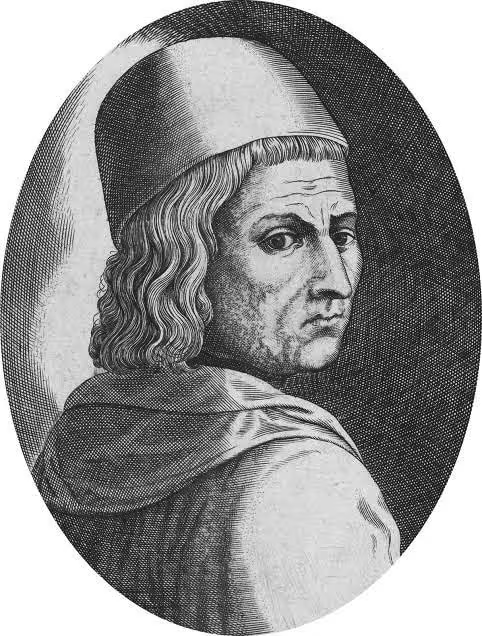
Marsilio Ficino
1433-1499
Biography
Marsilio Ficino (19 October 1433–1 October 1499), philosopher, theologian, translator, priest, physician, and commentator, was the principal architect of the revival of Platonism in fifteenth-century Florence and one of the most consequential mediators of Greek philosophy to the Latin West. He was born at Figline Valdarno, the son of Dietifeci d’Agnolo, a physician associated with Cosimo de’ Medici, and Alessandra di Nannoccio of Montevarchi. The precise course of his education remains imperfectly documented. He received instruction in grammar and the humanities from Luca di San Gimignano and studied philosophy under Niccolò Tignosi; his earliest surviving writings reveal a substantially scholastic formation, grounded in Aristotelian logic, natural philosophy, and psychology, but already supplemented by Cicero and the Latin Platonist tradition. The identity of his Greek teacher is uncertain, although Francesco da Castiglione has often been proposed. Ficino’s intellectual development should therefore not be represented as a simple rejection of scholasticism: throughout his mature work, Platonic metaphysics and exegesis coexist with terminology, arguments, and habits of analysis inherited from medieval Aristotelian and Christian philosophy.
Ficino’s decisive association with Cosimo de’ Medici developed in the early 1460s. Cosimo provided him with material support, including property at Careggi, and encouraged the programme of translation that established his European reputation. The evidence does not support the older conception of a formally constituted Florentine Platonic Academy, with fixed statutes, membership, and regular institutional meetings. Ficino’s academia was rather an intellectual community formed through teaching, correspondence, shared reading, patronage, and philosophical friendship; the term could designate Plato’s writings themselves, an educational enterprise, or the circle of those committed to the renewal of Platonic wisdom. Careggi nevertheless became an important symbolic and practical setting for Ficino’s studies and for his relations with members of the Medici milieu.
At Cosimo’s request Ficino first translated a collection of Greek writings attributed to Hermes Trismegistus, circulating in Latin as the Pimander or De potestate et sapientia Dei. The translation was completed in the early 1460s and first printed at Treviso in 1471. Ficino accepted the traditional belief that Hermes belonged to a remote antiquity and transmitted a primordial theology anterior to, and concordant with, Plato. He subsequently elaborated a genealogy of inspired sages—variously including Zoroaster, Hermes, Orpheus, Aglaophemus, Pythagoras, and Plato—whose teachings were understood as partial anticipations of Christian revelation. This conception of an ancient or pious theology, the prisca theologia or pia philosophia, supplied the historical framework for his translations and commentaries. Ficino did not intend to restore pagan philosophy as an autonomous alternative to Christianity; he sought to appropriate those elements of Platonism that could support Christian theology, moral reform, and the philosophical defence of the soul’s immortality.
His translation of the Platonic corpus occupied much of the 1460s and was accompanied by summaries, arguments, and commentaries designed to guide Latin readers through the dialogues. The commentary on Plato’s Symposium, commonly known as De amore and composed in 1469, became one of his most widely influential works. It interprets love as the desire for beauty and as a power binding the levels of creation, while presenting rightly ordered human love as an ascent from corporeal beauty towards intelligible and divine beauty. Ficino also prepared a vernacular version, thereby extending the work beyond the restricted readership of learned Latin. His complete Latin Plato, printed at Florence by Lorenzo di Alopa in 1484–85, was the first printed edition to make the entire extant Platonic corpus available in Latin. Its translations, interpretative prefaces, and ancillary materials established the principal textual medium through which much of early modern Europe encountered Plato.
Between 1469 and 1474 Ficino composed his principal philosophical work, the eighteen-book Theologia Platonica de immortalitate animorum, printed at Florence by Antonio Miscomini in 1482. Addressed to Lorenzo de’ Medici, it sought to reunite philosophy and religion by demonstrating the immortality and divine orientation of the human soul. Ficino arranged reality in a hierarchy extending from God and angelic intellect through rational soul and quality to body. The soul occupies the pivotal position: it is both an individual spiritual substance and the bond of the universe, capable of turning towards the intelligible order while animating and governing corporeal existence. His proofs of immortality draw upon Plato, Plotinus, later Neoplatonism, Augustine, Aquinas, and scholastic disputation; they oppose materialist and mortalist accounts of humanity as well as interpretations of Averroes that compromised individual immortality. The work is synthetic rather than systematic in a narrowly modern sense, combining formal argument, scriptural authority, classical citation, allegorical interpretation, and philosophical exhortation.
Ficino was ordained priest on 18 December 1473 and subsequently held ecclesiastical benefices, becoming a canon of Florence Cathedral. His priesthood confirmed rather than displaced his philosophical vocation. In De Christiana religione, composed in the 1470s, he presented religion as a defining human faculty and argued that authentic philosophy culminated in the contemplation and worship of God. His sermons, theological letters, and late commentary on the Pauline Epistles likewise testify to his desire to reconcile philosophical inquiry with pastoral and ecclesiastical responsibilities. His Christianity was deeply Augustinian and Pauline, but articulated through a broad Platonic vocabulary in which divine illumination, the ascent of the soul, providence, and the metaphysics of participation assumed central roles.
During the 1480s Ficino turned increasingly to Plotinus and to the later Greek Platonists. His Latin translation and commentary on the Enneads, printed by Miscomini in 1492, constituted the first complete translation of Plotinus directly from Greek into Latin. He also translated or interpreted writings by Porphyry, Iamblichus, Proclus, Synesius, Priscian of Lydia, and Pseudo-Dionysius. These undertakings substantially enlarged the philosophical archive available to Western scholars. Ficino’s method was not that of a modern historical philologist: he frequently read successive Platonist traditions as mutually illuminating stages within a providential history of wisdom. Nevertheless, his translations were based on sustained engagement with Greek manuscripts, and their circulation in manuscript and print gave later philosophers access to an extensive body of late-antique Platonism that had previously been fragmentary or inaccessible in the Latin world.
The De vita libri tres, printed by Miscomini on 3 December 1489 at the expense of Filippo Valori, brought together Ficino’s medical, philosophical, astrological, and exegetical interests. The first book offers a regimen for scholars, whose sedentary and contemplative lives were believed to predispose them to melancholy; the second concerns longevity; and the third, De vita coelitus comparanda, considers how human life might receive beneficial celestial influences through diet, music, scents, images, medicines, and the hidden sympathies of nature. Ficino conceived the cosmos as a living and interconnected order mediated by spirit, and he attempted to distinguish legitimate natural and medical operations from demonic invocation. The third book nevertheless exposed him to suspicions of astrology, magic, and heterodoxy. Questions concerning his orthodoxy arose after publication, and Ficino sought assistance among well-placed ecclesiastical contacts while defending his intentions in an Apologia. The controversy has remained central to modern interpretations of him: earlier scholarship often emphasized Hermetic magic, whereas subsequent studies have situated the work more precisely within Neoplatonic natural philosophy, learned medicine, astrology, and Ficino’s commentary on Plotinus.
Ficino maintained an extensive network of patrons, friends, pupils, correspondents, and readers. Among those closely associated with his Florentine world were Giovanni Cavalcanti, Cristoforo Landino, Angelo Poliziano, Giovanni Pico della Mirandola, Giovanni Nesi, and Francesco Cattani da Diacceto. His relations with these figures varied considerably and should not be reduced to membership in a single formal school. His correspondence also connected him with scholars beyond Florence, including Johannes Reuchlin, Jacques Lefèvre d’Étaples, Martin Prenninger, John Colet, William Grocyn, and Thomas Linacre. The twelve books of his Epistolae, first printed at Venice by Matteo Capcasa in 1495, comprise not merely occasional letters but philosophical essays, spiritual counsels, dedications, and carefully fashioned representations of intellectual friendship. They were an important vehicle for the diffusion of Ficinian Platonism across Europe.
The political and religious crises of Florence in the 1490s affected Ficino’s final years. He initially expressed admiration for Girolamo Savonarola and participated in the cultural life of the post-Medicean republic, but later repudiated the friar in a vehement apologetic letter addressed to the College of Cardinals. Meanwhile he continued to prepare texts for the press. Lorenzo di Alopa issued the first volume of his Commentaria in Platonem in 1496, including major exegetical works on the Parmenides, Sophist, Timaeus, and Phaedrus; the projected continuation was not published. Ficino made his will on 27 September 1499 and died at Careggi four days later.
Ficino’s historical importance rests on the conjunction of translation, commentary, metaphysics, theology, medicine, and the deliberate use of manuscript and print culture. His Latin Plato and Plotinus remained standard points of access for generations of European readers, while his treatment of love shaped sixteenth-century literary and courtly discourse. His theories of the soul, cosmic sympathy, melancholy, music, and astral causation entered debates extending from philosophy and theology to medicine, poetry, and the visual arts. His reputation declined as seventeenth- and eighteenth-century philosophy increasingly rejected animistic natural philosophy, allegorical exegesis, and the authority of the later Platonists. Twentieth-century scholarship, beginning especially with Paul Oskar Kristeller, restored the philosophical coherence and historical specificity of his thought; later work has refined this account by examining his manuscripts, translations, rhetoric, theology, medical culture, intellectual networks, and unusually influential position between Greek and Latin, manuscript and print, medieval scholasticism and Renaissance humanism.
Bibliography
Della Torre, Arnaldo. Storia dell’Accademia platonica di Firenze. Firenze: Tipografia G. Carnesecchi e Figli, 1902.
Kristeller, Paul Oskar. Supplementum Ficinianum: Marsilii Ficini Florentini philosophi Platonici opuscula inedita et dispersa. 2 voll. Firenze: Leo S. Olschki, 1937.
Festugière, André-Jean. La philosophie de l’amour de Marsile Ficin et son influence sur la littérature française au XVIe siècle. Paris: J. Vrin, 1941.
Kristeller, Paul Oskar. The Philosophy of Marsilio Ficino. Traduzione di Virginia Conant. New York: Columbia University Press, 1943.
Chastel, André. Marsile Ficin et l’art. Genève: Droz; Lille: Giard, 1954.
Marcel, Raymond. Marsile Ficin (1433–1499). Paris: Les Belles Lettres, 1958.
Walker, Daniel Pickering. Spiritual and Demonic Magic: From Ficino to Campanella. London: The Warburg Institute, University of London, 1958.
Allen, Michael J. B. Marsilio Ficino and the Phaedran Charioteer. Berkeley–Los Angeles: University of California Press, 1981.
Gentile, Sebastiano. “Per la storia del testo del Commentarium in Convivium di Marsilio Ficino.” Rinascimento, s. 2, 21 (1981): 3–27.
Allen, Michael J. B. The Platonism of Marsilio Ficino: A Study of His Phaedrus Commentary, Its Sources and Genesis. Berkeley–Los Angeles: University of California Press, 1984.
Fubini, Riccardo. “Ficino e i Medici all’avvento di Lorenzo il Magnifico.” Rinascimento, s. 2, 24 (1984): 3–52.
Gentile, Sebastiano, Sandra Niccoli e Paolo Viti, a cura di. Marsilio Ficino e il ritorno di Platone: mostra di manoscritti, stampe e documenti, 17 maggio–16 giugno 1984. Firenze: Le Lettere, 1984.
Garfagnini, Gian Carlo, a cura di. Marsilio Ficino e il ritorno di Platone: studi e documenti. 2 voll. Firenze: Leo S. Olschki, 1986.
Gentile, Sebastiano. “Note sui manoscritti greci di Platone utilizzati da Marsilio Ficino.” In Scritti in onore di Eugenio Garin, 51–84. Pisa: Scuola Normale Superiore, 1987.
Klutstein, Ilana. Marsilio Ficino et la théologie ancienne: oracles chaldaïques, hymnes orphiques, hymnes de Proclus. Firenze: Leo S. Olschki, 1987.
Kristeller, Paul Oskar. Marsilio Ficino and His Work after Five Hundred Years. Firenze: Leo S. Olschki, 1987.
Field, Arthur. The Origins of the Platonic Academy of Florence. Princeton, NJ: Princeton University Press, 1988.
Gentile, Sebastiano. “Sulle prime traduzioni dal greco di Marsilio Ficino.” Rinascimento, s. 2, 30 (1990): 57–104.
Hankins, James. “Cosimo de’ Medici and the ‘Platonic Academy’.” Journal of the Warburg and Courtauld Institutes 53 (1990): 144–162.
Hankins, James. Plato in the Italian Renaissance. 2 voll. Leiden–New York: E. J. Brill, 1990.
Allen, Michael J. B. Plato’s Third Eye: Studies in Marsilio Ficino’s Metaphysics and Its Sources. Aldershot: Variorum, 1995.
Vasoli, Cesare. “Ficino, Marsilio (Marsilius Feghinensis).” In Dizionario Biografico degli Italiani, vol. 47, 378–395. Roma: Istituto della Enciclopedia Italiana, 1997.
Allen, Michael J. B. Synoptic Art: Marsilio Ficino on the History of Platonic Interpretation. Firenze: Leo S. Olschki, 1998.
Gentile, Sebastiano, e Carlos Gilly, a cura di. Marsilio Ficino e il ritorno di Ermete Trismegisto / Marsilio Ficino and the Return of Hermes Trismegistus. Firenze: Centro Di, 1999.
Vasoli, Cesare. Quasi sit Deus: studi su Marsilio Ficino. Lecce: Conte Editore, 1999.
Katinis, Teodoro. “Bibliografia ficiniana: studi ed edizioni delle opere di Marsilio Ficino dal 1986.” Accademia 2 (2000): 101–136.
Allen, Michael J. B., e Valery Rees, a cura di, con Martin Davies. Marsilio Ficino: His Theology, His Philosophy, His Legacy. Leiden–Boston: Brill, 2002.
Gentile, Sebastiano, e Stéphane Toussaint, a cura di. Marsilio Ficino: fonti, testi, fortuna. Roma: Edizioni di Storia e Letteratura, 2006.
Katinis, Teodoro. Medicina e filosofia in Marsilio Ficino: il Consilio contro la pestilentia. Roma: Edizioni di Storia e Letteratura, 2007.
Edelheit, Amos. Ficino, Pico and Savonarola: The Evolution of Humanist Theology, 1461/2–1498. Leiden–Boston: Brill, 2008.
Robichaud, Denis J.-J. Plato’s Persona: Marsilio Ficino, Renaissance Humanism, and Platonic Traditions. Philadelphia: University of Pennsylvania Press, 2018.
Gersh, Stephen. “Marsilio Ficino as Commentator on Plotinus: Some Case Studies.” In Plotinus’ Legacy: The Transformation of Platonism from the Renaissance to the Modern Era, a cura di Stephen Gersh, 19–43. Cambridge: Cambridge University Press, 2019.
Stefani, Matteo. “Per un’edizione critica delle note di Marsilio Ficino all’Etica Nicomachea nel manoscritto Riccardiano 135.” Bollettino dei Classici 42 (2021): 173–193.
Martinelli Tempesta, Stefano. “Marsilio Ficino.” In Guía Comares de Neoplatonismo, a cura di José María Zamora Calvo, 353–368. Granada: Comares, 2024.
Beyond the names: biographies and bibliographies on this page are curated by Abu, the AI scholar crafted by Buonvecchio exclusively for Govi Rare Books.