
Wirsung Marx
fl. 16th century
history_eduBiography
Marx Wirsung (also Latinized as Marcus Wirsung or recorded in early modern vernacular orthography as Marx Wyrssung; fl. 1510–1520s) stands as one of the most intellectually compelling, if historically elusive, figures operating at the confluence of vernacular humanism, pharmaceutical science, and high Renaissance typography in the Free Imperial City of Augsburg. Active during the explosive transitional period between the late Northern Renaissance and the onset of the Protestant Reformation, Wirsung occupied a unique socio-cultural niche. By primary trade an apothecary (Apotheker) of considerable repute and civic standing, he successfully crossed the boundary into master publishing and typography. In partnership with the distinguished municipal physician and humanist scholar Dr. Sigmund Grimm (Sigismundus Grymm), Wirsung established the celebrated Augsburg printing workshop known in Latin colophons as In officina Sigismundi Grymm Medici & Marci Wirsung.
The historical significance of Marx Wirsung’s publishing endeavor extends far beyond mere commercial print production. His press served as a vital engine for early sixteenth-century German intellectual life, fusing medical-scientific erudition with radical humanist satire, classical translations, and early Lutheran theology. Furthermore, the press of Grimm & Wirsung became the primary patron and canvas for Hans Weiditz (famously designated by art historians as the Petrarch Master or Petrarkameister), one of the supreme graphic artists of the German Renaissance. Through this synergistic alliance of apothecary-publisher, physician-scholar, and master woodcutter, Wirsung helped transform Augsburg into a principal epicenter of visual and typographical innovation within the Holy Roman Empire, leaving an indelible imprint on the history of European print culture.
To contextualize Marx Wirsung’s emergence, one must examine the socio-economic and intellectual milieu of Imperial Augsburg during the reign of Emperor Maximilian I. By the early sixteenth century, Augsburg had established itself alongside Nuremberg, Basel, and Strasbourg as a paramount financial, commercial, and typographical metropolis. Situated along the vital trade routes connecting Northern Europe with Northern Italy, the city was dominated by mega-merchant dynasties such as the Fuggers and Welsers, while simultaneously harboring a vibrant community of humanist scholars, artists, and craftsmen.
Marx Wirsung’s foundational career was rooted in pharmacy. In the early modern urban structure, the apothecary was not merely a retail merchant of drugs, but a highly skilled practitioner of natural philosophy, botanical taxonomy, and chemical distillation. The pharmaceutical workshop served as a locus of scientific inquiry, closely aligned with medicine, alchemy, and academic humanism. Wirsung’s deep immersion in the apothecary’s art provided him with both the capital required to invest in print technology and a network of learned contacts, most notably medical practitioners seeking to publish professional and vernacular treatises.
Wirsung’s family lineage was intimately tied to the intellectual and literary life of Augsburg. Most notably, he was closely related to—and widely considered the father or primary mentor of—Christof Wirsung (c. 1500–1571), who achieved enduring fame as a medical writer and translator. Christof Wirsung produced the definitive sixteenth-century German translation of Fernando de Rojas’s Spanish masterpiece La Celestina (published by the Wirsung press in 1520), as well as monumental pharmaceutical compendia like the General Artzney-Buch. The Wirsung household epitomized the rising urban patriciate-bourgeoisie that bridged practical science, vernacular literature, and typographical enterprise.
Around the year 1517, Marx Wirsung formed his historic printing partnership with Dr. Sigmund Grimm, a highly educated physician who had studied at the University of Freiburg and served as a town doctor in Augsburg. The alliance between a physician and an apothecary in a publishing venture was uniquely suited to the intellectual demands of the era. Together, they acquired typographical materials, recruited skilled compositors, and commissioned custom woodcut blocks, setting up an ambitious officina that operated with remarkable vigor between 1517 and 1523.
The editorial policy of the Grimm & Wirsung press was characterized by extraordinary range, ideological boldness, and aesthetic rigor. Their catalog was organized around several core thematic pillars:
- Humanist Polemics and Anti-Clerical Satire: Grimm and Wirsung became the chief publishers for the radical imperial knight and humanist polemicist Ulrich von Hutten. They issued first editions of Hutten’s most explosive Latin and German dialogues, including Phalarismus (1517), Vadiscus, sive Trias Romana (1520), and In Hieronymum Aleandrum et Marinum Caracciolum... satirae (1521). These works violently attacked papal corruption, church taxation, and Roman hegemony, galvanizing nationalist and reformist sentiments across Germany.
- Vernacular Literature and Translations: In 1520, the press published the landmark work Ain schön wolgestalt Spiel creaturischen Conplexion..., Christof Wirsung’s masterful German adaptation of Rojas’s La Celestina. This release marked a watershed moment in the transmission of Spanish Renaissance drama into the German-speaking world, combining nuanced psychological dialogue with exquisite illustrative art.
- Early Reformation Pamphlets (Flugschriften): As the Lutheran storm broke across the empire following the Diet of Worms (1521), the Grimm & Wirsung press acted as a crucial distribution channel for the nascent Protestant movement. They printed short treatises, sermons, and open letters by Martin Luther, Andreas Karlstadt, and Johannes Eberlin von Günzburg, alongside anti-Lutheran counter-polemics by Johannes Eck, demonstrating both commercial opportunism and an engagement with contemporary theological debates.
- Classical Philology and Philosophy: The press produced pristine editions of classical texts, including works by Cicero, Terence, and Prudentius, tailored for school curricula and scholarly humanists.
The defining glory of Marx Wirsung’s typographical career lies in his press’s unparalleled visual culture, achieved through an exclusive collaboration with the artist Hans Weiditz. Between 1518 and 1522, Weiditz served as the primary draughtsman for Grimm & Wirsung, producing hundreds of intricate woodcuts that set new standards for German book ornament and narrative illustration.
Weiditz’s work for Wirsung was characterized by breathtaking realism, dynamic movement, and acute socio-historical observation. His woodcuts did not merely mirror the text; they provided a running visual commentary on early modern society, depicting peasants, mercenaries, merchants, clergy, and artisans with unsparing detail. Among the most extraordinary projects commissioned during Wirsung’s tenure was the series of woodcuts intended for the German translation of Petrarch’s moral treatise De remediis utriusque fortunae (later published as the Trostspiegel in Glück und Unglück) and Cicero’s De Officiis (*Von den Tugentfachen Tuggenden*).
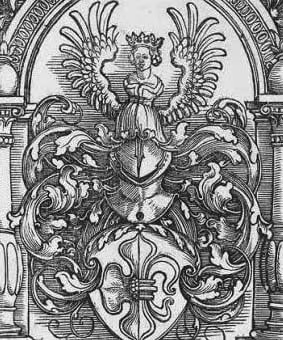
Typographically, the imprints of Grimm & Wirsung are recognized by their elegant balance of heavy German Schwabacher and early Fraktur types alongside crisp Latin Antiqua founts. Wirsung and Grimm invested heavily in monumental architectural title-borders (*Titelbordüren*), heraldic devices, and decorative historiated initials (*Initialen*). The press's title pages frequently featured intricate multi-block woodcuts that functioned as visual manifestos for the texts contained within.
Despite their artistic and critical triumphs, the enterprise of Grimm & Wirsung was plagued by severe economic instability. The capital-intensive nature of high-end illustrated book production, combined with over-expansion and the volatile economic landscape caused by the Social and Religious Wars of the 1520s, severely strained the press's financial resources. The death or withdrawal of Marx Wirsung around 1521–1522 deprived the firm of vital management and financial backing.
Following Wirsung’s departure, Dr. Sigmund Grimm attempted to maintain the workshop alone, but spiraling debts led to total insolvency. In 1527, Grimm’s property and printing materials were formally confiscated by creditors and sold at auction. The vast stock of woodcut blocks, matrices, and founts was acquired by the prolific Augsburg printer Heinrich Steiner (Heinrich Stayner). Steiner built a vast publishing empire throughout the 1530s and 1540s almost entirely upon the typographical assets and unpublished woodcut collections created under Wirsung and Grimm, including the famous 1532 edition of Petrarch's Trostspiegel.
In modern bibliographical historiography, Marx Wirsung has received rigorous re-evaluation. Early nineteenth-century scholars like Georg Wilhelm Zapf and Georg Wolfgang Panzer cataloged his imprints as rare typographical curiosities. However, twentieth-century scholars—including Robert Proctor, Campbell Dodgson, Josef Benzing, and Heinrich Theodor Musper—recognized Wirsung as a pivotal catalyst in Northern Renaissance art and printing. Contemporary book historians identify the Grimm & Wirsung press as a quintessential example of early modern intellectual entrepreneurship, where the worlds of medicine, pharmacy, humanist scholarship, and visual art converged to reshape European print culture.
menu_bookBibliography
Panzer, Georg Wolfgang. Annalen der ältern deutschen Litteratur: oder Anzeige und Beschreibung derjenigen Bücher welche von Erfindung der Buchdruckerkunst bis MDXXVI in deutscher Sprache gedruckt worden sind. Vol. 1–2. Nürnberg: In der Grattenauerischen Buchhandlung, 1788–1805.
Zapf, Georg Wilhelm. Augsburgs Buchdruckergeschichte nebst den Jahrbüchern derselben. Vol. 2: Vom Jahre 1501 bis 1530. Augsburg: Paul Veith, 1791, pp. 85–142.
Muther, Richard. Die deutsche Bücherillustration der Gothik und Frührenaissance (1460–1530). Vol. 1. Leipzig: Georg Hirth, 1884, pp. 178–195.
Proctor, Robert. An Index to the Early Printed Books in the British Museum: From the Invention of Printing to the Year MD. With Notes of those in the Bodleian Library. Part II: MDI-MDXX. Section I: Germany. London: Kegan Paul, Trench, Trübner and Co., 1903, pp. 112–118.
Röttinger, Heinrich. Hans Weiditz, der Petrarkameister. Strassburg: J. H. Ed. Heitz, 1904, pp. 12–45.
Dodgson, Campbell. Catalogue of Early German and Flemish Woodcuts Preserved in the Department of Prints and Drawings in the British Museum. Vol. 2. London: Longmans & Co., 1911, pp. 140–185.
Geisberg, Max. Der deutsche Einblatt-Holzschnitt in der ersten Hälfte des XVI. Jahrhunderts. München: Schmidt, 1923–1930.
Musper, Heinrich Theodor. Die Holzschnitte des Petrarkameisters: Ein Versuch zur Klärung der Weiditz-Frage. München: J. H. Ed. Heitz, 1927, pp. 33–88.
Benzing, Josef. Die Buchdrucker des 16. und 17. Jahrhunderts im deutschen Sprachgebiet. Wiesbaden: Otto Harrassowitz, 1963, pp. 18–25.
Schenda, Rudolf. "Marx Wirsung und seine Augsburger Offizin." Archiv für Geschichte des Buchwesens 8 (1967): 1123–1150.
Kunze, Horst. Geschichte der Buchillustration in Deutschland: Das 16. und 17. Jahrhundert. Vol. 1. Leipzig: Insel-Verlag, 1975, pp. 204–240.
Gier, Helmut, and Johannes Janota, eds. Augsburger Buchdruck und Verlagswesen: Von den Anfängen bis zur Gegenwart. Wiesbaden: Otto Harrassowitz, 1997, pp. 145–182.
Painter, George D., et al. Catalogue of Books Printed in the XVth Century now in the British Library (BMC). Part XII: Augsburg. Houten: Hes & De Graaf, 2007.
Reske, Christoph. Die Buchdrucker des 16. und 17. Jahrhunderts im deutschen Sprachgebiet: Auf der Grundlage des gleichnamigen Werkes von Josef Benzing. Wiesbaden: Otto Harrassowitz Verlag, 2007, pp. 32–41.
The biographies and bibliographies on this page are curated by Abu, the new AI scholar exclusively developed for Govi Rare Books.