
Galeazzo Florimonte
1484-1565
Biography
Galeazzo Florimonte (Sessa Aurunca, 27 April 1484 – early May 1565) was an Italian humanist, physician, ecclesiastical reformer, bishop, moral philosopher, and translator whose career joined the learned culture of the Renaissance courts to the pastoral ambitions of the Catholic Reformation. Born the illegitimate son of the notary Marco Ferramonte and Antonina Castello, also recorded as Zitello, he was initially known by his father's surname; Ferramonte survives in documents as late as 1537, while Florimonte is found in his correspondence from 1529. The choice of the latter name has been connected with his spiritual conversion around 1528–29, although that explanation remains hypothetical. Between about 1500 and 1506 he studied grammar, poetry, and rhetoric at Sessa under Agostino Nifo, the celebrated Aristotelian philosopher and physician. He subsequently acquired degrees in philosophy and medicine at an unidentified university. Nifo's teaching supplied a lasting intellectual point of reference, not least for the dialogues on Aristotle's ethics that Florimonte would eventually bring to print in a form quite different from the master's Latin university commentaries.
By 1514 Florimonte had entered the service of Alfonso d'Avalos, marquess of Vasto, whom he accompanied on a diplomatic mission to the French court of Francis I. He later served Marcantonio Colonna as a physician and returned to Paris around 1520 for a more extended stay. There he encountered Jacques Lefèvre d'Étaples, a central figure in biblical humanism, and the theologian Albert Pighius, whose concern with grace and justification belonged to debates that would continue to preoccupy Florimonte at Trent. These experiences exposed him to the possibilities of combining philological learning, religious instruction, and reform, although they do not establish his adherence to a particular doctrinal faction. Service in aristocratic households also gave him intimate knowledge of the language, ceremonies, rivalries, and expectations of courtly life, material later reflected both in his moral dialogues and in the observations on conduct that he shared with Giovanni Della Casa.
During 1527–28 Florimonte was a tutor in the Serego household at Verona, where he came into the orbit of Bishop Gian Matteo Giberti. Giberti's household and intellectual circle brought together Marcantonio Flaminio, Francesco Berni, Francesco Della Torre, Agostino Fumani, and Ludovico da Canossa, among others, around an ideal of scriptural study, clerical discipline, and cultivated conversation. A letter of Jacopo Sadoleto places Florimonte in a religious setting in 1529, the period generally associated with his decision to enter the priesthood. The Veronese experience did not simply substitute religion for humanism: it redirected his classical education toward the practical reform of Christian life. The pension of 300 scudi assigned to him on the revenues of the bishopric of Tricarico through Giberti's intervention also illustrates the dependence of reform-minded scholars upon ecclesiastical patronage and benefice income.
Florimonte had left Verona by early 1536 and is securely documented in Rome in 1537. Back at Sessa he administered episcopal revenues and welcomed Flaminio in November 1538, when the latter had recently encountered the spiritually experimental circles associated with Juan de Valdés in Naples. This contact places Florimonte near, but does not by itself identify him with, the spectrum of Italian evangelical reform. In the same period he became a patron and employer of the young Gaetan humanist Giovanni Tarcagnota, subsequently active in Venice as the translator, historian, and antiquarian Lucio Fauno. Florimonte's connections helped Tarcagnota enter Roman learned circles linked to the Farnese; the younger scholar's subsequent publishing career makes this relationship particularly revealing of Florimonte's function as a mediator between scholarly households and the expanding Venetian book trade. During a further Roman stay in 1539 he also acted, at Ludovico Beccadelli's request, as tutor to Filippo Gheri.
Through the patronage of Cardinal Gasparo Contarini, Florimonte assumed charge of the Holy House of Loreto in 1540. His reform of its finances, property administration, and clerical conduct gave an institutional expression to the principles previously cultivated in Verona. In August 1541 he joined d'Avalos in Milan as spiritual counsellor and, after Bernardino Ochino's flight to Switzerland in 1542, may have written to the former Capuchin preacher, although the contents and purpose of such a communication cannot be reconstructed. Contarini's death in August 1542 did not end Florimonte's standing at Rome. On 4 May 1543 he was consecrated bishop of Aquino at Bologna; in June he accompanied Paul III during the pope's meeting with Charles V at Busseto. On 25 September 1544 he was given the spiritual government of the Church of Naples on behalf of the young Cardinal Ranuccio Farnese, and on 18 November received corresponding temporal responsibilities. The accumulation of these demanding commissions sharpened a problem that would remain central to his life: the incompatibility of absentee ecclesiastical office with the effective care of souls.
Arriving at Trent on 12 December 1545, Florimonte joined the bishops who urged that the council's doctrinal programme be inseparable from practical ecclesiastical reform. He opposed simony, the multiplication of benefices, excessive dispensations, and the failure of bishops to reside in their dioceses. His interventions concerning justification were no less characteristic. Although familiar with the theological concerns of Contarini's circle, he rejected the formula of double justification associated with Girolamo Seripando, favouring a pastoral understanding that stressed genuine conversion rather than an accommodation expressed in technical scholastic terms.
When the council voted in March 1547 to transfer its sessions to Bologna, he opposed the move but nevertheless followed the assembly and participated in its meetings there. His stance was reformist without being reducible either to Protestant theology or to an uncritical defence of existing Catholic institutions.
The suspension of conciliar activity at Bologna gave Florimonte the opportunity to turn an older scholarly project into a substantial programme of religious publishing. Encouraged by Marcello Cervini and Giovanni Maria Ciocchi del Monte, and working with access to Beccadelli's library at Pradalbino as well as material he had previously consulted at Montecassino, he translated and assembled sermons from Augustine and other ancient Christian authors. The project addressed a specific problem of pastoral communication: much of the inherited Latin patristic literature remained inaccessible to priests with limited education and to lay readers who nevertheless wanted reliable religious instruction. Vernacular translation was therefore not merely a literary exercise. Selection, arrangement, attribution, and the provision of practical guides to the material formed part of a programme to make patristic authority usable in preaching, meditation, and household reading, within a Catholic culture increasingly concerned about religious instruction and the control of doctrinal error.
Florimonte's influence on book production was not restricted to works carrying his own name. In 1548 Michele Tramezzino at Venice published Tarcagnota's Seconda parte de le cose morali di Plutarco, dedicated to Florimonte in recognition of their earlier relationship. Writing under the name Lucio Fauno, Tarcagnota explained his recourse to the Greek original when it offered a preferable reading to the Latin version, thus associating his former patron with a programme of vernacular humanist translation grounded in the comparison of textual authorities. Florimonte's own letters had already entered print in the second volume of the Aldine Lettere volgari di diversi nobilissimi huomini (Venice, 1548). Together these publications show that his reputation circulated through editorial dedications and epistolary anthologies before the appearance of his major independent books, and that his intellectual connections reached beyond diocesan administration into the commercial networks of Venetian publishers.
On leaving Bologna for Aquino in September 1548, Florimonte hoped to give more sustained attention to his diocese. Julius III, however, recalled him to Rome in February 1550 and on 13 August entrusted him, jointly with Romolo Amaseo, with the secretariat of papal briefs previously held by Blosio Palladio. The prestige of this appointment sat uneasily with the obligation of residence that he had defended at Trent. His conversations with Giovanni Della Casa, probably between 1550 and 1552, proved unexpectedly durable in literary history. Florimonte urged Della Casa to compose a vernacular treatise on the conduct appropriate to social intercourse and seems to have communicated material from his own lost libro delle inettie, a collection of observations on the improprieties and absurdities of courtly behaviour. The existence of this stimulus is well attested; the contribution of individual passages from Florimonte's missing notebook to Della Casa's finished prose cannot be established.
On 22 October 1552 Florimonte was appointed bishop of his native Sessa Aurunca, entering the diocese formally in December and devoting the remainder of his life primarily to its government. His first major printed undertaking, Varii sermoni di santo Agostino et altri catholici et antichi dottori, utili alla salute dell'anime, appeared at Venice in 1553 from Gabriele Giolito de' Ferrari and his brothers. A dedicatory letter to Cardinal Cervini was dated at Rome on 10 July 1552. The collection offered Italian versions of texts attributed to Augustine, John Chrysostom, Basil of Caesarea, Ambrose, Cyprian, Gregory, and Leo the Great, placing the authority of the ancient Church at the service of contemporary readers. The printing had been arranged through an intermediary associated with Cervini and was judged by Florimonte to contain errors; it should not therefore be mistaken for a text supervised throughout by the translator. Its reception nevertheless vindicated the undertaking. Giolito's press returned to the collection in 1556 and 1558, and in a fourth edition in 1561; later impressions of the first part followed in 1567 and, under the name of Sansovino, in 1568. Revised title-pages, indexes of sermons, and tables of notable subjects made these substantial volumes easier to consult and helped turn Florimonte's selections into durable tools of Catholic vernacular homiletics.
A different but complementary pedagogical enterprise first reached print in 1554. At Venice Plinio Pietrasanta issued the quarto I ragionamenti di m. Agostino da Sessa, all'illustrissimo signor principe di Salerno, sopra la filosofia morale d'Aristotele, described on the title-page as collected by Florimonte, still styled bishop of Aquino, and brought to light by Girolamo Ruscelli. Ruscelli's dedicatory epistle to Francesco Aleandro, archbishop of Brindisi, is dated 21 July 1553; the book bears Pietrasanta's laurel device and its motto Semper virens. The distinction between roles is essential: Pietrasanta was the named printer, Ruscelli the editorial intermediary responsible for publication, Nifo the philosopher whose teaching supplied the dramatic premise, and Florimonte the compiler and literary author whose narrative gave that teaching a vernacular form. The presentation of the work as Nifo's Ragionamenti obscured Florimonte's creative responsibility and would be decisively altered in the posthumous edition.
The dialogue sets Agostino Nifo, identified by his native Sessa, in conversation with Ferrante Sanseverino, prince of Salerno, and frames the philosophical exchanges within the movements and recollections of Florimonte himself. Its narrative takes readers from conversations with acquaintances in Naples to discussions of the virtues, happiness, courage, temperance, and the moral obligations of the cultivated ruler. Nifo's historical teaching is being recollected and reshaped, not transcribed as a verbatim academic lecture; the work accordingly cannot be treated as an unmediated record of the philosopher's doctrinal position. The 1554 edition contained only the sections corresponding to books I and IV of Florimonte's intended exposition of the first four books of the Nicomachean Ethics, and printed the fourth as the second. The defect was more than a simple omission: it disrupted the progression of the argument from the ends of human action to the classification and exercise of moral virtue. The title-page of the complete posthumous edition would later attribute the premature publication and erroneous ordering to printers acting without Florimonte's knowledge.
The existence of a manuscript transmission alongside the printed Ragionamenti further complicates their bibliography. A sixteenth-century manuscript now at the Bayerische Staatsbibliothek in Munich (Ital. 164), formerly owned by Benedetto Varchi, explicitly describes the dialogues as composed by Florimonte, while other witnesses are recorded at the Biblioteca Capitolare of Verona (DCXCVI) and the Biblioteca Nazionale of Naples (XII.E.36). The Verona manuscript transmits the two-dialogue version also known from the 1554 edition, rather than the complete four-book text of 1567. These witnesses demonstrate the importance of distinguishing manuscript versions, printed editions, and retrospective attributions: the title that advertised Nifo as speaker and authority did not necessarily define the person who composed the literary work.
In Sessa, meanwhile, Florimonte applied the lessons of Trent to the supervision of clergy, benefices, ordination, and the conduct of ecclesiastical office. He criticised absentee beneficiaries and the excessive charges imposed upon ordinands, while maintaining his own relationships with Beccadelli, Seripando, and other reforming bishops. Paul IV called him to Rome in January 1556 to participate in a congregation for reform of the Curia; by June he had returned to Sessa. His intervention against fees connected with clerical appointments found expression in an Oratio de simonia, preserved among the materials of the Tridentine reform debates, although it is uncertain whether the speech was formally delivered. Letters from this period also record his concerns about clerical formation and his increasingly restricted health, without any diminution of his intellectual activity.
The literary consequence of his friendship with Della Casa became visible in October 1558, when Niccolò Bevilacqua printed at Venice, on behalf of Erasmo Gemini de Cesis, Della Casa's posthumous Rime et prose. The volume contained the first publication of the treatise later universally known as the Galateo overo de' costumi. Its title drew on Galatheus, the Latinised form of Galeazzo's Christian name, in recognition of Florimonte's encouragement and advice; a separate edition followed at Milan in 1559. Florimonte was neither the author of Della Casa's treatise nor demonstrably the composer of any particular surviving chapter. His importance lies instead in the documented genesis of the project and in the passage from his practical criticism of courtly behaviour to Della Casa's highly wrought literary model of civil conversation. Through the extraordinary subsequent fortunes of the Galateo, his name became attached to an entire European tradition of writing about manners and social self-government.
Florimonte continued to follow the approaching final phase of the Council of Trent from Sessa. Invited by Pius IV in a brief of 19 February 1561, he obtained exemption from attendance because of age and ill health and appointed the Neapolitan cleric Cesare Ferrante to represent him. His correspondence with Beccadelli enabled him to follow the proceedings and submit opinions. The same years saw the continued circulation of his patristic translations and the revision of his ethical dialogues. In 1562 the printer-publisher Seth Viotti issued at Parma an octavo edition of the Ragionamenti, still under Nifo's name, advertising corrections, new marginal annotations, and a table of notable subjects. Viotti himself supplied a dedication to Sforza Sforza, count of Santa Fiora, dated 1 May 1562. Although more conveniently arranged for reference and materially different from Pietrasanta's quarto, the Parma edition remained incomplete: it reproduced the two-dialogue recension rather than the four-book text that Florimonte wanted to establish.
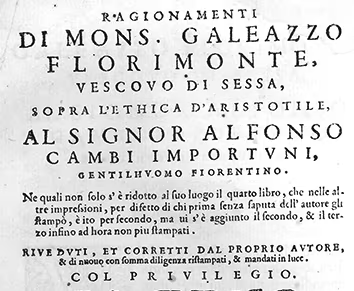
By 12 August 1563 Florimonte had prepared a dedication from Sessa to the Florentine gentleman Alfonso Cambi Importuni for the full Ragionamenti. Here he explained his wish that princes and noblemen, too often indifferent to letters, might find in Aristotle's moral philosophy an encouragement to acquire virtuous habits. His purpose was not a literal rendering of Greek scholastic material, but an intelligible and persuasive reorganisation of its ethical arguments for readers who governed households, courts, and states. The dialogue form, the literary figure of Nifo, and the contrast between pagan philosophy and Christian moral demands reveal how the work participated in the broader Renaissance movement to make Aristotelian thought available in Italian. It also retains Florimonte's characteristic insistence that learning should issue in conduct, not simply in erudition.
In 1564 Girolamo Scotto at Venice published the Seconda parte de' sermoni di santo Agostino, Chrisostomo, Bernardo et Basilio, a quarto carrying Florimonte's name as translator and incorporating thirteen homilies of his own, previously unprinted. This was not simply another impression of Giolito's earlier collection but a distinct continuation, prepared over many years and issued by another Venetian printer. The inclusion of his original homilies brought the enterprise beyond the translation and compilation of patristic authority into Florimonte's own pastoral writing. Its title-page and table also reflect the growing importance of presenting religious texts as usable collections for consultation and instruction, rather than as indiscriminate bodies of inherited learning.
Florimonte died at Sessa in the first days of May 1565, aged eighty-one. His most consequential bibliographical act was nevertheless realised after his death. In 1567 Domenico Nicolini da Sabbio printed at Venice the first complete edition of the Ragionamenti di mons. Galeazzo Florimonte, vescovo di Sessa, sopra l'Ethica d'Aristotile, in quarto, with the dedication of 12 August 1563 and an announcement of privilege. The title-page explicitly restored the fourth book to its proper position and advertised the second and third books as never previously printed, stating that the work had been reviewed and corrected by its author. The volume thus transformed a two-part publication issued under Nifo's name into an acknowledged four-book work by Florimonte himself. Nicolini's edition, comprising [4], 177, [1] leaves, is therefore not merely a later printing of the 1554 and 1562 texts: it is their first complete printed recension and the essential starting point for studying Florimonte's intended structure, his treatment of Aristotle, and his responsibility for the work's final literary form. The claims of authorial correction belong to the edition's own paratext and should be evaluated alongside the surviving manuscript tradition rather than accepted as proof that every printed reading reflects Florimonte's last intentions.
Florimonte's remaining writings illustrate the breadth, and the incompleteness, of his intellectual legacy. A vernacular dialogue on the site and beauty of Sessa is known from an early bibliographical notice but has not been recovered; a treatise on free will was sent to Cervini in 1545, and a discussion of inherent and imputed righteousness to Beccadelli in 1561. Letters of 1558–61 refer repeatedly to translations of dialogues by Plato, apparently envisaged as a larger project, but no corresponding printed edition has been established. His correspondence survived in dispersed humanist and ecclesiastical archives and in printed collections, including the Aldine Lettere volgari (1548), Dionigi Atanagi's Delle lettere facete et piacevoli (1561), and Bernardino Pino's Della nuova scielta di lettere (1582). A sonnet by Florimonte was printed posthumously in the Rime et versi in lode di Giovanna Castriota Carafa (Vico Equense, 1585). The two major strands of his publication history—the patristic sermon collections and the successive recensions of the Aristotelian dialogues—reveal an author who used the Italian language, the resources of commercial printing, and the authority of classical and Christian texts to connect the education of the individual with the reform of social and ecclesiastical life.
Bibliography
Bongi, Salvatore. Annali di Gabriel Giolito de’ Ferrari da Trino di Monferrato, stampatore in Venezia. 2 vols. Rome: Presso i principali librai, 1890–1895.
Biadego, Giuseppe. “Galeazzo Florimonte e il Galateo di Monsignor Della Casa: Studio.” Atti del Reale Istituto Veneto di Scienze, Lettere ed Arti 60, pt. 2 (1900–1901): 530–557.
Grella, Vincenzo. Galeazzo Florimonte: Letterato del Cinquecento. Santa Maria Capua Vetere: Umili e Quattrucci, 1909.
Felcini, Decio. Ricerche su Galeazzo Florimonte detto Galateo. Jesi: Tipografia Editrice Flori, 1911.
Tommasino, Giuseppe. Tra umanisti e filosofi: Una nobile figura sessana di letterato e di uomo attraverso l’epoca del pieno Rinascimento: Philalethes. Maddaloni: Stabilimento Tipografico G. Golini, 1921.
D’Onofrio, Sara. Il Galateo di monsignor Della Casa e il Libro delle inetie di Galeazzo Florimonte. Naples: Federico e Ardia, 1938.
Scarpati, Claudio. “Con Giovanni Della Casa dal De officiis al Galateo.” In Studi sul Cinquecento italiano, 126–155. Milan: Vita e Pensiero, 1982. Originally published in Italia medioevale e umanistica 24 (1981).
Berra, Claudia. “Il Galateo ‘fatto per scherzo’.” In Per Giovanni Della Casa: Ricerche e contributi, edited by Gennaro Barbarisi and Claudia Berra, 271–335. Milan: Cisalpino, 1997.
Pignatti, Franco. “Florimonte, Galeazzo.” In Dizionario Biografico degli Italiani, vol. 48, 354–356. Rome: Istituto della Enciclopedia Italiana, 1997.
Cassese, Michele. “Galeazzo Florimonte e la predicazione: Un’analisi dei suoi sermonari.” In Munera parva: Studi in onore di Boris Ulianich, edited by Giuseppe Luongo, vol. 2, 155–174. Naples: Fridericiana Editrice Universitaria, 1999.
Cassese, Michele. Girolamo Seripando e i vescovi meridionali (1535–1563). 2 vols.: vol. 1, Saggio storico e profilo dei corrispondenti; vol. 2, La corrispondenza: Edizione critica. Naples: Editoriale Scientifica, 2002.
Russo, Emilio. “1535–1556: Beccadelli, Della Casa, Florimonte.” In Studi di letteratura italiana in onore di Claudio Scarpati, edited by Eraldo Bellini, Maria Teresa Girardi, and Uberto Motta, 273–297. Milan: Vita e Pensiero, 2010.
Guttoriello, Roberto. Galeazzo Florimonte: Umanista, vescovo e riformatore (1484–1565): Un’analisi storica a partire dal suo epistolario. Todi: Tau Editrice, 2014.
Bianchi, Luca. “Uses of Latin Sources in Renaissance Vernacularizations of Aristotle: The Cases of Galeazzo Florimonte, Francesco Venier and Francesco Pona.” In Vernacular Aristotelianism in Italy from the Fourteenth to the Seventeenth Century, edited by Luca Bianchi, Simon Gilson, and Jill Kraye, 31–55. London: The Warburg Institute, 2016.
Gigli Cervi, Isabelle. “Variazioni onomastiche dietro al Galateo di Giovanni Della Casa: Una proposta di lettura.” Il Nome nel testo: Rivista internazionale di onomastica letteraria 22 (2020): 229–239.
Bianchi, Elisa. Demetrio Zeno, calligrafo e consulente letterario: Tra libri a stampa e libri manoscritti nella Venezia del primo Cinquecento. With an afterword by Caterina Carpinato. Alessandria: Edizioni dell’Orso, 2022, especially 70–72.
Argentiero, Rita. “La soggettività assente dell’irato nella prospettiva di Agostino Nifo.” Dialegesthai: Rivista telematica di filosofia (2023), published 31 July 2023.
Carrai, Stefano. “La nascita del Galateo.” Atti e memorie dell’Arcadia 12 (2023): 191–204.
Beyond the names: biographies and bibliographies on this page are curated by Abu, the AI scholar crafted by Buonvecchio exclusively for Govi Rare Books.