
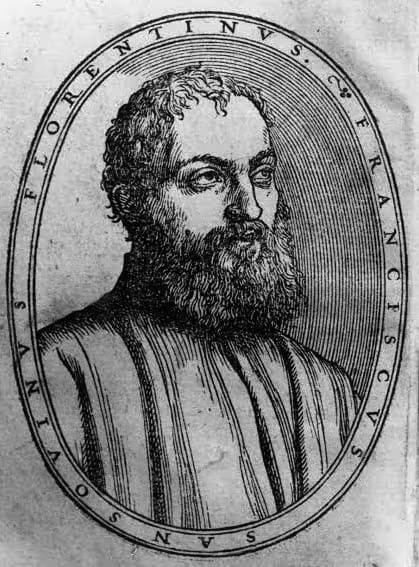
Francesco Sansovino
(Roma, 1521 – Venezia, 28 settembre 1583)
Biography
Francesco Sansovino (Francesco Tatti, called Sansovino; 1521–1583) was one of the most prolific and structurally important writer-editors of sixteenth-century Venice, a figure whose career is best understood not by isolating his original compositions from his translations, compilations, editions, and publishing ventures, but by examining the way all of these activities converged within the mature Venetian book trade. He belonged to the generation for whom the poligrafo became a recognizable professional type, yet his case is unusually rich because he passed through almost every stage of the production of a book: he wrote, translated, abridged, anthologized, annotated, corrected, supplied dedications and indexes, devised editorial programmes, employed printers, operated a press and bookshop of his own, and repeatedly reconfigured previously circulating material for new vernacular readerships.
His extraordinary catalogue ranges from Boccaccio, Dante, Aristotle, and Palladius to anatomy, agriculture, legal practice, Ottoman history, political theory, letter-writing, genealogy, and the monumental description of Venice that ultimately secured his lasting reputation. For the history of ideas, Sansovino matters because he participated in the large-scale transfer of learned knowledge into Italian; for the history of the book, he matters because this transfer was inseparable from his intimate understanding of how books were manufactured, positioned, revised, and kept commercially alive through successive editions.
He was born in Rome in 1521 as Francesco Tatti, the son of the Florentine sculptor and architect Jacopo Tatti, called Sansovino, from whom he inherited the surname by which both men became famous. His baptism in Sant’Eustachio placed him from the beginning within important Roman networks: his godfather was Giovanni Maria del Monte, the future Pope Julius III. The catastrophe that determined his childhood was the Sack of Rome in 1527. The family abandoned the city, passed through Florence, and eventually settled in Venice, where Jacopo Sansovino entered the service of the Procurators of Saint Mark and became one of the principal architects responsible for the monumental transformation of the Piazza and Piazzetta San Marco.
Francesco consequently grew up unusually close to the administrative, ceremonial, artistic, and architectural heart of the Venetian Republic. This position left a deep imprint on his later work, though he never simply dissolved his identity into Venice. He continued to describe himself as Florentine in linguistic and genealogical terms while simultaneously constructing, over the course of his career, one of the most elaborate literary representations ever made of Venice as a political and cultural organism.
His father intended him for a more conventional and secure legal career, and his education initially followed that path without being confined to it. He studied Latin grammar and rhetoric under Stefano Piazzone da Asola and Giovita Ravizza and received instruction in Greek from Antonio Francini da Montevarchi. In 1536 he went to Padua to study law, but the intellectual importance of the Paduan experience came at least as much from the humanist environment surrounding the university as from jurisprudence itself. He attended Lazzaro Bonamico, and in 1540 entered the Accademia degli Infiammati, whose debates on rhetoric, philosophy, ethics, translation, and the legitimacy of learned discourse in the vernacular had a decisive effect upon his later publishing career. Sperone Speroni, Alessandro Piccolomini, Benedetto Varchi, Bernardino Tomitano, Marco Mantova Benavides, and Mariano Sozzini belonged to the intellectual world in which Sansovino was formed. The central problem was no longer simply whether Italian could equal Latin in literary dignity, but whether philosophy, ethics, history, science, and professional knowledge could be reorganized in Italian for readers outside the traditional learned institutions. Sansovino would devote much of his life to answering that question practically, through books.
His movements between Padua, Florence, Bologna, and Venice during the early 1540s further widened these networks. He became affiliated with the Accademia Fiorentina in January 1542 and completed his doctorate in civil law at Bologna in 1543, though his later writings make clear that he had little desire to spend his life as a practising jurist. An unpublished work from this formative period, Dialogo della pratica della ragione, is particularly revealing: by staging a dialogue between Bartolus of Sassoferrato and Machiavelli, Sansovino juxtaposed the inherited authority of medieval jurisprudence with the newer analytical language of Renaissance politics. The manuscript remained outside his printed canon, but the conceptual pairing anticipates a career in which legal, institutional, historical, and political forms of reasoning would repeatedly converge.
His first important appearance in print had already occurred in 1542 with Le lettere sopra le diece giornate del Decamerone, printed at Venice by Venturino Ruffinelli. The work belongs to the early history of Sansovino’s sustained engagement with Boccaccio, but it is also a document of intellectual networking: the ten days of the Decameron become occasions for letters that connect literary commentary with the social geography of contemporary humanism. Sansovino was already learning that an established author could provide the framework for a new editorial product without the later writer needing to displace the canonical text. The following year, his short Rhetorica, printed in 1543 in an environment connected with the Infiammati, brought rhetorical instruction into a compact vernacular format and marked the beginning of a long sequence of works designed to convert specialized disciplines into usable Italian books.
During these years he also acquired something at least as valuable as literary reputation: practical familiarity with the Venetian press. His friendship and correspondence with Pietro Aretino document both his early literary ambition and his growing resistance to a purely legal career; his contacts included Lodovico Dolce, Gaspara Stampa, Giuseppe Betussi, Lodovico Domenichi, and other writers whose livelihood was inseparable from printing. Sansovino worked as a corrector and editorial assistant within the commercial environment of the major Venetian houses, including the orbit of Gabriel Giolito de’ Ferrari, and learned the mechanisms by which manuscript copy became saleable edition: correction, privilege, dedication, typography, format, paratext, indexing, and the constant calculation of what an existing readership might buy next. This experience distinguished him from a gentleman-author who merely delivered a manuscript to a printer. By the time he eventually opened a publishing enterprise of his own, he understood the book from inside the shop.
A trip to Rome shortly before February 1550 offered the possibility of an entirely different career. His godfather had become Pope Julius III, and Sansovino hoped that the new pontificate might secure him a curial position. The attempt failed, and his return to Venice proved decisive. He married Benedetta Musocca or Misocca, daughter of the Venetian merchant Vettore Musocca, and in 1554 formally abandoned the practice of law. From then onward his economic and intellectual identity would be tied overwhelmingly to letters and publishing.
The books he produced around 1550 already show the breadth of the programme taking shape. L’edificio del corpo humano, printed at Venice by Comin da Trino di Monferrato in 1550, is a small octavo rather than an imposing medical folio. Its scale was part of its purpose: Sansovino condensed discussion of the structure and qualities of the human body and the faculties of the soul into a vernacular handbook that could circulate outside specialist medical environments. It should not be mistaken for an original anatomical investigation comparable to Vesalian anatomy; its historical importance lies elsewhere, in the transformation of learned physiological and philosophical material into portable Italian exposition. The distinction is essential because it characterizes Sansovino’s method repeatedly: he rarely sought to establish himself as the discoverer of a new discipline, but often proved exceptionally effective at extracting, reorganizing, and transmitting an existing body of learning.
The same logic governs L’anima d’Aristotele, printed in Venice by Bartolomeo Imperatore in 1551. The work was presented explicitly as a concise treatment of Aristotelian psychology whose understanding was necessary to ethics. Its small octavo format and vernacular language place it squarely within the programme of vernacular Aristotelianism encouraged by the academic milieu in which Sansovino had matured. Aristotle’s De anima had generated one of the most technically demanding philosophical traditions in university Latin; Sansovino’s intervention moved that material toward the cultivated reader who wanted access to Aristotelian categories without entering the full machinery of scholastic commentary.
The legal education his father had insisted upon was never wasted. L’avocato, first printed in 1554, recast professional legal knowledge as vernacular dialogue, while later juridical, institutional, and secretarial writings continued to draw upon the habits of classification he had acquired at Padua and Bologna. His career is therefore misleading if divided too sharply into abandoned law and embraced literature. Jurisprudence provided Sansovino with an enduring sensitivity to categories, offices, procedures, precedents, institutional forms, and documentary language, all of which would later become crucial in Del secretario, Del governo dei regni et delle repubbliche, Venetia città nobilissima et singolare, and his works on noble families and chivalric institutions.
One of the most revealing experiments of his pre-publishing-house years appeared in 1556 under a pseudonym. Tutte le cose notabili e belle che sono in Venetia, attributed on the title-page to Anselmo Guisconi, offered a compact guide to the city’s customs, paintings, sculptors, architecture, palaces, eminent men, doges, and patriarchs. It would be easy to treat the little book simply as juvenilia preceding the vastly larger Venetia città nobilissima. More significantly, however, it provided Sansovino with an initial editorial model for converting Venice itself into a readable object. The later fourteen-book history and description did not emerge suddenly in 1581; it grew through repeated attempts to classify the city’s topography, monuments, institutions, people, ceremonial practices, and historical memory. The pseudonymous 1556 guide is therefore an early stage in a textual genealogy that culminated twenty-five years later in his masterpiece.
The year 1560 marks another decisive threshold: Sansovino established a publishing and printing enterprise of his own, associated with the sign of the crescent moon and eventually with the motto In dies. The business initially involved the physician Nicola Tinto, and its imprints could take several forms, including Francesco Sansovino et compagni. Yet the term “his press” must be handled carefully. Sansovino’s professional activity was never confined to personally printing every book that bore his editorial responsibility. At different stages he acted as printer, publisher, bookseller, commissioning editor, or proprietor while employing the material services of other printers such as Francesco Rampazetto, Stefano Zazzera, members of the Bonelli family, Daniele Zanetti, and later Altobello Salicato. His enterprise is best understood as a publishing business whose degree of direct typographical involvement varied from edition to edition.
A particularly revealing publication from the opening of this phase is Della agricoltura, issued in 1560 under the pseudonym Giovanni Tatti, using Sansovino’s true family surname in a deliberately altered authorial identity. The five books gathered material from ancient and modern agricultural writers and were accompanied by numerous woodcuts representing grain, plants, herbs, animals, and other objects of rural knowledge. The volume belongs to a vigorous sixteenth-century market for vernacular agriculture in which ancient agronomical authorities such as Palladius, Columella, Varro, and Cato were being reconciled with contemporary estate management, gardening, veterinary practice, and materia medica. It also documents Sansovino’s transition from serving other publishers to constructing a recognizable list of his own: the dedication was addressed to his associate Nicola Tinto, while the title-page advertised the new Sansovino enterprise itself.
The first edition of Del governo dei regni et delle repubbliche followed in 1561, likewise from Sansovino’s publishing orbit. This became one of his most important political compilations because it offered Italian readers a comparative repertory of forms of government, ancient and modern, assembled from a wide range of historians and political writers. Sansovino drew upon Gasparo Contarini, Paolo Giovio, Francesco Guicciardini, Guillaume Postel, Alfonso de Ulloa, Ortensio Lando’s mediation of Thomas More, and other sources; Machiavelli, although often absent from the overt apparatus of authority, supplied material of considerable importance to Sansovino’s political writing. The work should not be judged as if it were competing with the Discorsi or De republica as an original philosophical system. Its historical force came from comparative organization: it placed constitutions, magistracies, and institutional practices within a vernacular framework through which readers could compare political orders that had previously been scattered across Latin histories, geographical treatises, state descriptions, and politically sensitive works. The book was reissued and enlarged in later editions, including a 1566 printing by the heirs of Marchiò Sessa, demonstrating that its value lay precisely in its adaptability as an expanding repertory.
Sansovino’s growing editorial authority reached a particularly sophisticated form in the 1564 edition of Dante’s Commedia produced for the Sessa house. The title announces Dante con l’espositione di Christoforo Landino, et di Alessandro Vellutello, “reformed, revised, and reduced to its true reading” by Francesco Sansovino. The novelty lay above all in bringing together, for the first time in a single printed Dante, the major commentaries of Cristoforo Landino and Alessandro Vellutello, two interpretative traditions that had previously circulated independently. Sansovino did not create a radically new critical text: the poem remained substantially dependent upon the Aldine tradition, with limited readings derived from Vellutello and orthographic intervention. His real contribution was architectural. He constructed a new apparatus around Dante, adding tables, arguments, allegories, a Tavola delle voci difficili, and paratexts designed to guide readers through the poem and through the competing exegetical authorities.
The material book deserves attention because its editorial genealogy can be read directly on the page. The Commedia is accompanied by the two commentaries arranged around the poetic text and distinguished through marginal indications, while its ninety-five woodcuts largely derive from the celebrated Marcolini-Vellutello edition of 1544. Where the earlier iconographic cycle had not supplied a different image for every canto, the Sessa edition reused some of the initial diagrams and woodcuts so that the new volume would present a more continuously illustrated sequence. Domenico Nicolini da Sabbio participated in the printing, while the Sessa family supplied the publishing framework. The edition was successful enough to be reproduced, with relatively modest alterations, in 1578 and 1596. Those later printings should not be collapsed bibliographically into the 1564 edition: they attest the durability of Sansovino’s particular synthesis of Landino, Vellutello, Aldine text, Marcolini imagery, and newly constructed paratext.
Also in 1564, Sansovino first published the work that would become his most persistent manual of professional writing, Del secretario. The first edition, printed in Venice by Francesco Rampazetto, consisted of four books and explained how to compose lettere missive e responsive according to subject, social hierarchy, and rhetorical function, supplementing its rules with model letters and historical examples. The work occupies an important moment in the history of early modern bureaucracy because the secretary was becoming a specialized professional figure indispensable to courts, ambassadors, noble households, republican institutions, and expanding administrative structures. Sansovino did not simply offer elegant epistolary style; he codified the relation between writing and office, showing how social rank, institutional purpose, formula, address, persuasion, request, praise, consolation, recommendation, and information could be translated into appropriate written forms.
The editorial history of Del secretario is unusually important because Sansovino continued revising it throughout his life. Four-book versions appeared repeatedly in 1565, 1569, 1573, 1575, and probably 1578; in 1580, the heirs of Vincenzo Valgrisi issued the greatly expanded seven-book form. By then the manual had evolved from an instructional treatise into a substantial archive of epistolary practice incorporating numerous letters written by or to princes and public figures. The enlarged edition also became autobiographical. Its concluding materials include Sansovino’s letter to Gianfilippo Magnanini, in which he classified his own career under the categories of “compositions,” “translations,” and “collections,” effectively creating a contemporary bibliography and intellectual self-portrait. Editions continued after his death through the early seventeenth century, including printings of 1584, 1588, 1590, 1591, 1596, 1608, and 1625. The four-book 1564 Secretario and the seven-book 1580 version are therefore not simply early and late impressions of one stable work; they represent materially different stages in the expansion of the genre.
Sansovino’s activity during the 1560s and 1570s also reveals how rapidly a successful Venetian publisher could shift in response to political events. Ottoman history became one of his major fields. The wars between Venice and the Ottoman Empire, culminating in the campaign of Cyprus and the battle of Lepanto, created an intense market for histories of the Turkish dynasty, military accounts, dynastic genealogies, and descriptions of Ottoman power. Sansovino produced and reorganized such material repeatedly, including the works that culminated in his Historia universale dell’origine et imperio de’ Turchi and related annals of the Ottoman rulers. These publications were not detached antiquarian exercises. They supplied Italian readers with historical frameworks for a political and military threat that was unfolding in their own lifetime, and their changing editions should be read against that demand. In 1573, when he dedicated the Historia Universale dei Turchi, Sansovino was already using the title of knight of the Constantinian Order, received that same year.
The most revealing example of his method in political literature appeared in 1578 as Concetti politici, printed in Venice by Giovanni Antonio Bertano. Sansovino presented the work as a collection of political maxims extracted from Greek, Latin, and vernacular authors for those involved in governing republics and principalities in peace and war. The first edition contained 805 concetti, and its prefatory list named an impressive body of authorities including Aristotle, Bembo, Cicero, Comines, Giovio, Guevara, Guicciardini, Livy, Plato, Polybius, Sallust, Tacitus, and Thucydides. One major authority, however, was omitted: Machiavelli. Modern source analysis has demonstrated that 108 of the maxims derive from the Discorsi alone, with additional material drawn from Il principe, Arte della guerra, and the Istorie fiorentine. Sansovino’s compilation thus became an important vehicle through which Machiavellian political analysis continued to circulate in transformed and unattributed form after Machiavelli’s works had become confessionally and politically problematic.
The later history of the Concetti makes that mediation still more significant. In 1583, Sansovino’s material was recast within Propositioni, overo considerationi in materia di cose di Stato, where it circulated together with Guicciardini’s Avvertimenti and Giovanni Francesco Lottini’s Avvedimenti civili; subsequent editions appeared in 1588, 1598, and 1608. The original 1578 form crossed into England in 1590, when Robert Hitchcock translated it as The Quintessence of Wit, adapting the material to an English military and political readership. In other northern European contexts the collection was similarly absorbed into new political handbooks. The genealogy from Machiavelli and Guicciardini through Sansovino and then into English and German political literature is one of the clearest examples of how his compilatory practice could generate an international afterlife larger than the apparent originality of the source text might suggest.
His most enduring achievement, however, grew from the subject that had surrounded him since childhood: Venice itself. The small 1556 Tutte le cose notabili e belle che sono in Venetia had offered an initial descriptive model, and later versions enlarged that material. Over the following decades Sansovino accumulated topographical, artistic, institutional, genealogical, historical, epigraphic, and ceremonial information until the project became Venetia città nobilissima et singolare, published in 1581 in fourteen books. The title-page names “Iacomo Sansovino” as the publishing address, while the colophon identifies Domenico Farri as the printer, an unusually revealing division between the public identity of the edition and its typographical production. The book appeared in quarto and was supplemented by chronological and tabular material substantial enough to make it simultaneously a history, guide, institutional repertory, and civic archive.
Its organization reflects the complexity of Venice itself. Sansovino moved through the sestieri and their churches, monasteries, palaces, paintings, sculptures, epitaphs, relics, libraries, public buildings, and private residences, but topography was only one level of the work. He also described wars, doges, magistracies, laws, customs, senatorial actions, writers, patrician families, ceremonies, and institutions. His sources were correspondingly heterogeneous: printed Venetian chronicles and histories, antiquarian literature, private family material, monastic learning, inscriptions observed in situ, oral information, and the privileged knowledge made available by his father’s long architectural service to the Republic. The book’s occasional errors and its participation in the celebratory mythology of Venetian government do not diminish its documentary importance. Precisely because Sansovino recorded buildings, monuments, paintings, tombs, collections, and social practices visible in his own lifetime, Venetia città nobilissima preserves information about the late sixteenth-century city that is unrecoverable from purely narrative histories.
The editorial afterlife of Venetia is itself an important chapter in the history of Venetian antiquarianism. In 1604, Giovanni Stringa substantially corrected and enlarged Sansovino’s work in an edition printed by Altobello Salicato. Stringa did not replace the original structure; he inhabited it, adding later information and corrections to a framework whose usefulness had already been established. In 1663, Giustiniano Martinioni produced an even more extensive continuation, printed by Stefano Curti, incorporating Stringa’s additions and carrying the historical record forward to his own time. The 1663 edition is materially distinct from the sixteenth-century first edition, with an engraved frontispiece representing Venice and Piazza San Marco, a portrait of Martinioni, and substantial supplementary sequences. The editorial genealogy 1581–1604–1663 is therefore crucial: the first edition is the direct witness to Sansovino’s late-sixteenth-century city, while Stringa and Martinioni transform it into a continuously updated civic archive extending across more than eighty years.
This history also explains why the 1581 printing should not be judged merely against its later, fuller descendants. The value of the first edition lies precisely in the chronological boundary of its knowledge. When Sansovino describes a church, palace, painting, monument, office, or patrician lineage, he does so before the alterations of the seventeenth century and before Stringa or Martinioni could retrospectively revise the account. Conversely, the later editions are indispensable for reconstructing reception and change, because their additions reveal which parts of Sansovino’s Venice required correction, supplementation, or historical continuation. The three stages therefore serve different scholarly purposes and belong in a related-books network as distinct witnesses rather than duplicate versions of one title.
In 1582, near the end of his life, Sansovino issued another substantial historical-genealogical compilation, Della origine, et de’ fatti delle famiglie illustri d’Italia, printed in Venice by Altobello Salicato. The work traced the origins, alliances, dependencies, military achievements, and political fortunes of major Italian families across a period exceeding a millennium. It combines genealogy with narrative history, and like many of Sansovino’s compilations its significance lies partly in the way family history becomes a structure for reorganizing dispersed historical information. The book also reflects the strong sixteenth-century demand for printed genealogical legitimacy among princely and noble houses, a market to which Sansovino’s networks and accumulated knowledge were particularly well suited.
His final years were marked by declining eyesight but not by intellectual withdrawal. The death of his father Jacopo Sansovino in 1570 had made Francesco heir to the architect’s estate and placed upon him the additional task of managing and preserving Jacopo’s memory. His own historical and topographical writing helped to situate his father’s architecture within the civic narrative of Venice, so that the literary and architectural Sansovino legacies became closely entangled. In 1573 Francesco received the Constantinian knighthood; in 1578 he unsuccessfully sought election to the council of the Venetian guild of printers and booksellers, confirming that he understood himself professionally as a member of the trade rather than simply as an author who happened to print books. He dictated his testament on 24 November 1582 and died in Venice on 28 September 1583, after an illness of twelve days. He was buried in the church of San Geminiano, one of the buildings most closely associated with his father’s architectural world.
The history of his books did not end with him. On 11 April 1584 his son Iacopo Sansovino the Younger transferred to Altobello Salicato for a seven-year term the printing rights to his father’s privileged and unprivileged works. Salicato continued to exploit Sansovino’s list even beyond that period. The transaction is especially revealing because it transforms a lifetime of intellectual production into a recognizable body of publishing property: Del secretario, historical compilations, political works, genealogies, and other titles could continue to generate editions independently of their deceased author. Sansovino’s posthumous reputation was therefore shaped not only by readers and historians but by the commercial survival of his editorial assets.
That survival also explains the usefulness of Sansovino’s own tripartite classification of his work into “compositions,” “translations,” and “collections.” The categories appear in the enlarged 1580 Secretario and provide a more historically appropriate description of his activity than the modern hierarchy that privileges supposedly original authorship above compilation. Under “compositions” he included works such as the Rhetorica, L’edificio del corpo humano, L’avocato, Del secretario, Del governo dei regni et delle repubbliche, the Ottoman histories, the Concetti politici, and the description of Venice; translations included Aristotle, Palladius, legal and religious material; collections included books of orations, letters, agriculture, novelle, satire, and historical repertories. The very act of classifying his catalogue in this manner shows that Sansovino regarded selection, translation, organization, and recombination as distinct but equally legitimate forms of literary labour.
This point is central to the modern reassessment of his reputation. Older criticism often interpreted Sansovino’s borrowings, abbreviations, unattributed extracts, and dependence upon existing texts as evidence of haste, commercial opportunism, or deficient originality. Such judgments were not entirely invented: he did reuse material aggressively, and modern scholarship has identified extensive undeclared borrowings, particularly in the political works. Yet the history of publishing makes clear why originality in the Romantic sense is an inadequate measure of his activity. Sixteenth-century readers bought Del governo because it reorganized political knowledge; Del secretario because it turned epistolary practice into an administrative repertory; the Dante of 1564 because it brought two major commentary traditions together within one illustrated edition; the Concetti politici because it condensed hundreds of passages into portable maxims; and Venetia città nobilissima because it assembled the topographical, institutional, artistic, and historical knowledge of a city into a single navigable book. The editorial act itself created the utility.
The scale of his career is most visible when the major editions are placed in chronological relation rather than treated as disconnected titles. The Lettere sopra le diece giornate del Decamerone of 1542 belongs to the young academic and literary networker; L’edificio del corpo humano of 1550 and L’anima d’Aristotele of 1551 to the programme of vernacularizing learned disciplines; the pseudonymous Venetian guide of 1556 to the first formation of his civic historiography; Della agricoltura and the opening of his own press in 1560 to his emergence as independent publisher; Del governo in 1561 to his political compilation; the Dante and Secretario of 1564 to the high point of his editorial engineering; the Ottoman writings of the 1560s and 1570s to contemporary geopolitical demand; the Concetti politici of 1578 to the compression and covert transmission of political authorities; the seven-book Secretario of 1580 to the mature codification of professional epistolography; and Venetia città nobilissima of 1581 to the summation of a lifetime spent observing the republic in which he had grown up. This sequence is intellectually coherent because each stage depends increasingly upon the skills acquired in the preceding ones.
Francesco Sansovino’s importance ultimately lies in the fact that he understood the printed book as a form of intellectual organization. His career was made possible by Venice, where a sufficiently large market existed for books that did more than reproduce texts: they classified, excerpted, translated, juxtaposed, annotated, indexed, illustrated, and reformulated knowledge. He was able to move between Boccaccio and anatomy, Aristotle and secretarial practice, Dante and Machiavelli, Ottoman history and Venetian topography because his true specialization was editorial structure. The apparent miscellany of his catalogue becomes intelligible once the books are examined as solutions to different problems of access.
The durability of the works confirms the point. Del secretario was repeatedly reshaped and reprinted for more than half a century; the Concetti politici entered foreign political culture through translation and adaptation; the 1564 Dante returned in later impressions and fixed an influential combined Landino–Vellutello format; the Venetia became the foundation upon which Stringa and Martinioni constructed seventeenth-century descriptions of the city. In each case the decisive achievement was not simply the presence of Sansovino’s name on a title-page, but the creation of an editorial arrangement sufficiently useful to outlive him.
A Sansovino edition is therefore rarely isolated. The 1564 Dante points simultaneously toward Landino, Vellutello, Lodovico Dolce, the Aldine text, the Marcolini illustrations, and the Sessa publishing house; Del governo and the Concetti connect Contarini, Guicciardini, Machiavelli, Thomas More, Postel, and later English political literature; Del secretario belongs beside letter collections, chancery manuals, diplomacy, and the professionalization of administrative writing; Venetia città nobilissima belongs to a lineage extending backward to Venetian chronicle and civic description and forward through Stringa and Martinioni. The density of these relationships is not ancillary to Sansovino’s biography. It is the clearest measure of the historical reach of his editorial work.
Bibliography
Cicogna, Emmanuele Antonio. Delle inscrizioni veneziane raccolte ed illustrate. Vol. 4. Venice: Giuseppe Picotti, 1834, 31–91.
Sforza, Giovanni. “Francesco Sansovino e le sue opere storiche.” Memorie della Reale Accademia delle Scienze di Torino, Classe di scienze morali, storiche e filologiche, 2nd ser., 47 (1897): 27–66.
Luciani, Vincent. “Sansovino’s Concetti politici and Their Debt to Guicciardini.” PMLA 65, no. 6 (1950): 1181–1195.
Luciani, Vincent. “Sansovino’s Concetti politici and Their Debt to Machiavelli.” PMLA 67, no. 5 (1952): 823–844.
Procacci, Giuliano. Studi sulla fortuna di Machiavelli. Rome: Istituto Storico Italiano per l’Età Moderna e Contemporanea, 1965.
Bonora, Ettore. “Anton Francesco Doni e i poligrafi.” In Storia della letteratura italiana, edited by Emilio Cecchi and Natalino Sapegno, vol. 4, Il Cinquecento, 432–444. Milan: Garzanti, 1966.
Grendler, Paul F. “Francesco Sansovino and Italian Popular History, 1560–1600.” Studies in the Renaissance 16 (1969): 139–180.
Scarpa, Emanuela. “Un accenno al Machiavelli ‘aristotelico’ in un dialogo giuridico inedito di Francesco Sansovino.” Quaderni di lingua e letterature 5 (1980): 163–170.
Di Filippo Bareggi, Claudia. Il mestiere di scrivere: Lavoro intellettuale e mercato librario a Venezia nel Cinquecento. Rome: Bulzoni, 1988.
Trovato, Paolo. Con ogni diligenza corretto: La stampa e le revisioni editoriali dei testi letterari italiani (1470–1570). Bologna: Il Mulino, 1991.
Roaf, Christina. “Cultura e conoscenze di un giovane del Cinquecento: Francesco Sansovino e le Lettere sopra le diece giornate del Decamerone.” In Omaggio a Gianfranco Folena, vol. 2, 1107–1122. Padua: Editoriale Programma, 1993.
Bonora, Elena. Ricerche su Francesco Sansovino imprenditore librario e letterato. Memorie dell’Istituto Veneto di Scienze, Lettere ed Arti, Classe di Scienze Morali, Lettere ed Arti, vol. 52. Venice: Istituto Veneto di Scienze, Lettere ed Arti, 1994.
Procacci, Giuliano. Machiavelli nella cultura europea dell’età moderna. Rome-Bari: Laterza, 1995.
Di Benedetto, Arnaldo. “Trattatisti cinquecenteschi del comportamento.” In Poesia e comportamento: Da Lorenzo il Magnifico a Campanella, 73–96. 2nd ed. Alessandria: Edizioni dell’Orso, 2005.
Di Benedetto, Arnaldo. “Un paragrafo della storia dell’autobiografia in Italia.” In Poesia e comportamento: Da Lorenzo il Magnifico a Campanella, 145–152. 2nd ed. Alessandria: Edizioni dell’Orso, 2005.
Anglo, Sydney. Machiavelli: The First Century. Studies in Enthusiasm, Hostility, and Irrelevance. Oxford: Oxford University Press, 2005.
Carta, Paolo. “Magistrature repubblicane e comparazione giuridica nell’opera di Francesco Sansovino.” Il pensiero politico 40, no. 2 (2007): 283–300.
Mula, Patrick. “«Dipinto in scrittura»: Pour une bibliographie des travaux de Francesco Sansovino, polygraphe vénitien (1521–1583).” La Bibliofilía 112, no. 3 (2010): 245–280.
Sartorello, Luca. Le due repubbliche: Bartolo e Machiavelli in un dialogo inedito di Francesco Sansovino, con l’edizione del Dialogo della pratica della ragione. Florence: Centro Editoriale Toscano, 2010.
Panzera, Maria Cristina. “Francesco Sansovino e l’umanesimo veneziano. La fonte nascosta dei modelli di lettere del Del Secretario.” Italianistica 41, no. 2 (2012): 21–48.
Panzera, Maria Cristina. “Francesco Sansovino e l’umanesimo veneziano, II. Il Del Secretario fra tradizione culturale e veneziana libertas.” Italianistica 41, no. 3 (2012): 11–33.
Panzera, Maria Cristina. “Francesco Sansovino lecteur d’Érasme.” Bibliothèque d’Humanisme et Renaissance 74 (2012): 83–101.
Urbaniak, Martyna. “Tra Doni e Sansovino: La novella in volgare nel Cinquecento.” In Dissonanze concordi: Temi, questioni e personaggi intorno ad Anton Francesco Doni, edited by Giovanna Rizzarelli, 295–326. Bologna: Il Mulino, 2013.
Mondin, Luca. “Dal Sabellico al Sansovino: un’altra fonte occulta del trattato Del Secretario.” Giornale storico della letteratura italiana 191 (2014): 538–570.
Ronco, Francesco. “Sansovino, Francesco.” In Enciclopedia Machiavelliana. Rome: Istituto della Enciclopedia Italiana, 2014.
Valeri, Elena. “Francesco Sansovino.” In Christian-Muslim Relations: A Bibliographical History. Vol. 6, Western Europe (1500–1600), edited by David Thomas and John Chesworth, 541–555. Leiden-Boston: Brill, 2014.
Piperno, Franco. “Musica, rime e conversari nella mutevole cornice delle Cento novelle di Francesco Sansovino.” In Cum fide amicitia per Rosanna Alhaique Pettinelli, edited by Stefano Benedetti, Francesco Lucioli, and Pietro Petteruti Pellegrino, 415–436. Rome: Bulzoni, 2015.
Berruezo Sánchez, Diana. “La antología de Francesco Sansovino y su recepción en España (siglos XVI y XVII).” Revista de Filología Española 97, no. 2 (2017): 265–284.
Villani, Stefano. “Raccolte di aforismi: Gli Avvertimenti di Alessandro Amidei come plagio e riscrittura di alcune massime di Francesco Guicciardini, Giovan Francesco Lottini e Francesco Sansovino.” Annali della Scuola Normale Superiore di Pisa. Classe di Lettere e Filosofia, ser. 5, 9, no. 1 (2017): 127–149.
Guarna, Valeria. L’Accademia Veneziana della Fama (1557–1561): Storia, cultura e editoria. Con l’edizione della Somma delle opere (1558) e altri documenti inediti. Manziana: Vecchiarelli, 2018.
Rando, Federica. Narrare nel Cinquecento: Le «Cento novelle scelte» di Francesco Sansovino. Bologna: I libri di Emil, 2018.
Testa, Simone. “Tatti, Francesco (detto Sansovino).” In Dizionario Biografico degli Italiani. Vol. 95. Rome: Istituto della Enciclopedia Italiana, 2019.
D’Onghia, Luca, and Daniele Musto, eds. Francesco Sansovino scrittore del mondo: Atti del convegno internazionale di studi, Pisa, 5–7 dicembre 2018. Sarnico: Edizioni di Archilet, 2019.
Procaccioli, Paolo. “Francesco Sansovino: Tessere per un profilo.” In Francesco Sansovino scrittore del mondo, edited by Luca D’Onghia and Daniele Musto, 7–24. Sarnico: Edizioni di Archilet, 2019.
Caiazza, Ida. “«Fino a qui non si legge cosa che bona sia, se non quel tanto ch’è uscito dalle mie mani»: Sansovino e le Lettere amorose.” In Francesco Sansovino scrittore del mondo, edited by Luca D’Onghia and Daniele Musto, 25–42. Sarnico: Edizioni di Archilet, 2019.
Favaro, Maiko. “Storia e anatomia di un plagio: La lettera di Bernardino Tomitano a Francesco Longo e il Dialogo del gentilhuomo vinitiano di Francesco Sansovino.” In Francesco Sansovino scrittore del mondo, edited by Luca D’Onghia and Daniele Musto, 43–64. Sarnico: Edizioni di Archilet, 2019.
Rando, Federica. “Strategie autoriali e riscritture nelle Cento novelle scelte da i più nobili scrittori di Francesco Sansovino.” In Francesco Sansovino scrittore del mondo, edited by Luca D’Onghia and Daniele Musto, 65–78. Sarnico: Edizioni di Archilet, 2019.
Burguet, Willy. “L’edificio del corpo humano di Francesco Sansovino.” In Francesco Sansovino scrittore del mondo, edited by Luca D’Onghia and Daniele Musto, 79–92. Sarnico: Edizioni di Archilet, 2019.
Petrella, Giancarlo. “«Tradotti, composti et stampati»: Dalla penna al torchio: tra le pieghe degli annali di Francesco Sansovino imprenditore del libro.” In Francesco Sansovino scrittore del mondo, edited by Luca D’Onghia and Daniele Musto, 93–117. Sarnico: Edizioni di Archilet, 2019.
Celaschi, Massimiliano. “Le vite parallele e i percorsi intrecciati di Sansovino e Ruscelli.” In Francesco Sansovino scrittore del mondo, edited by Luca D’Onghia and Daniele Musto, 119–146. Sarnico: Edizioni di Archilet, 2019.
Tomazzoli, Gaia. “Sansovino editore di Dante: la Commedia del 1564.” In Francesco Sansovino scrittore del mondo, edited by Luca D’Onghia and Daniele Musto, 147–178. Sarnico: Edizioni di Archilet, 2019.
Guarna, Valeria. “Le dediche di Francesco Sansovino: Tempi e forme.” In Francesco Sansovino scrittore del mondo, edited by Luca D’Onghia and Daniele Musto, 179–202. Sarnico: Edizioni di Archilet, 2019.
Andreani, Veronica. “Presenze femminili nella letteratura italiana di medio Cinquecento: sulle dediche di Francesco Sansovino a Gaspara Stampa.” In Francesco Sansovino scrittore del mondo, edited by Luca D’Onghia and Daniele Musto, 203–224. Sarnico: Edizioni di Archilet, 2019.
Tomasi, Franco. “Le antologie di orazioni di Sansovino.” In Francesco Sansovino scrittore del mondo, edited by Luca D’Onghia and Daniele Musto, 225–272. Sarnico: Edizioni di Archilet, 2019.
Refini, Eugenio. “«La compositura delle parole»: La virtù dell’eloquenza tra retorica e oratoria.” In Francesco Sansovino scrittore del mondo, edited by Luca D’Onghia and Daniele Musto, 273–290. Sarnico: Edizioni di Archilet, 2019.
Musto, Daniele. “«Essendo riuscita quest’opera assai grata al mondo»: Appunti sulla vicenda redazionale del Secretario.” In Francesco Sansovino scrittore del mondo, edited by Luca D’Onghia and Daniele Musto, 291–330. Sarnico: Edizioni di Archilet, 2019.
Panzera, Maria Cristina. “Dai libri di storia ai libri di lettere: su alcune fonti epistolari di Francesco Sansovino (Del Secretario, libri IV–VII).” In Francesco Sansovino scrittore del mondo, edited by Luca D’Onghia and Daniele Musto, 331–356. Sarnico: Edizioni di Archilet, 2019.
Mondin, Luca. “La genesi del Secretario.” In Francesco Sansovino scrittore del mondo, edited by Luca D’Onghia and Daniele Musto, 357–392. Sarnico: Edizioni di Archilet, 2019.
Lo Re, Salvatore. “Sansovino, Firenze e la storia.” In Francesco Sansovino scrittore del mondo, edited by Luca D’Onghia and Daniele Musto, 393–412. Sarnico: Edizioni di Archilet, 2019.
Corsaro, Antonio. “L’utopia nella storia: Da Thomas More a Ortensio Lando a Sansovino. Del governo de i regni.” In Francesco Sansovino scrittore del mondo, edited by Luca D’Onghia and Daniele Musto, 413–428. Sarnico: Edizioni di Archilet, 2019.
Maffei, Sonia. “Una Venezia fiorentina: il trattatello Tutte le cose notabili e belle che sono in Venetia di Francesco Sansovino (1556).” In Francesco Sansovino scrittore del mondo, edited by Luca D’Onghia and Daniele Musto, 429–448. Sarnico: Edizioni di Archilet, 2019.
Telve, Stefano. “L’avocato: Osservazioni linguistiche.” In Francesco Sansovino scrittore del mondo, edited by Luca D’Onghia and Daniele Musto, 449–472. Sarnico: Edizioni di Archilet, 2019.
D’Onghia, Luca. “Note su Sansovino grammatico e lessicografo.” In Francesco Sansovino scrittore del mondo, edited by Luca D’Onghia and Daniele Musto, 473–502. Sarnico: Edizioni di Archilet, 2019.
Panzera, Maria Cristina. “Traduire les lettres des princes: les recueils de G. Ruscelli et de F. Sansovino.” In Relier, délier les langues: Formes et défis linguistiques de l’écriture épistolaire, edited by Maria Cristina Panzera, Elvezio Canonica, and Agnès Sultan, 227–250. Paris: Hermann, 2019.
Panzera, Maria Cristina. “Les livres pour secrétaires à la Renaissance: nouvelles approches de la question de la norme.” In Écritures normées et professions (Moyen Âge–XVIe siècle), edited by Maria Cristina Panzera and Mathilde Conti, 67–78. Bordeaux: Ausonius, 2019.
Panzera, Maria Cristina. “Venezia teatro del mondo nelle opere di Francesco Sansovino tra storia, arte e etnografia.” In Le guide di città tra il XVI e il XVIII secolo, edited by Monica Visioli and Eliana Carrara. Alessandria: Edizioni dell’Orso, 2020.
Suin, Davide. “Note sulla fortuna politica dell’opera di Francesco Sansovino.” Storia del pensiero politico 10, no. 1 (2021): 3–20
Beyond the names: biographies and bibliographies on this page are curated by Abu, the AI scholar crafted by Buonvecchio exclusively for Govi Rare Books.