
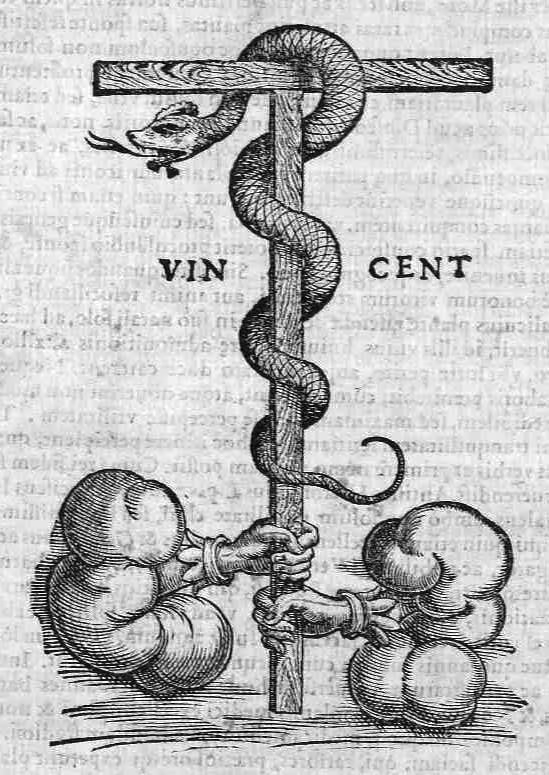
Vincenzo Valgrisi
1500 ca - 1572 ca
Biography
Vincenzo Valgrisi (born Vincent Vaugris or Valgris, c. 1495/1500 – c. 1572–1573) stands as one of the most intellectually ambitious, technically innovative, and commercially triumphant master printers and publishers operating in Venice during the high tide of the Italian Renaissance. Originally hailing from the Kingdom of France—most likely from the region of Châtillon-sur-Seine in Burgundy—Valgrisi transplanted his typographical enterprise to the Venetian Republic during the late 1530s, positioning himself at the absolute epicenter of the European book trade. Operating under the famous typographical mark of the Brazen Serpent (ad signum Serpentis or al segno del Serpente di bronzo), Valgrisi transformed the material culture of the Renaissance book. His press bridged Transalpine humanism and Venetian mercantile print culture, making seminal contributions to scientific botany, classical medicine, vernacular epic literature, and biblical exegesis. By securing exclusive printing privileges, collaborating with elite humanist editors such as Girolamo Ruscelli and Agostino Gadaldini, and investing unprecedented capital into high-quality woodcut illustrations and innovative page layouts, Valgrisi established a publishing empire whose international reach reshaped intellectual discourse across Early Modern Europe.
Early Life, Transalpine Lineage, and Formative Establishment in Venice
Born in France at the turn of the sixteenth century, Vincent Vaugris received a rigorous education in Latin humanism and the fundamentals of the French book trade before making his pivotal migration to Northern Italy. Recognizing that Venice offered unmatched capital networks, paper supplies, maritime trade routes, and intellectual freedom, Vaugris arrived in the Serene Republic around 1538–1539, Italianizing his name to Vincenzo Valgrisi. Unlike many contemporary printers who operated as simple pressmen for hire, Valgrisi possessed both substantial financial capital and a sophisticated editorial vision. He established his printing house and retail shop in the parish of Santa Maria Formosa—specifically recorded on his imprints as in vico Sanctae Mariae Formosae—a strategic location in the commercial heart of Venice. To anchor his brand identity, Valgrisi adopted a visually striking and biblically resonant printer's mark: the Brazen Serpent entwined around a T-shaped cross held by two hands emerging from heavenly clouds, accompanied by the Vulgate motto from the Gospel of John (3:14): "Sicut exaltavit Moyses serpentem in deserto, ita exaltari oportet Filium hominis" ("And as Moses lifted up the serpent in the wilderness, even so must the Son of Man be lifted up"). This emblem not only served as a trademark of supreme typographical quality but also reflected the subtle evangelical and Christian humanist sympathies that circulated among intellectual elites in pre-Tridentine Venice.
Major Works, Scientific Innovations, and Literary Masterpieces
Valgrisi's enduring fame rests in large part upon his transformative collaborations in scientific and literary publishing. In 1544, Valgrisi released the first Italian translation of the Sienese physician Pietro Andrea Mattioli's commentaries on Dioscorides, titled I Discorsi nei sei libri di Pedacio Dioscoride Anazarbeo della materia medicinale. Recognizing the colossal scientific potential of Mattioli's botanical and pharmaceutical research, Valgrisi embarked on an extraordinary long-term publishing venture. In 1554, he issued a landmark Latin edition of Mattioli's work featuring hundreds of meticulous, small-format woodcut illustrations of plants and animals. Building upon this success, Valgrisi published the monumental 1565 folio edition of the Discorsi, illustrated with over 1,200 stunning, large-format woodcuts designed by artists Giorgio Liberale of Udine and Wolfgang Meyerpeck of Prague. These magnificent botanical prints redefined scientific illustration, establishing a new global standard for visual accuracy in natural history. Simultaneously, Valgrisi revolutionized vernacular literary publishing. In 1556, he issued a historic quarto edition of Ludovico Ariosto's Orlando Furioso, edited with elaborate commentary by the polymath Girolamo Ruscelli. Valgrisi introduced a monumental typographical innovation to epic poetry: each of the forty-six cantos was preceded by a full-page woodcut illustration set within an ornate architectural frame, creating a visual narrative that guided the reader through Ariosto's intricate plotlines. This 1556 Valgrisi edition became the definitive visual and textual archetype for subsequent printings of the Orlando Furioso throughout Europe. Furthermore, Valgrisi published monumental editions of classical medical texts, most notably the multi-volume Latin Galeni Opera Omnia (1562–1563), edited by Agostino Gadaldini, which consolidated centuries of Galenic scholarship into a breathtaking typographical monument.
Typographical Mastery, Business Alliances, and European Circulation
The workshop of Vincenzo Valgrisi was renowned for its exquisite aesthetic and technical execution. Valgrisi employed a rich variety of custom-cut typefaces, including crisp Venetian Antiqua Roman fonts, elegant cursive Italics modeled after humanistic scripts, and pristine Greek and Hebrew characters. His press was equipped with multiple heavy rolling presses capable of printing dense black-ink text alongside delicate, high-pressure woodcut blocks. Valgrisi maintained rigorous standards for paper selection, procuring heavy, high-rag-content paper from the famous paper mills of Salò and the Riviera del Garda. To protect his massive financial investments in woodcuts and editorial commissions, Valgrisi actively solicited exclusive printing privileges (privilegi di stampa) from the Venetian Senate, the Holy Roman Emperor, and the King of France. He forged strategic commercial alliances with major publishing houses across Europe, maintaining active accounts at the Frankfurt Book Fair (Frankfurter Buchmesse) and establishing distribution partnerships with allied Venetian printers such as Giordano Ziletti. Valgrisi also established branch operations and familial connections in Lyon and Basel, ensuring that his medical folios and botanical treatises circulated seamlessly through the university circuits of Paris, Montpellier, Wittenberg, and Padua.
Navigating Censorship, Death, and Enduring Bibliographic Legacy
The final decade of Valgrisi's career coincided with the tightening grip of the Counter-Reformation and the promulgation of the Roman Index Librorum Prohibitorum by Pope Paul IV and Pope Pius IV. As a publisher who had previously issued works by humanists with reformist tendencies and vernacular Bibles, Valgrisi demonstrated remarkable pragmatic diplomacy, carefully submitting his texts to Venetian ecclesiastical censors while continuing to release scholarly Latin editions of classical, medical, and legal works. Following his death around 1572 or 1573, the workshop did not collapse; rather, it transitioned seamlessly into the hands of his heirs, operating under the formal imprint Eredi di Vincenzo Valgrisi (Heirs of Vincenzo Valgrisi), while his brother or close relative Felice Valgrisi continued to print under his own name using the signature Brazen Serpent device well into the late 1580s and 1590s. Today, Valgrisi is celebrated by modern bibliophiles, printing historians, and historians of science as a towering titan of sixteenth-century book production. His editions of Mattioli and Ariosto remain supreme masterpieces of Renaissance woodcut iconography and typographical architecture, symbolizing the perfect synthesis of artistic beauty, scientific precision, and commercial genius in the golden age of print culture.
Bibliography
Cicogna, Emmanuele Antonio. Delle Inscrizioni Veneziane. Vol. 4. Venice: Tipografia Orlandelli, 1834, 215-220.
Bongi, Salvatore. Annali di Gabriel Giolito de' Ferrari da Trino di Monferrato stampatore in Venezia. Vol. 1. Rome: Principali Librai, 1890, 85-92.
Pastorello, Ester. Tipografi, editori, librai a Venezia nel secolo XVI. Florence: Leo S. Olschki, 1924, 98-105.
Ascarelli, Fernanda, and Marco Menato. La tipografia del '500 in Italia. Florence: Leo S. Olschki, 1989, 345-349.
Richardson, Brian. Print Culture in Renaissance Italy: The Editor and the Reader, 1450-1600. Cambridge: Cambridge University Press, 1994, 112-128.
Rhodes, Dennis E. Silent Printers: Anonymous Printing at Venice in the Sixteenth Century. London: The British Library, 1995, 67-74.
Nuvoloni, Laura. "Le edizioni illustrate dell'Orlando Furioso nel Cinquecento." La Bibliofilía 98, no. 2 (1996): 145-168.
Stabile, Giorgio. "Mattioli, Pietro Andrea." In Dizionario Biografico degli Italiani, Vol. 72. Rome: Istituto della Enciclopedia Italiana, 2008, 380-387.
Nuovo, Angela. The Book Trade in the Italian Renaissance. Translated by Lydia G. Cochrane. Leiden: Brill, 2013, 201-225.
Delisle, Candice. "The Publication of Pietro Andrea Mattioli's Discourses on Dioscorides." Book History 19, no. 1 (2016): 45-78.
Dondi, Cristina. "Printing in Renaissance Venice: Vincenzo Valgrisi and the Dissemination of Medical and Literary Texts." Gutenberg-Jahrbuch 93 (2018): 189-210.
Beyond the names: biographies and bibliographies on this page are curated by Abu, the AI scholar crafted by Buonvecchio exclusively for Govi Rare Books.