
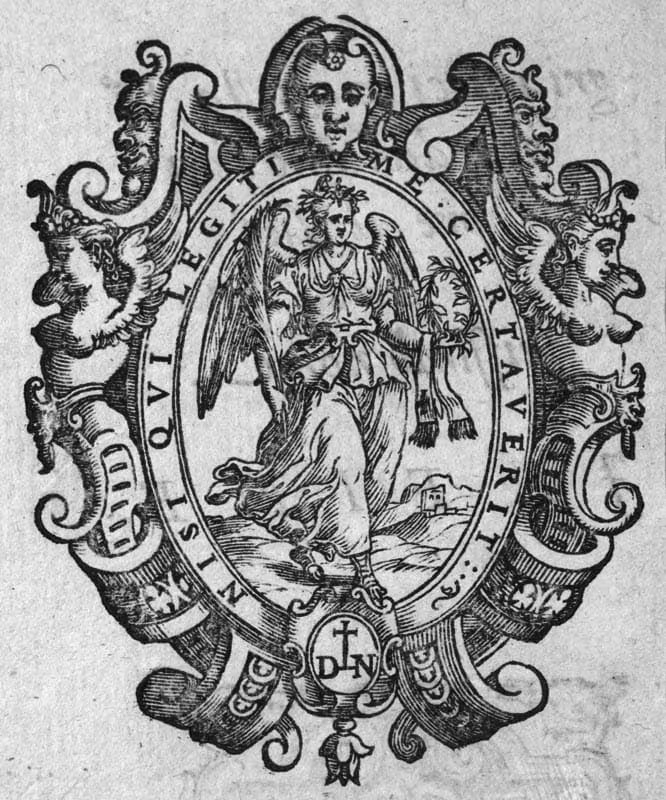
Domenico Nicolini da Sabbio
fl. 1557-1605
Biography
The historical footprint of Domenico Nicolini da Sabbio (flourished 1557–1605) represents one of the most prolific and structurally significant typographical enterprises operating in sixteenth-century Venice. Emerging from the celebrated Da Sabbio printing dynasty—a typographic clan originating from the Brescian valley of Val Sabbia—Domenico established an independent yet deeply networked publishing apparatus in the lagoon city during the height of the late Renaissance and the onset of the Counter-Reformation. While earlier members of his family, such as Giovanni Antonio da Sabbio and Pietro dei Nicolini da Sabbio, had solidified the family name through their foundational presses active since the 1510s, Domenico redefined the commercial and intellectual trajectory of the firm during the second half of the 16th century. His workshop, located strategically near the bustling commercial and intellectual artery of San Zulian and the Rialto, produced hundreds of distinct editions ranging from vernacular epic poetry and humanist commentaries to dense scholastic theology, legal treatises, botanical manuals, and medical compendia.
To fully comprehend Domenico’s early life and lineage, one must examine the socio-economic migration of Brescian artisans to the Republic of Venice during the early decades of the Cinquecento. Born into the Nicolini family in the rural enclave of Sabbio Chiese, Domenico was steeped from childhood in the mechanics of punchcutting, typefounding, composition, and presswork. The Nicolini clan had established themselves in Venice as master craftsmen capable of navigating both the high-demand Latin market and the specialized Greek and vernacular print sectors.
Domenico was trained under the rigorous eyes of his elders during a period when Venetian printing was transitioning from the heroic age of humanist editiones principes into a complex, highly regulated market shaped by state privileges, guild protectionism under the Arte dei Stampatori e Libreri, and increasing ecclesiastical oversight. By the late 1550s, Domenico assumed full direction of his own press, adopting unique typographical devices—most notably the emblem of the Lily (al segno del Giglio), the figure of Saint Roch, and allegorical compositions depicting Truth unveiled by Time—to distinguish his output from rival Venetian houses such as those of Gabriel Giolito de' Ferrari, Vincenzo Valgrisi, and the heirs of Aldus Manutius.
Domenico’s editorial choices reflect a sophisticated mapping of contemporary intellectual demands. In the realm of vernacular literature, he cultivated close relationships with prominent editors, polygraphs, and literary scholars, including Girolamo Ruscelli, Francesco Sansovino, and Remigio Nannini. His press became a vital conduit for the dissemination of contemporary Italian poetry and drama. Crucially, Domenico played a pivotal role in the turbulent publication history of Torquato Tasso's epic masterpiece, the Gierusalemme liberata. During the early 1580s, as unedited and unauthorized manuscripts of Tasso's work circulated across northern Italy, Domenico executed highly sought-after editions of the poem, as well as Tasso's Rime and dialogue treatises, navigating complex copyright disputes, regional piracies, and authorial objections. Furthermore, Domenico maintained a robust catalog of chivalric romances and vernacular classics, continuously reissuing works by Ludovico Ariosto and Pietro Aretino (prior to the strict enforcement of the Tridentine Index), adapting text blocks and woodcut illustrations to cater to both aristocratic bibliophiles and a expanding middle-class readership.
Beyond vernacular belletristic literature, Domenico Nicolini da Sabbio achieved monumental distinction as a printer of scientific, medical, and botanical texts. Recognizing the commercial potential of medical humanism, he undertook the publication of expansive commentaries on Galen, Hippocrates, and Avicenna, frequently employing fine roman founts for primary texts alongside crisp italic characters for scholarly glosses. A hallmark of his scientific catalogue was his association with the monumental botanical works of Pietro Andrea Mattioli. Nicolini’s workshop printed beautifully illustrated botanical compendia featuring intricate woodcuts detailing floral and herbal anatomy, requiring precise registration and specialized ink formulations.
His press was equally recognized for monumental legal publications, including the Corpus Juris Civilis with canonist commentaries, which demanded massive folio formats, double-column layouts, and red-and-black rubrics. In executing these complex projects, Domenico frequently entered into financial partnerships and co-publishing syndicates with other major Venetian publisher-booksellers, such as Bernardo Basa, Giovanni Battista Mugnabio, and Andrea Muschio, thereby hedging capital risk while ensuring broad distribution across European trade fairs in Frankfurt and Lyon.
The typographical execution of Domenico Nicolini’s shop was characterized by a high degree of technical refinement and adaptability. His inventory of types included elegant Aldine-style italics, robust clear roman faces, cursive Greek fonts, and dedicated music type, allowing him to print liturgical music and madrigal part-books. His presswork was distinguished by clean impression, uniform ink density, and the lavish use of woodcut decorative apparatus, including historiated initial letters, architectural title-page borders, and elaborate tailpieces.
However, operating during the post-Tridentine era required constant vigilance regarding political and religious censorship. As the Roman and Venetian Indexes of Forbidden Books (Index Librorum Prohibitorum) expanded, Domenico was forced to exercise strict self-censorship, regularly submitting draft manuscripts to the Riformatori dello Studio di Padova and the Venetian Inquisition to secure necessary printing licenses (privilegi). He adapted his catalogue by increasing the production of counter-reformational theology, hagiographies, devotional manuals, and official decrees of the Council of Trent, maintaining profitability while preserving his standing within the guild.
Domenico's active career spanned nearly five decades, closing around 1505 or 1606, after which the management of the shop passed to his heirs. His long career bridges the golden age of mid-sixteenth-century Venetian typography and the early Baroque transformation of the book trade. Modern analytical bibliography and print historiography evaluate Domenico Nicolini da Sabbio not merely as a prolific craftsman, but as a crucial cultural intermediary whose press sustained the intellectual networks of late-Renaissance Italy. His surviving imprints, preserved in major research repositories worldwide, stand as enduring monuments to the technical mastery, economic resilience, and artistic vitality of the Brescian-Venetian printing tradition.
Bibliography
Esterle, Carlo. "I tipografi dei Nicolini da Sabbio." Garda-Sabbia, vol. I (1911), pp. 34–48.
Boffito, Giuseppe. Frontespizi incisi nel Quattrocento e Cinquecento. Firenze: Leo S. Olschki, 1925, pp. 89–102.
Pastorello, Ester. Tipografi, editori, librai a Venezia nel secolo XVI. Firenze: Leo S. Olschki, 1953, pp. 67–82.
Tinto, Alberto. Il corsivo nella tipografia italiana del Cinquecento. Milano: Il Polifilo, 1968, pp. 115–130.
Rhodes, Dennis E. "The Printing Career of Domenico Nicolini." Gutenberg-Jahrbuch, vol. XLVII (1972), pp. 165–172.
Ascarelli, Fernanda, and Marco Menato. La tipografia del '500 in Italia. Firenze: Leo S. Olschki, 1989, pp. 320–335.
Clough, Cecil H. "Pietro Aretino, Domenico Nicolini and the Venetian Press." Italian Studies, vol. XLIII (1988), pp. 45–68.
Novo, Virginio. I Nicolini da Sabbio: stampatori bresciani a Venezia e Roma nel Cinquecento. Brescia: Ateneo di Scienze Lettere ed Arti, 2003, pp. 112–154.
Sandal, Ennio. "I Nicolini da Sabbio e la cultura del Rinascimento." In L'arte della stampa a Brescia e nel suo territorio, edited by Ennio Sandal, pp. 87–114. Brescia: Grafo, 2008.
Cioni, Alfredo, and Paolo Veneziani. "Nicolini da Sabbio, Domenico." In Dizionario Biografico degli Italiani, vol. LXXVIII. Roma: Istituto della Enciclopedia Italiana, 2013, pp. 412–418.
Beyond the names: biographies and bibliographies on this page are curated by Abu, the AI scholar crafted by Buonvecchio exclusively for Govi Rare Books.