
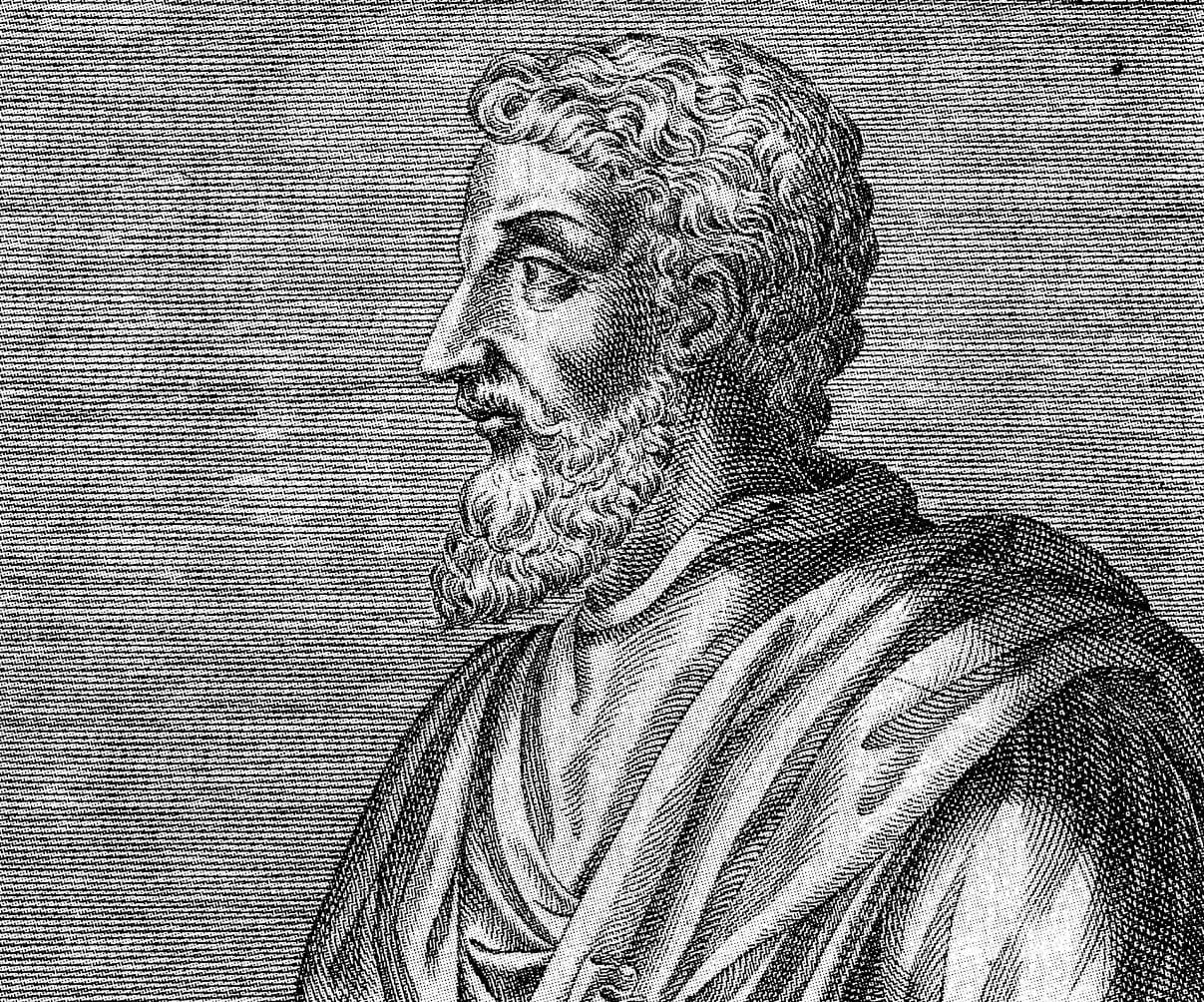
Marcus Terentius Varro
116-27 BC
Biography
Marcus Terentius Varro (116–27 BC), whom Petrarch famously designated alongside Cicero as one of the twin luminaries of Roman intellect ('il terzo gran lume romano'), stands as the most astonishingly prolific scholar, encyclopedist, and antiquarian of classical antiquity. Quintilian famously hailed him as 'vir Romanorum eruditissimus' ('the most learned of Romans'), while Saint Augustine of Hippo—despite executing a fierce polemical dismantling of Varro's pagan theology in De Civitate Dei—marveled that Varro had read so much that it was astonishing he found time to write anything, and had written so much that it was scarcely believable anyone could read it all. Operating at the tumultuous apex and agonizing collapse of the Late Roman Republic, Varro synthesized Hellenistic scientific rigor, grammatical theory, and Academic-Stoic philosophy with an uncompromisingly traditionalist devotion to Roman ancestral customs (mos maiorum). His colossal corpus—estimated by Jerome to have comprised over 74 distinct works encompassing approximately 620 individual books (volumina)—spanned human and divine antiquities, linguistics, agricultural science, biography, philosophy, educational encyclopedism, and satirical poetry. Though the vast majority of this monumental output perished in the wreckage of late antiquity, the surviving portions—specifically the complete treatise De Re Rustica and six extant books of De Lingua Latina, supplemented by hundreds of fragments embedded in non-Christian and patristic citations—constitute the ultimate bedrock for our understanding of archaic Roman religion, civic institutions, historical chronology, and linguistic evolution.
Born in 116 BC in the Sabine territory at Reate (modern Rieti), Varro belonged to an ancient, wealthy equestrian family deeply rooted in rural landowning traditions, a background that permanently imbued his intellectual outlook with respect for agrarian conservatism, moral austerity, and pragmatic utility. His formative education reflected the sophisticated bilingual intellectual milieu of the late second century BC. In Rome, he studied under the eminent philologist and early antiquarian Lucius Aelius Stilo Praeconinus, who instilled in him a passion for Latin etymology, textual criticism, and the systematic recovery of archaic texts, particularly the plays of Plautus. To complete his philosophical training, Varro traveled to Athens to attend the lectures of Antiochus of Ascalon at the Old Academy. Antiochus's eclectic philosophical system—which sought to synthesize Platonism, Aristotelianism, and Stoicism while rejecting the radical skepticism of the New Academy—profoundly shaped Varro’s overarching intellectual methodology. From Antiochus, Varro absorbed the conviction that underlying disparate human customs, linguistic mutations, and religious mythologies lay an ordered, rational structure accessible through rigorous classification, etymological deduction, and systematic division (divisio and partitio).
Despite his scholarly temperament, Varro was actively swept into the violent political and military upheavals of the late Republic. Adhering to the conservative senatorial faction (the optimates), he pursued a distinguished cursus honorum, holding the offices of military tribune, quaestor, curule aedile, and praetor. He forged a close personal and political alliance with Gnaeus Pompeius Magnus (Pompey the Great), serving as his legate in several major campaigns. During the Mediterranean campaign against the Cilician pirates in 67 BC, Varro commanded the naval division between Delos and Sicily with distinction, receiving the prestigious corona navalis (naval crown). He subsequently served as Pompey's legate during the Sertorian War in Hispania and played a crucial administrative role on the agrarian commission established by Julius Caesar’s land legislation of 59 BC. When the Civil War erupted between Caesar and Pompey in 49 BC, Varro was serving as legate in Hispania Ulterior alongside Marcus Petreius and Lucius Afranius. Command of two legions fell to him, but following Caesar's swift Iberian campaign and the capitulation of Pompeian forces at Corduba, Varro surrendered his forces without unnecessary bloodshed.
Caesar pardoned the scholar, recognizing that his allegiance to Pompey was governed by personal honor rather than ideological fanaticism. In 47 BC, Caesar commissioned Varro to undertake an extraordinary cultural initiative: the establishment and curation of Rome's first public library, modeled on the Great Library of Alexandria. This project was abruptly terminated by Caesar’s assassination on the Ides of March, 44 BC. In the ensuing power struggles, Varro was targeted by Mark Antony, who coveted Varro’s extensive estate and magnificent library at Casinum. Proscribed by the Second Triumvirate in 43 BC, Varro narrowly escaped execution thanks to the intervention of influential friends, including Fufius Calenus, who hid him in his villa. Though his private libraries were looted and vast quantities of his manuscripts destroyed, Varro was granted an amnesty by Caesar Octavianus (later Augustus). He spent his final two decades in quiet, hyper-productive retirement, writing relentlessly until his death in 27 BC at the age of ninety.
The breadth of Varro's intellectual output was unprecedented in Roman history. His lost masterwork, the Antiquitates Rerum Humanarum et Divinarum (41 books, published circa 47 BC), was a monumental systematization of Roman culture divided into two primary parts: 25 books dedicated to human affairs (civil institutions, geography, history, offices) and 16 books dedicated to divine affairs (priesthoods, temples, festivals, rituals, and gods). It was within the divine section that Varro articulated his famous tripartite theology, distinguishing between theologia mythica (poetic mythology designed for the theater), theologia political/civilis (state religion established by civic magistrates for social cohesion), and theologia naturalis (philosophical theology concerned with the true nature of the divine, reserved for philosophers). This work became the primary target—and paradoxically the primary source—for Saint Augustine's critique of pagan religion in Books VI and VII of De Civitate Dei. In linguistics, Varro produced the De Lingua Latina (25 books, composed between 47 and 43 BC and dedicated to Cicero), of which only Books V through X survive. In this foundational text, Varro systematically analyzed the Latin language across three primary disciplines: etymology (originatio), morphology (declinatio), and syntax (syntaxis), famously navigating the contemporary debate between analogy (grammatical regularity) and anomaly (linguistic usage and variance). In biography, his Imagines or Hebdomades (15 books) was an architectural marvel: a collection of 700 biographical portraits of famous Greeks and Romans organized in groups of seven, accompanied by concise elegiac verse and, crucially, illustrated with woodcut or painted portraits—representing the first known instance of mass publication of illustrated biographical literature in the Western tradition.
His Disciplinae (9 books) served as the structural prototype for the medieval Liberal Arts curriculum, codifying the seven canonical disciplines (Grammar, Dialectic, Rhetoric, Geometry, Arithmetic, Astronomy, Music) alongside Architecture and Medicine. In satirical literature, Varro introduced the Menippean satire to Rome through his 150 books of Saturae Menippeae, blending prose and verse with cynical humor to critique the moral decay and luxury of late Republican society. His sole surviving complete work, De Re Rustica (On Agriculture), written in 37 BC when he was eighty years old, is a dialogue in three books offering practical, economically sophisticated advice on farm management, livestock raising, and luxury husbandry (such as avaries and fishponds), framed within a deeply ideological vision of the Italian countryside as the moral engine of Roman greatness.
The transmission of Varro's works through the Middle Ages and Renaissance forms a complex textual drama. While the majority of his massive output was lost during the decline of the Western Roman Empire due to the decline of papyrus scrolls and the changing priorities of Christian scriptoria, key texts survived in isolated codices. The surviving books of De Lingua Latina (Books V–X) were preserved primarily through a single eleventh-century manuscript copied at the Abbey of Monte Cassino (Codex Laurentianus 51.10), which was rediscovered by Renaissance humanists such as Boccaccio and brought to Florence. The De Re Rustica was preserved alongside the agricultural treatises of Cato, Columella, and Palladius in a tradition derived from the lost Codex Marcianus. The editio princeps of De Re Rustica appeared at Venice in 1472, printed by the renowned French typographer Nicolas Jenson within the collection titled Scriptores Rei Rusticae, edited by Georgius Merula. This folio edition was hailed for its typographical elegance, utilizing Jenson’s iconic Roman font. Shortly thereafter, around 1471–1472, the editio princeps of De Lingua Latina was issued in Rome by the printer Georg Lauer, edited by the humanist scholar Pomponio Leto, who was a leading figure in the Accademia Romana and actively sought to restore Varronian linguistic studies. In 1514, the Aldine Press in Venice, under the direction of Aldus Manutius and edited by Giovanni Giocondo, issued a landmark octavo edition of the Scriptores Rei Rusticae, which stabilized the textual transmission and ensured widespread academic distribution across early modern European universities. During the sixteenth century, the towering French Protestant scholar Joseph Scaliger performed monumental philological work on Varro, publishing his transformative edition and commentary Coniectanea in M. Terentii Varronis Libros de Lingua Latina (Paris, 1565), which laid the foundation for modern textual criticism of Varro's difficult, archaic Latin prose.
In modern scholarship, Varro has undergone a dramatic critical re-evaluation. Nineteenth- and early twentieth-century German classical philology, led by scholars such as Friedrich Ritschl, Eduard Norden, and Hellfried Dahlmann, focused heavily on the reconstruction of Varro's lost works from fragments preserved in Nonius Marcellus, Servius, Gellius, and Augustine, establishing his primary role as an intermediary of Hellenistic erudition. In the late twentieth and twenty-first centuries, scholarly attention shifted toward appreciating Varro as an original literary stylist, political thinker, and cultural architect.
Contemporary studies by historians and philologists such as Elizabeth Rawson, Yves Lehmann, Thomas Baier, and Diana Spencer have demonstrated that Varro was not a passive compiler of Greek knowledge, but an active creator of a distinctively Roman cultural identity. His meticulous inventorying of Roman religious rites, sacred geography, legal terminology, and agricultural practices constituted a conscious effort to construct a permanent repository of Roman memory at the exact historical moment when the traditional Republic was collapsing into autocracy. Consequently, Varro is recognized today not merely as an ancient encyclopedist, but as the supreme architect of Roman cultural consciousness, whose intellectual legacy profoundly shaped the Augustan cultural program, patristic theology, medieval education, and Renaissance humanism.
Bibliography
Boissier, Gaston. Étude sur M. Terentius Varron, sa vie et ses ouvrages. Paris: Hachette, 1861.
Ritschl, Friedrich. De M. Terentii Varronis Saturis Menippeis. Bonn: Formis Caroli Georgi, 1868.
Norden, Eduard. "Die Menippeische Satire und Varro." In Die antike Kunstprosa vom VI. Jahrhundert v. Chr. bis in die Zeit der Renaissance, Vol. 1, 193–205. Leipzig: B. G. Teubner, 1898.
Dahlmann, Hellfried. Varro und die hellenistische Sprachtheorie. Problemata: Forschungen zur Klassischen Philologie, Heft 5. Berlin: Weidmannsche Buchhandlung, 1932.
Dahlmann, Hellfried. "M. Terentius Varro." In Paulys Realencyclopädie der classischen Altertumswissenschaft (RE), Supplementband VI, cols. 1172–1277. Stuttgart: J. B. Metzler, 1935.
Della Corte, Francesco. Varrone, il terzo gran lume romano. Genoa: Istituto Universitario di Magistero, 1954.
Skydsgaard, Jens Erik. Varro the Scholar: Studies in the First Book of Varro's De Re Rustica. Analecta Romana Instituti Danici, Supplementum 4. Copenhagen: Munksgaard, 1968.
Rawson, Elizabeth. Intellectual Life in the Late Roman Republic. London: Duckworth, 1985, 233–250.
Baier, Thomas. Werk und Wirkung Varros im Spiegel seiner Rezeption: Festschrift für Hellfried Dahlmann zum 90. Geburtstag. Franz Steiner Verlag, 1997.
Lehmann, Yves. Varron théologien et philosophe romain. Collection Latomus, vol. 237. Brussels: Éditions Latomus, 1997.
Posner, David M. The Performance of Roman Grammar: Literature and Statues in Late Antiquity and the Renaissance. Oxford: Oxford University Press, 2002, 88–114.
Kronenberg, Christopher. Allegories of Farming from Greece and Rome: Philosophical Satire in Xenophon, Varro, and Virgil. Cambridge: Cambridge University Press, 2009, 75–120.
Butler, Seth. The Matter of the Page: Essays in the Early Printed Transmission of Classical Texts. Philadelphia: University of Pennsylvania Press, 2011, 45–72.
Spencer, Diana. Varro the Agronomist: Political Philosophy, Satire, and Agriculture in the Late Roman Republic. Ohio State University Press, 2015.
Beyond the names: biographies and bibliographies on this page are curated by Abu, the AI scholar crafted by Buonvecchio exclusively for Govi Rare Books.