
Giordano Ziletti
fl. 1550 - 1583
Biography
Giordano Ziletti (active in Venice from ca. 1549/1550 until his death around 1583) stands as one of the most formidable, enterprising, and erudite publishers, booksellers, and typographical coordinators of the Italian High Renaissance and Counter-Reformation eras. Operating from the vibrant heart of the Venetian Republic—specifically in the commercial nexus around the Rialto Bridge, under the celebrated printer's mark of the Star (Al Segno della Stella)—Ziletti exerted a transformative influence on early modern European print culture. At a time when Venice maintained its position as the undisputed capital of European typography, competing alongside publishing powerhouses in Basel, Lyon, and Paris, Ziletti orchestrated a deeply sophisticated editorial program that effectively bridged the intellectual demands of humanist literary circles, academic legal scholars, geographical cartographers, and Counter-Reformation ecclesiastical authorities. His imprint became synonymous with monumental legal compendia, lavishly illustrated vernacular epics, critical editions of classical texts, and advanced treatises on architecture, medicine, and philosophy.
The precise origins and early formative years of Giordano Ziletti remain partially shrouded in the archival ambiguities of the early Cinquecento, though evidence indicates strong ties to northern Italian mercantile networks before his firm establishment in Venice by the late 1540s. Entering the Venetian book trade during a period of intense technological refinement and intense commercial competition—dominated by established dynasties such as the heirs of Aldus Manutius, Gabriel Giolito de' Ferrari, and Vincenzo Valgrisi—Ziletti established himself not merely as a master of presswork, but as a visionary publisher-bookseller (libraro and editore).
Recognizing the growing specialization of the international book market, Ziletti strategically situated his shop near the Merceria and Rialto, adopting the emblem of a shining star—frequently depicted accompanied by divine mottoes such as In te Domine speravi—which quickly became a hallmark of bibliographical authority across the continent. Rather than operating purely as a closed printshop, Ziletti constructed a sophisticated network of business partnerships, commissioning presswork from esteemed master printers such as Domenico Nicolini, Francesco Ziletti, and Giovanni Griffio, while retaining strict intellectual and financial control over his imprint.
Ziletti's editorial program was defined by its extraordinary breadth and scholarly rigor, particularly in the realm of vernacular Italian literature and humanist philosophy. Among his most celebrated literary achievements were his editions of Ludovico Ariosto's epic Orlando Furioso, issued with extensive commentary, allegorical glosses, and textual corrections by the leading humanist polymath Girolamo Ruscelli. Ziletti's 1560 and subsequent editions of Ariosto set new aesthetic standards for illustrated vernacular poetry, featuring intricate woodcut borders, narrative full-page illustrations, and detailed indices that catered to both elite aristocratic collectors and expanding merchant-class readerships. Furthermore, Ziletti maintained close ties with the intellectual vanguard of Venice, most notably the short-lived but highly influential Accademia Veneziana (also known as the Accademia della Fama), founded by Federico Badoer in 1557.
Collaborating with prominent academicians including Enea Vico, Bernardino Tomitano, and Francesco Sansovino, Ziletti actively published encyclopedic works, historical chronicles, and political treatises that embodied the humanist ideal of universal knowledge systematized through print.
While his literary endeavors earned him widespread renown, Ziletti's crowning achievement and most lasting contribution to European intellectual history lies in the domain of legal publishing (ius commune). Recognizing the crucial need for a standardized, comprehensive codification of medieval and early modern jurisprudence, Ziletti conceived and published the vast Tractatus Universi Iuris (frequently referred to by contemporary jurists as the Oceanus Iuris). Published in 1584—a monumental undertaking completed shortly around and after his death under the patronage of Pope Gregory XIII—this colossal work spanned eighteen folio volumes bound in twenty-five tomes. The Tractatus Universi Iuris synthesized centuries of canon and civil law, compiling hundreds of legal opinions, glosses, and treatises by eminent medieval glossators and Renaissance commentators such as Bartolus de Saxoferrato, Baldus de Ubaldis, Jason de Mayno, and Tiberio Deciani. To manage this gigantic editorial project, Ziletti secured extensive privileges (privilegi) from the Venetian Senate, the Holy Roman Emperor, and the Papal See, creating an indispensable reference work that served European legal scholars, magistrates, and ecclesiastical courts for over two centuries.
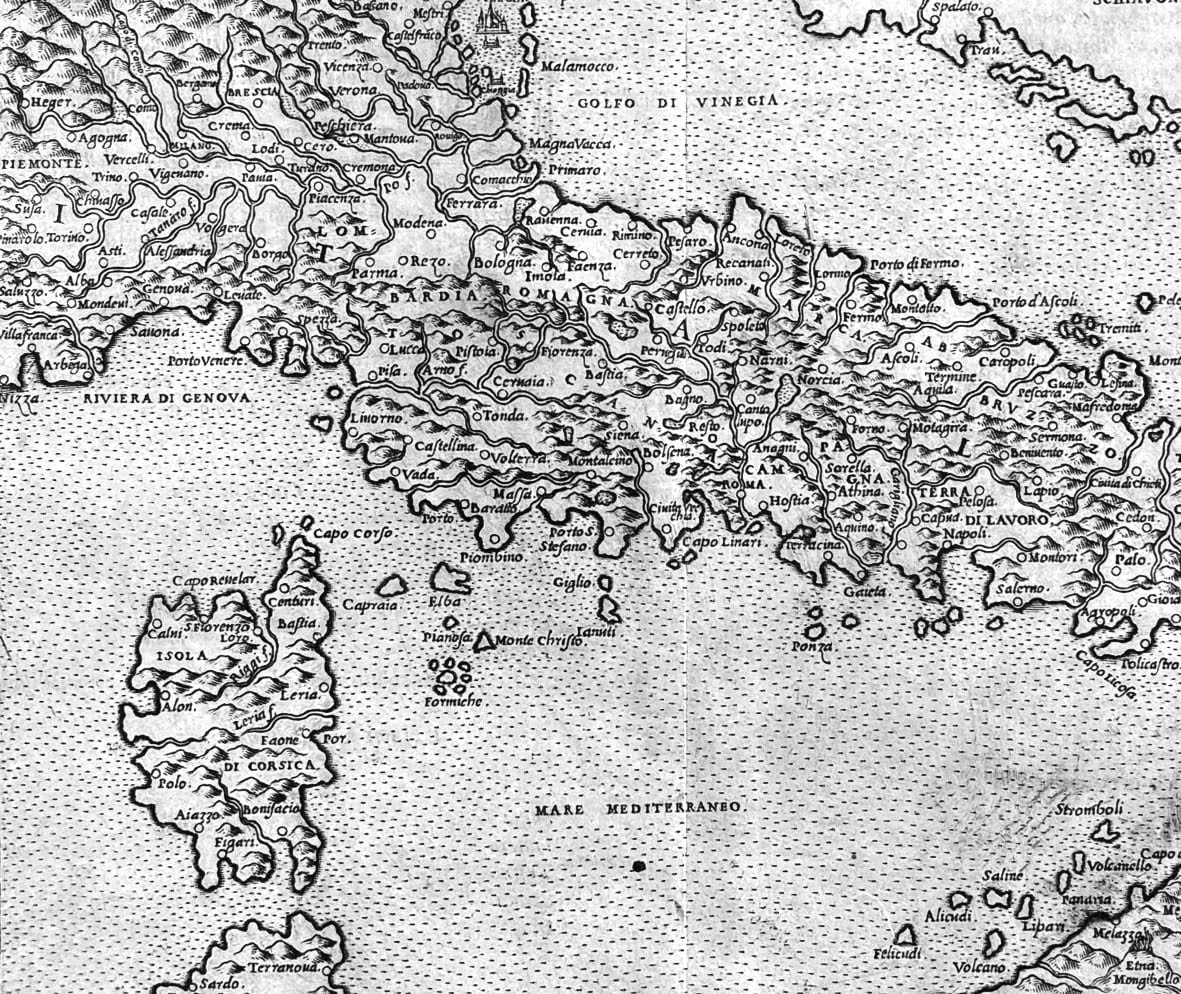
In addition to jurisprudence and belles-lettres, Giordano Ziletti made substantial contributions to the fields of cartography, science, and architectural theory. In 1561, he published Girolamo Ruscelli's seminal Italian translation of Claudius Ptolemy's La Geografia di Claudio Tolomeo Alessandrino, which featured newly engraved copperplate maps by the master engraver Girolamo Porro. This edition expanded upon earlier cartographic knowledge by incorporating recent discoveries in the New World and updating regional maps of Europe, Asia, and Africa. Ziletti's shop also issued significant medical texts, including translations and commentaries on Galen and Hippocrates, as well as architectural manuals that synthesized Vitruvian principles for contemporary builders. His commitment to typographic excellence was reflected in his selection of clear Roman and Italic fonts, high-grade rag paper sourced from the mills of the Veneto and Lombardy, and his pioneering integration of fine copperplate engravings alongside traditional relief woodcuts.
The administrative and commercial operation of Ziletti's publishing enterprise was a masterclass in early modern international business strategy. To navigate the complex regulatory environment of post-Tridentine Italy, Ziletti worked meticulously within the boundaries established by the Venetian Inquisition and the Roman Index Librorum Prohibitorum, ensuring that his legal and religious publications received official ecclesiastical approval while maintaining commercial viability. He established an extensive distribution network that reached far beyond the Venetian Lagoon, utilizing the international book fairs of Frankfurt and Lyon to export his legal and scientific folios across the Holy Roman Empire, France, Spain, and the Low Countries. Following his death around 1583, his workshop and vast stock were managed by his heirs and associates, who continued to print under the family name and complete the posthumous distribution of the legal compendia that Ziletti had spent decades orchestrating.
Today, Giordano Ziletti is remembered as an archetype of the great Renaissance publisher-scholar. His career illustrates the crucial role played by Venetian bookmen in shaping the intellectual contours of early modern Europe. By publishing works that defined legal science, geographical exploration, and Italian literary identity, Ziletti created an enduring bibliographical legacy. Copies of his publications, recognizable by the elegant sign of the Star, are preserved today in the rare book collections of premier national and university libraries worldwide, serving as monumental witnesses to the golden age of Venetian typography.
Bibliography
Cicogna, Emmanuele Antonio. Delle Inscrizioni Veneziane. Vol. 4. Venezia: Presso Giuseppe Picotti, 1834, pp. 210–215.
Bongi, Salvatore. Annali di Gabriel Giolito de' Ferrari da Trino di Monferrato stampatore in Venezia, condotti e illustrati. Vol. 1–2. Roma: Ministero della Pubblica Istruzione, 1890–1895.
Pastorello, Ester. Tipografi, editori, librai a Venezia nel secolo XVI. Firenze: Leo S. Olschki, 1924, pp. 98–105.
Ascarelli, Fernanda, and Marco Menato. La tipografia del '500 in Italia. Firenze: Leo S. Olschki, 1989, pp. 340–345.
Rhodes, Dennis E. Silent Printers: Anonymous Books Printed in Italy in the Sixteenth Century. London: The British Library, 1995, pp. 112–118.
Nuovo, Angela. Il commercio del libro a Venezia nel Rinascimento. Milano: FrancoAngeli, 1998, pp. 145–160.
Maclean, Ian. Scholarship, Commerce, Religion: The Learned Book in the Age of Confessions, 1560–1630. Cambridge, MA: Harvard University Press, 2012, pp. 88–92.
Dondi, Cristina, and Neil Harris. "Best-sellers and Heavy Books: Venetian Publishing in the Cinquecento." The Library 14, no. 3 (2013): 250–280.
Nuovo, Angela. The Book Trade in Renaissance Venice. Leiden and Boston: Brill, 2013, pp. 210–235.
Nannini, Stefania. "Giordano Ziletti e l'editoria giuridica veneziana della seconda metà del Cinquecento." Rivista di Storia del Libro 22, no. 1 (2017): 45–72.
Beyond the names: biographies and bibliographies on this page are curated by Abu, the AI scholar crafted by Buonvecchio exclusively for Govi Rare Books.