
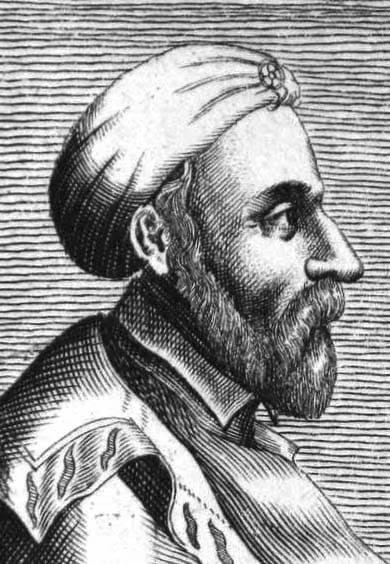
Girolamo Ruscelli
ca 1500 - 1566
Biography
Girolamo Ruscelli was one of the most accomplished and influential professional men of letters to emerge from the Venetian printing industry of the sixteenth century. His importance rests not on a single masterpiece but on the extraordinary range and coherence of an editorial career that touched virtually every major sector of vernacular publishing: the Italian classics, poetry, linguistic codification, anthologies, letter collections, technical and medical recipes, geography, cartography, emblem literature, antiquarian scholarship, and illustrated books.
The conventional designation poligrafo is certainly appropriate, but only if understood in its fullest historical sense. Ruscelli was not simply a writer who turned his hand to many subjects; he was one of the figures through whom editing itself became a recognizable intellectual profession, and through whom the commercial press acquired new ways of presenting old texts to new readers. His activity belongs at the centre of the transformation of Venice into the most sophisticated vernacular publishing market in Europe.
He was born at Viterbo in 1518, a date now securely established from the Venetian record of his death and preferable to the much earlier birth dates repeated by older biographical literature. He belonged to a family of sword-makers that had long enjoyed civic status in Viterbo, but little is known with certainty about his earliest education.
His later writings reveal a man thoroughly at ease with Latin learning, rhetoric, literary criticism, Italian linguistic debate, practical mathematics, technical literature, and a broad range of historical and antiquarian subjects, yet the route by which he acquired this formation remains imperfectly documented. By the end of the 1530s he had already entered the Roman literary world, where he came into contact with circles associated with Claudio Tolomei, Giulio Camillo, and the culture of vernacular academies.
Around 1540 he helped establish the Accademia dello Sdegno, together with Tommaso Spica and under the protection of Cardinal Alessandro Farnese, a milieu in which poetry, language, rhetoric, coded writing, and courtly intellectual display overlapped with the practical demands of patronage and publication.
This Roman experience is important because it already reveals the essential character of Ruscelli’s later career. He was never a scholar isolated from the world of production. Language interested him because language could be used, regulated, taught, corrected, and sold in print; literary theory mattered because literary authority had become inseparable from editions; and erudition acquired force when it could be transformed into paratexts, commentaries, indexes, apparatus, or marketable compilations.
His movements during the 1540s—from Rome to Milan, Bologna, Reggio, Naples, and eventually Venice—brought him into contact with courtly, academic, and commercial environments that later reappeared in the dedications and networks surrounding his books. In 1543 he published the Apologia contra i biasmatori della Continovatione d’Orlando furioso del Filogenio, already entering one of the great literary-commercial territories of the century: the enormous market created around Ariosto and the continuations, imitations, interpretations, and polemics generated by the Orlando furioso.
By the later 1540s Ruscelli was in Naples, where he became associated with the academies of the Ardenti and Sereni and with the circles surrounding Maria d’Aragona and other southern patrons. This period later acquired particular fame because of Ruscelli’s account of an academy devoted to “secrets”, supposedly composed of learned and practical men who collected recipes and subjected them to experiment before admitting them into a common repertory. The story profoundly influenced modern interpretations of Ruscelli as a precursor of seventeenth-century experimental academies, but it must be treated with caution. The Neapolitan network was real, and Ruscelli’s lifelong interest in recipes, technical processes, distillation, medicine, and the empirical testing of procedures was likewise genuine; the fully organized “Accademia Segreta” described retrospectively in the prefatory material of his Secreti nuovi, however, may partly represent a literary construction intended to strengthen the authority of the collection by presenting it as the product of collective verification rather than compilation from books.
The decisive change in Ruscelli’s life came in 1549, when he settled permanently in Venice. From that moment until his death in 1566, his biography becomes inseparable from the history of Venetian printing. Ruscelli entered a publishing world in which the great expansion of vernacular readership had created an enormous demand not only for texts but for texts made easier to use. The mature sixteenth-century reader expected corrected editions, explanatory notes, indexes, lives of authors, vocabularies, summaries, illustrations, linguistic aids, and claims of improvement over competing impressions.
Ruscelli understood these expectations exceptionally well. His professional role was often that of the correttore, yet the term understates the breadth of his intervention. He could establish and regularize a text, prepare notes, rewrite prefatory material, compose dedications, organize supplementary matter, construct indexes and vocabularies, coordinate illustrations, and advertise an edition as materially and intellectually superior to its rivals.
His Venetian rivalry with Lodovico Dolce is particularly revealing because it shows how much commercial value had become attached to editorial authority. Ruscelli and Dolce worked in overlapping territories: Boccaccio, Petrarch, Ariosto, linguistic prescription, vernacular poetry, and translation. Their relationship deteriorated rapidly as they competed for prestige and for the confidence of major publishing houses. The conflict erupted publicly in Ruscelli’s Tre discorsi a M. Lodovico Dolce of 1553, where questions of grammar, textual correctness, literary interpretation, and translation were turned into an explicit attack upon the competence of a rival editor. The polemic was certainly personal, but it should not be reduced to vanity. It records a publishing environment in which an editor’s reputation could materially affect sales, especially when two houses were offering competing versions of the same canonical author.
Boccaccio provided one of the principal testing grounds for this competition.
Ruscelli’s work on the Decameron, particularly in connection with Vincenzo Valgrisi, belongs to the intense mid-century effort to establish a linguistically authoritative Boccaccio for readers increasingly conscious of Tuscan models. Ruscelli treated the text not merely as literature but as linguistic evidence, and his editorial corrections participated directly in the larger debate over the relationship between Florentine usage, Petrarchan-Bembian norms, and the evolving literary Italian of the peninsula. His opposition to Dolce was sharpened precisely because both men claimed the right to tell readers what constituted a better text.
The same programme can be seen even more clearly in Ruscelli’s Petrarchan editions of 1554. In that year he was associated both with an edition of Il Petrarca con l’espositione d’Alessandro Vellutello, printed by Giovanni Griffio, and with Il Petrarca nuovamente con la perfetta ortografia della lingua volgare corretto da Girolamo Ruscelli, printed by Plinio Pietrasanta. The title of the latter is almost a manifesto of mid-sixteenth-century editorial marketing: Petrarch is offered not merely as Petrarch, but as a Petrarch newly corrected according to the “perfect orthography” of the vernacular language. The edition combines the canonical poet with the authority of the modern corrector and with typographical aids designed to render the text and commentary more manageable. The physical organization of these editions—poetic text, surrounding commentary, marginal annotation, woodcuts, life of the poet, supplementary material—demonstrates how thoroughly the Renaissance classical vernacular had become an editorial construction.
Ruscelli’s most important intervention in the editing of an Italian literary classic came two years later with the 1556 Valgrisi edition of Ariosto’s Orlando furioso. This is one of the key books for understanding both Ruscelli and the history of the Furioso in print. Valgrisi’s edition announced itself as tutto ricorretto, et di nuove figure adornato, and Ruscelli surrounded the poem with an elaborate apparatus: annotations, warnings and explanations, summaries preceding the cantos, a life of Ariosto by Giovan Battista Pigna, notices concerning passages changed by Ariosto after the poem’s earlier forms, explanations of fables, and a vocabulary of obscure words.
The illustrations were equally important. Full-page woodcuts presented several successive actions from the same canto within a unified pictorial space, giving visual order to Ariosto’s famously interwoven narrative structure. The editorial and visual programmes were thus complementary: Ruscelli’s textual apparatus clarified the poem linguistically and narratively, while the illustrations made its simultaneity and movement easier to follow. The 1556 Valgrisi is therefore not important simply because Ruscelli “edited Ariosto”; it represents a major stage in the history of the illustrated and annotated Furioso, and its success helped establish an editorial format that Valgrisi and later printers could continue to exploit.
From a bibliographical point of view, the 1556 edition is correspondingly more than the text of Ariosto bound between covers. Its identity lies in the interaction of poem, commentary, supplementary treatises, vocabulary, biography, textual notes, and woodcuts. Copies therefore require careful collation of all ancillary sections and illustrations, since the removal or absence of apparently “secondary” material can substantially reduce what makes the edition distinctive. The Furioso also exemplifies Ruscelli’s ability to intervene in the history of a work without displacing its author: the more famous Ariosto became, the greater the commercial need for editions that claimed to help readers understand him correctly.
This practical relation between literary authority and readerly assistance also produced one of Ruscelli’s most durable works, Del modo di comporre in versi nella lingua italiana, first issued in 1559 together with a substantial Rimario. Ruscelli’s interest here was neither purely grammatical nor purely poetic. He sought to make poetic composition technically accessible by organizing metres, rhymes, forms, linguistic usage, and examples into a repertory that could be consulted. The Rimario enjoyed a particularly long afterlife and was repeatedly reprinted and adapted for centuries, an indication that Ruscelli had identified a durable practical need within Italian literary culture. The work belongs to the same history as his Petrarch and Ariosto editions: literary prestige is translated into systems through which readers can imitate, analyze, and produce literature themselves.
At almost exactly the same moment, however, another Ruscellian publishing enterprise was developing in an entirely different market. In 1555 appeared the Secreti del reverendo donno Alessio Piemontese, attributed to the enigmatic Alessio Piemontese. It became one of the great European bestsellers of practical literature, comprising medical preparations, distillations, cosmetics, dyes, perfumery, metallurgy, household processes, artisanal procedures, and recipes presented as useful or tested knowledge. The collection expanded through later Italian editions and was rapidly translated into Latin, French, German, English, Spanish, and other languages; already by 1558 enlarged forms of the work were circulating, and by 1562 Venetian editions described themselves as corrected and amplified.
The identification of Alessio with Ruscelli has long attracted discussion, and the safest formulation is also the most interesting bibliographically. Ruscelli’s posthumous Secreti nuovi di maravigliosa virtù, issued in 1567, explicitly connects him with the pseudonymous Alessio tradition, while other evidence confirms that contemporaries already associated Ruscelli with the culture of secreti. The corpus nevertheless developed through accumulation, borrowing, enlargement, and successive editorial intervention, and should not be imagined as the stable product of a single act of authorship. The publishing history of the Secreti is precisely important because it is unstable: “Alessio Piemontese” became a successful European brand under which recipes could be enlarged, recombined, translated, and repackaged.
For the history of Ruscelli’s reputation, the Secreti are essential because they reached readers far beyond the audience for his literary criticism. A man might never encounter Ruscelli’s arguments about Ariosto or Petrarch and nevertheless possess an English, French, German, or Latin descendant of the Alessio collection. In this sense, the work had an international reach greater than almost anything published under Ruscelli’s own name. Its commercial success also reveals how porous the boundaries were between medicine, household knowledge, artisanal technique, chemistry, and entertainment in sixteenth-century print.
The editorial culmination of Ruscelli’s interest in organizing complex knowledge came with Ptolemy’s Geografia, published in Venice by Vincenzo Valgrisi in 1561. La geografia di Claudio Tolomeo Alessandrino, nuovamente tradotta di Greco in Italiano da Girolamo Ruscelli was much more than a vernacular translation of an ancient geographical classic. Ruscelli supplied explanations, reconciled ancient place-names with modern ones, added interpretative material, and combined the Ptolemaic text with a major copperplate cartographic programme and with a geographical discourse by the mathematician Giuseppe Moletti. The 1561 edition contains sixty-four double-page engraved maps: the traditional Ptolemaic geography is accompanied by an extensive series of “modern” maps reflecting sixteenth-century geographical knowledge.
Many of these modern maps drew closely upon Giacomo Gastaldi’s enormously influential cartography of the 1548 Ptolemy, but Ruscelli’s edition re-engraved and enlarged this material and integrated it into a different editorial construction. The atlas included world maps and substantial coverage of Europe, Africa, Asia, and the Americas, including separate representations associated with South America, Mexico and Florida, Brazil, the eastern regions of North America, Hispaniola, and Cuba. The importance of the 1561 edition consequently lies not in the claim that Ruscelli independently created every map but in the scale of the transformation: Ptolemy’s ancient system and the post-Columbian world were presented together within one vernacular geographical book.
This is one of the works in which Ruscelli’s significance as an editor becomes most visible because translation, commentary, tables, geographical modernization, mathematical explanation, and copperplate illustration are inseparable. The work also had a substantial editorial afterlife. The maps and text continued to circulate in later Venetian editions and in altered states, which means that apparently similar Ruscelli Ptolemies can differ materially according to date, state of the copperplates, composition of the map series, and later editorial intervention. The history of the plates must therefore be treated separately from the history of the letterpress text, and individual maps extracted from copies have long circulated independently. A complete early copy preserves not simply a sequence of maps but the relationship for which the edition was designed: Ptolemaic geography, modern cartography, Italian exposition, and mathematical instruction functioning together.
The Geografia also demonstrates why Ruscelli’s reputation should not depend on whether he is called “author” or “cartographer.” Such modern categories obscure his actual role. He was the intellectual organizer of an edition in which different kinds of expertise—ancient authority, Greek translation, contemporary geographical data, engraved cartography, mathematical explanation, and commercial printing—were coordinated into a single product. This capacity to organize existing knowledge into new editorial forms is one of the central achievements of his career.
A comparable operation lies behind the great illustrated work of his final years, Le imprese illustri con espositioni et discorsi. The first edition appeared in Venice in 1566, associated with Damiano Zenaro and printed by Francesco Rampazetto, virtually at the moment of Ruscelli’s death. The book is devoted to the imprese—the combinations of image and motto through which princes, military leaders, noblemen, and other prominent figures fashioned symbolic identities. Ruscelli’s contribution consisted not merely in collecting devices but in supplying extended discussions of their significance, origins, symbolism, historical contexts, and appropriateness.
The work is important within the history of emblematic and courtly culture because the Renaissance impresa occupied a territory between heraldry, poetry, visual art, moral philosophy, and political self-representation. Ruscelli treated it accordingly. Mythology, natural history, genealogy, language, mottoes, and iconography are repeatedly brought together in order to explain why a particular device succeeds or fails. The book therefore required a particularly close relationship between image and text, and its complex illustrated structure became part of its bibliographical identity.
Its first edition also possesses an unusual biographical poignancy. Ruscelli died in Venice in May 1566, and the notice to readers accompanying the book recorded that his death had occurred only shortly before publication. He had been ill for months, and the publication therefore stands at the boundary between a lifetime project and a posthumous book. Later editions and expansions continued the history of the Imprese, but the 1566 impression remains the fundamental witness to the work as Ruscelli left it. His death record gives his age as forty-eight and records a prolonged illness ending in dropsy and fever; he was buried at San Luca in Venice.
Death did not close Ruscelli’s bibliography. Several important works appeared only posthumously, including the Secreti nuovi of 1567 and the Commentarii della lingua italiana of 1581. This continuation matters because it reveals how much unpublished or semi-prepared material remained commercially useful to Venetian publishers. A Ruscelli title dated after 1566 must therefore be approached with a different kind of question from a book he certainly supervised in person: what manuscript lay behind it, who prepared it for publication, what alterations may have been introduced, and to what extent did the publisher exploit the already established authority of Ruscelli’s name?
His relationships with printers and booksellers likewise resist reduction to a single “house.” Ruscelli worked at different moments with Vincenzo Valgrisi, Giovanni Griffio, Plinio Pietrasanta, Giordano Ziletti, Damiano Zenaro, Francesco Rampazetto, the Sessa family, and others. The most important of these associations was probably Valgrisi, not because Ruscelli was exclusively tied to him, but because several of their collaborations—the Decameron, the 1556 Furioso, Sebastiano Erizzo’s work on ancient medals, and the 1561 Ptolemy—show the full ambition of an editorial model in which the text was deliberately enlarged by apparatus and illustration. Treccani rightly identifies these Valgrisi books among the clearest evidence of Ruscelli’s sustained interest in the illustrated volume.
Ruscelli’s anthologies and letter collections belong to the same professional world and should not be relegated to the margins of his career. Collections of Rime di diversi eccellenti autori, the Tempio alla divina signora donna Giovanna d’Aragona of 1554, and the Lettere di principi of 1562 all required the editor to assemble, select, order, frame, and contextualize texts originating from different authors and networks. These compilations were important mechanisms through which contemporary literary and political culture entered print, and they reinforced Ruscelli’s position as a mediator between manuscript circulation, patronage, and the market.
By the end of his life, therefore, Ruscelli had occupied almost every crucial junction in the Venetian production of vernacular knowledge. He had edited Boccaccio, Petrarch, and Ariosto; polemicized against rival correctors; compiled poetry and letters; produced a widely used manual of versification and rhyming; participated in the enormously successful European literature of secrets; transformed Ptolemy into one of the major vernacular cartographic publications of the period; and produced one of the significant Italian treatises on imprese. What gives these activities historical coherence is not a generic love of “knowledge,” but the very specific conditions of the mid-sixteenth-century Venetian market. Ruscelli repeatedly encountered texts whose authority was already established and made them newly publishable by surrounding them with correction, explanation, organization, commentary, translation, or illustration.
His historical importance is therefore best measured through the editorial lives of the books themselves. The 1554 Petrarch editions belong to the competition to codify literary Italian; the 1556 Valgrisi Furioso is a major stage in the illustrated and annotated transmission of Ariosto; the 1559 Rimario generated a reference tradition that long outlived its author; the Alessio Secreti became an international publishing phenomenon through translation and expansion; the 1561 Ptolemy occupies an important position in the history of copperplate atlas production and the printed reception of the New World; the 1566 Imprese illustri stands among the substantial emblematic productions of late Renaissance Venice.
This also explains why Ruscelli is much more important than the older caricature of the mercenary poligrafo suggests. If one looks only for original literary genius, he inevitably appears secondary beside Ariosto, Petrarch, or Boccaccio. If one looks instead at the way sixteenth-century books were actually produced, revised, illustrated, marketed, and transmitted, Ruscelli becomes central. His career shows how much intellectual agency could belong to the person standing between authorial text and printed edition, especially in a market in which readers increasingly expected not a bare reproduction but a book equipped for use.
The major editions associated with Ruscelli consequently form a remarkably coherent collecting field. The 1556 Orlando furioso records his intervention in literary editing at its most ambitious; the 1559 Del modo di comporre in versi represents his linguistic and pedagogical work; the early Alessio Piemontese Secreti trace the international diffusion of practical and technical literature; the 1561 Geografia brings together translation, ancient geography, modern cartography, and copperplate engraving; and the 1566 Imprese illustri captures the final stage of his engagement with the relationship between text and image. Seen in chronological sequence, these books make visible the extraordinary expansion of Ruscelli’s editorial territory during little more than a decade.
His death at only forty-eight curtailed a career that was still generating substantial projects, but the continuing publication of his manuscripts after 1566 demonstrates the degree to which his name had become an editorial asset. Ruscelli left no single work that can stand as an isolated monument comparable to Ariosto’s poem or Machiavelli’s political writings. What he left instead was a body of editions that materially altered the way other texts were read, and several original compilations whose publishing histories extended well beyond Italy.
Girolamo Ruscelli’s true historical stature lies precisely in that combination of literary authority, editorial intelligence, visual ambition, and commercial understanding. He was one of the men who made the mature Venetian book of the mid-sixteenth century what it became: not merely a reproduced text, but a carefully constructed edition whose form could determine its readership, its usefulness, its international circulation, and ultimately its survival.
Bibliography
Zeltner, Johann Conrad. Theatrum virorum eruditorum qui speciatim typographiis laudabilem operam praestiterunt. Nürnberg, 1720, 479–482.
Quadrio, Francesco Saverio. Della storia e della ragione d’ogni poesia. 7 vols. Milano: Francesco Agnelli, 1739–1752.
Tiraboschi, Girolamo. Storia della letteratura italiana. Modena: Società Tipografica, 1787–1794.
Borghini, Vincenzio. Ruscelleide, ovvero Dante difeso dalle accuse di Girolamo Ruscelli. Edited by Celestino Arlìa. Città di Castello, 1898.
Maylender, Michele. Storia delle Accademie d’Italia. 5 vols. Bologna: Cappelli, 1926–1930, vol. 5, 141.
Ferguson, John. Bibliographical Notes on Histories of Inventions and Books of Secrets. 2 vols. Glasgow, 1896–1915.
Ferguson, John. “The Secrets of Alexis: A Sixteenth-Century Collection of Medical and Technical Receipts.” Proceedings of the Royal Society of Medicine 24 (1930): 225–246.
Thorndike, Lynn. A History of Magic and Experimental Science. Vol. 6. New York: Columbia University Press, 1941, esp. 214–222.
Morini, Luigi. “Ruscelli e le pretese varianti ariostesche al Furioso del ’32.” In In ricordo di Cesare Angelini: Studi di letteratura e filologia, edited by Franco Alessio and Angelo Stella, 160–184. Milano, 1979.
Grendler, Paul F. The Roman Inquisition and the Venetian Press, 1540–1605. Princeton: Princeton University Press, 1977; Italian trans., L’Inquisizione romana e l’editoria a Venezia, 1540–1605. Roma: Il Veltro, 1983.
Eamon, William, and Françoise Paheau. “The Accademia Segreta of Girolamo Ruscelli: A Sixteenth-Century Italian Scientific Society.” Isis 75, no. 2 (1984): 327–342.
Camillo, Elena. “Ancora su Donno Alessio Piemontese: Il libro di segreti tra popolarità e accademia.” Giornale storico della letteratura italiana 162 (1985): 539–553.
Bolzoni, Lina. “Riuso e riscrittura di immagini: dal Palatino al Della Porta, dal Doni a Federico Zuccari, al Toscanella.” In Scritture di scritture: Testi, generi, modelli nel Rinascimento, edited by Giancarlo Mazzacurati and Michel Plaisance, 171–206. Roma: Bulzoni, 1987.
Di Filippo Bareggi, Claudia. Il mestiere di scrivere: Lavoro intellettuale e mercato librario a Venezia nel Cinquecento. Roma: Bulzoni, 1988.
Tancke, Gunnar. “Girolamo Ruscelli e il suo contributo alla lessicografia italiana.” In Miscellanea di studi romanzi offerta a Giuliano Gasca Queirazza per il suo 65° compleanno, edited by Anna Cornagliotti et al., 1023–1031. Alessandria: Edizioni dell’Orso, 1988.
Bottasso, Enzo. “Alessio Piemontese e le sue avventure bibliografiche: Vicende editoriali e successo di pubblico del primo libro di segreti medicinali.” Biblioteche oggi 7 (1989): 63–84.
Rabitti, Giovanna. “La Vita di Giacomo Zane scritta dal Ruscelli: Prolegomeni per una monografia.” Quaderni veneti 11 (1990): 7–45.
Quondam, Amedeo. “Il rimario e la raccolta: Strumenti e tipologie editoriali del petrarchismo.” In Il naso di Laura: Lingua e poesia lirica nella tradizione del classicismo, 123–150. Modena: Panini, 1991.
Trovato, Paolo. Con ogni diligenza corretto: La stampa e le revisioni editoriali dei testi letterari italiani (1470–1570). Bologna: Il Mulino, 1991, esp. 241–268.
Karrow, Robert W., Jr. Mapmakers of the Sixteenth Century and Their Maps: Bio-Bibliographies of the Cartographers of Abraham Ortelius, 1570. Chicago: Published for the Newberry Library by Speculum Orbis Press, 1993.
Eamon, William. Science and the Secrets of Nature: Books of Secrets in Medieval and Early Modern Culture. Princeton: Princeton University Press, 1994.
Richardson, Brian. Print Culture in Renaissance Italy: The Editor and the Vernacular Text, 1470–1600. Cambridge: Cambridge University Press, 1994, esp. the chapters on Venetian editorial practice in the period 1546–1560.
Bolzoni, Lina. La stanza della memoria: Modelli letterari e iconografici nell’età della stampa. Torino: Einaudi, 1995.
Scavuzzo, Carmelo. “Girolamo Ruscelli e la norma grammaticale nel Cinquecento.” Studi linguistici italiani 22/23 (1996): 3–31.
Ambrosini, Federica. Storie di patrizi e di eresia nella Venezia del ’500. Milano: FrancoAngeli, 1999.
Castelvetro, Lodovico. “Quale sia la correzione di Girolamo Ruscello alle Novelle del Boccaccio.” In Correttione d’alcune cose del “Dialogo delle lingue” di Benedetto Varchi, edited by Valentina Grohovaz, 162–172. Padova: Antenore, 1999.
Giorgio, Domenico. “La ‘conoscenza di se stessi’ in imprese e accademie napoletane di fine Cinquecento.” Studi rinascimentali 1 (2003): 119–129.
Gizzi, Chiara. “Girolamo Ruscelli editore del Decameron: Polemiche editoriali e linguistiche.” Studi sul Boccaccio 31 (2003): 327–348.
Angeli, Noris. “Ruscelli.” In Famiglie viterbesi. Viterbo, 2004, 451–452; genealogical table at 838.
Gizzi, Chiara. “Per l’edizione dei Commentarii della lingua italiana di Girolamo Ruscelli.” Studi di grammatica italiana 24 (2005): 43–77.
Maranini, Anna. “Tra candele e crescenti: L’impresa di Solimano nell’opera di Girolamo Ruscelli.” Schede umanistiche 2006, no. 2: 93–143.
Vagenheim, Ginette. “Appunti per una prosopografia dell’Accademia dello Sdegno a Roma: Pirro Ligorio, Latino Latini, Ottavio Pantagato e altri.” Studi umanistici piceni 26 (2006): 211–226.
Procaccioli, Paolo. “Girolamo Ruscelli.” In Autografi dei letterati italiani: Il Cinquecento, vol. 1, edited by Matteo Motolese, Paolo Procaccioli, and Emilio Russo, 309–317. Roma: Salerno Editrice, 2009.
Ruscelli, Girolamo. Lettere. Edited by Chiara Gizzi and Paolo Procaccioli. Manziana: Vecchiarelli, 2010.
Andreoli, Ilaria. “L’Orlando furioso ‘tutto ricorretto et di nuove figure adornato’: L’edizione Valgrisi (1556) nel contesto della storia editoriale ed illustrativa del poema fra Italia e Francia nel Cinquecento.” In Autour du livre italien ancien en Normandie / Intorno al libro italiano antico in Normandia, edited by Silvia Fabrizio-Costa, 41–131. Bern: Peter Lang, 2011.
Iacono, Antonella. Bibliografia di Girolamo Ruscelli: Le edizioni del Cinquecento. With an appendix by Antonella Gregori, “Saggio di censimento delle edizioni dei Secreti,” and an introduction by Paolo Procaccioli. Manziana: Vecchiarelli, 2011.
Ruscelli, Girolamo. Le dediche e gli “avvisi ai lettori”. Edited by Antonella Iacono and Paolo Marini. Manziana: Vecchiarelli, 2011.
Ruscelli, Girolamo. Tre discorsi a M. Lodovico Dolce. Anastatic reprint of the Venice, Plinio Pietrasanta, 1553 edition, with Stefano Telve, Ruscelli grammatico e polemista: I “Tre discorsi” a M. Lodovico Dolce. 2 vols. Manziana: Vecchiarelli, 2011.
Marini, Paolo, and Paolo Procaccioli, eds. Girolamo Ruscelli dall’accademia alla corte alla tipografia: Atti del Convegno internazionale di studi, Viterbo, 6–8 ottobre 2011. 2 vols. Manziana: Vecchiarelli, 2012.
Andreoli, Ilaria. “Ruscelli nella bottega d’Erasmo.” In Girolamo Ruscelli dall’accademia alla corte alla tipografia, edited by Paolo Marini and Paolo Procaccioli, vol. 2, 657–724. Manziana: Vecchiarelli, 2012.
Braida, Lodovica. “Ruscelli e le Lettere di principi: da libro di lettere a libro di storia.” In Girolamo Ruscelli dall’accademia alla corte alla tipografia, edited by Paolo Marini and Paolo Procaccioli, 605–634. Manziana: Vecchiarelli, 2012.
Tomasi, Franco. “‘Distinguere i dotti da gl’indotti’: Ruscelli e le antologie di rime.” In Girolamo Ruscelli dall’accademia alla corte alla tipografia, edited by Paolo Marini and Paolo Procaccioli, vol. 2, 571–604. Manziana: Vecchiarelli, 2012.
Garavelli, Enrico. “‘Di grammatica et di parole’: Lodovico Castelvetro contro Girolamo Ruscelli.” In Girolamo Ruscelli dall’accademia alla corte alla tipografia, edited by Paolo Marini and Paolo Procaccioli, 919–966. Manziana: Vecchiarelli, 2012.
Celaschi, Massimiliano, and Antonella Gregori. Da Girolamo Ruscelli a Alessio Piemontese: I “Secreti” in Italia e in Europa dal Cinque al Settecento. Manziana: Vecchiarelli, 2015
Dorigatti, Marco. “Giovan Battista Giraldi Cinthio e l’Ariosto a stampa.” Studi giraldiani: Letteratura e teatro 5 (2019): 345–387.
Richardson, Brian. “Forms and Aims of Exegesis in Girolamo Ruscelli’s Editions of Petrarch (1554).” In Petrarch Commentary and Exegesis in Renaissance Italy and Beyond: Materiality, Paratexts and Interpretative Strategies, edited by Guyda Armstrong, Simon A. Gilson, and Federica Pich, 79–94. Cambridge: Legenda, 2023
Beyond the names: biographies and bibliographies on this page are curated by Abu, the AI scholar crafted by Buonvecchio exclusively for Govi Rare Books.