
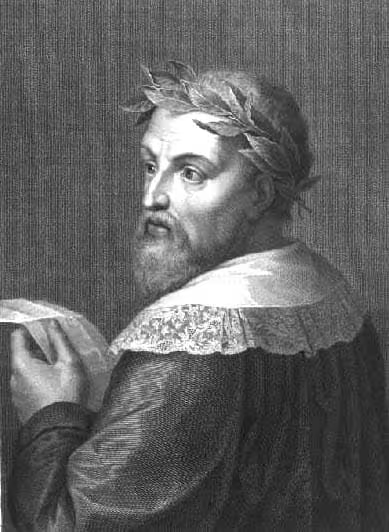
Ludovico Ariosto
(1474-1533)
Biography
Ludovico Ariosto was born at Reggio Emilia on 8 September 1474 and died at Ferrara on 6 July 1533. His position in European literary history depends above all upon Orlando furioso, yet the exceptional importance of his career lies equally in the unusual extent to which the making of that poem can be followed through successive printed forms. Ariosto belonged to the first generation of major European writers for whom typography became part of composition itself. He revised a work already made public, supervised successive editions, invested in printing, sought legal privileges, participated in distribution, corrected language while books were being manufactured, and watched unauthorized reproduction weaken the control he attempted to exercise over his own texts. The three authorially supervised editions of the Furioso—Ferrara 1516, 1521 and 1532—are therefore not merely successive impressions of one poem but three materially and textually distinct moments in the history of its creation.
Ariosto was the eldest son of Niccolò Ariosto, an official and military servant of the Este dynasty, and Daria Malaguzzi Valeri. Niccolò's appointments caused the family to move during Ludovico's childhood, but the decisive transfer was to Ferrara in 1484, where Ariosto entered the political and cultural environment that would determine almost every important dimension of his life. Ferrara under the Este was one of the principal courts of Renaissance Italy, simultaneously a dynastic state, a centre of humanist learning, a theatre of diplomatic competition and a place in which literature, music, spectacle and political self-representation were closely connected. Initially compelled by his father to study law, Ariosto spent several years on legal studies before turning more fully toward literature. His humanist formation, particularly under Gregorio da Spoleto, gave him an intimate familiarity with Virgil, Horace, Ovid, Plautus, Terence and the Latin elegists. Classical literature was never merely ornamental within his work: epic structure, comic intrigue, Horatian self-examination, Ovidian metamorphosis and Virgilian narrative gravity all became active components of his vernacular imagination.
His earliest surviving writing reflects this classical formation. Ariosto composed Latin poems and experimented with vernacular lyric while participating in Ferrarese court culture; he also became involved in theatrical production. By the 1490s the Este court had made performance an important component of dynastic ceremony, reviving Plautus and Terence while encouraging experiments in modern vernacular comedy. This environment would eventually produce Ariosto's Cassaria and I Suppositi, works crucial to the development of Renaissance Italian theatre. His literary identity therefore formed at the intersection of humanist classicism and court entertainment, long before the Furioso established his European reputation.
The death of Niccolò Ariosto in 1500 abruptly changed the practical conditions of Ludovico's life. As eldest son of a large family, he inherited obligations that made economic independence impossible. In 1503 he entered the household of Cardinal Ippolito d'Este, brother of Duke Alfonso I. The service was financially necessary but personally constraining.
Ariosto travelled on diplomatic and administrative missions, negotiated on behalf of his patrons and repeatedly found literary work subordinated to court obligations. His later Satire expose with unusual clarity the material economy behind Renaissance patronage: salaries delayed or insufficient, benefices sought and defended, household dependants supported, journeys undertaken reluctantly and literary autonomy continuously negotiated. The relationship with Ippolito broke decisively in 1517, when Ariosto refused to accompany the cardinal to Hungary. He subsequently entered the service of Duke Alfonso I d'Este, and from 1522 to 1525 served as ducal commissioner in the turbulent Garfagnana, where he confronted banditry, feuds, administrative weakness and the limits of central authority.
The same Este world that burdened Ariosto with service nevertheless supplied the intellectual and literary conditions from which his greatest work emerged. Ferrara possessed an extraordinary chivalric tradition. Matteo Maria Boiardo's Orlando innamorato, left unfinished at the poet's death in 1494, had already fused Carolingian heroes with Arthurian adventure, erotic pursuit, magic, dynastic prophecy and the proliferating narrative structures of romance. Ariosto did not simply continue Boiardo's unfinished story. He inherited characters, situations and an open narrative universe, then subjected them to a far more elaborate architecture of interruption, recurrence, symmetry and irony. The earliest certain evidence that the Furioso was already under way occurs in January 1507, when Isabella d'Este Gonzaga reported hearing Ariosto recite part of the poem. Its composition had probably begun somewhat earlier, around 1505.
The poem organizes several great narrative systems at once: the war between Charlemagne's Christian forces and the armies of Agramante; Orlando's destructive passion for Angelica and his consequent madness; and the dynastic love of Ruggiero and Bradamante, ancestors within the poem's fiction of the Este house. Around these principal lines develops an immense network of subsidiary stories, journeys, duels, imprisonments, seductions, mistaken identities, magical interventions and interrupted quests. Ariosto's characteristic technique of entrelacement continually suspends one narrative at a moment of urgency in order to resume another, sometimes after a long interval. The effect is not disorder but controlled instability: characters pursue people, objects, honour, love or power that perpetually elude them. Desire becomes the engine of narrative motion, and loss of direction becomes one of the poem's fundamental anthropological conditions. Astolfo's journey to the Moon to recover Orlando's lost reason is the most famous crystallization of this vision, transforming romance fantasy into a meditation on the innumerable things human beings lose while imagining themselves rational.
Ariosto's theatre developed alongside the early stages of the poem. La Cassaria was performed at Ferrara in 1508, and I Suppositi in 1509, both originally in prose. These were among the foundational experiments of modern vernacular comedy: classical structures derived from Plautus and Terence were transferred into recognizably contemporary Italian social worlds, populated by servants, young lovers, fathers, impostors and citizens whose behaviour belonged as much to Renaissance Ferrara as to antiquity. The textual history of these plays is especially important because Ariosto's first encounters with printing were not exclusively exercises in authorial control. Clandestine editions of Cassaria and I Suppositi appeared as early as 1509, apparently drawing upon theatrical scripts rather than an authorially prepared copy.
The press had demonstrated its capacity to detach a text from its author before Ariosto attempted to make typography serve his own revisionary purposes.
He later returned repeatedly to the theatre. Gli Studenti, begun around 1518–1519, remained unfinished and was continued after his death by his brother Gabriele and his son Virginio in different forms. A first version of Il Negromante was completed around 1520, while La Lena, composed in 1528–1529, belongs to Ariosto's mature theatrical period. He also rewrote Cassaria and I Suppositi in endecasillabi sdruccioli, an attempt to create an Italian verse approximating the rhythmical function of classical comic metres. The linguistic history of these plays differs fundamentally from that of the Furioso: the demands of comic speech encouraged colloquial, regional and socially marked forms that could not be subjected straightforwardly to the same progressive Tuscanization as heroic narrative.
By the middle of the 1510s, however, the Orlando furioso had become Ariosto's dominant literary and material enterprise. Preparing the poem for publication required more than textual completion. Printing a large vernacular quarto demanded paper, capital, labour, legal protection and distribution. Ariosto became directly involved in these processes. He sought printing privileges from multiple political jurisdictions because no single Italian authority could protect the edition across the fragmented legal geography of the peninsula. The privilege granted by Pope Leo X in March 1516, subscribed by Jacopo Sadoleto, was printed with the poem itself. Such privileges served two related purposes: they attempted to defend Ariosto's financial investment against unauthorized reproduction and to protect the integrity of a text whose exact wording already mattered deeply to him.
The first edition of Orlando furioso appeared at Ferrara in April 1516, printed by Giovanni Mazzocco da Bondeno. Bibliographical sources differ between 21 and 22 April in recording the precise date, the discrepancy reflecting different readings of the colophon and issue convention; the essential bibliographical fact is the Ferrarese Mazzocco princeps of April 1516. It was a quarto in forty cantos, dedicated to Cardinal Ippolito d'Este. A print run of approximately 1,300 copies has often been proposed and is plausible, though it should remain an estimate rather than an immutable edition fact. Ariosto participated personally in the circulation of copies; a letter of May 1516 records him travelling with books from the new edition, some intended as presentation copies and others for sale.
The princeps was already a carefully constructed authorial book. The privileges advertised its protected status; emblematic devices associated the printed object with Ariosto's identity; and special copies could function diplomatically as instruments of presentation. An illuminated example was sent to Francis I of France, a particularly revealing survival because it demonstrates how the same edition could exist simultaneously as commercial merchandise and as a princely presentation object. Its decoration belongs to that individual copy and must not be generalized to the whole edition.
The 1516 text is not an unfinished approximation of the poem readers know from 1532. It was a complete authorial version that Ariosto chose to publish as such. Its forty-canto structure and linguistic identity must therefore be respected. The language still preserves substantial characteristics of the northern Italian literary koinè: Ferrarese and broader Padano forms coexist with Tuscan usage, Latinisms and forms drawn from the heterogeneous linguistic tradition of chivalric poetry. Modern textual scholarship has consequently restored the princeps to independent literary importance. To read it solely as a defective stage on the road toward Bembo and 1532 is to erase the specific linguistic world within which Ariosto first conceived a major poem capable of circulating beyond Ferrara.
Its rapid success immediately revealed the limits of Ariosto's legal strategy. A successful vernacular poem could move more quickly than privileges could restrain it. Venetian and other printers recognized its commercial potential, and derivative editions began to detach the Furioso from the conditions under which Ariosto had first attempted to control it. This unauthorized or only partially controlled transmission is bibliographically important. Later impressions could introduce spelling changes, errors, editorial interventions, paratexts and eventually images; they document the reception and commercial reconstruction of Ariosto even where they carry less authority for establishing his own text.
Ariosto did not respond by abandoning authorial control. Instead he prepared a new edition. The second authorized Orlando furioso appeared at Ferrara on 13 February 1521, printed by Giovanni Battista della Pigna. It remained a forty-canto poem, but it was far from a simple reprint. Comparison with 1516 shows extensive local revision: approximately 2,912 verses out of 32,944 were altered, while eleven ottave were added and eleven removed. The basic narrative architecture remained substantially unchanged, yet the linguistic surface was being steadily reconsidered. The edition, traditionally estimated at only about 500 copies, was typographically less satisfactory than its predecessor and required a substantial errata list in which Ariosto corrected not merely compositorial errors but linguistic forms he himself no longer accepted.
The 1521 edition is therefore indispensable for understanding Ariosto's method. Revision did not proceed simply from manuscript to print. A printed copy of an earlier edition could become the physical foundation for further rewriting: typography generated the next textual witness from which new authorial intervention could proceed. The direction of linguistic change is already visible before Pietro Bembo's Prose della volgar lingua of 1525. Ariosto was eliminating regionalisms and moving toward a supraregional literary Tuscan before Bembo's treatise supplied its extraordinarily influential codification. The relationship between Bembo and the final Furioso is thus one of convergence strengthened by prescription, not sudden conversion. The 1521 text shows the process already under way.
During the following decade Ariosto revised on a much larger scale. His political and administrative obligations continued—most conspicuously during his governorship of the Garfagnana—but the poem remained in motion. The seven Satire, composed principally between 1517 and 1524, belong to this same period and provide an unusually intimate counterpoint to the heroic expansiveness of the Furioso. Written in terza rima and indebted particularly to Horace, they transform family obligations, court service, literary ambition, travel, poverty, patronage and personal independence into a form at once conversational and morally analytic. Unlike the three authorial editions of the Furioso, however, the Satire did not receive a definitive printed form supervised by Ariosto; their first printing was posthumous, in 1534, and their textual history therefore poses a different editorial problem.
The decisive transformation of Ariosto's masterpiece came with the third edition, printed at Ferrara by Francesco Rosso da Valenza and dated 1 October 1532. Its print run has been estimated at approximately 2,750 copies, substantially larger than that proposed for 1521, and some copies were printed on parchment. Such figures are historically useful but should be handled as reconstructed evidence rather than as universally guaranteed properties of every bibliographical description. What is beyond dispute is the scale of the textual transformation. The poem expanded from forty to forty-six cantos, but Ariosto did not merely append six new cantos. Major narrative complexes—including episodes involving Olimpia, Marganorre and Drusilla, and Ruggiero and Leone—were inserted into the existing fabric, earlier transitions were reconstructed, and local revision affected the entire text.
The linguistic transformation was equally profound. After Bembo's Prose della volgar lingua, Ariosto could work within a more clearly articulated model of literary Tuscan based especially upon Petrarch and Boccaccio, yet he adopted this norm as a poet rather than as a mechanical grammarian. Regional and Latinizing forms were reduced, morphology and vocabulary were regularized, and countless local choices moved toward the language that would contribute to the formation of a supraregional Italian literary standard.
The transformation can be observed through tiny variants as well as broad tendencies. Forms accepted in 1516 or even 1521 could be replaced in 1532 as Ariosto recalibrated the poem's phonology, morphology, lexicon and rhythm. The historical importance of the final Furioso thus extends beyond literature: it is one of the major documents in the formation of Italian as a national literary language.
Yet the 1532 edition did not become fixed the moment printing began. This is one of the most important facts in Ariosto bibliography. Ariosto continued correcting while the sheets were being printed. In handpress production a forme could already have yielded a number of impressions before a mistake or undesirable reading was noticed; compositors could alter the standing type and continue the run without discarding sheets already printed. Corrected and uncorrected sheets might subsequently be gathered into different copies of the same edition. As a result, two copies carrying the same title page, printer and date need not preserve identical texts.
The analytical work of Conor Fahy, especially his study of the 1532 edition, established this phenomenon as one of the major case studies of modern textual bibliography. By collating multiple surviving copies rather than assuming that a single representative example embodied the edition, scholars could identify numerous press variants and states. Some correct ordinary typographical accidents; others involve linguistic or stylistic readings compatible with direct authorial intervention. The edition must therefore be understood simultaneously as a single publishing event and as a population of materially non-identical copies.
This has direct consequences for the meaning of a particular copy. In most printed books, provenance, binding and annotation provide the principal copy-specific distinctions. In the 1532 Furioso, the textual state of individual sheets may itself be copy-specific. Special-paper and parchment copies introduce another layer of evidence, but their luxury characteristics must not be confused with textual priority: only detailed collation can establish which readings a particular copy preserves. The bibliographer confronting a 1532 Furioso therefore cannot assume that identification of the edition exhausts the description of its textual significance.
The unfinished Cinque canti present the opposite problem: not variation within an authorized edition, but material Ariosto did not incorporate into the final poem. Their chronology and intended function have been debated extensively. They cannot safely be described as straightforward cantos XLVII–LI removed from the definitive Furioso. Their darker political atmosphere, their relation to the narrative architecture and the uncertainty surrounding the period of composition have supported competing interpretations. What is certain is that they did not enter any of Ariosto's three authorized editions. They appeared only posthumously in the Aldine Furioso of 1545. Their exclusion from 1532 is therefore itself authorially significant, even when the reasons for that exclusion remain uncertain.
Ariosto died at Ferrara on 6 July 1533, less than a year after the appearance of the third Furioso. His death marks a fundamental transition from authorial revision to editorial appropriation. The poem had already escaped complete control during his lifetime, but after 1533 Venetian publishing turned it into one of the great commercial and editorial phenomena of sixteenth-century literature. Printers and publishers could no longer obtain further authorial revisions, so competition increasingly operated through format, textual correction, illustration, commentary, arguments, allegories, indexes and other forms of added value.
Illustration became one of the most powerful means of transforming the poem. The process began before Ariosto's death: Nicolò d'Aristotele de' Rossi, called Zoppino, produced an illustrated edition in 1530. The significance of such illustrations is interpretative as well as commercial. A canto whose narrative may contain several simultaneous or sequential actions had to be reduced to a visual field; selecting which episodes and characters to represent meant constructing a reading of Ariosto's narrative. The woodcut was therefore a form of commentary.
A major new stage came with Gabriele Giolito de' Ferrari's 1542 edition, part of the increasingly sophisticated Venetian market for vernacular classics. Lodovico Dolce, one of the most important professional editors and poligrafi of the period, helped mediate Ariosto to this new readership. The historical change is fundamental. Ariosto had personally supervised the authorized Ferrarese editions; after his death, writers such as Dolce and publishers such as Giolito reconstructed the poem through professional editorial labour. Text, typography, arguments and images increasingly worked together to determine how readers entered each canto.
The process reached another high point with Vincenzo Valgrisi's 1556 edition, prepared with the editorial collaboration of Girolamo Ruscelli. Here the Furioso had become the object of a substantial interpretative apparatus: summaries, annotations, explanations of difficult passages, allegorical interpretations and a glossary accompanied a new series of full-page woodcuts, one for each canto. Attribution of the designs has long been debated, with names such as Dosso and Battista Dossi or Donato Bertelli proposed, but current evidence favours understanding the cycle as the work of a workshop rather than assigning it securely to a celebrated individual artist. The essential point is bibliographical: the edition offered multiple parallel systems of reading—poem, argument, commentary, glossary and image.
By the later sixteenth century the choice between editions of the Furioso had become a choice between different editorial interpretations. The culmination of this tendency is represented by the 1584 Venice edition published by Francesco de' Franceschi, with copper engravings by Girolamo Porro and a dense assemblage of ancillary material. Its contents included Ruscelli's annotations, biographies of Ariosto, explanatory and allegorical apparatus, the Cinque canti with further commentary and additional interpretative texts. The transition from the relatively spare authorial quarto of 1516 to this heavily mediated illustrated book shows how canonical status was materially constructed. A classic was created not only by repeated reading but by editorial architecture.
Ariosto's other writings underwent analogous but distinct processes. The Satire reached print posthumously and therefore lack the unique sequence of three authorially supervised printed states preserved by the Furioso. His lyric poetry and Latin verse circulated partly in manuscript before entering posthumous collections. The prose Erbolato, a mock oration placed in the mouth of a quack physician and exploiting the rhetoric of medical salesmanship, was published posthumously in 1545 by Giovanni Antonio and Pietro Nicolini da Sabbio after the relevant privilege had passed to Iacopo Coppa. Such works demonstrate why an apparently unified printed “Ariosto” is in part the creation of his heirs, editors and publishers.
The theatre provides particularly clear evidence of this posthumous reconstruction. Cassaria and I Suppositi had already circulated clandestinely near the time of their first performances. La Lena and the different redactions of Il Negromante reached print through editorial channels over which the dead author could exercise no control. Virginio Ariosto supplied autograph material to Lodovico Dolce, helping to establish later printed texts, while by 1562 Giolito could issue a collected theatrical corpus that presented Ariosto's comedies as a coherent authorial body. The commercial unity of the collected edition thus postdates and reorganizes a manuscript and printing history that had originally been far less uniform.
The same phenomenon shaped Ariosto's international reception. Jerónimo de Urrea's Spanish translation of the Orlando furioso, first published in 1549, introduced the poem into a linguistic and political world closely linked to Habsburg Italy and was repeatedly reprinted. French translations and adaptations multiplied during the century. In England, Sir John Harington's complete translation, printed by Richard Field in 1591, transformed the poem into English heroic verse and surrounded it with a new interpretative apparatus. Exceptionally, substantial sections of Harington's working manuscript survive with corrections and instructions to the printer, allowing the English translation itself to be studied as a material publishing process.
Ariosto's theatre also crossed linguistic borders: George Gascoigne's English adaptation of I Suppositi was performed at Gray's Inn in 1566, while French versions and imitations circulated during the same period. Such transmissions are important because they show that Ariosto's European reception did not depend upon a single genre. He could be encountered simultaneously as epic-romance poet, dramatist, satirist and source of narrative structures adaptable to other literary systems.
The influence of the Furioso upon later literature was correspondingly extensive but never uniform. Edmund Spenser absorbed Ariostean entrelacement and romance multiplicity into The Faerie Queene; English drama exploited motifs and plots derived directly or indirectly from Ariosto; visual artists, tapestry designers and later composers repeatedly mined the poem's extraordinary repertory of episodes. Yet influence was inseparable from transmission. The Ariosto encountered by a French, Spanish or English reader might already have passed through translation, editorial annotation, new illustration and different ideological framing. There was no single European Furioso: there were historically specific books through which Ariosto became European.
During the second half of the sixteenth century, the critical situation of the poem itself changed. The rise of Aristotelian poetics, theoretical debates over epic unity and the eventual success of Torquato Tasso's Gerusalemme liberata made Ariosto's multiplicity newly problematic. Critics such as Giovan Battista Giraldi Cinzio and Giovan Battista Pigna theorized romance and attempted to explain the coherence of its apparently proliferating structures. Editors responded materially. Allegories, summaries and interpretative notes increasingly demonstrated that the poem possessed moral and structural order beneath its surface dispersion. The history of criticism thus entered the physical book: sixteenth-century editions increasingly arrived before readers already interpreted.
Modern scholarship has reversed that process by returning from the apparently stable text to the unstable material evidence from which it was produced. Santorre Debenedetti established the foundations for systematic study of Ariosto's textual revision; Cesare Segre reconstructed the internal history of the poem across its redactions; Conor Fahy demonstrated how analytical bibliography could recover corrections made during the printing of 1532; Marco Dorigatti, followed by further work on the princeps, restored the autonomous importance of the 1516 text. The three authorial editions are now understood not as crude, intermediate and final versions of one invariant object, but as three historically complete states of a poem that remained deliberately open to revision.
This distinction is essential to the bibliographical history of Ariosto. Ferrara 1516 preserves the first completed forty-canto Furioso and the linguistic world of its initial publication. Ferrara 1521 records a second authorial state, still in forty cantos, in which thousands of individual verses bear evidence of reconsideration and in which linguistic normalization has visibly accelerated. Ferrara 1532 is the greatly enlarged forty-six-canto redaction, profoundly revised in structure and language, but also a manufacturing event whose copies can preserve different states of individual sheets because correction continued during presswork. To collapse those three books into a teleological progression toward a single “correct” Furioso is to lose exactly the evidence that makes Ariosto so important to textual and book history.
His career therefore reveals several histories at once. It is the history of a writer formed within Este court culture who learned to reconcile classical humanism with the vernacular romance tradition; of a servant whose Satire expose the economic realities beneath the ideal of courtly patronage; of a dramatist whose comedies participated in the foundation of modern Italian theatre; and of a poet who inherited Boiardo's unfinished romance and transformed it into one of the most intricately controlled narrative structures of European literature. But it is equally the history of an author discovering what print could and could not do.
Ariosto used typography to extend authorship beyond the manuscript. He financed books, circulated copies, pursued privileges, revised already printed language and intervened while presses were running. Yet printing continually escaped him. Clandestine editions reproduced his plays; derivative Furiosi multiplied beyond his jurisdiction; Venetian publishers after his death turned the poem into a commercial platform that could be renewed through illustrations, commentaries, glossaries, indexes and translations. The tension between authorial control and reproductive abundance is therefore fundamental to his historical position.
For this reason the history of Orlando furioso cannot end with the famous sequence 1516–1521–1532. Those dates define the authorial redactions, but the life of the work continues through clandestine and derivative editions, illustrated Venetian books, professional editors, the posthumous publication of excluded material, French and Spanish transmission, Harington's English translation, critical debates over romance and epic, and finally the methods of modern textual bibliography. Each stage altered what an Ariosto book could mean.
Ludovico Ariosto thus occupies an exceptional position at the intersection of literary history and the history of the book. His achievement lies not simply in having written Orlando furioso, nor merely in having revised it three times.
The surviving editions allow us to observe composition becoming publication and publication becoming composition again. They show a regional literary language being transformed toward a supraregional Italian norm; a forty-canto romance becoming a forty-six-canto structure without surrendering its extraordinary equilibrium; movable type preserving different moments of authorial decision within copies ostensibly belonging to the same edition; and a writer's attempts at textual and economic control giving way to an international publishing industry that continually reconstructed his work. In Ariosto, the history of a masterpiece and the history of its material transmission are inseparable: the poem survives not behind the book, but through the successive books in which Ariosto and his readers made it anew.
Bibliography
Baruffaldi, Girolamo. La vita di Ludovico Ariosto. Ferrara: Giuseppe Rinaldi, 1807.
Panizzi, Antonio. “Essay on the Romantic Narrative Poetry of the Italians.” In Orlando Innamorato di Bojardo; Orlando Furioso di Ariosto, vol. I, pp. 1–398. London: William Pickering, 1830.
De Sanctis, Francesco. “L’Orlando Furioso.” In Storia della letteratura italiana, vol. II. Naples: Morano, 1870.
Rajna, Pio. Le fonti dell’Orlando Furioso: ricerche e studii. Florence: G. C. Sansoni, 1876.
Gardner, Edmund Garratt. Dukes and Poets in Ferrara: A Study in the Poetry, Religion and Politics of the Fifteenth and Early Sixteenth Centuries. London: Archibald Constable & Co., 1904.
Gardner, Edmund Garratt. The King of Court Poets: A Study of the Life and Times of Ludovico Ariosto. London: Archibald Constable & Co., 1906.
Bertoni, Giulio. L’Orlando furioso e la Rinascenza a Ferrara. Modena: Società Tipografica Modenese, 1919.
Croce, Benedetto. Ariosto, Shakespeare e Corneille. Bari: Giuseppe Laterza & Figli, 1920.
Catalano, Michele. Vita di Ludovico Ariosto ricostruita su nuovi documenti. 2 vols. Geneva: Leo S. Olschki, 1930–1931.
Agnelli, Giuseppe, and Giuseppe Ravegnani. Annali delle edizioni ariostee: con CXIV tavole fuori testo. 2 vols. Bologna: Nicola Zanichelli, 1933.
Fusai, Giovanni. L’Ariosto poeta e commissario in Garfagnana. Arezzo: Zelli, 1933.
Fava, Domenico. “Nuovi documenti sul governo di Ludovico Ariosto nella Garfagnana.” Atti e Memorie della Deputazione di Storia Patria per le Province Modenesi e Parmensi 4 (1938–1939): 229–237.
Binni, Walter. Storia della critica ariostesca. Lucca: Lucentia, 1951.
Caretti, Lanfranco, ed. Ariosto. Milan: Luigi Trevisini, 1954.
Ramat, Raffaello. La critica ariostesca dal secolo XVI ad oggi. Florence: La Nuova Italia, 1954.
Fatini, Giuseppe. Bibliografia della critica ariostesca. Florence: G. C. Sansoni, 1958.
Caretti, Lanfranco. Ariosto e Tasso. Turin: Einaudi, 1961.
Segre, Cesare. Lingua, stile e società: Studi sulla storia della prosa e della poesia italiana da Sannazaro ad Ariosto. Milan: Feltrinelli, 1963.
Bigi, Emilio. La poesia del Furioso. Florence: La Nuova Italia, 1966.
Segre, Cesare. Esperienze ariostesche. Pisa: Nistri-Lischi, 1966.
Dionisotti, Carlo. “Per la storia del testo del Furioso.” Studi di filologia italiana 25 (1967): 43–84.
Borsellino, Nino. Ludovico Ariosto. Rome–Bari: Laterza, 1973.
Bigi, Emilio. La poesia del Furioso. Milan: Rizzoli, 1977.
Ascoli, Albert Russell. Ariosto’s Bitter Harmony: Crisis and Evasion in the Italian Renaissance. Princeton, NJ: Princeton University Press, 1987.
Fahy, Conor. “L’autore in tipografia: le edizioni ferraresi dell’Orlando furioso.” In I libri di Orlando innamorato. Modena: Panini, 1987.
Fahy, Conor. Saggi di bibliografia testuale. Padua: Antenore, 1988.
Fahy, Conor. L’«Orlando furioso» del 1532: Profilo di una edizione. Milan: Vita e Pensiero, 1989.
Casadei, Alberto. “Sulle prime edizioni a stampa delle ‘Rime’ ariostesche.” La Bibliofilía 94, no. 2 (1992): 187–195.
Casadei, Alberto. Il percorso del “Furioso”: Ricerche intorno alle redazioni del 1516 e del 1521. Bologna: Il Mulino, 1993.
Quint, David. Epic and Empire: Politics and Generic Form from Virgil to Milton. Princeton, NJ: Princeton University Press, 1993.
Sangirardi, Giuseppe. Boiardismo ariostesco: Presenza e trattamento dell’Orlando innamorato nel Furioso. Lucca: Maria Pacini Fazzi, 1993.
Harris, Neil. “Filologia e bibliologia a confronto nell’Orlando Furioso del 1532.” In Libri tipografi biblioteche: Ricerche storiche dedicate a Luigi Balsamo, pp. 105–122. Florence: Leo S. Olschki, 1997.
Bologna, Corrado. La macchina del Furioso: Lettura dell’Orlando e delle Satire. Turin: Einaudi, 1998.
Harris, Neil, ed. Bibliografia testuale o filologia dei testi a stampa? Definizioni metodologiche e prospettive future: Convegno di studi in onore di Conor Fahy, Udine, 24–25–26 febbraio 1997. Udine: Forum, 1999.
Harris, Neil. “Per una filologia del titolo corrente: il caso dell’Orlando furioso del 1532.” In Bibliografia testuale o filologia dei testi a stampa? Definizioni metodologiche e prospettive future, edited by Neil Harris, pp. 139–204. Udine: Forum, 1999.
Dini, Claudio. Ariosto: Guida all’Orlando furioso. Rome: Carocci, 2001.
Zatti, Sergio. Il Furioso fra letteratura e storia. Lecce: Manni, 2001.
Dorigatti, Marco. Ariosto e l’ortografia: Le varianti grafiche dell’Orlando Furioso del 1532. Florence: Leo S. Olschki, 2007.
Casadei, Alberto. La strategia delle immagini: Ariosto e la narrazione visiva. Lucca: Maria Pacini Fazzi, 2008.
Ferroni, Giulio. Ariosto. Rome: Salerno Editrice, 2008.
Marangoni, Marco. Ariosto: Un amore assoluto per la narrazione. Naples: Liguori, 2008.
Jossa, Stefano. Ariosto. Bologna: Il Mulino, 2009.
Praloran, Marco. Le lingue del poema: Studi sull’Orlando furioso. Rome: Carocci, 2009.
Baldacchini, Lorenzo. Alle origini dell’editoria in volgare: Niccolò Zoppino da Ferrara a Venezia, annali (1503–1544). Modena: Franco Cosimo Panini, 2011.
Bolzoni, Lina, Serena Pezzini, and Giovanna Rizzarelli, eds. “Tra mille carte vive ancora”: Ricezione del Furioso tra immagini e parole. Lucca: Maria Pacini Fazzi, 2011.
Casadei, Alberto. Ariosto: La vita, il pensiero, le opere. Rome: Salerno Editrice, 2013.
Bolzoni, Lina, ed. L’Orlando furioso nello specchio delle immagini. Rome: Istituto della Enciclopedia Italiana, 2014.
Polcri, Alessandro. Auxilium in litteris: Ariosto and the Classical Tradition. Florence: Franco Cesati, 2016.
Campeggiani, Ida. L’ultimo Ariosto: Dalle Satire ai frammenti autografi. Pisa: Edizioni della Normale, 2017.
Guassardo, Giada, et al., eds. Il “Furioso” del 1516 tra rottura e continuità. Collection de l’É.C.R.I.T. 17. 2018–2019.
Harris, Neil. “L’Orlando furioso del 1516 in tipografia.” In Il “Furioso” del 1516 tra rottura e continuità, Collection de l’É.C.R.I.T. 17, pp. 185–242. 2018–2019.
Zampese, Cristina, ed. Di donne e cavallier: Intorno al primo Furioso. Milan: Ledizioni, 2018.
Harris, Neil. “L’esemplare ‘Cavalieri’ dell’Orlando Furioso del 1516: Storia di un cimelio.” In Di donne e cavallier: Intorno al primo Furioso, edited by Cristina Zampese, pp. 89–133. Milan: Ledizioni, 2018.
Albonico, Simone. “Ariosto.” In Autografi dei letterati italiani: Il Cinquecento, vol. III, edited by Matteo Motolese, Paolo Procaccioli, and Emilio Russo, pp. 3–35. Rome: Salerno Editrice, 2022.
Dalmas, Davide. Ariosto apocalittico e politico. Macerata: Quodlibet, 2024.
Beyond the names: biographies and bibliographies on this page are curated by Abu, the AI scholar crafted by Buonvecchio exclusively for Govi Rare Books.