
Francesco Cei
1471-1505
Biography
Francesco Cei (Florence, 1471–1505), also called Ceo, was a vernacular poet, political satirist, and improviser whose surviving writings connect the literary sociability of late fifteenth-century Florence with the expanding market for printed Italian verse. His principal collection, first published by Filippo Giunta in 1503, brought poems associated with personal relationships and occasions into a separately circulating book. Its subsequent editions in Florence, Venice, and Milan, together with an independent manuscript tradition, document a readership extending beyond the company in which much of the poetry had originated.
The most important early source for his life is the family memoir compiled by his nephew Galeotto di Giovambattista Cei, preserved in the Biblioteca Nazionale Centrale di Firenze, manuscript II IV 14. It gives his birth as 26 March 1471 and identifies his parents as Galeotto di Francesco Cei and his second wife, Cornelia di Gregorio Lensi. Discordant civic indications counsel caution about the exact day, but 1471 remains the accepted year. These family notices provide a firmer foundation than the reconstruction of personal events exclusively from poems whose speakers adopt changing literary roles.
Cei’s participation in Florentine public life becomes visible during the struggle between Girolamo Savonarola’s supporters and opponents. Associated with the anti-Savonarolan party, he employed verse in factional controversy and was sentenced to banishment by the Otto di guardia e balia in 1497. The sentence was formally cancelled in April 1498. Accounts of the Ascension Day disturbances in Santa Maria del Fiore in May 1497 nevertheless place him in Florence during the intervening period. Chronicles describing hostile poems sung in public or displayed as defamatory notices show how compositions could become political interventions without first appearing in a printed collection. The anti-Savonarolan Ceo of these accounts and the writer praised for amorous invention belonged to the same contentious urban culture.
His reputation for improvisation was preserved both by his nephew and by Benedetto Varchi. The connection with musical recitation is important, but does not warrant treating the surviving poems as unaltered transcriptions of extempore performances. A revealing contemporary document concerns a poem written against him: on 16 July 1501, Agostino Vespucci, writing from Rome to Niccolò Machiavelli, reported a scurrilous sonnet by Francesco da Puliga directed at their friend Cei. Vespucci had tried unsuccessfully to obtain it in writing, since its author had read or recited it without distributing copies. The episode provides unusually concrete evidence of the distance between hearing a composition and possessing a reproducible written text.
Cei’s own letter to Machiavelli, dated Florence, 12 November 1502, gives a further view of this network. Addressing Machiavelli, then at Imola, in terms of intimate friendship, he asked him to forward an enclosure to Vespucci and anticipated conversation on his return; Raffaello Pulci also appeared in the exchange. The letter establishes Cei’s presence in Florence late in 1502. It consequently prevents the departure for Rome suggested by the love poems from being converted into a securely documented permanent removal in 1501. The evidence supports a connection among these men through correspondence, conversation, and poetry, not the existence of a formally constituted academy of improvisers.
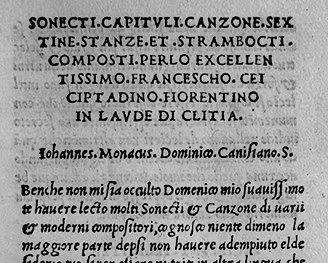
The 1503 princeps bore the title Sonecti, capituli, canzone, sextine, stanze et strambocti composti per lo excellentissimo Francescho Cei ciptadino fiorentino in laude di Clitia. Its imprint identified Filippo Giunta as a Florentine cartolaio, retaining the occupational designation of the stationer and bookseller even within a printed publication. The book was an octavo of sixty-two unnumbered leaves, with the collation π⁴ a–g⁸ h², and its title appeared as a heading on the first leaf. Set in italic, it gave contemporary Florentine poetry the compact material form associated with portable literary reading. The importance of the edition lies in this conjunction of a new collection and an early vernacular undertaking of the Florentine Giunta house, not in an unqualified claim to precedence across the entire Giunti family’s production.
Giovanni Monaci, signing in Latin as Iohannes Monacus, supplied the prefatory letter to Domenico Canigiani. His praise emphasized Cei’s learning and the suggestiveness of verses that could leave readers to recognize an implication rather than state everything directly. The preface thus offered an interpretation of the poetry as well as a recommendation of its author. Monaci’s responsibility for this letter should not automatically be expanded into responsibility for selecting, arranging, or correcting the entire book. Likewise, the fact that the edition appeared during Cei’s lifetime does not establish the extent of his supervision: the preparation of the printer’s copy and his involvement in correcting proofs remain unresolved.
The collection contains ninety-six sonnets, eight capitoli in terza rima, nine compositions grouped as canzoni, three sestinas, a continuous poem of twenty stanzas, and seventeen strambotti. The twenty stanzas are not twenty independent poems: counted as a single composition, they bring the total to 134 texts. The title’s enumeration of metres therefore describes the book’s organization more accurately than the modern shorthand Canzoniere. The poems are principally grouped by form, rather than interwoven into a continuous narrative following the arrangement of Petrarch’s Rerum vulgarium fragmenta. Love supplies a recurrent subject and an identifiable addressee, but the ordering also preserves the variety of occasions and modes in which Cei wrote.
Petrarch furnished an indispensable vocabulary of longing, contradictory impulses, absence, and frustrated service, without becoming Cei’s exclusive stylistic authority. His language also accommodated the comic possibilities of Dante, the poetry of Luigi Pulci and Poliziano, the narrative habits of the cantari, familiar Florentine speech, classical examples, and the ingenious conceits associated with Serafino Aquilano and Antonio Tebaldeo. Describing him as a “courtly poet” identifies affinities within this literary repertory; it does not establish a career spent in a princely household. His documented setting remained substantially Florentine, and the coexistence of canzoni and sestinas with shorter, more immediately performable forms distinguishes the collection from a straightforward adoption of contemporary court fashions.
Objects and gestures give the amorous writing a conspicuous social concreteness.
Clothing, colours, a glove, devotional beads, gifts, a dog, and a parrot become occasions for complaint, jealousy, insinuation, or praise. The lover’s condition is repeatedly displaced onto something that can be seen, handled, withheld, or exchanged. Such poems reward readers who recognize conventional metaphors while also following shifts into colloquial or equivocal language. The shorter strambotti are particularly suited to this movement: their concentrated argument and emphatic ending connect literary ingenuity with memorability and possible performance. Their apparent immediacy should not be confused with the absence of formal calculation or with an expectation that every allusion would be intelligible outside the original circle.
The longer forms permit different kinds of development. The capitoli accommodate dialogue, moral and erotic reasoning, comic argument, and departure; the compositions grouped under canzoni include structures closer to the ballata or barzelletta as well as more elaborate lyric experiments. The twenty connected octaves sustain a description of the beloved, whereas the seventeen strambotti function as shorter, self-contained units. The book consequently juxtaposes poems with markedly different relations to narrative, song, and recitation. This variety is part of its literary identity, rather than a deficiency to be corrected by imagining that Cei intended a more uniform Petrarchan sequence.
The identity behind Clitia, also written Clizia, is illuminated by Naples, Biblioteca Nazionale Vittorio Emanuele III, manuscript XIII D 50. A rubric at folio 57v identifies her as Cassandra di Bartolomeo Bartolini Salimbeni, who married the Florentine merchant and banker Carlo di Leonardo Ginori in 1500. This evidence supplies a historical name for the poetic addressee, but does not turn the collection into a literal record of their relationship. The poems place the beginning of the attachment in 1494 and suggest its continuation after her marriage; their chronology remains an element of the literary representation unless independently corroborated.
The Neapolitan manuscript matters beyond this identification because it preserves an alternative redaction, not simply another copy of the text familiar from the Giuntina. Other witnesses transmit individual poems outside the collected sequence; the twenty-stanza composition, for example, also survives in Milan, Biblioteca Trivulziana, manuscript 973, folios 42r–47v. These witnesses complicate a genealogy based exclusively on successive printed editions. A manuscript reading independent of the princeps may preserve a different stage or branch of transmission, whereas a reading found in a later printed book may result from intervention after Cei’s death. Neither “manuscript” nor “later edition” is, by itself, a guarantee of greater authorial authority.
Cei died in 1505, according to the family memoir, which states that he left neither wife nor children. His place of death remains uncertain; Rome is an older conjecture founded principally on the interpretation of the poems. The subsequent publishing history was therefore posthumous, although the books continued to present a conspicuously personal collection devoted to Clitia. Editorial responsibility increasingly passed to producers whose relationship with the poet was different from that of the contemporaries involved in the first Florentine publication.
The early reprint sequence is not equally secure at every point. Bibliographies record a Florentine Giunta edition of 1507, but the record depends on older repertories and should not be treated as equivalent to an examined surviving copy. A dated Venetian edition by Giorgio Rusconi, completed on 26 November 1510, establishes the collection’s passage into another major printing centre. An undated Venetian printing by Nicola Brenta further enlarges the sequence, although its year cannot be fixed precisely. The existence of such imprints explains why a publishing history confined to the better-known Florentine editions gives an incomplete account of the collection’s early circulation.
Filippo Giunta’s Florentine edition of 1514 retained the enumerative title beginning Sonecti, capituli, canzone, sextine, stanze et strambocti, but gave the collection a different physical presentation. It is catalogued as an octavo with five preliminary leaves, fifty-eight numbered leaves, and a final unnumbered leaf. The decorated title border and Giuntine device distinguish it from the comparatively spare presentation of 1503, while the numbered text altered the means of navigating the volume. It belongs to the continued activity of Filippo the Elder, not to the later production of his heirs. The renewed investment in a poet dead for approximately nine years demonstrates the continuing place of his work within the house’s vernacular programme. A Venetian edition by Giovanni Tacuino da Trino, conventionally assigned to approximately 1515, continued the division into metrical sections; its date remains a bibliographical inference rather than an explicit statement in the imprint. The collection was thus represented by several Venetian printers as well as by the original Florentine house.
Rusconi returned to the collection on 3 November 1518, now presenting it as Opera nova composta per lo excellentissimo Francesco Cei fiorentino in laude de Clitia. Opera gentile & amorosa. This octavo comprised sixty leaves, signed A–G⁸ H⁴, with a woodcut title border and text in roman type. The departure from the italic presentation of the princeps is a concrete example of the same poetic corpus being repackaged for another edition. The phrases opera nova and novamente stampata promoted the current publication; they do not establish a new work written by Cei or an authorially revised text.
The Florentine edition of 20 May 1519, Lopere del preclarissimo poeta Francesco Cei in laude di Clitia, involved a different distribution of responsibilities. The colophon states that it was produced at the request of Francesco di Iacopo, the Florentine bookseller; bibliographical research attributes the actual printing to Bartolomeo Zanetti. Francesco’s device, an armillary sphere with initials and the motto In Deo, appeared at the colophon. The octavo contained four preliminary leaves and fifty-eight numbered leaves, with roman type, a woodcut title border, and an ornamental initial. This was a new Florentine arrangement outside the original Giunta enterprise, with a bookseller commissioning production from a separate workshop.
The sequence extended to Milan in 1520. A printing dated 5 February was undertaken by Agostino da Vimercate for the brothers da Legnano, under the title Opera gentile et amorosa in laude de Clitia; another, dated 30 March, was printed by the brothers da Valle for Niccolò da Gorgonzola. The distinction between the presses and the commissioning publishers reveals two commercial arrangements rather than an undifferentiated Milanese continuation. Together with the Florentine and Venetian editions, these books document the repeated republication of Cei’s poetry across several workshops and markets.
The prefatory letter of Monaci continued to accompany later editions, preserving an early recommendation of the author even when the title, type, and publishing responsibility changed. The book’s public identity was consequently cumulative: Cei remained the Florentine poet of Clitia, while successive producers altered the physical and promotional form through which readers encountered him. Evidence for the reach of these editions is supplied by Spanish inventories. The 1514 Giuntina is recorded among the Italian poetry books of Diego Sarmiento de Acuña, Count of Gondomar, and is also identified in the inventory of Rodrigo de Silva y Mendoza, second Duke of Pastrana. These are specific witnesses to ownership beyond Italy, not grounds for assuming an otherwise undocumented translation or a uniform international reception.
Cei’s literary reputation was similarly divided. Varchi’s objection to readers who preferred Ceo or Serafino to Dante and Petrarch was intended to establish a hierarchy of taste, but also attests to the continuing recognizability of the poets he depreciated.
Later accounts by Giovanni Cinelli Calvoli and Giovanni Mario Crescimbeni preserved a more appreciative view of Cei’s learning and invention, alongside reservations about his manner. These judgments concern different aspects of the same writing: the ingenuity and compression praised within one account could appear affected or excessive within another. They do not justify assigning him retrospectively to a coherent “Baroque” programme, any more than the prominence of Petrarchan language makes him an orthodox Petrarchist.
Modern investigation acquired a documentary foundation through Guglielmo Volpi’s study, collected in Note di varia erudizione e critica letteraria in 1903, which brought family records and political evidence into the reconstruction of Cei’s life. Marta Ceci’s Il Canzoniere of 1994 made the full collection available to modern readers, but was based on a single copy of the 1503 princeps and did not provide a commentary. A new stage followed with Irene Falini’s research: her critical and annotated edition of the seventeen strambotti, published in Interpres in 2018, examined a compact part of the corpus that required comparison with manuscript witnesses as well as the printed collection.
Falini’s Sonetti, published by the Accademia della Crusca in 2021, changed the evidential basis more substantially by comparing the surviving copies of the Giuntina, identifying their rare variants, and examining the independent Neapolitan redaction alongside the dispersed manuscript tradition. It also distinguished the establishment of the early text from the additional material transmitted by later printed editions. This approach makes the history of Cei’s books integral to the interpretation of his poetry: the text of a particular reprint, the sequence preserved in a manuscript, and the wording of the princeps cannot be treated as interchangeable representations of one entirely stable work.
Bibliography
D’Ancona, Alessandro. “Del secentismo nella poesia cortigiana del secolo XV.” In Studi sulla letteratura italiana dei primi secoli, 149–237. Ancona: Gustavo Morelli, 1884.
Volpi, Guglielmo. “Di Francesco Cei poeta fiorentino dell’ultimo Quattrocento.” In Note di varia erudizione e critica letteraria (secoli XIV e XV), 56–72. Firenze: Bernardo Seeber, 1903.
Ferrara, Mario. Nota savonaroliana: di un sonetto politico di Francesco Cei avversario del Savonarola. Arezzo: Scheggi, 1921.
Mutini, Claudio. “Cei, Francesco.” In Dizionario Biografico degli Italiani, vol. 23, 327–329. Roma: Istituto della Enciclopedia Italiana, 1979.
Ceci, Marta. “Introduzione.” In Francesco Cei, Il canzoniere, a cura di Marta Ceci, 9–22. Roma: Zauli Arti Grafiche, 1994.
Tanturli, Giuliano. “Fra poesia volgare e latina nel secondo Quattrocento a Firenze: un’elegia del Landino, un sonetto di Francesco Cei.” In Laurentia laurus: per Mario Martelli, a cura di Francesco Bausi e Vincenzo Fera, 399–409. Messina: Centro Interdipartimentale di Studi Umanistici, 2004.
Villoresi, Marco. “Panoramica sui poeti performativi d’età laurenziana.” Rassegna Europea di Letteratura Italiana 34 (2009): 11–33.
Degl’Innocenti, Luca. “Machiavelli canterino?” Nuova Rivista di Letteratura Italiana 18, n. 1 (2015): 11–67.
Ceci, Marta, e Irene Falini. “Francesco Cei.” In Atlante dei canzonieri in volgare del Quattrocento, a cura di Andrea Comboni e Tiziano Zanato, 207–213. Firenze: SISMEL–Edizioni del Galluzzo, 2017.
Falini, Irene. “Le rime di Francesco Cei: preliminari osservazioni metriche e tematiche.” In L’Italianistica oggi: ricerca e didattica. Atti del XIX Congresso dell’ADI (Roma, 9–12 settembre 2015), a cura di Beatrice Alfonzetti, Teresa Cancro, Valeria Di Iasio ed Ester Pietrobon, 1–9. Roma: ADI Editore, 2017.
Falini, Irene. “Gli strambotti di Francesco Cei: edizione critica e commento.” Interpres 36 (2018): 139–190.
Falini, Irene. “Non può esser gentil core: un inno all’amore dalle rime di Francesco Cei.” In Briciole di discorsi amorosi. Scritti per Sara Natale & Simone Albonico offerti dagli amici fiorentini, 189–199. Pisa: Edizioni il Campano, 2018.
Ott, Christine. “Procreation sonnets all’italiana. Der alternative Petrarkismus des Francesco Cei.” In Europäische Gründungsmythen im Dialog der Literaturen: Festschrift für Michael Bernsen zum 65. Geburtstag, a cura di Roland Alexander Ißler, Rolf Lohse e Ludger Scherer, 103–116. Göttingen: V&R unipress, 2019.
Cei, Francesco. Sonetti. Edizione critica e commento a cura di Irene Falini. Firenze: Accademia della Crusca, 2021. (Quaderni degli Studi di Filologia Italiana, 18.)
Falini, Irene. “L’artificio retorico dell’eco nella poesia volgare di fine Quattrocento.” In Repetita iuvant, perseverare diabolicum: un approccio multidisciplinare alla ripetizione, a cura di Davide Mastrantonio, Valentina Bianchi, Marianna Marrucci, Orlando Paris, Ibraam Abdelsayed e Martina Bellinzona, 269–278. Siena: Edizioni Università per Stranieri di Siena, 2023.
Beyond the names: biographies and bibliographies on this page are curated by Abu, the AI scholar crafted by Buonvecchio exclusively for Govi Rare Books.