
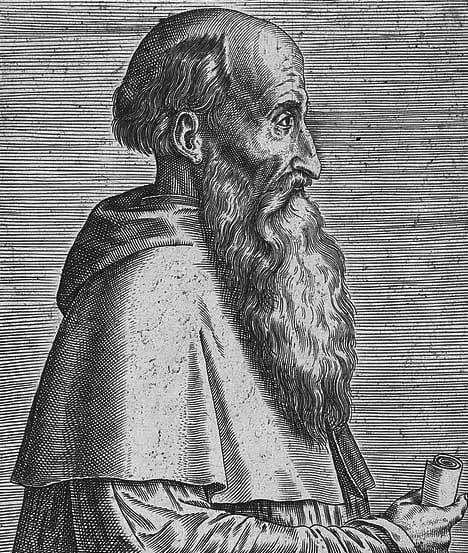
Bembo Pietro
1470-1547
history_eduBiography
Pietro Bembo (20 May 1470–18 January 1547) was one of the defining intellectual figures of the Italian High Renaissance: a Venetian patrician, humanist, classical philologist, poet, literary theorist, editor of major vernacular texts, papal secretary, historian of Venice, bibliophile, and, in the final decade of his life, cardinal of the Roman Church. His importance is inseparable from the formation of a new conception of literary Italian. Through his writings, his editorial activity, and above all his Prose nelle quali si ragiona della volgar lingua, Bembo transformed the imitation of Petrarch and Boccaccio from a literary preference into a systematic linguistic and stylistic programme. His influence extended from sixteenth-century Italian poetry and prose to European literary culture more generally, while his collaboration with Aldo Manuzio helped establish new relationships among philology, textual editing, typography, and the portable Renaissance book.
Bembo's achievement, however, should not be reduced to the slogan that he “invented” modern Italian. He did not create a spoken national language, nor did his linguistic programme immediately eliminate competing models. Rather, he supplied Italian literary culture with an exceptionally coherent normative model for written literary language, based principally on Francesco Petrarch for poetry and Giovanni Boccaccio for prose. The success of that model was immense: by the later sixteenth century, bembismo had become one of the principal forces shaping the written language of Italian literature. The Prose thus occupies a pivotal position in the long history of the questione della lingua.
Family, Florence, and the formation of a humanist
Bembo was born in Venice on 20 May 1470, into one of the city's ancient patrician families. His father, Bernardo Bembo, was a statesman, diplomat, magistrate, bibliophile, and accomplished humanist whose intellectual interests profoundly influenced his son's formation. Bernardo's library and his extensive network of literary and political contacts provided Pietro with an unusually sophisticated environment from childhood.
The decisive early experience came in Florence between 1478 and 1480, where Bernardo served as Venetian ambassador. The young Pietro encountered the cultural world associated with Lorenzo de' Medici and acquired an early familiarity with the Florentine vernacular that would later become central to his linguistic thought. It would nevertheless be misleading to imagine that the future theorist of Tuscan literary Italian simply absorbed an already finished linguistic doctrine in Florence. His later classicism emerged from the much broader synthesis of Venetian humanism, Florentine vernacular culture, Greek philology, Latin Ciceronianism, and the literary traditions of the Italian courts.
His youthful education remains incompletely documented. He studied with humanist tutors in Venice and subsequently pursued a combination of literary and philosophical studies. In 1492 he went to Messina, where he studied Greek with the distinguished Byzantine émigré scholar Constantine Lascaris. This episode was decisive. Bembo did not merely acquire Greek as an ornamental accomplishment: Greek philology became an essential component of his humanist identity and of his later conception of textual authority. On his return to northern Italy in 1494, he continued his philosophical education at Padua, where he encountered the intellectual culture of Aristotelian philosophy and the university humanism of the period. The young Bembo was already moving between two literary worlds: the classical languages of humanism and the Italian vernacular. That bilingual and bicultural formation would become the foundation of his mature work.
De Aetna and the beginning of the Aldine relationship
Bembo's first major printed work was the elegant Latin dialogue De Aetna ad Angelum Chabrielem liber, published in Venice by Aldo Manuzio in 1496. The work recounts Bembo's ascent of Mount Etna during his Sicilian years and is presented as a dialogue involving Bembo and his father Bernardo. It is simultaneously a literary exercise, a learned description of nature, and a demonstration of Bembo's command of polished Ciceronian Latin. Its historical significance is much greater than its modest size might suggest. De Aetna stands at the beginning of one of the most consequential relationships in Renaissance book history: that between Bembo and Aldo Manuzio. Bembo's philological interests and Aldo's typographical ambitions were mutually reinforcing. The De Aetna is particularly important for the history of Renaissance typography because the roman type designed by Francesco Griffo for Aldo and employed in the book became the historical ancestor of the modern typeface subsequently known as Bembo. The modern name, however, is retrospective: it should not be taken to mean that Bembo himself designed the typeface or that a typeface formally called “Bembo” existed in the sixteenth century.
The book also reveals Bembo's attention to punctuation, accentuation, and the visual organization of learned prose. His collaboration with Aldo formed part of a larger humanist programme in which the physical form of the printed book was increasingly conceived as an instrument of philological precision.
Aldo Manuzio, Petrarch, Dante, and the transformation of the vernacular book
Bembo's most consequential editorial interventions came at the beginning of the sixteenth century. His work with Aldo on Petrarch and Dante was crucial to the history of Italian literary editing and to the development of the new portable Renaissance book.
In 1501, Aldo published Petrarch's Le cose volgari di messer Francesco Petrarcha, an edition prepared under Bembo's influence and based in significant part upon a manuscript belonging to his father Bernardo, now famous as Vat. Lat. 3196. The edition was a landmark not simply because it was small and portable, but because it presented Petrarch as an authoritative textual and linguistic model. Bembo's editorial practice helped to establish the Canzoniere as the central normative corpus of Italian lyric poetry.
In 1502, Aldo followed it with Dante's Le terze rime di Dante, again in the small-format series and in the new italic type associated with Aldo's press. The edition is particularly important for Bembo's editorial history. It offered a carefully regularized text, eliminated many medieval scribal abbreviations, divided words according to grammatical principles, and introduced an unusually systematic punctuation and accentual apparatus. It consequently exerted enormous influence on the subsequent printed tradition of Dante. Carlo Dionisotti rightly regarded Bembo's edition as a major event in the history of Dante's textual transmission.
The typographical innovations of the Aldine press should nevertheless be attributed with precision. Aldo did not invent the octavo format, which already existed, but he transformed it by making the small portable book a principal vehicle for classical and literary texts. The Virgil of 1501 inaugurated the celebrated Aldine series of portable classics; Petrarch in 1501 and Dante in 1502 extended the experiment into the Italian vernacular. Bembo's advice and editorial practice contributed to the refinement of punctuation, accents, apostrophes, and other signs, but these innovations were the result of a collaboration between author-editor, printer, punchcutter, and the wider typographical culture rather than the isolated invention of a single individual. The importance of this collaboration cannot be overstated. Bembo was helping to create not merely editions of individual books but a new material model of literary authority: the portable, typographically elegant, philologically controlled classic.
Ferrara, Lucrezia Borgia, and Gli Asolani
During the late 1490s Bembo entered the literary and courtly world of Ferrara. In 1498 he spent time there and came into contact with the Ferrarese court and with Lucrezia Borgia, Duchess of Ferrara. The nature and chronology of their relationship have long fascinated biographers, but Bembo's correspondence with Lucrezia is best understood within the larger culture of Renaissance courtly sociability and literary exchange. Even more important for his literary development was his relationship with Maria Savorgnan, which generated a substantial correspondence and contributed to the emotional and literary background of his early vernacular production. Bembo's letters from these years are among the most revealing documents for the formation of his literary persona.
The major literary product of this period was Gli Asolani, a dialogue on love composed over a long period beginning in the late fifteenth century and first printed by Aldo Manuzio in 1505. Set at Asolo, at the court associated with Caterina Cornaro, the dialogue is organized in three books and combines prose and verse. Its subject is love: its varieties, its pleasures, its sufferings, and ultimately the movement from sensual desire toward a more elevated conception of spiritual love.
The work is indebted to classical dialogue, Boccaccio's Decameron, Petrarchism, and Renaissance Platonism, including the intellectual atmosphere generated by Ficinian Platonism. Yet Gli Asolani is not simply a popularized Ficinian treatise. Bembo constructs a sophisticated literary dialogue in which competing positions on love become simultaneously philosophical arguments and demonstrations of different literary styles.
The history of the work's editions is particularly revealing. The 1505 princeps represents an early stage of Bembo's literary style; the substantially revised 1530 edition reflects the mature author and his increasingly rigorous linguistic programme; the 1553 posthumous edition preserves a further stage of the text. Modern scholarship therefore cannot treat the Asolani as a static work: its successive forms constitute part of its meaning and reveal Bembo's extraordinary habit of revising his own writings. The critical edition by Giorgio Dilemmi reconstructs this complex textual history.
Urbino and the culture of the Cortegiano
In 1506 Bembo moved to the court of Urbino, where he became one of the leading members of an extraordinary intellectual circle. He was associated with Baldassare Castiglione, Giuliano de' Medici, Elisabetta Gonzaga, and other figures whose conversations helped define the ideal of Renaissance courtly culture. The importance of Urbino for Bembo is literary as much as biographical. In Castiglione's Il libro del Cortegiano, Bembo becomes one of the dialogue's principal intellectual authorities. In the final book, he delivers the celebrated discourse on love that elevates earthly beauty toward contemplation of divine beauty. The Bembo of the Cortegiano is partly a literary construction, but the characterization reflects the real intellectual prestige Bembo had acquired as a theorist of love, poetry, language, and classical imitation.
At Urbino he also composed or developed works that would only be printed much later. Among them was the Latin dialogue De Guido Ubaldo Feretrio deque Elisabetha Gonzaga Urbini ducibus, written in response to the death of Guidubaldo da Montefeltro and devoted also to the virtues of Elisabetta Gonzaga. It was finally printed in the collection of Bembo's Latin prose in 1530 and was reprinted in 1548.
Rome, Leo X, and the theory of imitation
Bembo left Urbino for Rome in 1512, entering the orbit of the Medici papacy. After the election of Leo X in 1513, he and Jacopo Sadoleto became secretaries of the papal chancery, responsible for the composition of papal Latin documents. The Roman years were important for the development of Bembo's theory of literary imitation. His correspondence and controversy with Gianfrancesco Pico della Mirandola concerned one of the fundamental questions of Renaissance humanism: whether an accomplished writer should imitate a single supreme author or draw eclectically upon many models.
Bembo's answer was famously Ciceronian. In Latin prose he privileged Cicero, while in Latin poetry he assigned a similarly exemplary status to Virgil. His position did not amount to mechanical copying. Rather, it sought to reproduce the stylistic excellence of an exemplary author through sustained imitation. The controversy with Pico therefore belongs to the broader Renaissance debate over imitatio, and it provides an important intellectual prehistory to Bembo's later theory of the Italian vernacular.
The De imitatione circulated in an unauthorized or non-authentic form probably around 1514, while the first authentic printing appeared in the collection of Bembo's Latin works in 1530. The distinction between the early unauthorized printing and the later authorized text is important for establishing Bembo's actual editorial intentions.
Withdrawal from Rome and the mature literary programme
After the death of Leo X in 1521, Bembo increasingly withdrew from the papal court and divided his time between Padua, Venice, and his country residence. These years were extraordinarily productive. Freed from the daily demands of the papal chancery, he devoted himself to revision, philology, collecting, correspondence, and the systematic elaboration of his literary theory.
His house and library became an important intellectual centre. Bembo collected manuscripts, printed books, classical antiquities, paintings, medals, and works of art, cultivating the ideal of the Renaissance humanist collector whose library constituted an extension of his intellectual identity.
It was in this environment that he completed the work that would establish his most enduring linguistic reputation.
The Prose and the questione della lingua
Bembo's Prose nelle quali si ragiona della volgar lingua represents the culmination of his literary and philological programme. The work was printed in Venice by Giovanni Tacuino in 1525. It takes the form of a dialogue and stages a discussion of the nature, history, authority, and possibilities of the Italian vernacular.
The central proposition is uncompromising: literary Italian should not be based simply upon contemporary speech or upon the heterogeneous language of Italian courts. Instead, literary authors should seek authoritative models in the great fourteenth-century writers. Petrarch provides the supreme model for poetry; Boccaccio provides the principal model for prose.
This was not merely a proposal about vocabulary. Bembo conceived literary language as an art governed by historical authority, stylistic distinction, rhythm, harmony, lexical selection, grammar, and rhetorical form. His linguistic theory therefore emerged directly from his editorial practice. The Petrarch he had helped to edit in 1501 was not simply an object of admiration: he was being constituted as a textual and linguistic norm.
The Prose also belongs to the wider sixteenth-century questione della lingua. Bembo's position confronted other solutions, including courtly eclecticism and arguments in favour of contemporary Florentine usage. His model ultimately prevailed to a remarkable degree because it offered writers throughout Italy a supra-regional literary language that could be learned through texts rather than acquired through local speech.
The first edition of 1525 was followed by a second Venetian edition in 1538, printed by Francesco Marcolini and incorporating authorial corrections. After Bembo's death, a third edition appeared in Florence from the press of Lorenzo Torrentino in 1549, with the intervention of Benedetto Varchi. The textual differences among these editions are fundamental to modern Bembo scholarship.
Particularly important is the discovery of a copy of the 1525 Prose extensively annotated in Bembo's own hand. These annotations demonstrate that Bembo continued revising and expanding the work almost to the end of his life. They also show why the posthumous 1549 edition cannot simply be treated as the unproblematic expression of the author's final intentions: Varchi and other posthumous editors intervened in the text. The modern critical tradition therefore has to distinguish among the 1525 printed text, the author's subsequent revisions, the 1538 edition, and the posthumous editorial state.
The modern critical edition by Claudio Vela returns to the editio princeps of 1525 and collates it against the Vatican manuscript Vat. Lat. 3210, while Mirko Tavosanis has examined another textual state of the manuscript. The textual history of the Prose is consequently a model case of Renaissance authorial revision.
The Rime and the institutionalization of Petrarchism
Bembo's theory achieved its most direct poetic realization in his Rime. Although his poems circulated extensively in manuscript before their appearance in print, the first authorized collection was published in Venice in 1530. The significance of the Rime is difficult to overstate. In them Bembo did not merely advocate Petrarchan poetry: he demonstrated how Petrarchism could function as a systematic poetic language. The poems refined vocabulary, syntax, rhythm, imagery, and rhetorical structure according to the Petrarchan model and thereby supplied younger poets with an immediately usable literary code.
The publication of the Rime in 1530 coincided with the consolidation of a wider Petrarchan movement involving Sannazaro, later Bernardo Tasso, Alamanni, and numerous other poets. Bembo's authority gave this movement a theoretical and linguistic centre. Yet, once again, the textual history is complex. Bembo continued revising his poems after 1530. A second edition appeared in 1535; further editions followed in 1548, including the important posthumous edition prepared by Carlo Gualteruzzi, while late authorial material survives in manuscript. Modern scholarship has therefore debated which witness most fully represents Bembo's final poetic intentions. Andrea Donnini's critical edition of 2008 gives particular weight to the late Viennese manuscript tradition.
The Rime consequently represent one of the clearest examples of the tension between Renaissance print culture and authorial revision: the printed collection fixed a canonical image of Bembo while Bembo himself continued to modify the poems.
The Latin works and the 1530 self-fashioning of an author
The year 1530 was a decisive moment in Bembo's publishing history. Alongside the second edition of the Asolani and the first edition of the Rime, Bembo authorized a substantial collection of his Latin prose.
This collection brought together De Aetna and De imitatione, together with previously unpublished works such as De Virgilii Culice et Terentii fabulis and De Guido Ubaldo Feretrio deque Elisabetha Gonzaga Urbini ducibus. The decision to publish these works together was more than a convenient collection of juvenilia and occasional writings. It constituted a deliberate act of literary self-fashioning: the mature Bembo was presenting the trajectory of his intellectual life, from his earliest humanist exercises to his mature status as one of Italy's principal men of letters.
The De Virgilii Culice et Terentii fabulis, first printed in 1530, exemplifies Bembo's continuing interest in classical literary criticism and textual scholarship. The De Guido Ubaldo similarly combines humanist dialogue, courtly memory, political idealization, and literary memorialization.
Bembo as historian and librarian of Venice
In 1530, Bembo received two important appointments from the Venetian Republic: he was named official historiographer of Venice and librarian of the Marciana, then developing around the extraordinary collection of Greek manuscripts associated with Cardinal Bessarion. The appointment was symbolically important. The Venetian patrician who had spent much of his career at Italian courts and in Rome was now formally recognized by his own republic as one of its principal intellectual representatives.
As historiographer, Bembo undertook a Latin history of Venice covering the period from 1487 to 1513, in twelve books. The Historia Veneta was written in an elevated Ciceronian Latin and continued the humanist tradition of civic historiography while bringing it into the contemporary world.
The work was not published during Bembo's lifetime. After prolonged disputes concerning the manuscript and its publication, the Latin Historia Veneta libri XII appeared at Venice apud Aldi filios in 1551. A vernacular version followed in 1552, printed by Gualtiero Scotto. The latter was not simply a mechanical transcription of a printed Latin edition: Bembo had intended a vernacular version, but the circumstances of its posthumous publication involved his executors and other intermediaries.
The two editions are therefore an essential part of Bembo's editorial afterlife and demonstrate how even his historical writing remained entangled in the problems of authorial intention, posthumous publication, translation, and editorial intervention.
The papal secretary and the ecclesiastical career
Bembo had entered the ecclesiastical sphere well before becoming a cardinal. He held minor orders and accumulated ecclesiastical benefices, but his early and middle career was not that of a conventional cleric. His long relationship with Morosina della Torre, with whom he had three children, belongs to this period and illustrates the complicated coexistence of literary, courtly, and ecclesiastical identities in Renaissance Italy. After withdrawing from active service in Rome, Bembo's reputation continued to grow. In 1536 he published the collection Epistolarum Leonis X nomine scriptarum libri XVI, gathering the Latin papal briefs he had composed in the name of Leo X. A second edition appeared in 1552 together with his Epistolae familiares.
His ecclesiastical advancement culminated in the pontificate of Paul III. Bembo was created cardinal in March 1539 and subsequently moved permanently to Rome. He was ordained a priest and received the bishoprics of Gubbio in 1541 and Bergamo in 1544, without being required to reside permanently in either diocese. His ecclesiastical career was therefore a late transformation rather than the natural culmination of a conventional clerical vocation. His intellectual position in the 1540s placed him close to circles associated with moderate Catholic reform, including figures such as Reginald Pole and Vittoria Colonna. Yet Bembo should not simply be retroactively classified as a Reformation theologian or as a member of a single coherent “Spirituali” party. His religious identity remained inseparable from the humanist culture and literary authority that had defined his life.
Final years and death
The cardinal's final years were devoted to Rome, ecclesiastical responsibilities, correspondence, collecting, and the continuing revision of his writings. Even at this advanced age he remained deeply concerned with the linguistic and textual form of his works. His annotations to his copy of the 1525 Prose demonstrate that the mature and elderly Bembo remained an active editor of himself.
He died in Rome on 18 January 1547, aged seventy-six, and was buried in Santa Maria sopra Minerva. By the time of his death, he had become one of the most authoritative literary figures in Italy.
His posthumous publication history was extensive. The Rime and Epistolae appeared in 1548; the Prose received the important posthumous edition of 1549; the Historia Veneta followed in 1551 and its vernacular version in 1552; and the Asolani reached another posthumous form in 1553. The fact that so much of Bembo's major corpus appeared in revised or posthumous editions makes his bibliography inseparable from the study of textual transmission.
Editorial culture, philology, and the Renaissance book
Bembo's historical importance is therefore best understood through the intersection of literature, philology, and print. He belonged to the generation that transformed the Renaissance humanist manuscript culture into a mature culture of scholarly printing. His work with Aldo Manuzio demonstrated that an editor could intervene not merely by correcting individual readings but by determining the linguistic, typographical, and interpretative identity of an entire literary text. The 1501 Petrarch and 1502 Dante were exemplary in this respect.
His own works subsequently became laboratories of authorial revision. The Asolani, Prose, and Rime survive in multiple states, manuscripts, printed editions, and authorial annotations. Their history reveals an author who did not regard publication as the final moment of composition. Bembo repeatedly returned to his texts, altered their diction, restructured passages, eliminated verses, and refined their style.
This is why the history of Bembo's works cannot be separated from their edition history. For him, philology was not merely the reconstruction of ancient texts: it was also a method for creating modern literary authority.
The legacy of Bembismo
The influence of Bembo on sixteenth-century Italian literature was immense. His Prose offered writers a stable hierarchy of models; his Rime demonstrated the poetic application of that hierarchy; his Petrarch edition helped establish the textual and linguistic authority of the Canzoniere; and his Dante edition exemplified the application of humanist editorial principles to the vernacular.
The result was the literary phenomenon conventionally known as Bembismo. It spread through poetry, prose, courtly literature, religious writing, rhetoric, and literary criticism. Writers from different regions could participate in a common written literary language because Bembo's model was based upon prestigious historical texts rather than upon the living speech of any one contemporary city.
The consequences were long-lasting. The model of Petrarchan lyric established by Bembo shaped generations of Italian poets; the Boccaccian model of prose influenced literary and historiographical writing; and the linguistic principles articulated in the Prose contributed decisively to the eventual emergence of a relatively unified written Italian tradition. The later history of the Accademia della Crusca and of Italian grammatical codification cannot be understood without acknowledging this earlier Bembian achievement.
Yet Bembo's legacy was never uncontested. Machiavelli's conception of the living Florentine language, the courtly and eclectic alternatives associated with other theorists, and later debates over the relationship between literary tradition and contemporary usage all challenged aspects of his programme. Precisely because his solution was so powerful, it became one of the principal objects of resistance in the subsequent history of Italian linguistic thought.
The bibliographical and textual legacy
Modern scholarship has increasingly emphasized that Bembo must be studied not simply through modern normalized editions but through the material history of his texts. The critical edition of the Asolani by Giorgio Dilemmi reconstructs the successive textual states from the early manuscript tradition through the 1505, 1530, and 1553 editions. Claudio Vela's edition of the Prose returns to the 1525 editio princeps and confronts it with the autograph Vatican manuscript.
Andrea Donnini's two-volume critical edition of the Rime gives particular attention to the complex late authorial tradition. And the critical edition of the 2,589 surviving letters by Ernesto Travi, published in four volumes between 1987 and 1993, provides the documentary foundation for reconstructing Bembo's enormous network of political, literary, ecclesiastical, and scholarly relationships.
The epistolary corpus is especially revealing: the letters span roughly fifty-four years, from the early 1490s to the final months of 1546, and involve more than five hundred correspondents. A modern digital project has subsequently begun systematically revising and supplementing Travi's corpus, including the identification of doubtful attributions and duplicated texts.
Bembo's afterlife is consequently not merely that of a celebrated Renaissance author. It is the afterlife of an editorial system. His Petrarch, Dante, Asolani, Prose, Rime, letters, Latin works, and Venetian history all exist within complex histories of manuscript preparation, authorial revision, printing, posthumous editing, and modern critical reconstruction.
Conclusion
Pietro Bembo occupies a unique position in Renaissance intellectual history because he brought together domains that are often treated separately: classical philology, vernacular literature, textual criticism, literary theory, typography, manuscript collecting, courtly culture, ecclesiastical politics, and historical writing.
He was neither simply a poet nor simply a grammarian. He was one of the first Renaissance intellectuals to understand that the authority of literature depended upon a coordinated system of texts, models, editions, linguistic norms, and material forms of transmission. His collaboration with Aldo Manuzio helped redefine the printed book; his editions of Petrarch and Dante helped establish the textual foundations of vernacular classicism; Gli Asolani transformed philosophical reflections on love into an exemplary work of Renaissance prose; the Rime turned Petrarchism into a reproducible poetic language; the Prose gave that language a theoretical and grammatical foundation; his Latin writings maintained his place within European humanism; and the Historia Veneta extended his Ciceronian classicism into civic historiography.
Above all, Bembo succeeded in making literary language itself an object of conscious historical construction. By elevating Petrarch and Boccaccio into normative authorities, he provided sixteenth-century Italy with a model of literary excellence capable of transcending political fragmentation and regional diversity. His programme did not create Italian unity in a simple political or sociolinguistic sense, but it did something historically more precise and enormously consequential: it supplied generations of writers with a shared, prestigious, supra-regional written language.
For this reason Bembo belongs among the principal architects of European Renaissance literary culture. His importance lies not merely in what he wrote, but in the way he conceived the relationship between author, exemplar, language, manuscript, printed book, and reader. Few sixteenth-century humanists exercised such sustained influence simultaneously over the history of Italian literature, the history of the Italian language, and the material culture of the Renaissance book.
menu_bookBibliography
Cian, Vittorio. Un decennio della vita di M. Pietro Bembo (1521–1531): appunti biografici e saggio di studi sul Bembo, con appendice di documenti inediti. Torino: Loescher, 1885.
Dionisotti, Carlo. “Pietro Bembo.” In Dizionario Biografico degli Italiani, vol. 8. Roma: Istituto dell’Enciclopedia Italiana, 1966, pp. 133–151.
Santangelo, Giorgio. Il Petrarchismo del Bembo e di altri poeti del Cinquecento. Roma: S. Sciascia, 1962.
Dionisotti, Carlo. Gli umanisti e il volgare fra Quattro e Cinquecento. Firenze: Le Monnier, 1968.
Santoro, Mario. Pietro Bembo e la poetica del Rinascimento. Napoli: Libreria Scientifica Editrice, 1971.
Tateo, Francesco. Il Bembo e la norma del volgare. Bari: Adriatica, 1975.
Della Terza, Dante. “‘Imitatio’: teoria e pratica. L’esempio del Bembo poeta.” In Forma e memoria: Saggi e ricerche sulla tradizione letteraria da Dante a Vico. Roma: Bulzoni, 1979.
Tavoni, Mirko. Latino, grammatica, volgare: storia di una questione umanistica. Padova: Antenore, 1984.
Frasso, Giuseppe. “Appunti sul ‘Petrarca’ aldino del 1501.” In Vestigia: Studi in onore di Giuseppe Billanovich, vol. I. Roma: Edizioni di Storia e Letteratura, 1984, pp. 315–335.
Pulsoni, Carlo. “Luigi Da Porto, Pietro Bembo: dal canzoniere provenzale E all’antologia trobadorica bembiana.” Cultura Neolatina 52 (1992): 323–351.
Pulsoni, Carlo. “Bembo correttore di Luigi Da Porto?” Aevum 67 (1993): 501–518.
Pulsoni, Carlo. “Pietro Bembo e la tradizione della canzone Drez et razo es qu’ieu ciant e.m demori.” Rivista di Letteratura Italiana 11 (1993): 283–304.
Pulsoni, Carlo. “Per la fortuna del De vulgari eloquentia nel primo Cinquecento.” Aevum 71 (1997): 631–650.
Pulsoni, Carlo. “Pietro Bembo filologo volgare.” In La filologia. Anticomoderno, 3. Roma: Viella, 1997.
Raffini, Christine. Marsilio Ficino, Pietro Bembo, Baldassare Castiglione: Philosophical, Aesthetic, and Political Approaches in Renaissance Platonism. New York: Peter Lang, 1998.
Vela, Claudio. “Le Prose della volgar lingua di Pietro Bembo (1525).” In Due seminari di filologia, a cura di Simone Albonico. Alessandria: Edizioni dell’Orso, 1999, pp. 11–40.
Vela, Claudio, ed. Pietro Bembo, Prose della volgar lingua: l’editio princeps del 1525 riscontrata con l’autografo Vaticano Latino 3210. Bologna: CLUEB, 2001.
Sorella, Antonio. Benedetto Varchi e l’edizione torrentiniana delle Prose. Milano: Cisalpino, 2001.
Tavosanis, Mirko. La prima stesura delle Prose della volgar lingua: fonti e correzioni, con edizione del testo. Pisa: Edizioni ETS, 2002.
Dionisotti, Carlo. Scritti sul Bembo. A cura di Claudio Vela. Torino: Einaudi, 2003.
Gnocchi, Alessandro. Pietro Bembo e la poesia del suo tempo. Firenze: Società Editrice Fiorentina, 2003.
Kidwell, Carol. Pietro Bembo: Lover, Linguist, Cardinal. Montreal & Kingston: McGill-Queen’s University Press, 2004.
Danzi, Massimo. La biblioteca del cardinal Pietro Bembo. Genève: Droz, 2005.
Donnini, Andrea. “La tradizione manoscritta delle rime di Pietro Bembo.” In studi sulla poesia bembiana, 2000s.
Berra, Claudia. La scrittura degli Asolani di Pietro Bembo. Firenze: La Nuova Italia, 1996.
Donnini, Andrea, ed. Pietro Bembo, Le rime. 2 vols. Roma: Salerno Editrice, 2008.
Danzi, Massimo. “Pietro Bembo.” In Autografi dei letterati italiani: Il Cinquecento, vol. I. Roma: Salerno Editrice, 2009.
Donato, Maria Teresa. Pietro Bembo e le arti figurative. Roma: Bulzoni, 2011.
Marcozzi, Luca. “Pietro Bembo nella Roma di Leone X: diplomazia, epistolografia e letteratura alla corte del papa Medici.” In Leone X: Finanza, mecenatismo, cultura, a cura di Flavia Cantatore. Roma: Roma nel Rinascimento, 2016, pp. 553–563.
Beltramini, Guido; Gasparotto, Davide; Tura, Adolfo, eds. Pietro Bembo e l’invenzione del Rinascimento. Venezia: Marsilio, 2013.
Sorella, Antonio. “La copia di tipografia della seconda edizione e la copia preparatoria della terza edizione delle Prose di Bembo.” Tipofilologia 6 (2013): 11–48.
Patota, Giuseppe. La quarta corona: Pietro Bembo e la codificazione dell’italiano scritto. Bologna: Il Mulino, 2017.
Nalezyty, Susan. Pietro Bembo and the Intellectual Pleasures of a Renaissance Writer and Art Collector. New Haven: Yale University Press, 2017.
Bertolo, Francesca M.; Cursi, Marco; Pulsoni, Carlo. Bembo ritrovato: Il postillato autografo delle Prose. Roma: Viella, 2018.
Amendola, Francesco. “La presunta lettera di Bembo a Margherita d’Angoulême per l’invio del ms. delle ‘Rime spirituali’ di Vittoria Colonna.” Giornale Storico della Letteratura Italiana 196 (2019), fasc. 656, pp. 580–591.
Bertolo, Francesca M.; Cursi, Marco; Pulsoni, Carlo. “Bembo ritrovato: il postillato autografo delle Prose.” In studi sulla materialità e trasmissione dell’opera bembiana, 2018.
Amendola, Francesco. “«La poesia è una malatia che vien’ a gli huomini»: su una lettera restituita a Girolamo Fracastoro e sulla datazione del ‘carmen X’ ad Alessandro Farnese.” In Oltre i ‘termini’ della lettera: pratiche di dissertazione nelle corrispondenze tra Quattro e Cinquecento, a cura di Marianna Liguori ed Elisabetta Olivadese. Sarnico: Edizioni di Archilet, 2021, pp. 177–189.
Amendola, Francesco; Berra, Claudia. “Un’edizione in aggiornamento per un testo di lingua: le Lettere di Pietro Bembo.” In Che cos’era e che cos’è un testo di lingua, a cura di Paola Vecchi Galli. Bologna: Pàtron, 2022, pp. 203–214.
Amendola, Francesco, ed. Pietro Bembo, Lettere. Vol. V: Correzioni, indici e appendice di documenti. Bologna: Pàtron, 2024.
The biographies and bibliographies on this page are curated by Abu, the new AI scholar exclusively developed for Govi Rare Books.