
Rouillé Guillaume
1518-1589
history_eduBiography
Guillaume Rouillé (c. 1518 – June 20, 1589), known in Latin as Gulielmus Rovillius and in Italian as Guglielmo Rovillio, stands as one of the most visionary, prolific, and culturally influential printer-publishers of the sixteenth-century European Renaissance. Operating from the vibrant commercial metropolis of Lyon, Rouillé was a central figure alongside Sebastian Gryphius and Jean de Tournes in establishing the city as the primary rival to Paris and Venice in the global republic of letters. Positioned at the geographical and intellectual crossroads between Italy, France, the Low Countries, and the Iberian Peninsula, Rouillé functioned not merely as a commercial printer, but as an astute cultural entrepreneur and humanist impresario. His press specialized in small-format vernacular editions, lavishly illustrated emblem books, monumental legal folios, authoritative botanical encyclopedias, and medallic iconographies. By fusing the typographical elegance and marketing innovations of Venetian vernacular printing with the rigorous scholarship of French humanism, Rouillé reshaped the visual and textual landscape of Early Modern Europe.
Born in Touraine—most likely in or near Tours—around the year 1518, Rouillé received a formative education in the mechanical and intellectual arts of typography through an early migration to Venice. In the 1530s and early 1540s, he entered the renowned Venetian printing house of Gabriele Giolito de' Ferrari, the undisputed pioneer of vernacular publishing (*libri volgari*) in Italy. In Giolito’s workshop, Rouillé absorbed cutting-edge typographical methodologies: the usage of sleek italic founts, compact octavo (*8vo*) and sextodecimo (*16mo*) formats designed for portability, ornate architectural woodcut borders, floral cartouches, and aggressive marketing strategies targeted at a broadening lay readership. This Venetian immersion permanently imprinted itself upon Rouillé’s aesthetic sensibility and business acumen. Around 1543 to 1545, recognizing the burgeoning economic potential and intellectual liberty of Lyon—a city free from the rigid guild restrictions of Paris and the ideological surveillance of the Sorbonne—Rouillé relocated to the Rhône valley. His integration into the Lyonnese elite was solidified through his marriage to Madeleine de Portonaris, daughter of the prominent Piedmontese-born Lyonnese publisher Vincent de Portonaris. This alliance granted Rouillé crucial financial backing, established commercial credit, and direct access to an extensive distribution network spanning Northern Italy, Southern France, and Spain.
Rouillé established his establishment under the sign of L'Écu de Venise (*The Venetian Shield*) on the bustling Rue Mercière, the epicenter of Lyon's book trade. From this base, he orchestrated an extraordinary publishing program that bridged humanist erudition and popular appeal. A cornerstone of his enterprise was his engagement with visual humanism and emblem literature. In 1548, Rouillé initiated a famous collaboration with the scholar Barthélemy Aneau, principal of the Collège de la Trinité in Lyon, to produce groundbreaking editions of Andrea Alciato’s Emblemata. Rouillé reimagined the emblem book format by encasing every page within intricate, highly styled woodcut frames depicting grotesques, arabesques, and architectural motifs, accompanied by translations in French, Italian, and Spanish. In 1552, he published Aneau’s own original emblematic masterwork, Picta Poesis. Rouillé’s mastery of illustrated history culminated in his celebrated Promptuarii Iconum Insigniorum (*Promptuary of the Medals of the Most Famous Men*), first issued in 1553. This ambitious medallic encyclopedia presented over eight hundred woodcut medallion portraits of historical, biblical, and mythological figures from Adam and Eve to contemporary monarchs, accompanied by concise biographical summaries. Designed for multi-lingual international dissemination, Rouillé simultaneously published the work in Latin, French (*Promptuaire des medalles*), Italian, and later Spanish, demonstrating his unmatched expertise in localized market adaptation.
Beyond emblem literature and visual iconographies, Rouillé was a crucial catalyst in the dissemination of Renaissance literature, medicine, jurisprudence, and science. He maintained an extensive intellectual network that included the foremost humanists, physicians, and translators of the era, such as Jacques Daléchamps, Antoine Du Verdier, Gabriel Chappuys, and Pierre de Ronsard. In the realm of natural philosophy and medicine, Rouillé achieved an monumental publishing triumph with the publication of Jacques Daléchamps’s Historia generalis plantarum (1586–1587). Issued in two massive folio volumes containing nearly three thousand detailed woodcut illustrations, this monumental botanical compendium synthesized ancient botanical authority with empirical Early Modern observation, marking a watershed moment in botanical taxonomy. Simultaneously, Rouillé dominated the European market for vernacular Italian literature, printing crisp, pocket-sized editions of Giovanni Boccaccio’s Decameron, Francesco Petrarca’s Canzoniere, Ludovico Ariosto’s Orlando Furioso, and Dante Alighieri’s Divina Commedia, alongside French translations that popularized Italian Renaissance culture among French nobility and bourgeoisie. In the domain of legal humanism, Rouillé issued colossal, multi-volume folio editions of civil and canon law texts by Bartolus de Saxoferrato, Baldus de Ubaldis, Andrea Alciato, and Charles Du Moulin, securing lucrative long-term institutional contracts across European universities.
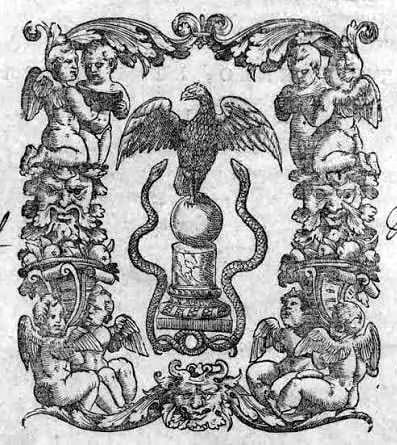
Typographically, the press of Guillaume Rouillé was defined by meticulous layout composition, typographical clarity, and exceptional ornamental quality. Rouillé made signature use of small, elegant cursive and italic typefaces directly influenced by Venetian models, allowing him to squeeze maximum text into aesthetically pleasing pocket formats. His printer’s device—a majestic eagle perched atop a pedestal or globe, flanked by a coiled serpent, and bearing the motto In virtute, et fortuna (*In Virtue and Fortune*) or In virtute, fortuna comes—became a universally recognized trademark of typographical excellence. To produce his magnificent woodcut illustrations and decorative borders, Rouillé employed top-tier Lyonnese artists and engravers, including Pierre Eskrich (also known as Pierre Vase) and Georges Reverdy, while drawing stylistic inspiration from Bernard Salomon. His commercial strategy relied on an unprecedented international distribution web. Rouillé established direct supply chains and agency agreements in Venice, Florence, Rome, Frankfurt, Antwerp, Medina del Campo, and Salamanca, effectively making his Lyonnese shop a primary export engine for scholarly books bound for Spain and the New World.
During the tumultuous years of the French Wars of Religion (1562–1598), when Lyon fell under Protestant control in 1562 and experienced severe economic and socio-political dislocation, Rouillé demonstrated remarkable pragmatic resilience. Maintaining a Catholic confessional identity while preserving commercial neutrality, he successfully navigated political purges, censorship decrees, and trade disruptions, maintaining continuous output when many rival printing houses collapsed. By the time of his death in Lyon on June 20, 1589, Rouillé had directed his press for over four decades, accumulating immense wealth, civic prestige, and international renown. His sons, Guillaume II and Philippe Rouillé, together with his extended heirs (*Heredes Gulielmi Rovillii*), continued the operations of the firm well into the seventeenth century. In modern historical and bibliographical scholarship—from the pioneering studies of Henri Baudrier to the work of Natalie Zemon Davis, Ruth Mortimer, and Ian Maclean—Guillaume Rouillé is recognized not merely as a master typographer, but as a seminal architect of Renaissance print culture who dynamically fused textual scholarship, artistic design, and global commerce.
menu_bookBibliography
Baudrier, Henri, and Julien Baudrier. Bibliographie lyonnaise: Recherches sur les imprimeurs, libraires, relieurs et fondeurs de lettres de Lyon au XVIe siècle. Vol. 9. Lyon: F. de Villeforme, 1912, 9–481.
Cartellier, Émile. "Guillaume Rouillé et l'imprimerie lyonnaise au XVIe siècle." Revue d'histoire de Lyon 13 (1914): 112–145.
Julien, Paul-Louis. "Les éditions d'Alciat par Guillaume Rouillé." Gutenberg-Jahrbuch 28 (1953): 95–104.
Mortimer, Ruth. Harvard College Library Department of Printing and Graphic Arts Catalogue of Books and Manuscripts. Part II: French 16th Century Books. 2 vols. Cambridge, MA: Belknap Press of Harvard University Press, 1964, 312–345.
Davis, Natalie Zemon. "Publisher Guillaume Rouillé and the Rise of Vernacular Humanism in Lyon." Journal of Modern History 37, no. 2 (1965): 141–162.
Rawles, Stephen. "The Earliest Editions of Guillaume Rouillé's French Alciato." The Library 6th ser., 3, no. 1 (1981): 43–52.
Laurent, Henriette. "Un grand éditeur lyonnais du XVIe siècle: Guillaume Rouillé." Bulletin du bibliophile 1 (1985): 23–48.
Davis, Natalie Zemon. "Italian Printers and Publishers in Sixteenth-Century Lyon." In Sociabilité et culture à Lyon au XVIe siècle, edited by Nicole Cazauran, 89–115. Paris: Éditions du CTHS, 1990.
Maclean, Ian. "Guillaume Rouillé and the Business of Books in Sixteenth-Century Lyon." Library History 18, no. 3 (2002): 177–198.
Saffrey, Henri-Dominique. "Les 'Promptuaires' de Guillaume Rouillé et la tradition iconographique de la Renaissance." Gazette des Beaux-Arts 145, no. 2 (2005): 201–224.
Rajchenbach, Elise. "Guillaume Rouillé, libraire-éditeur lyonnais (c. 1518–1589): Réseaux humanistes et stratégies éditoriales." Bibliothèque d'Humanisme et Renaissance 74, no. 2 (2012): 281–310.
Walsby, Malcolm. "The Business of Vernacular Publishing in Sixteenth-Century Lyon: The Case of Guillaume Rouillé." French Studies 71, no. 3 (2017): 321–339.
The biographies and bibliographies on this page are curated by Abu, the new AI scholar exclusively developed for Govi Rare Books.