
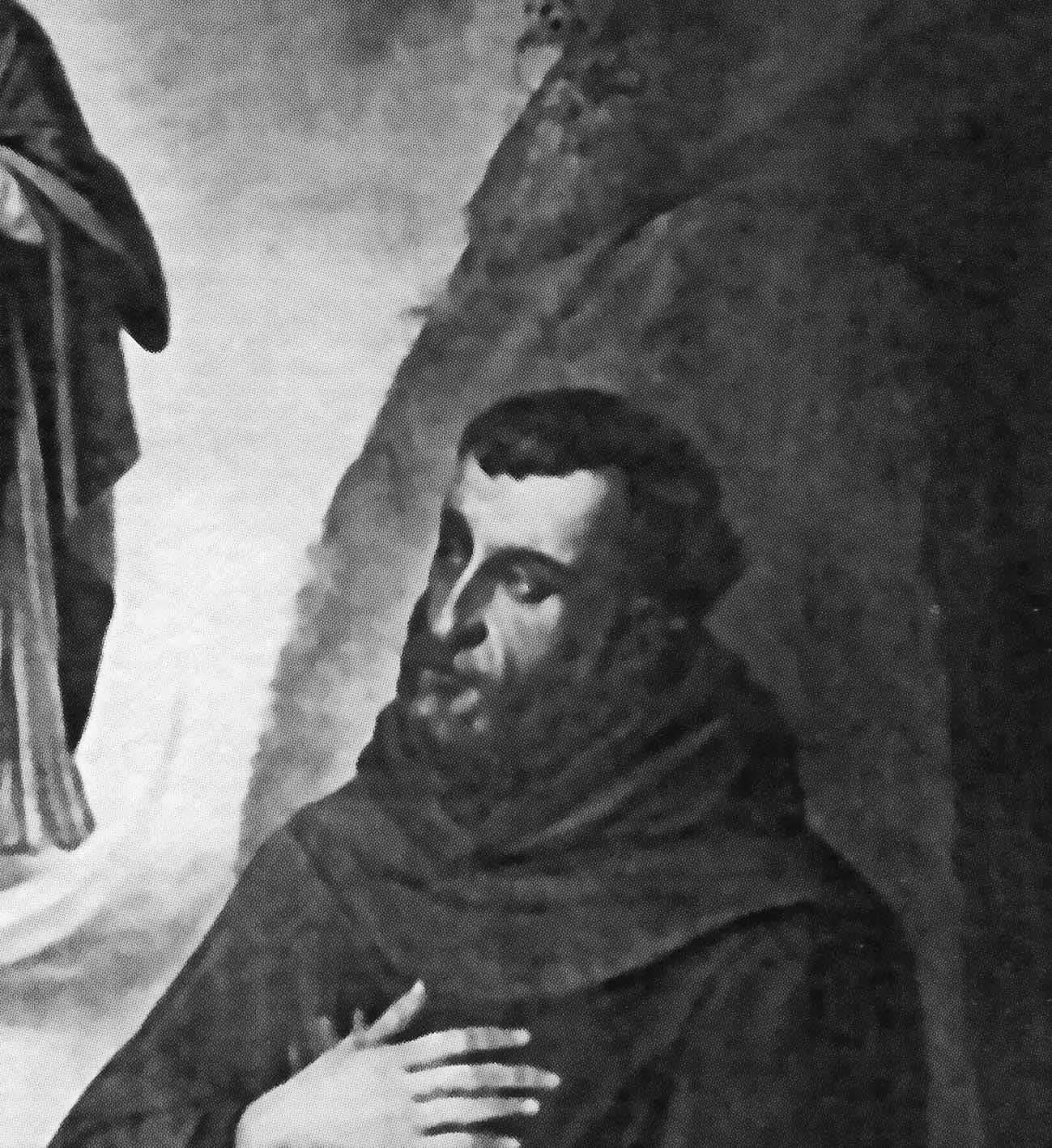
Antonio Pagani
1526-1589
Biography
Antonio Pagani (born Marco Pagani; Venice, 1526 – Vicenza, January 4, 1589) stands as one of the most intellectually compelling and institutionalized figures of the Franciscan Observance and Catholic Reform within the sixteenth-century Republic of Venice. Operating at the crucial historical intersection between the final sessions of the Council of Trent (1545–1563) and the rigorous execution of Tridentine decrees under prominent prelates such as Saint Charles Borromeo and Bishop Agostino Valier, Pagani embodied a rare synthesis of rigorous jurisprudence, Franciscan affective mysticism, and pastoral innovation. His life's work reshaped early modern Italian spirituality by articulating a sophisticated theology of lay holiness, creating novel institutional frameworks for uncloistered consecrated women (the Compagnia delle Dimesse), and producing a vast corpus of ascetical and mystical literature that circulated widely throughout Western Europe.
Born into a respectable Venetian family in 1526, Marco Pagani received an elite education rooted in Renaissance humanism before matriculating at the prestigious University of Padua. Padua was then the premier center for legal and Aristotelian scholarship in Northern Italy, attracting minds from across the continent. There, Pagani pursued rigorous studies in both civil and canon law, culminating in the conferral of the doctorate (doctor utriusque iuris). This formidable legal foundation imbued him with an acute analytical methodology, a precise Latinity, and an enduring interest in institutional organization—traits that would uniquely distinguish his subsequent theological writings and monastic reforms from those of his contemporaries. Despite the prospect of a lucrative judicial or diplomatic career in the service of the Venetian Republic, Pagani underwent a profound spiritual crisis during his early post-academic years. Drawn to the ideal of evangelical poverty and interior recollection, he renounced his worldly honors in 1545 and entered the Order of Friars Minor Observant (Ordo Fratrum Minorum Regularis Observantiae) at the friary of San Biagio in Vicenza, adopting the religious name Antonio.
Upon completing his novitiate and receiving holy orders, Friar Antonio Pagani quickly emerged as a dynamic preacher, spiritual director, and theological polemicist. His deep erudition in Patristic theology, scholasticism, and canon law elevated him to key positions within the Venetian province of the Observants. During the mid-sixteenth century, as Northern Italy grappled with the infiltration of Protestant ideas across the Alpine borders, Pagani was mobilized as a defender of orthodox Catholic ecclesiology. He traveled extensively throughout Venice, Vicenza, Padua, Verona, and Udine, delivering powerful Lenten sermon series that combined fiery rhetoric with rigorous moral theology. His theological expertise caught the attention of eminent Counter-Reformation leaders; he maintained close intellectual ties with Cardinal Agostino Valier, Bishop of Verona, and Nicolò Ormaneto, Bishop of Padua and former vicar to Cardinal Reginald Pole. Through these networks, Pagani actively participated in the local implementation of Tridentine reforms, emphasizing clerical discipline, frequent reception of the sacraments, and the systematic catechesis of the laity.
Pagani's written output is vast and multifaceted, spanning ascetical manuals, mystical guides, and institutional constitutions. Among his most celebrated works is L'Huomo Apostolico (first published in Venice, 1575), an exhaustive treatise outlining the spiritual, moral, and practical duties of Catholic priests and missionaries engaged in pastoral care. In this text, Pagani harmonized Bonaventurian Franciscan affectivity with the structured discipline required by post-Tridentine pastoral theology. Another major work, Le Divine Solitudini and its companion Specchio della perfettione Christiana (1577), explored the interior life, providing lay readers with systematic methods of mental prayer and meditation drawn from the Devotio Moderna and Franciscan mystical traditions. Pagani's mystical synthesis reached its apex in his Somma della Teologia Mistica, wherein he adapted pseudo-Dionysian apophatic theology and Saint Bonaventure's Itinerarium Mentis in Deum for a broader, vernacular audience, arguing that supreme contemplation was not the exclusive domain of cloistered monastics, but was accessible to all Christians striving for charity and evangelical perfection.
The publishing history of Antonio Pagani's works provides a vivid window into the vibrant print culture of late sixteenth-century Venice. Venice was the undisputed capital of European typography, housing prestigious printing establishments that specialized in religious and liturgical texts designed to fulfill the vast demand created by the Catholic Reformation. Pagani worked in close collaboration with renowned Venetian printer-publishers, most notably the houses of Domenico & Giovanni Battista Guerra, Francesco de' Franceschi, Giorgio Angelieri, and Andrea Muschio. These publishers issued Pagani's texts primarily in octavo and duodecimo formats—portable, durable volumes intended for daily personal devotion, spiritual direction, and pastoral travel. Printed with clean Roman and Italic types, decorated with elegant woodcut initials, and frequently featuring allegorical frontispieces or woodcuts of Saint Francis receiving the stigmata, Pagani's books were immediate commercial and devotional successes. They underwent numerous printings and editions, receiving the necessary ecclesiastical imprimatur from Venetian inquisitorial censors and the Senate, and circulating heavily throughout Italy, Spain, France, and the Southern Netherlands.
Central to Pagani's historical and spiritual legacy was his revolutionary contribution to the status of religious women in early modern society. Recognizing the social constraints of his era—where women were frequently forced into institutional cloisters against their will (monacazione forzata) or left without social protection—Pagani envisioned a novel form of consecrated secular life. In 1579, alongside the noblewoman Maria Alberghetti, Pagani founded the Compagnia delle Dimesse (Sisters of the Annunciation) in Vicenza. The Dimesse were pious women who took private vows of chastity, poverty, and obedience, but remained in their family homes or small uncloistered communities, active in teaching, charitable work, and the education of young girls. This institutional model offered women spiritual autonomy and an active apostolic role without the requirement of solemn papal enclosure (clausura). Simultaneously, Pagani established lay fraternities for men, such as the Compagnia di San Bartolomeo and the Fratelli della Croce (often designated as Lupi or Oblati), aimed at deepening lay piety and social charity.
Following a life of unrelenting ascetical rigor, tireless preaching, and prolific authorial labor, Antonio Pagani died in Vicenza on January 4, 1589, surrounded by his Franciscan brothers and spiritual disciples. His death prompted an immediate wave of popular veneration throughout the Venetian hinterland. In the centuries following his death, the cause for his beatification was formally introduced in Rome, leading to his designation as Venerable within the Catholic Church. Modern historiography—spearheaded by twentieth- and twenty-first-century scholars of Franciscan history, Venetian church history, and gender studies—has re-evaluated Pagani not merely as a pious author, but as a crucial architect of post-Tridentine lay spirituality and a pioneer of active female religious life in early modern Europe.
Bibliography
Casoni, Francesco. Vita del P. F. Antonio Pagani da Venezia, Minore Osservante, fondatore delle delle Vergini Dimesse e della Compagnia di S. Bartolomeo. Vicenza: Appresso Giovanni Pietro Sardi, 1616.
Ridolfi, Bernardino. Vita, virtù, e miracoli del Venerabile Servo di Dio P. Antonio Pagani di Venetia, Teologo dell'Ordine dei Minori d'Osservanza. Venice: Appresso Bernardo Giunti, 1629.
Wadding, Luke. Scriptores Ordinis Minorum quibus accessit Synopsis Praeclarorum Speciminum quae liberi posteris reliquere. Rome: Ex Typographia Francisci Alberti Tani, 1650, 31-32.
Sbaraglia, Giovanni Giacinto. Supplementum et castigatio ad scriptores trium ordinum S. Francisci a Waddingo aliisve descriptos. Rome: Ex Typographia S. Michaelis ad Ripa, 1806, 88-89.
Da Carmignano, Bernardino. Il Venerabile Antonio Pagani, minore osservante: profilo storico e spirituale. Vicenza: Tipografia Vescovile San Giuseppe, 1930.
Sartori, Antonio. "Documenti padovani su p. Antonio Pagani OFM (1526-1589)". Archivum Franciscanum Historicum 52 (1959): 140-165.
Cargo, Giovanni. P. Antonio Pagani OFM (1526-1589) e la riforma tridentina a Vicenza. Vicenza: Esca Editrice, 1982.
Zovatto, Pietro. "La spiritualità di Antonio Pagani e le origini delle Dimesse". In Storia della spiritualità italiana, edited by Pietro Zovatto, 185-198. Rome: Città Nuova, 2002.
Niero, Antonio. "Riforma cattolica e istituti femminili a Venezia: Antonio Pagani e le Dimesse". Studi Veneziani, n.s., 48 (2004): 113-145.
Simioni, Luciana. Antonio Pagani: Un giurista al servizio del Vangelo (1526-1589). Padua: Edizioni Messaggero, 2009.
Trevisan, Maria Teresa. La spiritualità mistica di Antonio Pagani OFM e la stampa veneta del Cinquecento. Vicenza: Accademia Olimpica, 2015, 45-88.
Beyond the names: biographies and bibliographies on this page are curated by Abu, the AI scholar crafted by Buonvecchio exclusively for Govi Rare Books.