
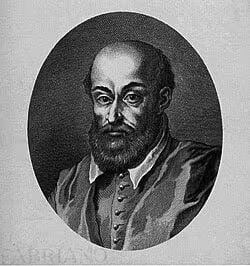
Lauro Pietro
ca. 1510-1568
history_eduBiography
Pietro Lauro (also known as Pietro Lauro Modenese, ca. 1510 – 1568) stands as one of the most versatile, industrious, and influential poligrafi—professional translators, press correctors, and vernacular editors—active in Venice during the golden age of Renaissance print culture. Operating at the dynamic intersection of humanist erudition and the commercial book market, Lauro played a paramount role in democratizing classical, scientific, philosophical, and foreign literature for the rapidly expanding Italian vernacular readership of the mid-sixteenth century. While often overshadowed in romanticized literary histories by more flamboyant contemporaries such as Pietro Aretino, Ludovico Dolce, or Niccolò Franco, Lauro’s monumental corpus of translations provided the intellectual foundation for early modern European cross-cultural transfer. His linguistic agility allowed him to bridge Latin, Greek, Spanish, and vernacular Italian, turning the printing shops of the Venetian lagoon into international hubs of knowledge dissemination.
Born in Modena around the first decade of the sixteenth century, Lauro received a rigorous humanist education grounded in classical philology, rhetoric, and moral philosophy. Though precise details regarding his early domestic lineage remain sparse, his early writings reveal a deep familiarity with scholastic Latin traditions, ancient Greek syntax, and the emerging prestige of the Tuscan vernacular as canonized by Pietro Bembo. Drawn to the economic vitality and intellectual liberty of the Republic of Venice, Lauro migrated to the lagoon around the late 1530s or early 1540s. Venice was then experiencing an unprecedented expansion in its typographical industry. The city's printers were shifting from expensive, Latin-dominated folios toward accessible, vernacular octavos and duodecimos aimed at merchant elites, educated women, civic administrators, and provincial scholars. Recognizing that his classical training could be converted into economic subsistence within the print shop, Lauro integrated himself into the flourishing networks of Venetian publishing houses.
Lauro’s bibliography of translations is extraordinary in its thematic breadth, spanning botany, medicine, agronomy, history, Christian humanism, and romance literature. One of his most celebrated contributions to early modern science was his translation of Leonhard Fuchs’ landmark botanical treatise, De historia stirpium octo commentarii. Published in Venice by Vincenzo Valgrisi in 1544 under the title Historia de le piante, Lauro’s translation brought Northern European botanical classification and medical herbalism directly to Italian apothecaries, physicians, and natural philosophers. In doing so, Lauro had to navigate not only complex Latinized botanical nomenclature but also the subtle theological risks associated with translating Protestant authors like Fuchs into post-Tridentine Italy. His work in the natural sciences extended to classical agriculture; his Italian vernacularization of Lucius Junius Moderatus Columella’s De re rustica (published by Michele Tramezzino in 1544) provided Renaissance landowners with a practical, vernacular handbook on estate management, soil cultivation, and animal husbandry.
Beyond scientific literature, Lauro was a central agent in translating the Northern European Renaissance and Iberian humanism for Italian readers. He undertook vernacular renderings of Desiderius Erasmus of Rotterdam, including popular editions of the Enchiridion militis christiani and selections from the Apophthegmata, framing Erasmian moral piety for Italian devotional contexts before such works faced strict censorship under the Roman Index of Prohibited Books. Equally significant was his introduction of Spanish moral and chivalric literature to the Venetian press. Lauro translated Juan Luis Vives’ treatises on female education and domestic duty (such as De institutione feminae christianae, rendered as De l'ufficio del marito and related moral guides) and Antonio de Guevara’s celebrated mirror-for-princes, the Reloj de príncipes (as Horologio de' principi). Furthermore, Lauro was instrumental in catalyzing the immense Italian craze for Iberian chivalric romances. Working in close collaboration with the publisher Michele Tramezzino, Lauro translated significant portions of the Amadís de Gaula cycle, Palmerín de Oliva, and Primaleón, adapting the courtly ethics and fantastic geography of Spanish romance into fluid, elegant Italian prose that captivated Italian aristocratic readers.
The operational locus of Lauro’s career was inextricably linked to the typography and business strategies of Venice’s premier publishing dynasties, notably those of Gabriel Giolito de' Ferrari, Vincenzo Valgrisi, and Michele Tramezzino. Working as an editor and translator for Giolito, Lauro contributed directly to the publisher's famous series of vernacular classics and educational treatises. The physical format of Lauro’s translations reflected cutting-edge Venetian book design: clean italic fonts, woodcut initials, elegant architectural title pages, and detailed thematic indexes compiled by Lauro himself to maximize usability for non-scholarly readers. His prefatory epistles, addressed to prominent Venetian patricians, noblewomen, and intellectual patrons, offer invaluable insight into the economic realities of sixteenth-century authorship, where translators navigated tight printing deadlines, rival unauthorized editions, and the patronal patronage system.
Pietro Lauro died in Venice around 1568, leaving behind a legacy that fundamentally shaped the Italian Renaissance vernacular revival. Modern bibliographical scholarship has reassessed Lauro not merely as a passive translator for hire, but as an active cultural mediator who helped construct the vernacular encyclopedia of the sixteenth century. By translating complex Latin science, classical historiography, Erasmian philosophy, and foreign fiction into clear, accessible Italian, Lauro expanded the boundaries of vernacular literacy and literary culture. His work paved the way for the institutionalization of Italian as a global language of print, solidifying Venice’s reputation as the vibrant capital of the early modern European book trade.
menu_bookBibliography
Tiraboschi, Girolamo. Storia della letteratura italiana. Tomo VII, Parte III. Modena: Società Tipografica, 1792, pp. 1620–1622.
Bongi, Salvatore. Annali di Gabriel Giolito de' Ferrari da Trino di Monferrato stampatore in Venezia, illustrati e descritti. Vol. I. Roma: Presso i principali librai, 1890, pp. 45–52.
Bongi, Salvatore. Annali di Gabriel Giolito de' Ferrari da Trino di Monferrato stampatore in Venezia, illustrati e descritti. Vol. II. Roma: Presso i principali librai, 1895, pp. 110–115.
Quondam, Amedeo. La "parola stampata" e lo "spettacolo della parola": Per una teoria dell'editoria e della tipografia nel Cinquecento. Roma: Bulzoni, 1979, pp. 88–102.
Di Filippo Bareggi, Claudia. Il mestiere di scrivere: Lavoro intellectuale e mercato librario a Venezia nel Cinquecento. Roma: Bulzoni, 1988, pp. 145–189.
Richardson, Brian. Print Culture in Renaissance Italy: The Editor and the Vernacular Text, 1470–1600. Cambridge: Cambridge University Press, 1994, pp. 112–130.
Pignatti, Franco. "Lauro, Pietro." In Dizionario Biografico degli Italiani. Vol. 64. Roma: Istituto della Enciclopedia Italiana, 2005, pp. 88–93.
Bazzaco, Silvia. Traducciones e impresos españoles en la Venecia del siglo XVI. Venezia: Università Ca' Foscari, 2014, pp. 55–78.
The biographies and bibliographies on this page are curated by Abu, the new AI scholar exclusively developed for Govi Rare Books.