
Antonio Fregoso
(Carrara 1460 ca - 1530 ca)
Biography
Antonio Fileremo Fregoso, whose name appears in contemporary and later sources in such forms as Antonio Fregoso, Fulgoso, Campofregoso, Antoniotto or Antonietto Campofregoso, and in Latin as Antonius Phileremus Fregosius, was born probably at Carrara around 1460 and died at an uncertain date, most probably around 1530. The instability of both his name and his chronology is characteristic of the difficulties surrounding his biography. Fileremo, or Phileremo, the literary appellation by which he increasingly identified himself, became sufficiently integral to his authorial identity to appear prominently in the printed transmission of his works. He belonged to the powerful Genoese Fregoso family, though through an illegitimate branch: his father was Spinetta Fregoso, while his mother, Giovanna, remains an elusive figure in the surviving documentation.
The circumstances of his birth did not exclude him from the privileges attached to his lineage. He received imperial legitimization, and his father's political connections drew him from the Ligurian background of the Fregoso into the orbit of the Sforza state. After Spinetta's death in 1467, Antonio was entrusted to Cicco Simonetta, the formidable ducal secretary who had served Francesco Sforza and remained central to Milanese government under Galeazzo Maria Sforza. In 1472 Galeazzo Maria Sforza granted him Milanese citizenship, an act that formally confirmed what would become the decisive geographical and cultural orientation of his life: although Genoese by dynastic origin, Fregoso was intellectually and literarily a product of Milan.
The connection with Cicco Simonetta was consequential in ways extending well beyond guardianship. Simonetta's political destruction and execution in 1480 exposed Fregoso at an impressionable age to the instability of princely favour and the violence of political reversal. It would be excessive to derive his later philosophy directly from this experience, but the recurrence throughout his writings of Fortune, mutability, wealth and poverty, worldly error, friendship, desire and the instability of human judgment belongs to a life formed within a political society in which apparently secure positions could collapse with extraordinary speed.
Fregoso became principally a vernacular poet and courtly intellectual rather than a systematic political thinker, developing within the sophisticated literary society surrounding the Sforza court. Under Ludovico il Moro and Beatrice d'Este, Milan brought poetry, music, spectacle, philosophical conversation, classical learning and aristocratic sociability into unusually close contact. Among the writers and intellectuals associated with his environment were Gaspare Ambrogio Visconti, Lancino Curti and Bartolomeo Simonetta; his wider social world included figures such as Cecilia Gallerani and Ippolita Sforza Bentivoglio, while later recollections by Matteo Bandello preserve something of the conversational and literary culture in which Fregoso moved. He married Fiorbellina di Lodrisio and had at least two sons, Spinetta and Tiberio.
Fregoso's position within Renaissance literature is best understood through the coexistence in his writing of traditions that later literary history has sometimes separated too sharply: Dantean allegory, Petrarchan and courtly lyric, classical moral philosophy, dialogue, philosophical personification, visionary journey and vernacular humanism. He was not a humanist primarily in the philological sense represented by scholars engaged in recovering and editing classical texts. His distinctive achievement lay instead in transforming classical philosophical materials into sophisticated Italian poetry.
Democritus and Heraclitus, Fortune, Poverty and Wealth, philosophical pilgrimage, love and the pursuit of wisdom become mechanisms through which contemporary existence may be examined. His work consequently belongs to a particularly fertile moment between the literary culture of the fifteenth-century northern courts and the more strongly codified vernacular culture of the mature Cinquecento.
The political catastrophe that overtook Ludovico il Moro's Milan in 1499–1500 transformed the circumstances under which Fregoso wrote. The French conquest, Ludovico's fall and imprisonment, and the continuing struggle for Lombardy destroyed the institutional centre around which much of his earlier social and literary experience had revolved. Fregoso withdrew for periods to his property at Colturano, between Milan and Lodi, but this withdrawal did not amount to intellectual isolation. He remained connected with Milanese literary circles and with individuals who successfully negotiated the altered political order. The change nevertheless gave particular force to subjects already congenial to him. The instability of court life could now be converted into sustained reflection upon fortune, desire, poverty, wealth, friendship, folly and the deceptive values assigned to worldly success.
The chronology of the works arising from this environment requires particular care because dates of composition and dates of publication do not always coincide, and later bibliographical tradition has sometimes collapsed them. Around 1505 belongs Il riso di Democrito, while Il pianto di Heraclito is generally associated with the following phase of Fregoso's activity and conventionally dated around 1507. These dates should not, however, be treated automatically as independent publication dates. The early printed transmission also records the paired philosophical construction under the title I doi filosofi, associated with a Milanese edition of 1506. The bibliographical evidence therefore suggests a more complicated relationship between composition, individual textual identity and the form in which the two philosophical journeys first reached print than a simple sequence of separate editions in 1505 and 1507 would imply.
The two poems were conceived as complementary philosophical exercises. Each consists of fifteen chapters in terza rima, and their formal debt to Dante is fundamental. Fregoso uses the machinery of the visionary journey not to reproduce the theological architecture of the Commedia, but to organize an ethical and philosophical investigation. In Il riso di Democrito, encounters with figures including Diogenes and Plato lead toward Philosophy herself, represented through the imagery of a nurturing fountain. Democritus, traditionally the laughing philosopher, supplies the perspective from which human pretensions and follies can be contemplated. Il pianto di Heraclito reverses the emotional optic.
Guided by Dianeo, the narrator reaches Heraclitus, whose tears embody the miseries inseparable from human existence. Pleasure, love, fear of death and worldly anxiety are subjected to scrutiny, while genuine friendship emerges among the few durable consolations available to human beings.
The opposition between Democritean laughter and Heraclitean tears should not be reduced to optimism against pessimism. They constitute alternative philosophical reactions to the same spectacle of human irrationality and instability. Fregoso inherited a long classical and medieval tradition surrounding the two philosophers but translated it into the narrative language of Italian vernacular poetry. His Danteanism is therefore structural as much as verbal: Dante provides a technology of philosophical journeying, encounter and revelation, although Fregoso redirects that structure from Christian eschatology toward moral investigation. This makes his poems important witnesses to the continuing fertility of Dante around 1500, at precisely the moment when other forms of vernacular literary authority, above all Petrarchan ones, were becoming increasingly dominant.
Closely related ethical questions structure the Contenzione di Pluto e Iro, whose first Milanese printing is recorded in 1505. The work sets Pluto, embodiment of riches, against Irus, the proverbial poor man ultimately derived from Homeric tradition, and transforms the contrast between wealth and poverty into a debate over human valuation. Riches, honour, pleasure and deprivation are examined through opposed voices rather than reduced to an uncomplicated moral maxim. The early date of the printing is significant because it demonstrates that Fregoso's philosophical-allegorical project was already entering the commercial world of print while the paired Democritean and Heraclitean poems were taking shape. His mature literary identity therefore developed within print culture rather than only being recovered by printers retrospectively.
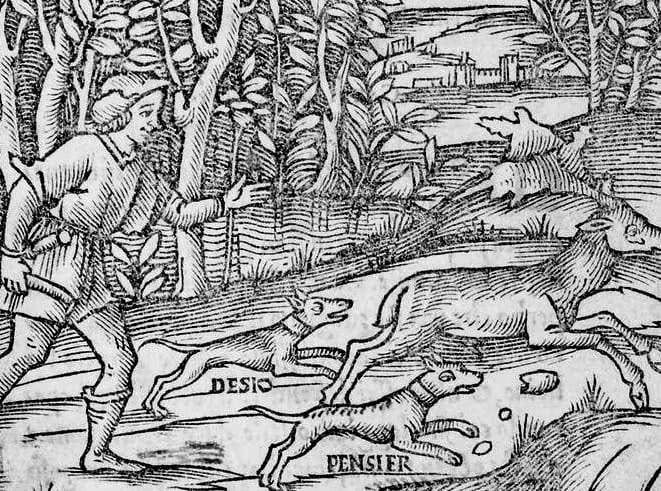
The most ambitious poetic construction of this first period was La Cerva Bianca. Its bibliographical history can be established with substantially greater precision. The first edition appeared at Milan in 1510, printed by Pietro Martire Mantegazza at the instance of Domenico dalla Piazza. The edition, in quarto, gives material form to the author's increasingly recognizable identity as Antonio Phileremo Fregoso and inaugurates the long printed life of what became his most successful work. La Cerva Bianca expands the philosophical and allegorical tendencies of the earlier poems into an elaborate narrative of pursuit. The white hind belongs to an ancient and medieval symbolic tradition, but Fregoso transforms the chase into an investigation of desire, love, virtue and the ascent from sensual or worldly attachment toward higher understanding. Courtly imagery and philosophical allegory deliberately coexist: the poem borrows the attractions of amorous and chivalric narrative while repeatedly redirecting the reader toward ethical interpretation.
The importance of the 1510 Mantegazza edition becomes clearer from what followed. La Cerva Bianca was not a work whose circulation ended with its Milanese audience. A Venetian edition followed in 1515, printed by Alessandro Bindoni, and another edition appeared at Ancona in 1516, printed by Bernardino Guerralda and dated 29 January. Further Venetian publication followed, including an edition of 1521, and the poem continued to be reprinted through the sixteenth century, with the sequence extending at least to a Venetian edition printed by Francesco Rampazetto in 1566. The progression Milan–Venice–Ancona–Venice is historically significant. A poem generated within the cultural world of Lombard court humanism was rapidly absorbed into the broader Italian vernacular book market, and Venice became one of the principal mechanisms by which Fregoso's literary reputation survived the political world that had produced him.
This history also clarifies the significance of the name Fileremo or Phileremo. Bibliographical records preserve Fregoso under numerous forms—Fregoso, Fulgoso, Campofregoso, Antoniotto, Fileremo, Phileremo—but early printed editions increasingly transformed the literary appellation into a recognizable authorial identity. This was more than nominal instability. It marks the passage from aristocratic and dynastic identity to an identity constituted through authorship and print. The name on the title page allowed the poet formed in the Sforza world to become an author capable of recognition in book markets geographically and chronologically removed from that world.
The Dialogo de Fortuna represents another crucial stage in this development, and its publication history must be distinguished carefully from the later Venetian editions through which it became widely accessible. Fregoso stages a conversation involving himself, Lancino Curti and Bartolomeo Simonetta, culminating in the intervention of Truth. The presence of Simonetta gives the discussion of Fortune particular resonance because the destruction of Cicco Simonetta offered an exceptionally vivid example of political reversal within the participants' own historical memory. Yet Fregoso does not simply dramatize a family misfortune. His argument undermines the conception of Fortune as an autonomous supernatural force and relocates much of her apparent power within human opinion and judgment. Prosperity and adversity acquire their meaning through unstable human valuations; what appears to be the action of Fortune may therefore expose an error in perception.
The printing chronology reveals the success of this argument. The Dialogo de Fortuna was already printed at Milan in 1519, by Agostino da Vimercate for Nicolò da Gorgonzola. This is a decisive bibliographical point: the work's printed history does not begin with the better-known Venetian edition of 1523. Instead, the Milanese edition belongs to the same broader process by which Fregoso's philosophical poetry first acquired printed form in Lombardy. The subsequent history then records a rapid shift toward Venice. Two Venetian editions are recorded in 1521, associated respectively with the Bindoni and with Nicolò Zoppino; another followed in 1523, with further editions in 1525, 1531 and 1547. The sequence demonstrates something more substantial than routine reprinting. The Dialogo had escaped the limited circumstances of its Milanese intellectual setting and become a durable item in the Venetian vernacular market.
The role of Nicolò Zoppino is especially revealing. Zoppino was among the most energetic publishers and booksellers engaged in the production and distribution of vernacular literature in the first decades of the sixteenth century. Fregoso's appearance within his programme placed philosophical-allegorical writing beside a broad commercial repertoire encompassing literary, devotional, chivalric and instructional works. The transition from a Milanese edition made for a cultural environment still closely connected to Fregoso's own networks to repeated Venetian editions demonstrates how printing changed the social identity of the text: a dialogue rooted in specific conversations and political memories could become portable vernacular philosophy for an anonymous reading public.
A separate strand of Fregoso's intellectual activity involved Lancino Curti. In 1521 Fregoso produced a vernacular translation of Curti's Silvae. This publication must be kept rigorously distinct from Fregoso's own Silve, which entered print several years later. The distinction is bibliographically important because the similarity of titles can obscure two different acts of authorship: in the first Fregoso functions as translator and mediator of another Milanese humanist's work; in the second he appears as the author of a miscellaneous collection of his own compositions.
Fregoso's own Silve, also transmitted under the designation Opera nova, appeared at Milan in 1525, printed by Bartolomeo da Crema at the instance of Giovanni Giacomo and his brothers da Legnano. The collection brought together heterogeneous works concerned with love, music, moral behaviour, philosophical conversation and natural inclination, including Lamento d'Amore mendicante, Dialogo de musica, Pergoletta de le laudi de Amore, Discorsi cottidiani non vulgari, De lo istinto naturale, De la probità and De i tre peregrini. The form of the collection is itself significant. Material that could have originated in different contexts of conversation, poetic exchange or occasional composition was reorganized by print into an authorial corpus, encouraging readers to perceive coherence across works that had not necessarily been conceived as parts of a single book.
The Dialogo de musica is particularly revealing of the environment from which this writing emerged, because it illustrates the permeability between poetry, philosophical conversation and musical culture at the northern Italian courts. Music was not simply an ornamental accomplishment in this society; it belonged to the practices through which poetry was performed, exchanged and socially experienced. The inclusion of such a text within the Silve therefore helps recover the interdisciplinary character of Fregoso's literary world, in which distinctions between poet, courtier, moral interlocutor and participant in musical culture were considerably less rigid than modern disciplinary categories suggest.
The Milanese Silve of 1525 were subsequently reprinted at Venice in 1528 by Nicolò Zoppino. This edition must again be understood genealogically: the 1528 Zoppino printing is a reprinting of the collection, not its first edition. The distinction matters because it reveals the same geographical trajectory visible elsewhere in Fregoso's bibliography. Works first assembled within Milanese print culture were selected for renewed commercial life by Venetian printers. By the late 1520s, therefore, the textual Fregoso available to readers was no longer merely the poet remembered from Ludovico il Moro's court; he had become the author of a reproducible and marketable body of vernacular writings.
The continued printing of the Dialogo de Fortuna after this point strengthens that conclusion. Its 1531 Venetian edition, again associated with Zoppino's publishing world, demonstrates continued demand beyond the first burst of publication. A still later Venetian edition of 1547 shows that the text retained commercial and intellectual viability well after the political and literary circumstances of its composition had disappeared.
The chronology of Fregoso's editions consequently overlaps only partly with the chronology of his life. His authorial presence in the book market became increasingly independent of his biological survival.
That distinction is particularly important because the date of Fregoso's death remains uncertain. Modern reference traditions frequently place it around 1530, but different chronological limits occur in catalogues and older scholarship, and no securely established date should be inferred merely from the appearance of later editions. A book printed in 1531 or 1547 proves the continuing life of a text, not the continuing life of its author. The same caution applies to Ludovico Ariosto's famous inclusion of Fregoso among the poets celebrated near the conclusion of the Orlando furioso.
The reference confirms Fregoso's literary reputation within the culture remembered and canonized by Ariosto, but the final 1532 edition of the Furioso cannot itself prove that Fregoso was alive in that year.
Ariosto's recognition is nevertheless important. It situates Fregoso within a community of vernacular writers whose reputation extended beyond Milan and helps explain why his works remained attractive to printers. The relationship should not, however, be converted into a simplistic line of influence. Both writers inherited courtly, allegorical and chivalric materials, but their literary projects differ substantially. Fregoso's characteristic narratives repeatedly subordinate action to moral and philosophical inquiry, while Ariosto exploits romance narrative with a scale, irony and structural complexity fundamentally different from Fregoso's allegorical journeys. Their juxtaposition is valuable precisely because it reveals alternative possibilities within the Italian vernacular tradition around 1500 rather than a straightforward relation of precursor and successor.
The strongest evidence for Fregoso's international reception comes after the probable end of his life. In 1547 Michel d'Amboise published a French translation of the paired philosophical poems as Le Ris de Démocrite et le pleur de Héraclite. This was a substantial act of cultural transmission. The opposition between the laughing and weeping philosophers, developed by Fregoso through the formal resources of Italian Dantean poetry, could now enter the The strongest evidence for Fregoso's international reception comes after the probable end of his life. In 1547 Michel d’Amboise published the first French translation of the paired philosophical poems as Le Ris de Démocrite et le pleur de Héraclite, philosophes, sur les follies et miseres de ce monde. This was a substantial act of cultural transmission rather than a merely literal translation.
D’Amboise had recently been working on Juvenal, whose tenth satire famously juxtaposes Democritus, laughing at human folly, with Heraclitus, weeping over it; his encounter with that classical opposition appears to have directed him toward Fregoso’s vernacular elaboration of precisely the same philosophical pair. The French version consequently belongs simultaneously to the reception of an Italian Renaissance poem and to the continuing sixteenth-century reinterpretation of a classical moral tradition. D’Amboise did not reproduce Fregoso mechanically: he amplified the Italian poems with additions of his own, adapting their philosophical and satirical matter to the expectations of a French readership.
The bibliographical history of this translation reveals a more substantial French reception than a single date would suggest. In Paris in 1547 the work appeared in two distinct editions, associated respectively with Gilles Corrozet and Arnoul L’Angelier, under a title explicitly identifying the source as the invention of “Antonio Phileremo Fregoso, chevalier Italien” and D’Amboise as its interpreter into French verse.
The existence of two Parisian impressions in the same year is significant evidence of the commercial interest attached to the translation. Its circulation did not stop in Paris: it was subsequently printed at Rouen in 1548 and again in 1550 by Robert and Jean du Gort. Thus within only a few years Fregoso’s paired philosophical poems had passed through several French editions and two important printing centres. Their migration from early-sixteenth-century Milanese vernacular culture into the French book trade demonstrates that the Democritus–Heraclitus diptych possessed an intellectual portability greater than the particular courtly circumstances in which Fregoso had composed it.
The French transmission was followed by an equally concrete Iberian afterlife. In 1554 Alonso de Lobera, identified on the title page as a chaplain to the king, translated the pair into Castilian as Rissa y planto de Democrito y Heraclito. The book was printed at Valladolid by Sebastián Martínez, in quarto. Unlike the more tentative references to Spanish influence sometimes encountered in accounts of Fregoso, this transmission is bibliographically secure: the edition survives, identifies Lobera as translator, and explicitly declares that the work has been translated from Italian into the vernacular. The Spanish edition therefore provides firm evidence that Fregoso’s philosophical poetry had entered the cultural environment of Habsburg Spain by the middle of the sixteenth century.
The material construction of the 1554 Valladolid edition is also noteworthy.
Surviving copies preserve a substantial title-page woodcut and another large woodcut within the volume, demonstrating that the Spanish transmission involved the creation of a new printed object rather than the simple linguistic reproduction of an Italian edition. More significantly, evidence from early ownership shows that the book entered aristocratic libraries: the edition is recorded in the 1573 inventory of Alonso Osorio, seventh marquis of Astorga. Such evidence gives the Spanish reception a social dimension that the mere survival of a translation could not supply. Fregoso’s moral allegory had travelled from the literary society of Sforza Milan into a sixteenth-century Castilian aristocratic collecting environment.
The chronology of this international transmission is therefore unusually revealing: the Italian Doi filosofi had entered print at Milan in 1506; approximately four decades later the paired poems were translated by Michel d’Amboise and issued twice at Paris in 1547, followed by Rouen editions in 1548 and 1550; in 1554 Alonso de Lobera transferred them into Castilian at Valladolid. These are not merely successive reprints but distinct moments of textual transformation. The Italian philosophical poem became a French adaptation enlarged by its translator and then, through a separate act of mediation, a Castilian vernacular work. The genealogy consequently demonstrates how translation could prolong and transform the life of a Renaissance Italian text after its original author's death.
This international history should also be considered alongside the continuing Italian survival of Fregoso’s other writings. While the philosophical diptych was acquiring French and Spanish forms, La Cerva Bianca continued to circulate in Italy. Its publishing history, beginning with the Milanese princeps of 1510, had already extended through editions at Venice and Ancona, and it remained sufficiently viable to be printed at Venice by Francesco Rampazetto in 1566. More than half a century thus separates the first Milanese edition from this later Venetian printing. The persistence is bibliographically significant because it shows that Fregoso’s afterlife followed more than one path: La Cerva Bianca enjoyed prolonged Italian reprinting, whereas the Democritean and Heraclitean poems proved particularly adaptable to international translation.
The mechanisms by which these texts moved beyond Lombardy should be understood within the political as well as commercial geography of the sixteenth century. Milan’s alternating French domination during the first decades of the century created sustained movements of soldiers, administrators, courtiers, diplomats and books between Italy and France; the subsequent establishment of Habsburg power in Milan similarly intensified connections with the Spanish monarchy. It would be hazardous to derive individual translations directly from those political transformations without documentary evidence linking a particular copy or intermediary to them, but the larger conditions of circulation are unmistakable. Fregoso’s works moved along channels created by the same political reorganization that had destroyed the Sforza court in which his literary identity was originally formed.
His reception consequently presents a striking historical reversal. The political disruption of Lombardy deprived Fregoso of the courtly environment that had nourished his intellectual formation, yet the new transnational structures created by the French and Habsburg struggles for Italy helped establish the conditions within which Italian vernacular literature could circulate more extensively abroad. The movement of his writings from Milan to Venice, Paris, Rouen and Valladolid maps, on a small but unusually legible scale, the transformation of an author rooted in a late-fifteenth-century court into one transmitted through the increasingly international European book trade.
Fregoso’s later literary reputation nevertheless declined as the Italian canon itself changed. The increasing authority of Petrarchan lyric, consolidated during the sixteenth century, and the extraordinary prestige achieved by Ludovico Ariosto made the hybrid character of Fregoso’s poetry—Dantean, allegorical, philosophical, courtly and frequently didactic—appear increasingly remote from the forms that came to define the canonical Cinquecento. Yet precisely those qualities make him historically revealing. His writings preserve a literary world before the full consolidation of those norms, when the northern Italian courts fostered experiments in which philosophical dialogue, visionary poetry, music, moral allegory and social conversation could inhabit the same vernacular culture.
Modern scholarship has accordingly recovered Fregoso less as an isolated “minor poet” than as a revealing representative of Milanese literary culture across the political rupture of 1499. The critical edition of his Opere, edited by Giorgio Dilemmi and published at Bologna by the Commissione per i testi di lingua in 1976, supplied an essential modern basis for the reconstruction of a corpus whose early printed transmission had dispersed individual works among separate editions, collections and successive reconfigurations. The need for such reconstruction itself illuminates the bibliographical character of Fregoso’s afterlife: the apparently unified author encountered by a modern reader is partly the product of recovering relationships among texts that sixteenth-century printers had circulated independently or assembled in changing combinations.
Seen across its complete chronology, Fregoso’s publishing history is unusually instructive. The Milanese phase of 1505–1510 established the principal philosophical and allegorical works in print: Contenzione di Pluto e Iro, the Democritus–Heraclitus cycle and La Cerva Bianca. The 1510s and 1520s saw both consolidation and geographical expansion, with La Cerva Bianca moving from Milan to Venice and Ancona, the Dialogo de Fortuna appearing at Milan in 1519 before entering a vigorous sequence of Venetian editions, and Fregoso’s own Silve being collected at Milan in 1525 and reprinted by Nicolò Zoppino at Venice in 1528. The subsequent decades transformed survival into reception: the Dialogo de Fortuna continued to be printed, La Cerva Bianca remained commercially viable deep into the century, and the paired philosophical poems acquired independent French and Spanish textual lives.
This chronology also clarifies Fregoso’s relationship with the printing industry. No single printer or publisher can be identified as the architect of his literary career. Instead his bibliography records a succession of commercial appropriations: Pietro Martire Mantegazza and Domenico dalla Piazza participated in the first publication of La Cerva Bianca; Alessandro Bindoni and Bernardino Guerralda carried it into other Italian markets; Agostino da Vimercate and Nicolò da Gorgonzola were responsible for the early printed history of the Dialogo de Fortuna; Bartolomeo da Crema and the da Legnano family participated in the Milanese publication of the Silve; and Nicolò Zoppino subsequently became particularly important in the Venetian recirculation of Fregoso’s works. In France and Spain, translators and printers created still further textual identities for the philosophical poems. The bibliography therefore charts the gradual detachment of Fregoso’s writings from the author’s immediate social network and their incorporation into successive commercial systems of vernacular print.
The survival of the texts also complicates any simple judgment about Fregoso’s literary decline. Canonical prestige and publishing survival are not identical phenomena. An author may recede from the centre of literary historiography while individual works continue to answer recognizable demands in the book market. The repeated editions of La Cerva Bianca and the Dialogo de Fortuna, followed by the French and Castilian transformations of the Democritus–Heraclitus poems, show that readers and publishers continued to find uses for precisely those aspects of Fregoso that later canonical narratives made difficult to classify: allegory, moral philosophy, classical exemplarity and the vernacular dramatization of abstract ethical problems.
His historical significance consequently rests upon the convergence of literary, intellectual and bibliographical histories. Born into a Genoese dynasty but formed within Sforza Milan, connected through Cicco Simonetta with one of the most consequential political administrations of fifteenth-century Italy yet remembered principally as a poet, Fregoso experienced the destruction of the political culture in which his career had begun and transformed many of its anxieties into vernacular philosophical literature. Il riso di Democrito and Il pianto di Heraclito reworked classical philosophical types through a Dantean architecture of vision; the Dialogo de Fortuna converted the conventional problem of Fortune into an inquiry into human judgment and the instability of value; the Contenzione di Pluto e Iro dramatized competing evaluations of wealth and poverty; and La Cerva Bianca brought courtly pursuit and philosophical allegory together in his most sustained poetic construction.
The history of their editions reveals the second half of that achievement. These works did not remain confined to the culture that produced them. They passed from Milanese presses into Venetian commercial publishing, from individually circulating compositions into collected authorial forms, and from Italian into French and Castilian translation. The geographical sequence—Milan, Venice, Ancona, Paris, Rouen, Valladolid—is therefore part of Fregoso’s intellectual history rather than an incidental bibliography appended to it. It shows how the writings of a poet shaped by the final decades of Sforza Milan could outlive that political world, be reconstructed for different readerships by printers and translators, and remain in circulation well into the second half of the sixteenth century. Fregoso’s importance lies precisely at this intersection: between court and print, Dantean inheritance and Renaissance moral philosophy, Italian vernacular experimentation and European transmissio
Bibliography
Crescimbeni, Giovanni Mario. Dell’istoria della volgar poesia. Venice, 1730–1731, vol. I, pp. 61, 345–346; vol. III, pp. 318–320.
Mazzuchelli, Giammaria. “Notizie intorno alla vita ed alle opere di A. F. F. nobile genovese.” Raccolta d’opuscoli scientifici e filologici 48 (Venice, 1753): 3–17.
Tiraboschi, Girolamo. Storia della letteratura italiana. Modena, 1772–1782; see the discussion of Antonio Fregoso among the Italian poets of the late fifteenth and early sixteenth centuries.
Repetti, Emanuele. “Di Antonietto Campofregoso signore di Carrara poeta volgare.” Antologia 5 (1822): 177–196.
Cian, Vittorio. Un decennio della vita di Pietro Bembo (1521–1531). Turin: Loescher, 1885, pp. 228, 233.
Renier, Rodolfo. “G. Visconti.” Archivio storico lombardo 13 (1886): 793–802.
Lochis, Carlo. “G. Prestinari e di un codice delle sue poesie.” Bergamo o sia Notizie patrie. Almanacco scientifico-artistico-letterario 73 (1887): 10–18.
Renier, Rodolfo. “Poeti sforzeschi in un codice di Roma recentemente segnalato.” Rassegna emiliana di storia, lettere ed arte 1 (1888): 18–19, 23–24.
Flamini, Francesco. “Viaggi fantastici e ‘trionfi di poeti’.” In Scritti storici, letterari e filologici (Nozze Cian–Sappa Flandinet). Bergamo, 1894, pp. 284–287.
Flamini, Francesco. “Lo Zodiacus vitae del Palingenio.” In Spigolature di erudizione e di critica. Pisa, 1898, pp. 193 ff.
Dobelli, Antonio. L’opera letteraria di Antonio Fileremo Fregoso. Modena, 1898.
Benedetto, Luigi Foscolo. “Altre fonti dell’Adone di G. B. Marino.” Giornale storico della letteratura italiana 56 (1910): 142.
Benedetto, Luigi Foscolo. “Il Roman de la Rose e la letteratura italiana.” Beihefte zur Zeitschrift für romanische Philologie 21 (1910): 219–238.
Musso, Giuseppe G. “La cultura genovese fra il Quattro e il Cinquecento.” In Miscellanea di storia ligure. Genoa, 1958, pp. 131, 134, 176.
Calmeta, Vincenzo. Prose e lettere edite e inedite. Edited by Cecil Grayson. Bologna: Commissione per i Testi di Lingua, 1959, pp. XVII, LVI, 11, 15, 25, 49, 71.
Isella, Dante. “La cultura lombarda e la letteratura italiana.” In Atti del VII Congresso dell’Associazione internazionale per gli studi di lingua e letteratura italiana. Bari, 1970, pp. 59–60.
Dilemmi, Giorgio. “Di un poeta ‘milanese’ fra Quattrocento e Cinquecento: Antonio Fileremo Fregoso.” In Studi di filologia e di letteratura italiana offerti a Carlo Dionisotti. Milan–Naples, 1973, pp. 117 ff.
Dilemmi, Giorgio, ed. Antonio Fileremo Fregoso: Opere. Bologna: Commissione per i Testi di Lingua, 1976. LIX, 406 pp.
Dilemmi, Giorgio. “Le rime di G. Prestinari.” Studi di filologia italiana 34 (1976): 187, 199, 229, 240.
Santoro, Mario. Fortuna, ragione e prudenza nella civiltà letteraria del Cinquecento. Naples, 1978, pp. 187–233.
Vecchi Galli, Paola. “La poesia cortigiana tra XV e XVI secolo. Rassegna di testi e studi (1969–1981).” Lettere italiane 34 (1982): 105, 108–112, 128.
Bongrani, Paolo. Lingua e letteratura a Milano nell’età sforzesca. Una raccolta di studi. Parma, 1986, ad indicem, especially pp. 121, 135 n.
Dilemmi, Giorgio. “Fregoso, Antonio Fileremo.” In Dizionario Biografico degli Italiani, vol. 50. Rome: Istituto della Enciclopedia Italiana, 1998.
Pezzè, Stefano. La “Cerva bianca” di Antonio Fileremo Fregoso: commento e storia del simbolo. PhD diss., Università Ca’ Foscari Venezia, 2018.
Beyond the names: biographies and bibliographies on this page are curated by Abu, the AI scholar crafted by Buonvecchio exclusively for Govi Rare Books.