
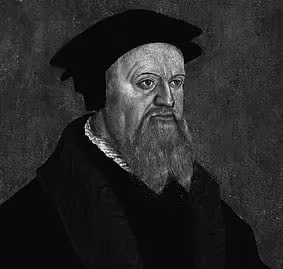
Pietro Martire Vermigli
(1499-1562)
Biography
Pietro Martire Vermigli, commonly known outside Italy as Peter Martyr, was a Florentine humanist, biblical exegete and Reformed theologian whose career connected the Italian evangelical movement with the reformations of Strasbourg, England and Zürich. His birth date remains bibliographically unsettled: much modern scholarship gives 8 September 1499, whereas the recent entry in the Dizionario Biografico degli Italiani, followed by some institutional authorities, assigns it to 8 September 1500. He died at Zürich on 12 November 1562. Baptised Piero Mariano, he was the eldest child of Stefano Vermigli, a prosperous member of the Florentine shoemakers’ guild, and Maria Fumanti. His mother began his Latin education, which continued under the Florentine humanist Marcello Virgilio Adriani. In 1514 he entered the abbey of S. Bartolomeo at Fiesole, belonging to the Lateran Canons Regular of St Augustine, and assumed the religious name Pietro Martire. After profession in 1518, his superiors sent him to Padua, where he resided at S. Giovanni di Verdara and studied philosophy and theology until 1526. His Paduan formation joined Thomistic theology and Aristotelian philosophy to humanist philology; he learned Greek in order to read Aristotle directly and later acquired Hebrew, thus developing the linguistic equipment that distinguished his mature biblical scholarship. ([treccani.it](https://www.treccani.it/enciclopedia/piero-mariano-vermigli_%28Dizionario-Biografico%29/))
Ordained priest on 23 September 1525 and awarded the doctorate in theology, Vermigli was elected a public preacher of his congregation in April 1526. During the following years he preached in numerous cities of central and northern Italy and taught philosophy and Scripture in houses of the order. From 1530 to 1533 he served as deputy to the prior of S. Salvatore at Bologna; in 1533 he became abbot of S. Giuliano at Spoleto, where he attempted to restore regular discipline and gained administrative experience. His appointment in 1537 as abbot of S. Pietro ad Aram in Naples proved decisive. There he encountered the circle of Juan de Valdés and associated with figures belonging to the broader Italian evangelical and spirituali milieu, while reading Erasmus and Protestant authors, notably Martin Bucer and Huldrych Zwingli. His lectures on the First Epistle to the Corinthians attracted both interest and suspicion; a prohibition against his preaching was subsequently removed through the intervention of influential ecclesiastical protectors. In 1540 he became a visitor of the Lateran congregation, and in 1541 prior of S. Frediano at Lucca. At Lucca he organised an ambitious programme of linguistic and theological instruction: Paolo Lazise and Massimiliano Celso Martinengo taught Latin and Greek, Emanuele Tremellius taught Hebrew, and Vermigli lectured and preached on Pauline texts and the Psalms. S. Frediano consequently became an unusual centre of reform-minded biblical education within pre-Tridentine Italy and a formative institution for the circle later called the Ecclesia lucensis. ([treccani.it](https://www.treccani.it/enciclopedia/piero-mariano-vermigli_%28Dizionario-Biografico%29/))
The establishment of the Roman Inquisition in 1542, opposition within his congregation and the increasingly explicit Protestant direction of his teaching made Vermigli’s position untenable. On 12 August 1542 he left Lucca with several companions. His departure constituted not merely an escape from prosecution but a rejection of religious dissimulation and of the prospect that Roman Catholic reform could accommodate his developing convictions. After travelling through Pisa, Florence and northern Italy, he reached Zürich, where Heinrich Bullinger recommended him to Oswald Myconius at Basel; Myconius in turn directed him to Strasbourg. Martin Bucer secured his appointment there as professor of Old Testament, succeeding to the academic sphere formerly occupied by Wolfgang Capito. Vermigli’s first Strasbourg period, from 1542 to 1547, consolidated his identity as a Reformed theologian. He lectured from the Hebrew text, combined grammatical and historical exegesis with patristic and scholastic argument, and entered the intellectual network of Bucer and the Upper Rhenish Reformation. In 1545 he married Catherine Dammartin, a former religious from Metz. His writings from this period included prayers associated with his biblical lectures and an Italian exposition of the Apostles’ Creed; the latter, printed at Basel in 1544, is the only printed work in Italian by Vermigli known to survive. ([treccani.it](https://www.treccani.it/enciclopedia/piero-mariano-vermigli_%28Dizionario-Biografico%29/))
Following the defeat of the Schmalkaldic League and the imposition of imperial pressure upon Strasbourg, Vermigli accepted Archbishop Thomas Cranmer’s invitation to England. He arrived late in 1547 and in 1548 became Regius Professor of Divinity at Oxford. His lectures on First Corinthians rapidly involved him in the controversy over the Eucharist, culminating in the public Oxford disputation of 1549. Against transubstantiation and a local, corporeal presence of Christ’s humanity in the elements, Vermigli defended a real sacramental participation effected by the Holy Spirit and received through faith. His formulation drew upon Scripture, patristic Christology and Aristotelian distinctions concerning substance, place and corporeal presence; it was neither a merely commemorative account nor a Lutheran doctrine of bodily ubiquity. The resulting treatises became among his most frequently contested and reprinted writings. Vermigli belonged to Cranmer’s international circle of reforming divines and participated in discussions concerning liturgy, ecclesiastical discipline and church law. Scholarship has traced his influence upon the eucharistic theology of the 1552 Book of Common Prayer, the Edwardian Articles and the projected Reformatio legum ecclesiasticarum, although the precise extent of individual authorship must be distinguished from broader theological collaboration. His Oxford household also embodied the contested Protestant institution of clerical marriage. Catherine died there in February 1553; under Mary I her remains were disinterred as those of a heretic, and after the Elizabethan settlement they were ceremonially restored and mingled with the reputed relics of St Frideswide. ([treccani.it](https://www.treccani.it/enciclopedia/piero-mariano-vermigli_%28Dizionario-Biografico%29/))
The accession of Mary I compelled Vermigli to leave England in 1553. He returned to Strasbourg, accompanied or later joined by several English exiles, including John Jewel, and resumed teaching. The increasingly confessional Lutheranism associated with Johann Marbach, particularly in eucharistic doctrine, made Strasbourg inhospitable to Vermigli’s Reformed position. His lectures on Judges supplied the setting for important discussions of political obedience, tyranny, resistance and the responsibility of lesser magistrates, while his polemics against religious conformity continued his rejection of Nicodemism. In 1556 he accepted Bullinger’s invitation to succeed Konrad Pellikan as professor of Old Testament at the Zürich Schola Tigurina. Zürich furnished the institutional stability in which he completed or prepared substantial commentaries on biblical books including Genesis, Judges, Samuel and Kings, revised his eucharistic arguments, and engaged Johannes Brenz over Christology and the Lutheran doctrine of ubiquity. He declined invitations to Geneva, Heidelberg and a return to Oxford. In 1559 he married Caterina Merenda, an Italian exile. Sent with Bullinger’s confidence to the Colloquy of Poissy in 1561, he represented the Zürich church in negotiations intended to moderate the French confessional conflict. He died after prolonged illness and was buried in the cloister of the Grossmünster. ([treccani.it](https://www.treccani.it/enciclopedia/piero-mariano-vermigli_%28Dizionario-Biografico%29/))
Vermigli’s historical importance rests upon the unusual conjunction of Italian humanism, monastic and scholastic education, Hebrew and Greek philology, patristic learning and Reformed confessional theology in his work. Biblical exposition remained the organising centre of his intellectual activity: doctrinal discussions generally arose as loci within commentaries rather than as parts of a system composed independently of exegesis. His theology of grace and predestination retained marked Augustinian and scholastic features, while his anthropology and account of causation reveal sustained engagement with Thomas Aquinas and Aristotle. His sacramental theology emphasised the divine promise, the operation of the Holy Spirit and the believer’s union with Christ; his political thought joined a strong doctrine of providence and magistracy to a limited theory of resistance exercised through constitutionally subordinate authorities rather than private persons. Such features complicate older descriptions of him as merely a follower of Calvin: Vermigli was an independently formed representative of the early Reformed tradition whose theology developed through Italian, Strasbourg, English and Zürich contexts. ([academic.oup.com](https://academic.oup.com/book/50148?searchresult=1&utm_source=openai))
His printed legacy was largely exegetical and frequently posthumous. Commentaries and controversial treatises circulated from presses in London, Zürich and Basel, while his manuscripts, lectures and correspondence were preserved and edited by pupils and colleagues. The most influential compilation was the Loci communes, first published in 1576 by the Huguenot minister Robert Masson, who extracted doctrinal discussions from Vermigli’s biblical writings and arranged them in four divisions broadly modelled upon Calvin’s Institutio. Repeated Latin editions, together with an English translation of 1583, transformed writings originally embedded in scriptural commentaries into a systematic theological repertory used by Reformed ministers and scholars well into the seventeenth century. This editorial afterlife both enlarged Vermigli’s readership and partially obscured the exegetical circumstances in which his theology had been composed. Modern scholarship, beginning with studies of his sacramental doctrine and Italian career and extending to his scholasticism, political theology, hermeneutics, metaphysics and international networks, has restored him to a central position in the study of the Italian Reformation and the formation of Reformed Protestantism. ([treccani.it](https://www.treccani.it/enciclopedia/piero-mariano-vermigli_%28Dizionario-Biografico%29/))
Bibliography
Beyond the names: biographies and bibliographies on this page are curated by Abu, the AI scholar crafted by Buonvecchio exclusively for Govi Rare Books.