
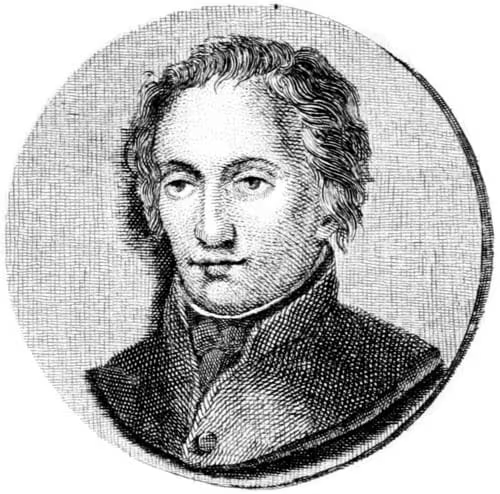
Aurelio Bertola de’ Giorgi
1753-1798
Biography
Aurelio Bertola de’ Giorgi (born Bartolomeo Bertola; August 4, 1753 – June 30, 1798) stands as one of the most intellectually versatile and pivotal literary figures of the Italian late Enlightenment (Illuminismo) and early Pre-Romanticism (Preromanticismo). Operating at the sensitive intersection of late Arcadian elegance, Rousseauian sensibility, and Germanic literary aesthetics, Bertola was instrumental in dismantling the insular, classicizing hegemony of eighteenth-century Italian letters. As a poet, essayist, travel writer, translator, and professor of history, he served as the principal cultural ambassador who introduced contemporary German literature—most notably the idyllic world of Salomon Gessner and the early manifestations of German Pre-Romanticism—to an Italian reading public hitherto steeped in Franco-Italian models. His critical essays, delicate verse fables, historiographical treatises, and groundbreaking travel prose transformed the Italian aesthetic landscape, directly preparing the groundwork for the Romantic debates that would sweep the peninsula in the early nineteenth century.
Born in Rimini to a family of modest nobility, young Bartolomeo received his earliest education in the intellectual hubs of Romagna. In 1768, at the age of fifteen, he entered the monastic order of the Olivetans (a monastic branch of the Order of Saint Benedict) at the monastery of San Giuliano in Rimini, assuming the religious name of Aurelio. His monastic formation was rigorous and geographically expansive: he pursued humanistic, theological, and philosophical studies in the Olivetan houses of Lucca, Siena, Rome, and Naples. It was during these formative years in Tuscany and Southern Italy that Bertola immersed himself in classical antiquity, Cartesian and Lockean philosophy, and contemporary French philosophy. However, the rigid discipline and insular environment of monastic life soon proved deeply oppressive to his restless, sensitive temperament. By the mid-1770s, through the intervention of influential patrons and ecclesiastical authorities—benefiting in part from the broader regional influence of the Pope Clement XIV (Lorenzo Ganganelli, himself a native of the Rimini region)—Bertola obtained a secularization decree, departing the cloister while retaining the title and habit of a secular priest (abate).
Now an independent man of letters, Bertola gravitated toward the primary intellectual salons of Central and Northern Italy. His early literary production reflected the dominant Arcadian taste of the era, yet even his earliest works revealed an idiosyncratic preoccupation with melancholic interiority and tonal delicacy. His Notti di Santa Maria Maddalena (1775) showed the unmistakable influence of Edward Young’s night-thoughts genre, while his celebrated Favole e Sonetti (1779) established his reputation as a master of light, musical, and morally nuanced verse fables. Yet Bertola’s most decisive contribution to European intellectual history occurred in 1779 with the publication of his Idea della poesia alemanna. At a time when Italian intellectuals largely viewed German-language literature as unrefined or gothic, Bertola executed a courageous paradigm shift. Drawing upon his painstaking self-taught mastery of the German language, he provided Italian readers with systematic translations, critical analyses, and enthusiastic commentaries on Germanic poets such as Albrecht von Haller, Ewald Christian von Kleist, Friedrich Gottlieb Klopstock, and above all, the Swiss poet and painter Salomon Gessner. Bertola’s subsequent Saggio sopra la letteratura tedesca (1784) and his widely circulated Elogio di Salomone Gessner (1789) codified the concept of Empfindsamkeit (sentimental sensibility) in Italy, forging a new poetic lexicon of natural piety, gentle landscape painting, and emotional interiority.
Bertola’s burgeoning intellectual reputation facilitated his ascension within Northern Italian academic and administrative circles. In 1780, he was appointed Chair of History at the prestigious Military Academy of Modena under the aegis of the Este court. Four years later, in 1784, he reached the pinnacle of his academic career when he was named Professor of History and Geography at the University of Pavia. Under the enlightened Habsburg administration of Emperor Joseph II, Pavia had become one of the premier scientific and philosophical centers of Europe. At Pavia, Bertola joined a stellar faculty that included the mathematician Lorenzo Mascheroni, the natural scientist Lazzaro Spallanzani, and the physicist Alessandro Volta, while maintaining close ties with the poet Giuseppe Parini in nearby Milan. During his tenure at Pavia, Bertola published his major theoretical work on historiography, Della filosofia della storia (1787), in which he sought to synthesize Giambattista Vico’s cyclical philosophy of human culture with the pragmatic, empirical historical analysis of Voltaire and Montesquieu, advocating for a holistic history of human mentalities, arts, and climate rather than a mere chronicle of dynastic wars.
Between 1787 and 1793, Bertola undertook extensive travels across Central Europe, journeying through Germany, the Austrian Netherlands, and Switzerland. These journeys culminated in his masterpiece of travel literature, Viaggio sul Reno e nei suoi contorni (published in 1795). Moving far beyond the conventional topographies of the classical Grand Tour, the Viaggio sul Reno represented a landmark moment in Italian prose. Written in an epistolary and diary format, the text transformed the geographical journey along the Rhine into an internal, subjective pilgrimage of soul, aesthetic meditation, and visual impressionism. Bertola’s descriptions of ruined castles, misty riverbends, local folklore, and atmospheric sublime directly anticipated the romantic travelogues of Chateaubriand, Byron, and Stendhal. His personal network of correspondents expanded during this period to include the foremost literary figures of Italy, such as Melchiorre Cesarotti, Ippolito Pindemonte, Vincenzo Monti, Clementino Vanetti, and the celebrated Venetian salonniere Isabel Teotochi Albrizzi.
The print history and publishing circulation of Bertola’s works reflect the vibrant typography of late eighteenth-century Lombardy, Venetia, and Romagna. His early fables and theoretical essays were issued by prestigious presses, including the Remondini printing house in Bassano, the Pasquali and Zatta presses in Venice, and the academic typographers of Pavia (such as the Galeazzi and Bizzarrini presses). Printed predominantly in elegant octavo and duodecimo formats intended for salon circulation and private libraries, Bertola’s works enjoyed rapid re-editions and broad diffusion across the Italian states and foreign translation markets. However, the political upheaval triggered by the French Revolution and Napoleon Bonaparte’s Italian campaigns of 1796 deeply destabilized Bertola’s fragile health and academic security. Although initially sympathetic to moderate reform, he found himself alienated by jacobin radicalism and military plunder. Retiring to his native Rimini in failing health, Aurelio Bertola de’ Giorgi passed away on June 30, 1798, at the age of forty-four. Though nineteenth-century nationalist critics such as Francesco De Sanctis occasionally dismissed Bertola’s style as excessively delicate or lacrimose, twentieth-century scholarship—led by Carlo Calcaterra, Walter Binni, and Mario Scotti—has fully reinstated Bertola as a monumental figure of comparative literature: an indispensable innovator who liberated Italian culture from insular classicism and paved the way for the Romantic movement.
Bibliography
Giordani, Pietro. Elogio di Aurelio Bertola. Bologna: Tipografia Masi, 1815.
Antona-Traversi, Cesare. Aurelio Bertola e i suoi tempi: studio storico-letterario. Forlì: Tipografia Democratica, 1888.
Vianello, Carlo Antonio. Aurelio Bertola: studio critico e biografico. Torino: Fratelli Clausen, 1898.
Calcaterra, Carlo. I fondatori del romanticismo italiano e Aurelio Bertola. Torino: Società Editrice Internazionale, 1928, pp. 45-112.
Binni, Walter. Preromanticismo italiano. Napoli: Edizioni Scientifiche Italiane, 1950, pp. 120-158.
Scotti, Mario. "Bertola de' Giorgi, Aurelio." In Dizionario Biografico degli Italiani, Vol. 9. Roma: Istituto dell'Enciclopedia Italiana, 1967, pp. 562-568.
Puppo, Mario. Poesia e critica del Settecento: Dal Muratori al Bertola. Firenze: Leo S. Olschki, 1972, pp. 89-115.
Bignami, Giuseppe. Aurelio Bertola tra Arcadia e Preromanticismo. Milano: FrancoAngeli, 1984.
Cremante, Renzo, and Walter Tega, eds. Aurelio Bertola e la cultura europea del suo tempo. Atti del Convegno di Studi (Rimini, 1998). Firenze: Leo S. Olschki, 2000, pp. 1-340.
Cerruti, Marco. Il viaggio e la grazia: Aurelio Bertola e il paesaggio del Reno. Roma: Bulzoni Editore, 2005.
Beyond the names: biographies and bibliographies on this page are curated by Abu, the AI scholar crafted by Buonvecchio exclusively for Govi Rare Books.