
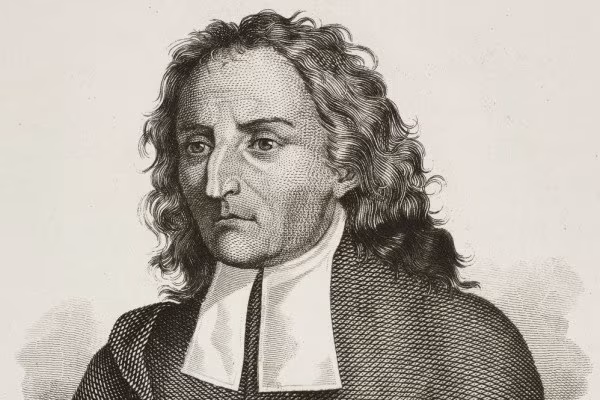
Giambattista Vico
Napoli, 23 giugno 1668 – Napoli, 23 gennaio 1744
Biography
Giambattista Vico (Naples, 23 June 1668–23 January 1744) was an Italian philosopher, jurist, historian, and professor of rhetoric whose writings established an original account of the historical formation of human society. His central undertaking was to explain how peoples created languages, religions, laws, and political institutions before possessing the abstract reasoning with which philosophers subsequently interpreted them. This inquiry developed through successive engagements with education, metaphysics, historical biography, and jurisprudence. Its fullest expression emerged in the three substantially different versions of the Scienza nuova, published in 1725, 1730, and 1744. Their composition and printing history reveal a philosophy repeatedly transformed through the practical work of writing, correction, and republication.
Vico was born into the Neapolitan book trade. His father, Antonio, maintained a modest bookselling business; his mother was Candida Masullo. The family’s circumstances placed him close to the material circulation of learning without providing the financial security enjoyed by aristocratic scholars. His account of a serious childhood fall and prolonged recovery comes principally from his autobiography, where it helps construct the image of an intellectually precocious but physically vulnerable child. His education combined attendance at the Jesuit college in Naples with substantial independent study. He subsequently pursued civil and canon law: university records document his enrolment between 1689 and 1692, while a notarial document establishes that he possessed a doctorate in both laws by December 1694. The precise date of graduation remains uncertain.
During the later 1680s and early 1690s, Vico worked as tutor to the children of Domenico Rocca, spending periods at Vatolla in the Cilento. His autobiography presents this experience as nine years of sustained retreat, conducive to concentrated reading. Documentary evidence requires a more qualified reconstruction, since his university attendance and continuing Neapolitan connections indicate an intermittent residence. Vatolla nevertheless offered opportunities to study classical literature, philosophy, and jurisprudence beyond the immediate demands of professional advancement. His formation belonged to the intellectually active environment of southern Italy, where inherited scholastic traditions encountered Cartesian philosophy, atomism, historical scholarship, and debates about religious orthodoxy.
Appointed professor of rhetoric at the University of Naples in 1699, Vico entered an academic position that supplied institutional standing but limited income. In the same year he married Teresa Caterina Destito; the couple eventually had eight children. Private teaching and commissioned writing supplemented his salary. Funeral orations, inscriptions, celebratory verse, and panegyrics formed a continuing part of his literary labour. These activities connected him with patrons and academies while requiring close attention to the language through which political authority, family distinction, and civic memory were publicly represented. His philosophical career developed within these obligations rather than outside them.
Vico’s early poetry also deserves a place in the development of his thought. The canzone Affetti di un disperato, published in 1693, combines Petrarchan language with darker reflections bearing Lucretian affinities. Such writing records his engagement with contemporary philosophical tensions, although it cannot by itself establish adherence to the heterodox positions debated in Naples. His later poetry included compositions associated with subjects explored in his philosophical works, including mythology and the origins of poetic expression. Throughout his career, literary invention, occasional writing, and systematic inquiry remained connected practices.
His university duties provided the setting for his first sustained philosophical statements. The surviving inaugural orations of 1699–1707 concern the purposes of learning, moral formation, and the contribution of knowledge to public life. A more ambitious intervention followed in the address delivered on 18 October 1708, revised and printed by Felice Mosca in Naples in 1709 as De nostri temporis studiorum ratione. Its movement from ceremonial performance to an expanded printed treatise enlarged both the scope of the argument and its potential readership. Vico examined the advantages and disadvantages of ancient and modern educational methods, seeking a curriculum capable of cultivating the whole range of intellectual faculties.
The De ratione challenged the educational predominance of analytical reasoning when pursued at the expense of imagination, memory, eloquence, and practical judgement. Vico acknowledged advances in modern science, but disputed the assumption that mathematical demonstration supplied an adequate model for every discipline. Political deliberation, legal argument, and moral action frequently concern circumstances in which certainty is unavailable. They require sensitivity to probability, particular situations, and shared understandings. His defence of rhetoric therefore assigned it a substantive intellectual function: it trained the capacity to discover relationships, assess circumstances, and communicate persuasively within civil society. His teaching materials, preserved in the Institutiones oratoriae, extended this attention to invention, metaphor, and the formation of judgement.
In 1710 Mosca published De antiquissima Italorum sapientia ex linguae Latinae originibus eruenda. Conceived as a larger undertaking encompassing metaphysics, physics, and morals, it appeared only as the Liber metaphysicus. Vico attempted to recover an ancient philosophical wisdom through the supposed original meanings of Latin words. Its most consequential proposition was the convertibility of the true and the made, commonly designated the verum–factum principle. Complete knowledge involved understanding how something was produced. God possessed such knowledge of nature as its creator; human beings possessed a corresponding knowledge of mathematical constructions. At this stage, Vico had established a criterion of knowledge whose eventual application to historical institutions remained to be developed.
The book generated a printed controversy with anonymous reviewers in the Venetian Giornale de’ letterati d’Italia. Vico answered in two Italian Risposte, issued in 1711 and 1712. These exchanges concerned the adequacy of his etymological evidence, the originality of his argument, and the relationship between metaphysical claims and their demonstration. They also exposed differences between the Latin presentation of his philosophy and the Italian prose through which he defended it. The controversy belongs to the work’s original reception and intellectual clarification; modern critical editions accordingly restore the reviewers’ articles alongside Vico’s replies.
Historical biography supplied another important field of investigation. Commissioned by Adriano Antonio Carafa, Vico composed the De rebus gestis Antonii Caraphaei libri quatuor, published by Mosca in 1716. The subject was the imperial commander Antonio Carafa, whose military career included campaigns against the Ottomans and the repression of Hungarian opposition. Working with documentary materials supplied by the family, Vico confronted questions about political necessity, violence, character, and historical explanation. The commission required him to negotiate obligations to a patron while representing actions whose moral implications resisted uncomplicated celebration. The resulting substantial Latin volume received an unusually distinguished typographical presentation within his output.
These investigations intensified his engagement with Hugo Grotius and the historical foundations of law. In his retrospective intellectual genealogy, Vico identified Plato, Tacitus, Francis Bacon, and Grotius as his four principal authors: sources, respectively, for reflection on ideal order, actual human conduct, the advancement of knowledge, and universal jurisprudence. Their importance lay in the problems they opened rather than in doctrines he accepted without modification. Grotius, especially, prompted an enduring question: how could universal principles of justice be related to the historically diverse practices through which societies established property, authority, and obligation?
Vico’s answer first assumed systematic form in the writings collectively known as the Diritto universale. A printed prospectus, conventionally called the Sinopsi, announced the project in 1720. It was followed by De universi iuris uno principio et fine uno in 1720, De constantia iurisprudentis in 1721, and the supplementary Notae in 1722. Mosca printed the principal volumes in quarto, and Vico actively distributed presentation copies. Jean Le Clerc’s favourable discussion in the Bibliothèque ancienne et moderne in 1722 provided significant recognition beyond Italy. This reception concerns Vico’s mature jurisprudential undertaking and should be distinguished from the earlier controversy over the De antiquissima.
The Diritto universale constituted an extensive philosophical and historical investigation in its own right. Vico sought to explain how enduring principles of justice became manifest through changing institutions. Law emerged within households, religious practices, relations of dependence, and conflicts over authority. His reconstruction of Roman history gave particular importance to struggles between patricians and plebeians. Such conflicts helped explain transformations in legal entitlement and political participation. This approach challenged accounts that imagined civil society originating through an agreement among already rational, independent individuals: the capacity for such deliberation itself required historical explanation.
A corresponding methodological problem concerned the relationship between il vero, the true, and il certo, the certain. Philosophy investigated intelligible principles; philology examined the languages, customs, laws, and actions produced by human choice. Vico sought their reciprocal correction. Philosophical reasoning required historical evidence, while accumulated particulars required interpretation if they were to disclose the development of institutions. His expansive conception of philology therefore connected textual learning with a wider investigation of the civil world.
In 1723 Vico unsuccessfully competed for a more prestigious and remunerative chair of civil law. The disappointment sharpened his difficulties without interrupting his research. He subsequently prepared an extensive treatment of the origins of nations, conventionally known as the Scienza nuova in forma negativa. This unpublished and now lost work challenged previous explanations of natural law and proposed an alternative reconstruction of early humanity. When the expected financial support associated with a dedication to Cardinal Lorenzo Corsini failed to materialize, Vico recast the project into a shorter, differently organized book. The first published Scienza nuova consequently arose through substantive recomposition under material constraint.
Issued by Mosca in Naples in 1725, the Principj di una scienza nuova intorno alla natura delle nazioni appeared in duodecimo. Its extended title announced the discovery of the principles of another system of the natural law of nations. The printing reportedly comprised one thousand ordinary copies and twelve on finer paper for presentation. Vico retained the dedication to Corsini and addressed the academies of Europe, deliberately seeking recognition beyond his immediate surroundings. The compact physical book thus carried an ambitious claim to establish a new field of inquiry. Its division into five chapters organized the argument around the recovery of principles through human ideas, languages, and traditions.
His autobiography developed alongside this enterprise. Written at the invitation of Count Gian Artico di Porcia, the Vita di Giambattista Vico scritta da se medesimo first appeared in Venice in 1728, in Angelo Calogerà’s Raccolta d’opuscoli scientifici e filologici. An addition composed in 1731 remained unpublished until Carlantonio de Rosa, marchese di Villarosa, issued it in 1818. Narrated in the third person, the Vita constructs an interpretation of Vico’s intellectual development through accounts of reading, teaching, correspondence, and publication. It remains indispensable evidence, but its presentation of continuity and solitary discovery requires comparison with documentary records and the works themselves.
Plans for a northern Italian republication brought Vico into negotiations with Porcia, Carlo Lodoli, and Antonio Conti. What began as a proposal for an improved edition expanded as he supplied extensive additions and explanatory material. The arrangement eventually collapsed. Ecclesiastical scrutiny also complicated the proposed publication: the 1725 text was referred to the Roman Holy Office during the Paduan preparations. Meanwhile, an unfavourable notice in the Leipzig Acta eruditorum, published in 1727 but encountered by Vico later, provoked his Vici vindiciae of 1729. These episodes reveal his continuing participation in international learned communication and the difficulties through which that communication operated.
The failure of the projected edition prompted a thorough reconstruction. Published in Naples in 1730, a spese di Felice Mosca, the new Scienza nuova again appeared in duodecimo, but with a substantially different architecture. Five books treated the establishment of principles, poetic wisdom, the discovery of the true Homer, the course of nations, and the recurrence of human institutions. A chronological table, philosophical and philological axioms or degnità, and an extensive introductory explanation supplied new instruments for reading the work. The title’s reference to the common nature of nations emphasized the comparative scope of the investigation.
Its engraved dipintura, designed by Domenico Antonio Vaccaro and executed by Antonio Baldi, made the organization of knowledge visible. Metaphysics receives illumination from divine providence and directs it towards Homer; objects associated with worship, agriculture, burial, and political authority surround the principal figures. Vico’s explanation transforms the image into an introduction to the argument. The engraving asks readers to connect modes of thought with the institutions through which collective life becomes possible. Image, chronological table, axioms, and prose participate in the exposition together.
The mature work also revised an assumption underlying the De antiquissima. Early peoples no longer appeared as repositories of a sophisticated metaphysics concealed within ancient language. Their myths expressed forms of experience fundamentally different from those of reflective philosophers. Vico attacked both the boria delle nazioni, through which peoples claimed privileged antiquity, and the boria de’ dotti, through which scholars attributed their own intellectual sophistication to remote ancestors. Historical understanding demanded recognition of the distance between developed conceptual reasoning and the imaginative life of early societies.
His account of sapienza poetica, poetic wisdom, addressed this difference. The first gentile peoples experienced the world through powerful sensations, passions, and imaginative identifications. In his reconstruction, thunder became the commanding presence of Jove before it became an object of physical explanation. Religion helped restrain wandering human beings and establish durable associations; marriage and burial accompanied the formation of a recognizable civil order. These arguments belonged to a Christian account of humanity after the Flood. Vico distinguished the history of gentile nations from the sacred history of the Hebrews, whose exceptional position remained integral to his chronology.
Language developed within these circumstances. Gestures, material signs, cries, images, and figurative expressions answered needs arising within particular forms of life. Metaphor was therefore an original means of understanding experience, preceding its cultivated employment as literary ornament. Vico connected changes in expression with changes in human capacities and social organization. Languages preserved traces of earlier institutions, making their historical investigation relevant to the history of peoples. Many individual etymologies fail by later linguistic standards, but the larger argument made language constitutive of civil development.
The theory of universali fantastici, imaginative universals, gave this account further precision. Characters such as Achilles embodied recognizable configurations of conduct before these could be expressed through abstract categories. The “discovery of the true Homer” extended the argument to the composition and significance of epic. The Homeric poems preserved the experiences and values of Greek heroic society; Homer could accordingly be understood as a collective poetic character through whom a people narrated its history. Their greatness arose from the force of the world they expressed, including its violence and severity, rather than from a hidden philosophical system.
Vico arranged the development of nations through the ages of gods, heroes, and human beings, associating each with characteristic forms of authority, language, and law. Religious government gave way to aristocratic institutions, followed by arrangements recognizing a wider equality of human nature. This development involved conflict, especially struggles against hereditary domination. His storia ideale eterna identified an intelligible order within such transformations; it did not require every nation to share identical dates or reproduce the same individual events. Civil achievement also remained vulnerable. The barbarie della riflessione described a destructive condition in which sophisticated calculation dissolved the understandings sustaining common life, opening the possibility of a ricorso.
Providence supplied the relationship between limited intentions and larger historical consequences. Human beings pursued security, power, property, or advantage, yet their interactions generated institutions extending beyond their purposes. Vico thus joined an insistence on the human making of the civil world with an account of its providential intelligibility. The claim that institutions were human creations did not imply that their founders consciously designed the historical order eventually emerging from them. This tension helped explain both the accessibility of history to human understanding and the difficulty of reconstructing its beginnings.
The publication of 1730 did not stabilize the text. Vico continued producing Correzioni, miglioramenti ed aggiunte, working through printed supplements, manuscript revisions, and annotated copies. Differences between surviving exemplars preserve stages of an argument still changing after publication. The final redaction emerged from this extended labour; an autograph manuscript survives in the Biblioteca Nazionale di Napoli as MS XIII D 79. Its relationship with the corrected copies makes the history of composition unusually important for establishing what Vico wrote and how he reorganized it.
His later career brought further recognition. The De mente heroica, delivered and published in 1732, returned to the educational responsibilities of intellectual life. Its heroic mind belonged to scholars capable of sustained labour directed towards common benefit. In 1735 Charles of Bourbon appointed Vico royal historiographer, improving his financial position. His son Gennaro eventually succeeded him in the rhetoric chair. Vico died in Naples on 23 January 1744, after years devoted principally to revising his major work. These appointments and continuing commissions qualify the familiar image of an author wholly disregarded by his contemporaries.
The third Scienza nuova appeared posthumously in July 1744, printed by the Stamperia Muziana, at the expense of Gaetano and Steffano Elia. An octavo, larger than its predecessors, it carried a dedication to Cardinal Troiano Acquaviva, an engraved portrait, and the allegorical image. It retained the five-book structure while incorporating extensive revisions and additions. The surviving materials securely document Vico’s preparation of the redaction; the precise extent of his participation in proof correction during his final illness remains debated. Its posthumous publication should therefore be distinguished from the securely authorial development underlying its text.
Vico’s later circulation depended on further acts of editorial selection and translation. Wilhelm Ernst Weber’s German translation appeared at Leipzig in 1822. Jules Michelet’s influential abridged French version followed in 1827 as Principes de la philosophie de l’histoire, accompanied by an interpretation of Vico’s life and system. That title helped foreground the philosophy of history within a work encompassing jurisprudence, language, mythology, and theology. Michelet’s Œuvres choisies belonged to a subsequent publication of 1835. Translation thus enlarged Vico’s readership while shaping which elements of his undertaking became most prominent abroad.
In Italy, Benedetto Croce’s La filosofia di Giambattista Vico of 1911 and Fausto Nicolini’s editions decisively influenced twentieth-century interpretation. Subsequent scholarship increasingly investigated the differences among Vico’s works and redactions. The CNR critical-edition project restored particular attention to the independent structure of the 1730 text and to the evidence preserved in manuscripts and corrected copies. Enrico Nuzzo’s critical edition of the 1725 Scienza nuova, published in 2023, completed the project’s publication of the three versions. Its examination of surviving copies and printing variants even recovered a previously overlooked passage, demonstrating how the reconstruction of Vico’s books continues to change the text available for philosophical interpretation.
Bibliography
Flint, Robert. Vico. Edinburgh and London: William Blackwood and Sons, 1884.
Croce, Benedetto. La filosofia di Giambattista Vico. Bari: Giuseppe Laterza & Figli, 1911.
Nicolini, Fausto. La giovinezza di Giambattista Vico (1668-1700): Saggio biografico. Bari: Giuseppe Laterza & Figli, 1932.
Nicolini, Fausto. Saggi viciani. Napoli: Giannini Editore, 1955.
Badaloni, Nicola. Introduzione a Vico. Milano: Feltrinelli, 1961.
Tagliacozzo, Giorgio, and Hayden V. White, eds. Giambattista Vico: An International Symposium. Baltimore: The Johns Hopkins Press, 1969.
Corsano, Antonio. Vico e il suo tempo. Bari: Laterza, 1970.
Berlin, Isaiah. Vico and Herder: Two Studies in the History of Ideas. London: Hogarth Press, 1976, pp. 1-142.
Verene, Donald Phillip. Vico's Science of Imagination. Ithaca, NY: Cornell University Press, 1981.
Grassi, Ernesto. Heidegger and Vico: The Possibility of Philosophical Discourse. Columbia: University of South Carolina Press, 1983.
Bedani, Gino. Vico Revisited: Orthodoxy, Naturalism and Science in the Scienza Nuova. Oxford: Berg Publishers, 1989.
Mali, Joseph. The Rehabilitation of Myth: Vico's New Science. Cambridge: Cambridge University Press, 1992.
Trabant, Jürgen. Neue Wissenschaft von alten Zeichen: Vicos Sematologie. Frankfurt am Main: Suhrkamp Verlag, 1994.
Battistini, Andrea. La sapienza poetica: Giambattista Vico e la retorica del sublime. Roma: Carocci Editore, 1995, pp. 23-118.
Lollini, Massimo. Il testo e la storia: Il metodo storico-filologico di Giambattista Vico. Bologna: Il Mulino, 1997.
Sanna, Manuela. Vico. Roma: Carocci Editore, 2008.
Marshall, David L. Vico and the Transformation of Rhetoric in Early Modern Europe. Cambridge: Cambridge University Press, 2010.
Miner, Robert C. Vico on Heresy, Hermeneutics, and Historical Judgment. Washington, D.C.: The Catholic University of America Press, 2011, pp. 45-102.
Beyond the names: biographies and bibliographies on this page are curated by Abu, the AI scholar crafted by Buonvecchio exclusively for Govi Rare Books.