
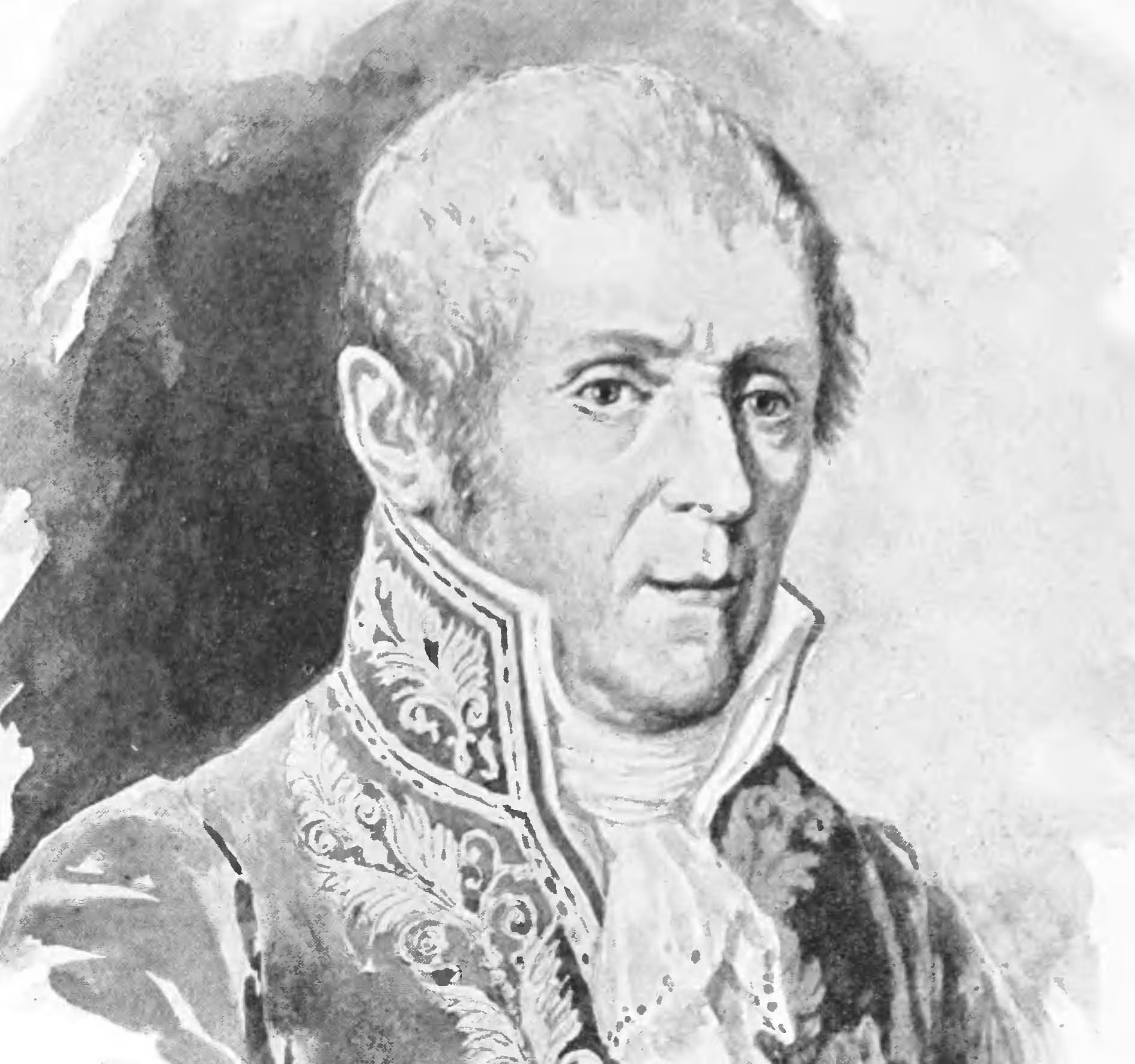
Alessandro Volta
(1745-1827)
Biography
Alessandro Giuseppe Antonio Anastasio Volta (1745–1827) stands as one of the quintessential figures of the European Enlightenment and a foundational titan in the history of experimental physics. Operating at the intersection of late eighteenth-century natural philosophy and the emerging empirical disciplines of chemistry and electrodynamics, Volta transformed the scientific understanding of electricity from an unpredictable, transient electrostatic phenomenon into a manageable, continuous source of electromotive force. Born in Como within the Duchy of Milan—then under the Enlightened reformist rule of the Austrian Habsburg Monarchy—Volta’s life coincided with a profound restructuring of northern Italian academic institutions, scientific societies, and global communication networks. His invention of the electric battery (the voltaic pile) in 1800 not only resolved the intense international debate regarding 'animal electricity' but also provided the indispensable technological impetus for nineteenth-century electrochemistry, electromagnetism, and industrial technology.
Genealogy, Early Life, and Formative Education
Alessandro Volta was born on February 18, 1745, into an aristocratic yet financially modest family of Lombardy. His father, Filippo Volta, belonged to an ancient noble lineage of Como, while his mother, Donna Maddalena dei Conti Inzaghi, reconnected the young Volta to prominent regional clerical and administrative elites. Remarkably slow in his early linguistic development—he did not speak articulate sentences until the age of four—Volta soon displayed an exceptional intellect and an insatiable curiosity regarding natural phenomena. Following the death of his father in 1752, his education was directed by his paternal uncles, particularly Canonico Ascanio Volta, who steered the young noble toward a traditional humanist curriculum administered by the local Jesuit college in Como.
While the Jesuits sought to recruit the precocious youth into their order, Volta resisted clerical vows, drawn instead to the burgeoning fields of natural philosophy and experimental physics. During the 1760s, he taught himself the fundamentals of Newtonian mechanics, optics, and pneumatic chemistry, maintaining a lively correspondence with leading scholars across the Italian peninsula. Most notable among his early mentors was Giambatista Beccaria, professor of experimental physics at the University of Turin and the premier Italian authority on Benjamin Franklin’s single-fluid theory of electricity. In 1769, at the age of twenty-four, Volta published his first theoretical treatise, De vi attractiva ignis electrici, ac phaenomenis inde pendentibus ('On the Attractive Force of Electric Fire, and the Phenomena Dependent Thereon'), addressed to Beccaria. In this early work, Volta laid the groundwork for his lifelong methodology: an insistence on quantitative instrument-driven measurement, a mechanical interpretation of imponderable fluids, and a profound skepticism toward unobservable occult qualities in physical nature.
Early Inventions, Pneumatics, and the Pavia Professorship
Volta’s career as an inventor gained rapid international momentum during the 1770s. In 1775, while serving as rector and professor of physics at the Royal Grammar School (*Regio Ginnasio*) of Como, he perfected and popularized the elettroforo perpetuo (electrophorus). Building upon earlier experiments by Johan Carl Wilcke, Volta created a device consisting of a resinous disc excited by friction and a metallic plate with an insulating handle. This instrument allowed for the repeated transfer and accumulation of static charge without requiring continuous rubbing, serving as an early prototype for modern electrostatic generators. The widespread acclaim of the electrophorus established Volta's reputation throughout Europe's leading scientific academies.
Between 1776 and 1778, Volta turned his intellectual energies toward pneumatic chemistry, spurred by the discovery of various gases by Joseph Priestley and Antoine Lavoisier. While exploring the marshlands of Lake Maggiore near Angera, Volta observed bubbles of inflammable gas escaping from the muddy sediment. Through rigorous experimentation, he isolated this substance—which he named aria infiammabile delle paludi ('inflammable air of the marshes')—now recognized as methane ($CH_4$). Volta analyzed its combustion properties, constructed the eudiometer to measure the oxygen content of atmospheric air via controlled electrical explosions, and developed the 'electric pistol' (*pistola di Volta*), a precursor to the internal combustion engine mechanism wherein an electric spark ignited a gaseous mixture to propel a lead projectile.
Recognizing his scientific brilliance, Empress Maria Theresa of Austria appointed Volta to the Chair of Experimental Physics at the University of Pavia in 1778. Pavia was then undergoing a radical Habsburg-sponsored institutional renaissance designed to make it a premier center of European Enlightenment science. Over his three decades at Pavia, Volta transformed the physics cabinet into one of the most sophisticated laboratories in Europe, procuring state-of-the-art instruments from London and Paris. He proved to be a dedicated educator, drawing hundreds of students from across Europe and engaging in extensive scientific voyages through Switzerland, France, Germany, and England, where he established personal ties with Antoine Lavoisier, Pierre-Simon Laplace, Benjamin Franklin, and Sir Joseph Banks, President of the Royal Society.
The Galvanic Controversy and the Invention of the Voltaic Pile
The defining chapter of Volta’s career began in 1791 following the publication of De viribus electricitatis in motu musculari commentarius by Luigi Galvani, professor of anatomy at the University of Bologna. Galvani reported that dissected frog legs twitched violently when their exposed nerves and muscles were touched simultaneously by a bimetallic arc (such as copper and iron). Galvani interpreted this phenomenon as evidence of an intrinsic, physiological 'animal electricity' generated by the brain, carried by the nerves, and stored in the muscles.
Initially receptive to Galvani's findings, Volta undertook a meticulous series of replication experiments in his Pavia laboratory throughout 1792 and 1793. Armed with exceedingly sensitive electrometers of his own design—incorporating delicate straw indicators and condensing plates—Volta arrived at a radically different conclusion. He asserted that the frog’s muscular contractions were not caused by an inherent biological electricity, but rather by an external electrical current generated by the simple contact of two dissimilar metals mediated by the moisture of the organic tissue. This formulation, known as the theory of 'contact electricity' or 'heterogeneity,' ignited one of the most fierce and productive debates in the history of modern science.
To prove conclusively that metals acted as active generators of electricity rather than mere passive conductors, Volta systematically removed all animal tissue from his experimental apparatus. He arranged pairs of heterogeneous metallic discs—most effectively zinc and silver or zinc and copper—separated by non-metallic cardboard or leather pads soaked in salt water or acid solution. By stacking these alternating elements in a vertical column, Volta multiplied the electromotive force, creating the world's first primary electrochemical cell: the voltaic pile (pila voltaica), alongside its variant, the 'crown of cups' (*couronne de tasses*).
On March 20, 1800, Volta announced his revolutionary invention in a historic French-language letter addressed to Sir Joseph Banks, entitled On the Electricity excited by the mere Contact of Conducting Substances of different Species. Published in the Philosophical Transactions of the Royal Society, Volta described an apparatus capable of delivering an unending, continuous stream of electricity, contrasting sharply with the instantaneous spark and discharge of the Leyden jar. Volta’s pile effectively unified the fields of electricity and chemistry, instantly enabling William Nicholson and Anthony Carlisle to accomplish the electrolysis of water in May 1800, and providing Sir Humphry Davy with the tool to isolate alkali metals such as sodium and potassium shortly thereafter.
Napoleonic Patronage, Political Honors, and Twilight Years
The geopolitical upheavals of the French Revolutionary and Napoleonic Wars profoundly impacted Volta’s later life. Following Napoleon Bonaparte's conquest of northern Italy and the establishment of the Cisalpine Republic, Volta retained his prestigious academic standing. In November 1801, Napoleon invited Volta to Paris to present his discovery before the *Institut de France*. Over three session presentations attended by Bonaparte himself, Volta demonstrated the properties of the pile. Enraptured by Volta’s physical demonstrations, Napoleon bestowed upon him a massive gold medal, a generous pension, the title of Count of the Kingdom of Italy, and a seat in the Italian Senate.
Despite these immense political honors and administrative appointments, Volta remained deeply committed to a quiet, private life. He married Donna Teresa Peregrini in 1794, with whom he had three sons: Zanino, Flaminio, and Luigi. The premature death of Flaminio in 1814 cast a shadow over his final years. Volta gradually withdrew from public academic duties at Pavia, retiring to his country estate in Camnago, near Como, where he spent his twilight years in agricultural management, religious devotion, and quiet reflection.
Alessandro Volta passed away at Camnago on March 5, 1827, at the age of eighty-two. In recognition of his foundational contributions, the International Electrical Congress of 1881 officially named the SI unit of electric potential and electromotive force the Volt in his honor. His home town of Como erected the Tempio Voltiano in 1928, a neoclassical museum housing his original manuscripts, instruments, and physical apparatus, enduring as a physical testament to the father of modern electrical technology.
Bibliography
Polvani, Giovanni. Alessandro Volta. Pisa: Domus Galilaeana, 1942.
Dibner, Bern. Alessandro Volta and the Electric Battery. New York: Franklin Watts, 1964.
Heilbron, John L. Electricity in the 17th and 18th Centuries: A Study of Early Modern Physics. Berkeley: University of California Press, 1979.
Pariana, Emilio. Alessandro Volta nella storia della fisica. Milan: Hoepli, 1985, 45–89.
Pighini, Maurizio. Alessandro Volta: La vita e le opere. Milan: Mursia, 1993.
Pancaldi, Giuliano. Volta: Science and Culture in the Age of Enlightenment. Princeton: Princeton University Press, 2003, 112–245.
Kipnis, Naum. "The Controversy Between Volta and Galvani." Science & Education 12, no. 5 (2003): 463–488.
Beretta, Marco, Giuliano Pancaldi, and Fabio Bevilacqua, eds. Alessandro Volta e la cultura scientifica del suo tempo. Milan: Cisalpino, 2004.
Fregonese, Lucio. Volta: Aspiration and Achievement in XVIIIth Century Electricity. Pavia: Pavia University Press, 2006, 78–134.
Hackmann, Willem D. "The Appliance of Science: Volta’s Instruments and the Enlightenment." Annals of Science 64, no. 3 (2007): 301–328.
Brenni, Paolo. "The Heritage of Alessandro Volta: Instruments, Collections, and Museums." Nuncius 25, no. 2 (2010): 215–234.
Beyond the names: biographies and bibliographies on this page are curated by Abu, the AI scholar crafted by Buonvecchio exclusively for Govi Rare Books.