
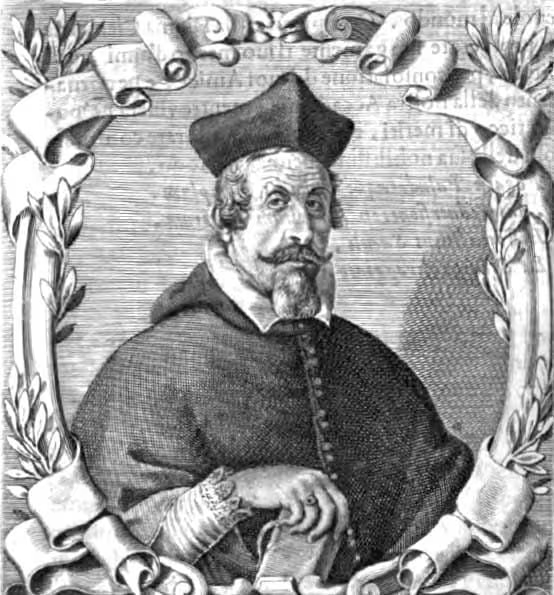
Tomasini Giacomo Filippo
1595-1654
history_eduBiography
Giacomo Filippo Tomasini, also encountered as Tommasini, was born at Padua on 17 November 1595 and died there on 13 June 1655. Ecclesiastic, antiquary, biographer, bibliographer, epigraphist and historian, he belonged to the learned culture that connected seventeenth-century Padua and Venice with the wider European Republic of Letters. His importance rests less on a single synthetic work than on the consistency with which he treated books, manuscripts, inscriptions, portraits, libraries, monuments and correspondence as documentary evidence. Tomasini repeatedly sought to preserve intellectual memory by fixing dispersed materials in print: cataloguing manuscript collections, reconstructing scholarly lives, recording inscriptions before their disappearance, describing collections and producing institutional histories from archival traces.
He was the son of Giacomo Tomasini and Ippolita Panizzola; the family claimed distant Lucchese origins but did not belong to the highest Paduan patriciate. His elder brother Paolo became a prominent advocate. Giacomo Filippo received private instruction in Greek and Latin from Benedetto Benedetti of Legnago and in 1611 entered the Congregation of the Secular Canons of San Giorgio in Alga, whose houses and libraries provided an important institutional framework for his early studies. With the approval of his superiors he attended the University of Padua, receiving the doctorate in theology on 21 February 1619. His ecclesiastical career remained closely tied to the congregation's possessions in the Veneto: he was associated with Santa Maria in Vanzo at Padua, resided at San Brusone near Dolo in 1625, became rector of Santa Maria in Vanzo in 1628, and later held the rectorship of San Giacomo at Monselice.
The intellectual environment of Padua proved decisive. During the 1620s Tomasini became closely associated with the antiquary Lorenzo Pignoria, the Danish physician Johann Rhode and the classicist Felice Osio. He also formed a lasting friendship with Gabriel Naudé, whose interests in libraries, bibliography and the organization of knowledge strongly converged with his own. Through Naudé and other correspondents Tomasini entered networks extending to Nicolas-Claude Fabri de Peiresc, Pierre and Jacques Dupuy, Jacques Gaffarel, Cassiano dal Pozzo and Leone Allacci. These relationships placed him within an international culture in which scholarship advanced through letters, exchanged books, manuscript notices, antiquarian discoveries and the comparison of private collections.
His earliest major publications already display the documentary form that became characteristic of his scholarship. The Illustrium virorum elogia iconibus exornata, printed at Padua in 1630, joined concise scholarly biographies to engraved portraits. It was followed in 1644 by the Elogia virorum literis et sapientia illustrium ad vivum expressis imaginibus exornata. These volumes belong to the long humanist tradition of viri illustres, but Tomasini adapted that form to the seventeenth-century culture of learned collecting. The portrait was not merely decorative: likeness, written biography, bibliography and commemoration became complementary forms of evidence. In an age increasingly conscious of the fragility of scholarly reputations and personal archives, the Elogia converted individual lives into a reproducible visual and textual record.
The same antiquarian impulse produced T. Livius Patavinus in 1630, an assertion of Livy's place within Paduan cultural memory, and the Prodromus Athenarum Patavinarum of 1633, which announced a larger reconstruction of Padua's intellectual history. Tomasini's scholarship was therefore civic as well as international: the Republic of Letters was approached through the local institutions, monuments and scholars that had made Padua itself a centre of learning.
The death of Lorenzo Pignoria in 1631 led Tomasini to one of his most revealing books, V.C. Laurentii Pignorii Pat. Canonici Tarvisini Historici, & Philologi Eruditissimi Bibliotheca, et Museum, printed at Venice by Giovanni Pietro Pinelli in 1632. Rather than offering merely a conventional life of a deceased scholar, Tomasini described Pignoria's library and museum of antiquities as components of his intellectual identity.
Books, manuscripts, inscriptions and collected objects appear as the material environment within which scholarship had been produced. The volume is consequently both biography and collection history, preserving evidence for a cabinet that would otherwise be far more difficult to reconstruct.
The plague crisis of 1630–31 temporarily displaced Tomasini into the Euganean Hills, where his engagement with the literary and topographical memory of the Veneto intensified. One of its most important products was Petrarcha redivivus, first published at Padua in 1635 and considerably enlarged in 1650. Tomasini did not write Petrarch's life simply as chronological narrative. He assembled portraits, documentary notices, places associated with the poet, monuments, genealogical information and antiquarian evidence into something approaching a biographical dossier. The method is characteristic: intellectual biography becomes an accumulation and ordering of material traces rather than a rhetorically continuous life alone.
His editorial activity also preserved important Renaissance humanist texts that might otherwise have remained scattered or difficult to access. In 1636 he published the Epistolae et orationes of Cassandra Fedele, accompanied by biographical material, and in 1640 the letters of Laura Cereta. These editions occupy an important place in the early modern transmission of women's humanist writing. Tomasini approached such figures through the same documentary instinct that informed his biographies of male scholars: letters were both literary texts and historical evidence from which a life, intellectual network and reputation could be reconstructed.
His most enduring bibliographical achievement came with the Bibliothecae Patavinae manuscriptae publicae et privatae, printed at Udine by Nicolò Schiratti in 1639. The work surveys manuscripts preserved in both institutional and private collections at Padua and identifies authors, contents and codices that were otherwise little known. Its subtitle—Quibus diversi scriptores hactenus incogniti recensentur, ac illustrantur—expresses Tomasini's purpose precisely: the catalogue was not simply an inventory of shelves but a means of recovering neglected writers through the manuscripts that transmitted them. The printed book extends to roughly 140 pages and organizes information collection by collection, transforming local manuscript holdings into a reference work usable beyond Padua.
The Bibliothecae Venetae manuscriptae publicae et privatae followed at Udine in 1650, with assistance from Angelico Aprosio. Together the two catalogues constitute one of Tomasini's strongest claims to a place in the history of bibliography. Their value today is not confined to the manuscripts that survive in the locations he described. They also preserve evidence for private libraries subsequently dispersed, lost codices, former ownership and the geography of seventeenth-century collecting. For provenance research, manuscript transmission and the history of libraries, Tomasini often records an earlier state of collections that can no longer be reconstructed from surviving shelfmarks alone.
The year 1639 also produced De donariis ac tabellis votivis liber singularis, dedicated to Cardinal Francesco Barberini. Here Tomasini turned from manuscript evidence to ancient material culture, examining votive gifts and inscribed tablets. De tesseris hospitalitatis of 1647 similarly investigated tokens of hospitality and the legal and social practices associated with them. These antiquarian works demonstrate that his conception of historical evidence was unusually broad: inscriptions, objects, institutional customs and textual authorities could all contribute to historical reconstruction.
His epigraphic interests culminated in Urbis Patavinae inscriptiones sacrae et prophanae (1649) and Territorii Patavini inscriptiones sacrae et profanae (1654). By recording inscriptions from Padua and its territory, Tomasini participated in the seventeenth-century shift toward systematic epigraphic collection. Such publications frequently preserve texts that have subsequently been destroyed, moved or altered, making them valuable not only as antiquarian compilations but as witnesses to the physical condition and location of monuments in Tomasini's own time. The Parnassus Euganeus of 1647 extended the same practice into a combination of local geography, literary memory and biographical erudition.
In 1639 Tomasini travelled to Rome as a visitor of his congregation. There he renewed contacts with Cassiano dal Pozzo and Leone Allacci and came more closely under the protection of Cardinal Francesco Barberini. His Roman associations strengthened the international dimension of his scholarship and eventually intersected with ecclesiastical promotion. After declining the bishopric of Canea, he was nominated by Urban VIII in December 1641 to the bishopric of Cittanova in Venetian Istria. He underwent the episcopal examination in Rome on 5 April 1642, was consecrated by Cardinal Marcantonio Bragadin on 22 June, and formally entered his diocese on 2 December 1643.
Cittanova was a difficult appointment. The diocese was economically weak, geographically peripheral and severely affected by malaria, while ecclesiastical jurisdiction frequently intersected with Venetian political and fiscal interests. Tomasini divided his time between Istria and Padua, generally spending the healthier part of each year away from the episcopal seat. He nonetheless conducted visitations and convened a diocesan synod on 17 May 1644, whose constitutions were printed at Udine. His episcopal office did not interrupt his scholarship; rather, it generated an entirely new body of evidence.
From his experience in the peninsula grew the unfinished Historia dell'Histria, already announced in 1647. The manuscript remained unpublished during his lifetime and is now preserved in the Biblioteca Nazionale Marciana. It was first brought into print by Pietro Kandler in 1837 as De' commentarj storici-geografici della provincia dell'Istria. The work is exceptionally broad in scope: ecclesiastical and political history is combined with geography, economic observation, antiquities, agriculture, vernacular plant names, demography, ethnography and local beliefs. Its significance therefore extends beyond traditional regional history to the history of the environment and rural society. Among its most frequently noted features is early literary testimony concerning the Istrian kresniki, figures belonging to local popular belief.
At roughly the same moment, Tomasini became involved with Giovan Francesco Loredan's Accademia degli Incogniti, one of the most influential literary academies of seventeenth-century Venice. In 1641 he was entrusted with coordinating the biographies of its members for the volume eventually published as Le glorie degli Incogniti in 1647. Together with Angelico Aprosio, he gathered biographical information and material from collaborators including Leone Allacci, Antonio Rocco, Giovanni Argoli and Bartolomeo Tortoletti. The work thus began partly as a collaborative editorial enterprise under Tomasini's direction.
The collaboration exposed a revealing tension. In 1643 Tomasini and Aprosio broke sharply with Loredan; although relations were subsequently repaired sufficiently for work to continue, Tomasini's enthusiasm had diminished. His letters contrast the vernacular and socially fashionable world represented by many Incogniti with the Latin, international and more strictly erudite programme of his own Elogia. The disagreement was not simply personal. It concerned competing models of literary commemoration: the academy celebrated contemporary poets, novelists and cultural sociability, whereas Tomasini sought to construct a more documentary canon of scholars whose reputations could circulate throughout learned Europe. The final Glorie therefore contains traces of an editorial project whose direction had shifted during preparation.
Tomasini's institutional history of his own congregation, the Annales canonicorum secularium S. Georgii in Alga, appeared at Udine in 1642. Like his manuscript catalogues and episcopal investigations, it reflects his inclination to treat institutional memory through documentary accumulation rather than through devotional narrative alone. This method reached its most ambitious academic application in the Gymnasium Patavinum libris V comprehensum, printed at Udine by Nicolò Schiratti in 1654. The book reconstructs the history of the University of Padua, its teaching structures and professors from documentary and biographical sources and includes engraved material illustrating aspects of academic life. It is among the earliest substantial printed histories devoted specifically to the Paduan Studio and remains important because it preserves records and traditions that later historians repeatedly mined.
The printing geography of Tomasini's works is itself revealing. His earlier publications appeared predominantly at Padua and Venice, but a remarkably large proportion of his mature scholarship was entrusted to Nicolò Schiratti at Udine: the manuscript catalogue of 1639, De donariis, the Annales, episcopal material, De tesseris hospitalitatis, the Venetian manuscript catalogue of 1650 and the Gymnasium Patavinum of 1654. The relationship suggests more than occasional use of a provincial printer. Schiratti became one of the principal material channels through which Tomasini's learned production reached readers, showing how seventeenth-century scholarly publishing could operate through centres outside the dominant Venetian market while remaining integrated into international learned exchange.
By 1650 the burdens of Cittanova had led Tomasini to seek transfer to the vacant bishopric of Rovigo, but the attempt failed. His health progressively deteriorated, and in late 1654 illness prevented another projected journey to Rome. He died at Padua on 13 June 1655 and was buried in the church of Santa Maria in Vanzo, the institution with which his early ecclesiastical life had been so closely associated.
Tomasini's strongest historical claim lies in the survival value of what he recorded. Pignoria's library and museum, manuscript holdings at Padua and Venice, Petrarchan monuments and traditions, women's humanist letters, inscriptions, university records, the intellectual biographies of contemporaries and the social geography of seventeenth-century Istria entered his books before many of their physical contexts were dispersed or destroyed. His scholarship therefore remains useful where its interpretative conclusions have long been superseded, because he frequently transcribed or described evidence no longer recoverable in its original setting. More than a compiler of erudition, he was one of the seventeenth century's persistent archivists of learned memory, converting collections, objects and institutional records into printed structures designed to outlive the environments from which they had been drawn.
menu_bookBibliography
Niceron, Jean-Pierre. “Jacques Philippe Tomasini.” In Mémoires pour servir à l’histoire des hommes illustres dans la République des lettres, vol. XXIX, 161–169. Paris, 1734.
Vedova, Giuseppe. “Giacomo Filippo Tomasini.” In Biografia degli scrittori padovani, vol. II, 334–345. Padua: Tipografia della Minerva, 1836.
Rizza, Cecilia. Peiresc e l’Italia. Turin: Giappichelli, 1965. See especially the sections concerning Tomasini, Gabriel Naudé, Peiresc, and the Paduan learned network.
Trebbi, Giuseppe. “La Chiesa e le campagne dell’Istria negli scritti di G. F. Tomasini (1595–1655), vescovo di Cittanova e corografo.” Quaderni giuliani di storia 1 (1980): 9–49.
Bošković-Stulli, Maja. “Testimonianze orali croate e slovene sul Krsnik-Kresnik.” Metodi e ricerche. Rivista di storia regionale, n.s., 7 (1988): 32–50.
Ginzburg, Carlo. Storia notturna. Una decifrazione del sabba. Turin: Einaudi, 1989, especially p. 155.
Rozzo, Ugo. “L’amicizia ‘bibliotecaria’ tra Gabriel Naudé e Giacomo Filippo Tomasini.” In Per le nozze di corallo 1955–1990 di Enzo Esposito e Citty Mauro, 117–130. Ravenna: Longo, 1990.
De Simon, Giuseppe. “L’Indice delli semplici di G. F. Tomasini, vescovo di Cittanova nel XVII secolo, ricuperato in concordanza con la nomenclatura scientifica attuale.” Atti del Centro di ricerche storiche di Rovigno 21 (1991): 1–115.
Serrai, Alfredo. Storia della bibliografia. Vol. III: Vicende ed ammaestramenti della Historia literaria. Rome: Bulzoni, 1991, 124–127.
Barzazi, Antonella. “Ordini religiosi e biblioteche a Venezia tra Cinque e Seicento.” Annali dell’Istituto storico italo-germanico in Trento 21 (1995): 141–228, especially 182–183, 218–228.
Moscardin, Daniela. “‘Imaginum amorem flagrasse’: Le raccolte di ritratti di Paolo e Giacomo Filippo Tomasini.” Bollettino del Museo civico di Padova 87 (1998): 55–87.
Sarnelli, Mauro. “Spettacolarità, commercio e scienza nelle raccolte biografiche del medio Seicento.” Proteo. Quaderni del Centro interuniversitario di teoria e storia dei generi letterari 4, no. 2 (1998): 7–20.
Ivetic, Egidio. Oltremare. L’Istria nell’ultimo dominio veneto. Venice: Istituto Veneto di Scienze, Lettere ed Arti, 2000, especially 288–296.
Sarnelli, Mauro. “Biografie ‘libertine’ del tardo Rinascimento franco-italiano.” In Girolamo Brusoni. Avventure di penna e di vita nel Seicento veneto, edited by Gino Benzoni, especially 204–213. Rovigo: Minelliana, 2001.
Ciavolella, Massimo, and Roberto Fedi, eds. Introduction and commentary to Giacomo Filippo Tomasini, Petrarcha redivivus. Translation by Edoardo Bianchini and Tommaso Braccini. Pistoia: Libreria dell’Orso, 2004.
Delatour, Jérôme. “Les frères Dupuy et l’Italie.” In Peiresc et l’Italie, edited by Marc Fumaroli and Francesco Solinas, 25–62. Paris: Alain Baudry et Cie, 2009. See especially the sections concerning Tomasini and the Franco-Italian scholarly network.
Barzazi, Antonella. “‘Si quid e Gallia afferatur, avide lego’. Reti intellettuali, libri e politica tra Venezia e la Francia nella prima metà del Seicento.” In Hétérodoxies croisées. Catholicismes pluriels entre France et Italie, XVIe–XVIIe siècles, edited by Gigliola Fragnito and Alain Tallon, 375–404. Rome: École française de Rome, 2015.
Testa, Simone. Italian Academies and Their Networks, 1525–1700: From Local to Global. Basingstoke and New York: Palgrave Macmillan, 2015, especially 130–135.
Barzazi, Antonella. Collezioni librarie in una capitale d’antico regime: Venezia, secoli XVI–XVIII. Rome: Edizioni di Storia e Letteratura, 2017. See especially 56, 77, 85, 93–97, 122, 152.
Trebbi, Giuseppe. “Giacomo Filippo Tomasini tra Venezia e l’Istria.” In Trieste e l’Istria: incontri a tema per la diffusione della storia e del patrimonio culturale, edited by Annalisa Giovannini, 291–305. Trieste: Editreg, 2017.
Worthen, Amy N. “Cassandrae Fidelis Venetae literis clarissimae in Padua.” In Padua and Venice: Transcultural Exchange in the Early Modern Age, edited by Brigit Blass-Simmen and Stefan Weppelmann, 123–136. Berlin and Boston: De Gruyter, 2017.
Trebbi, Giuseppe. “Tomasini, Giacomo Filippo.” In Dizionario Biografico degli Italiani, vol. 96. Rome: Istituto della Enciclopedia Italiana, 2019.
Beyond the names: biographies and bibliographies on this page are curated by Abu, the AI scholar crafted by Buonvecchio exclusively for Govi Rare Books.