
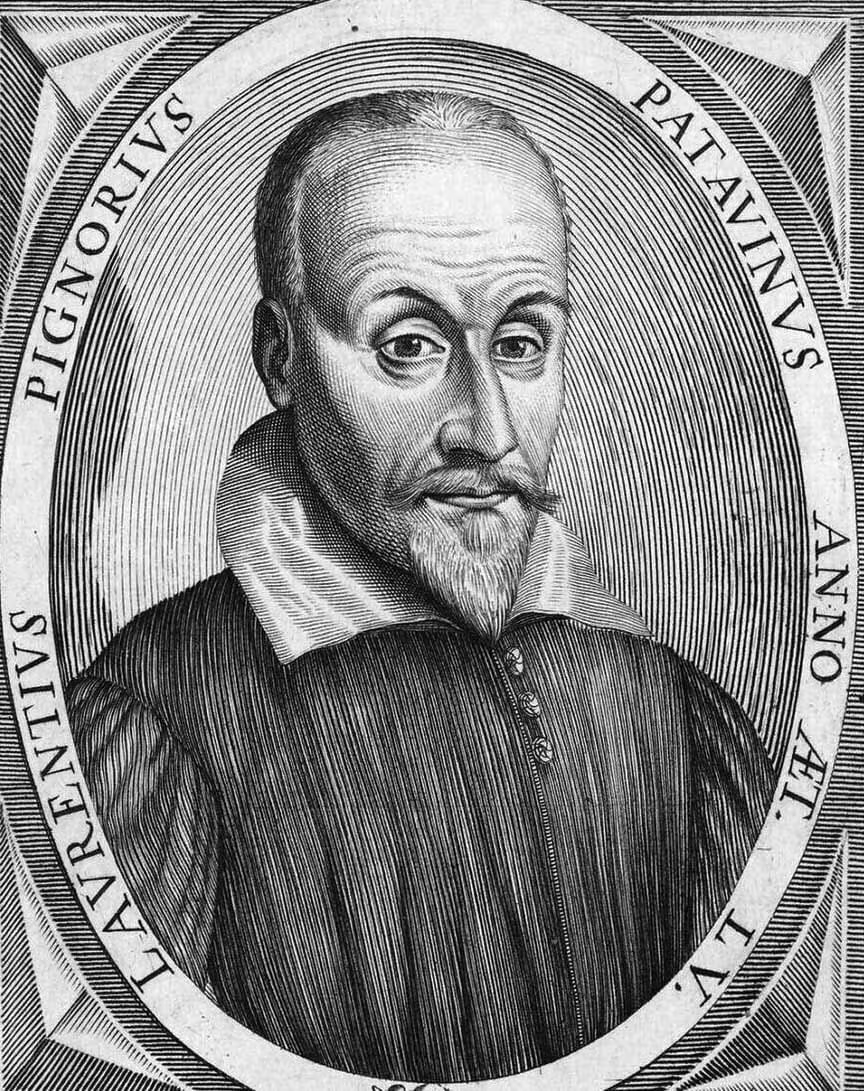
Pignoria Lorenzo
1571-1631
history_eduBiography
Lorenzo Pignoria was born at Padua on 12 October 1571 and died there on 13 June 1631, during the plague epidemic. Antiquary, philologist, priest, collector and correspondent, he belonged to the generation that transformed late humanist erudition into a more explicitly material form of historical enquiry. His characteristic evidence was heterogeneous: manuscripts, inscriptions, coins, engraved images, statues, domestic utensils, amulets, architectural remains, drawings sent by correspondents and objects preserved in private cabinets could all be placed beside classical texts and used to test them. This method linked the local antiquarian culture of Padua with the wider Republic of Letters and made Pignoria particularly effective in fields where textual testimony alone was insufficient: Egyptian religion, ancient domestic life, comparative mythology and the archaeology of his native city.
His father, Antonio Pignoria, served as factor to the Benedictine nuns of San Lorenzo. Lorenzo studied with the Jesuit Benedetto Benedetti, Giovanni Battista Scorza, Gerolamo Dandini and two of the most prominent philosophers associated with late sixteenth-century Padua, Francesco Piccolomini and Giacomo Zabarella. His father intended him for law, but he never completed a university degree. The decisive alternative education came through the household and celebrated library of Gian Vincenzo Pinelli, where books, instruments, manuscripts, natural specimens and conversation brought together scholars from different parts of Europe. Among those linked to this circle were Paolo Gualdo, Martino Sandelli, Giovan Francesco Mussato and Nicolas-Claude Fabri de Peiresc, whom Pignoria met around 1599–1601 and with whom he subsequently maintained a long correspondence. The Pinellian model—private collection as research infrastructure, supplemented by epistolary exchange—remained fundamental throughout his career.
Pignoria was ordained priest in 1602 by Marco Corner, bishop of Padua, who employed him as secretary and took him to Rome in 1605. The two-year Roman stay gave him direct access to monuments, libraries and antiquarian collections and brought him into contact with Angelo Rocca, Scipione Cobelluzzi and Cesare Baronio; later relationships connected him with Francesco Barberini and Cassiano dal Pozzo. He nevertheless disliked dependence on Roman patronage and returned permanently to Padua. In 1609 he received the second chaplaincy of San Lorenzo and also served as confessor to the nuns of Santo Stefano. A chair of humane letters at Pisa was proposed to him through Galileo Galilei, but he declined it, preferring the independence of private scholarship. Although never absorbed into a university career, he remained close to Paduan professors including Fortunio Liceti and had entered the Accademia dei Ricovrati in 1604.
His first major antiquarian publication appeared during the Roman period. The Vetustissimae tabulae aeneae sacris Aegyptiorum simulachris coelatae accurata explicatio was printed at Venice by Giovanni Antonio Rampazetto in 1605, apparently at the expense of Giacomo Franco. It examined the bronze object now known as the Mensa Isiaca or Bembine Table, then famous as an apparently Egyptian monument covered with divine figures and enigmatic signs. The quarto comprised forty-three numbered leaves together with preliminary and final matter and was furnished with engraved representations integral to Pignoria's argument.
Pignoria approached the table before Egyptian hieroglyphic writing could be understood linguistically.
He therefore interpreted its figures and characters through Herodotus, Plutarch, Diodorus, Horapollo, Macrobius and other classical or late-antique authorities, treating Egyptian signs primarily as symbolic condensations of theological meaning. His conclusions were necessarily conditioned by this pre-decipherment framework, and the table itself is now understood as a Roman work related to the cult of Isis rather than a Pharaonic document. Yet the methodological interest of the book lies elsewhere: Pignoria reproduced the object, isolated details, compared them with coins, gems and amulets and used the monument to correct or illuminate passages in ancient authors. The object was not an illustration subordinate to philology; it had evidentiary authority of its own.
The work was substantially repackaged for the German market as Characteres Aegyptii, printed at Frankfurt in 1608 by Matthias Becker. This was more than a casual reissue: the new title foregrounded the Egyptian “characters” and their relevance to the origins and rites of ancient religions, helping detach Pignoria's research from its original Venetian context and circulate it among northern European antiquaries. The fullest posthumous form appeared at Amsterdam in 1669 as Mensa Isiaca. That edition combined Pignoria's Egyptian material with his discourse on the Magna Mater, additional representations of gems and amulets, later interpretations derived from Athanasius Kircher and others, and Giacomo Filippo Tomasini's biography and description of Pignoria's library and museum. The 1669 volume therefore constitutes a composite scholarly afterlife rather than a simple authorial reprint, and it was largely through this enlarged form that Pignoria's Egyptian antiquarianism remained visible to later readers.
His De servis et eorum apud veteres ministeriis commentarius, first published at Augsburg in 1613, applied the same evidentiary habits to a very different subject: the organization of servile labour in antiquity. Pignoria reconstructed household and rural occupations from literary sources but supplemented them with inscriptions, images, clothing, tools, musical instruments and representations of bodily service. The decision to investigate cooks, attendants, musicians, labourers and other subordinate figures was itself significant. Rather than confining antiquarian scholarship to political institutions, religion or monumental art, he treated the ordinary material culture of social life as historically recoverable. Revised editions appeared at Padua in 1656 and Amsterdam in 1674, and the work later informed Ludovico Antonio Muratori's study of ancient slaves and freedmen.
Pignoria's most ambitious extension of antiquarian method beyond the Mediterranean emerged through his intervention in Vincenzo Cartari's Imagini de gli dei degli antichi. In the Padua edition of 1615, printed for Pietro Paolo Tozzi, he added extensive Annotationi occupying pp. 501–576 and a separately paginated Seconda parte delle imagini de gli dei indiani extending through sixty-three Roman-numbered pages. The addition moved Cartari's classical mythography into territories that Europeans conventionally grouped under the capacious geographical category of the “Indies”: India, Japan and Mexico among them.
The editorial structure matters. Pignoria did not replace Cartari; he surrounded and extended an established sixteenth-century text, turning a handbook of Greco-Roman mythology into a platform for comparative enquiry. Later editions developed the apparatus further: the 1626 second “novissima” edition reorganized the additions, included an Aggiunta all'imagini del Cartari and again printed the Seconda parte, now integrated into an expanded sequence. The work was republished again in 1647. Its transmission therefore belongs simultaneously to the reception history of Cartari and to Pignoria's own evolving antiquarian programme.
The Dei indiani is especially important because text and image operate on nearly equal evidentiary terms. Pignoria drew upon missionary accounts, travellers' reports, collections and materials transmitted through his correspondents. A woodcut of Ganesha, for example, identifies the elephant-headed god through information associated with Goa. His comparison was nevertheless governed by a powerful historical assumption: remote pagan traditions could ultimately be interpreted through an ancient Egyptian matrix. This Egyptogenetic hypothesis is untenable, but it encouraged him to juxtapose religious images from widely separated cultures at a moment when European scholarship possessed only fragmentary access to them.
The extraordinary reach—and danger—of this procedure is visible in his treatment of material ultimately derived from the lost Azuchi screens commissioned by Oda Nobunaga. Recent research has reconstructed the chain through which sketches by Philips van Winghe, themselves derived from the Japanese screens displayed in Rome after the Tenshō embassy, entered Pignoria's enlarged iconographic material. By the later editions, motifs copied through this chain were interpreted within his discussion of Japanese religious imagery. They are now among the very few visual traces associated with the lost screens, but their presence in Pignoria also demonstrates how easily information changed meaning while passing from object to sketch, annotation, copy and woodcut. His comparative antiquarianism was thus enabled—and limited—by the editorial transformations inherent in long-distance visual transmission.
This dependence upon intermediaries distinguishes Pignoria from a modern ethnographer, but it does not reduce him to a compiler. He actively interrogated provenance and sought better visual evidence when descriptions seemed inadequate. His letters with Peiresc are especially important in this respect: drawings, medals, seals, inscriptions and reports travelled through their correspondence together with hypotheses about their interpretation. Knowledge was produced collaboratively and often provisionally; the printed edition froze only one stage in an enquiry that might continue through subsequent letters and revised impressions.
Pignoria's scholarship remained equally committed to Padua itself. Le origini di Padova, printed by Pietro Paolo Tozzi in 1625 and dedicated to Scipione Cobelluzzi, confronted civic legend with textual criticism, inscriptions and recent archaeological discoveries. He discussed material such as an anchor and timbers found underground, a stamped brick and an inscription for which he proposed a corrected reading. His refusal to accept the Paduan origin of the Roman jurist Julius Paulus provoked vehement opposition precisely because antiquarian criticism challenged a claim embedded in civic prestige.
The companion L'Antenore of 1625 attacked an even more sensitive monument: the supposed tomb of Antenor, the Trojan founder of Padua according to local tradition. Pignoria concluded from the evidence that the monument was medieval rather than ancient. The importance of the episode lies not in whether every detail of his dating satisfies modern archaeology but in the hierarchy of evidence he adopted. Civic tradition could not override the physical characteristics of the monument. Antiquity had to be demonstrated rather than inherited through repetition.
His concern with religious history adopted the same critical vocabulary. The Vita di S. Giustina vergine e proto-martire padouana of 1627 explicitly promised to adjust the saint's history to “vera historia” and “real cronologia,” signalling the application of chronological scrutiny to hagiographical tradition. In 1628 he supplied historical notices to an edition of Tasso's Gerusalemme liberata, assembling biographical and chronological material relating to the First Crusade. Such editorial interventions show that Pignoria's antiquarian method was not confined to independent monographs: annotation, supplementary apparatus and historically corrective paratext were recurring forms of his scholarship.
The Symbolarum epistolicarum liber primus appeared at Padua in 1629, printed by Donato Pasquardi and associates. Despite the misleadingly emblematic sound of its title, it is fundamentally a collection of learned discussions extracting problems from antiquity, civil law and history and proposing corrections or explanations of ancient authors. It illustrates the degree to which Pignoria's published scholarship remained close to the form of learned correspondence: discrete problems could be treated individually, transmitted among correspondents and later assembled into print.
In 1630 he published the Antiquissimae picturae quae Romae visitur typus, devoted to the ancient painting now known as the Aldobrandini Wedding and dedicated to Cassiano dal Pozzo. The episode is particularly revealing because Cassiano did not accept Pignoria's interpretation. Their disagreement marks the limits of iconographical reconstruction when a visual monument lacks an explicit textual key. Pignoria's willingness to treat the painting as decipherable through comparative antiquarian scholarship remained innovative, but the failure to persuade a knowledgeable contemporary illustrates the difference between careful documentation and secure identification.
He participated as well in the long editorial preparation of Albertino Mussato, although the major printed collection appeared only in 1636, after Pignoria's death. His involvement should therefore be described as scholarly preparation rather than personal publication of the final edition. This distinction is important for understanding the collaborative character of antiquarian editing: manuscripts and notes could pass through several scholars before reaching the press, and the person whose research made an edition possible might not survive to see its printed form.
Pignoria's independence from the university was sustained by a dense network of patrons and friends, among whom the Venetian senator Domenico Molin was particularly important. Molin supplied access to collections and participated in the exchange economy upon which antiquarian research depended. Pignoria's surviving letters reveal similar transactions across Europe: requests for copies of inscriptions, descriptions of objects, images, identifications, bibliographical information and scholarly corrections. The network was not merely social accompaniment to finished books; it was the mechanism by which those books could be assembled.
His own library and museum formed the local centre of this system. After his death, Giacomo Filippo Tomasini's V.C. Laurentii Pignorii ... Bibliotheca, et Museum, printed at Venice in 1632, described a collection containing books and portraits together with inscriptions, coins, medals, weights, fibulae, lamps, amulets, keys and other ancient objects. The mixture corresponds closely to Pignoria's publications. A lamp or fibula could elucidate ancient domestic practice; a gem could contribute to the interpretation of Egyptian symbolism; a portrait preserved the memory of a scholar; an inscription could overturn literary tradition. Collection and scholarship were therefore not separate activities. The cabinet supplied a working archive of comparative evidence.
The same principle governed his use of reproductions. He did not require possession of an original whenever reliable surrogates could circulate: drawings, engravings, casts and copied inscriptions allowed remote monuments to enter scholarly debate. The practice necessarily introduced risks of distortion, as the Azuchi material dramatically demonstrates, but it also made a geographically distributed antiquarian science possible. An object in Rome, Padua, Japan or a private European cabinet could acquire a second scholarly existence through reproduction.
In 1630 Pignoria obtained a canonry at Treviso, an ecclesiastical advancement that came very late in his career. He died the following year, on 13 June 1631, during the plague that devastated northern Italy. Tomasini published his biography and the description of his collections in 1632, establishing the documentary basis from which much later biographical writing descended.
Pignoria's importance lies in the breadth of evidence he admitted into historical argument. He was neither an archaeologist nor a historian of religion in the modern sense, and some of his comparative hypotheses—above all the derivation of distant religions from an Egyptian source—belong firmly to the intellectual assumptions of his age. Yet he consistently required inherited texts to confront material testimony: images, inscriptions, coins, utensils, monuments, drawings, casts, and objects transmitted through scholarly correspondence.
His books are therefore especially significant for the history of antiquarian method and learned publishing. The successive transformations of the 1605 study of the Isiac Table into the Frankfurt Characteres Aegyptii and the composite Amsterdam Mensa Isiaca, and the expansion of Cartari through Pignoria's Annotationi and Seconda parte delle imagini de gli dei indiani, show how text, image, collection, and correspondence could be reorganized across editions to produce new forms of scholarship. His most lasting contribution was not the correctness of every interpretation, but the increasingly systematic use of material and visual evidence as a critical counterpart to textual authority.
menu_bookBibliography
Tomasini, Giacomo Filippo. V.C. Laurentii Pignorii Pat. canonici Tarvisini historici, & philologi eruditissimi Bibliotheca, et Museum. Venice: Giovanni Pietro Pinelli, 1632.
Vedova, Giuseppe. “Lorenzo Pignoria.” In Biografia degli scrittori padovani, vol. I, 87–96. Padua: Minerva, 1832.
Seznec, Jean. “Un essai de mythologie comparée au début du XVIIe siècle.” Mélanges d’archéologie et d’histoire 48 (1931): 268–281.
Vogt, Joseph. “La schiavitù antica nella storiografia moderna.” Quaderni Urbinati di Cultura Classica 18 (1974): 7–21. Especially pp. 9–10 on Pignoria’s De servis.
Zen Benetti, Francesca. “Per la biografia di Lorenzo Pignoria, erudito padovano (†1631).” In Viridarium floridum. Studi di storia veneta offerti dagli allievi a Paolo Sambin, edited by Maria Chiara Billanovich, Giorgio Cracco, and Antonio Rigon, 317–336. Padua: Antenore, 1984.
Favaretto, Irene. Arte antica e cultura antiquaria nelle collezioni venete al tempo della Serenissima. Rome: L’Erma di Bretschneider, 1990. See especially the discussion of Pignoria’s collection and Paduan antiquarianism.
Volpi, Caterina. “Lorenzo Pignoria e i suoi corrispondenti.” Nouvelles de la République des Lettres (1992): 71–127.
Herklotz, Ingo. “Das Museo Cartaceo des Cassiano dal Pozzo und seine Stellung in der antiquarischen Wissenschaft des 17. Jahrhunderts.” In Documentary Culture. Florence and Rome from Grand-Duke Ferdinand I to Pope Alexander VII, edited by Elizabeth Cropper et al., 81–125. Bologna: Nuova Alfa Editoriale, 1992.
Volpi, Caterina. “New Documents concerning the Discovery and Early History of the Nozze Aldobrandini.” Journal of the Warburg and Courtauld Institutes 56 (1993): 274–280.
Volpi, Caterina. Immagini degli dei. Mitologia e collezionismo tra ’500 e ’600. Rome: De Luca, 1995.
Ghirardini, Cristina. “Gli strumenti musicali dell’antichità nel De servis di Lorenzo Pignoria e la trattatistica sugli strumenti musicali: circolazione di modelli iconografici e problemi interpretativi.” Quaderni Estensi 0 (2009): 79–110.
Franzoni, Claudio. “Dai libri alle cose e ritorno: il musaeum di Lorenzo Pignoria.” In Dal libro di natura al teatro del mondo. Studi in onore di Adalgisa Lugli, edited by Vera Fortunati and Paolo Granata, 33–50. Bologna: Fausto Lupetti, 2011.
Maffei, Sonia. “Cartari e gli dèi del Nuovo Mondo: il trattatello sulle Imagini de gli dèi indiani di Lorenzo Pignoria.” In Cartari e le direzioni del mito nel Cinquecento, edited by Sonia Maffei, 62–119. Rome, 2013.
Stolzenberg, Daniel. Egyptian Oedipus: Athanasius Kircher and the Secrets of Antiquity. Chicago and London: University of Chicago Press, 2013. See especially the discussion of Pignoria, the Mensa Isiaca, and seventeenth-century approaches to Egyptian symbolism.
Buora, Maurizio. “Pignoria, Lorenzo.” In Dizionario Biografico degli Italiani, vol. 83. Rome: Istituto della Enciclopedia Italiana, 2015.
Maffei, Sonia. “Lettere di collezionisti: il caso di Lorenzo Pignoria.” In Archilet. Per uno studio delle corrispondenze letterarie di età moderna. Atti del seminario internazionale di Bergamo, 11–12 dicembre 2014, edited by Clizia Carminati, Paolo Procaccioli, Emilio Russo, and Corrado Viola, 333–353. Verona: QuiEdit, 2016.
Signaroli, Simone. “Scoperte di classici latini durante i secoli XIV e XV in una lettera di Lorenzo Pignoria (1615).” FuturoClassico 2 (2016): 47–61.
Mason, Peter. “Periculosae Plenum Opus Aleae: The Mensa Isiaca, Lorenzo Pignoria and the Perils of Cultural Translation.” In Beyond Egyptomania: Objects, Style and Agency, edited by Miguel John Versluys, 133–150. Berlin and Boston: De Gruyter, 2020.
Maffei, Sonia. La riscoperta dell’esotismo nel Seicento. Le «Imagini de gli dei indiani» di Lorenzo Pignoria. Pisa: Edizioni della Normale, 2020.
Beyond the names: biographies and bibliographies on this page are curated by Abu, the AI scholar crafted by Buonvecchio exclusively for Govi Rare Books.