
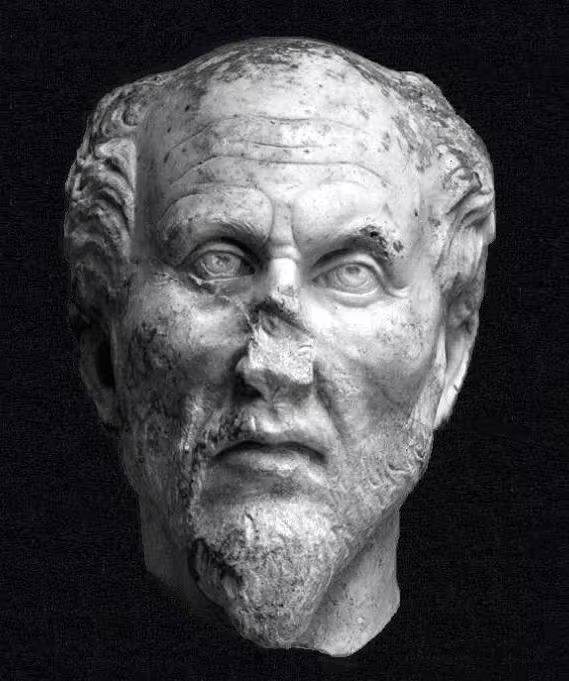
Plotinus
ca. 205-270
Biography
Plotinus (c. 204/205–270 CE) was the most influential philosophical interpreter of Plato in late antiquity and the thinker whose writings gave the movement now called Neoplatonism its enduring metaphysical structure. He did not regard himself as the founder of a new school: his ambition was to recover, clarify, and defend doctrines that he believed already present in Plato's dialogues. The principal source for his life is the Life of Plotinus (Vita Plotini) written by his pupil Porphyry as an introduction to the collected treatises. According to this account, Plotinus came from Egypt; the frequently repeated identification of his birthplace as Lycopolis rests on later testimony and should not be treated as a certain biographical fact. His Egyptian origin, Greek intellectual education, Roman teaching career, and eventual transmission through Greek manuscripts, Arabic philosophical adaptations, and Latin humanist printing together made his work one of the most remarkable instances of an ancient philosophical corpus being repeatedly reconstituted for different audiences.
Plotinus began serious philosophical study at Alexandria at about twenty-eight, but found his first teachers unsatisfactory. He then encountered Ammonius Saccas, with whom he studied for approximately eleven years. Ammonius left no writings, and the attempt to reconstruct a systematic doctrine behind his teaching remains speculative; Plotinus's debt to him is nevertheless evident from the exceptional importance attached to this period by Porphyry. In 243 Plotinus accompanied the eastern campaign of the emperor Gordian III, reportedly in the hope of investigating Persian and Indian philosophy. After Gordian's death and the expedition's collapse, he escaped to Antioch and in 244 settled at Rome, where he lived and taught for most of the remainder of his life. The encounter with the intellectual traditions of the eastern Mediterranean thus preceded the formation of the Roman circle in which his mature philosophy was developed, debated, and eventually committed to writing.
In Rome Plotinus taught without establishing a formally constituted school. His audience included philosophers, physicians, senators, rhetoricians, and women of educated households, while a smaller circle participated in more demanding philosophical discussions. Amelius, who remained with him for over twenty years, was his most sustained early associate; Porphyry, who joined the school in 263, became its decisive literary organiser. The emperor Gallienus and the empress Salonina were said to have favoured Plotinus, and Porphyry recounts his unsuccessful proposal to establish a community in Campania, Platonopolis, governed according to Plato's laws. Ancient testimony also presents him as a trusted guardian of children and family property. Such details are significant because his philosophical account of the contemplative life did not entail a simple rejection of civic responsibility. In his final illness he withdrew to Campania, where he died in 270.
Plotinus began composing treatises only around 254, when he was approximately fifty. These writings arose from the practice of the school rather than from a plan to construct a literary monument. Texts by Plato, Aristotle, and earlier interpreters were read aloud, problems were raised, and Plotinus developed arguments in a compressed prose that frequently preserves the movement of discussion and objection. He was not primarily concerned to produce polished manuals for beginners; his essays presuppose an audience already acquainted with the philosophical tradition. Porphyry eventually assembled fifty-four treatises, supplied an account of their chronological composition, and arranged them into six groups of nine, the Enneads. Their order is thematic rather than chronological: the first Ennead largely concerns ethics and the human good; the second and third discuss the sensible universe, nature, providence, time, and eternity; the fourth addresses the soul; and the fifth and sixth move increasingly towards intellect, being, and the ultimate principle. The numerical architecture is Porphyry's editorial creation, not the sequence in which Plotinus wrote, and some divisions reflect his treatment of longer compositions as separate units. The distinction between Plotinus as author and Porphyry as arranger, biographer, and transmitter is indispensable to the subsequent history of both manuscript and printed editions.
At the centre of Plotinus's metaphysics stands an ordered dependence of reality upon the One or Good, Intellect (Nous), and Soul (Psyche). The One is not the highest being among other beings but a principle beyond being and discursive thought, absolutely simple and incapable of being reduced to the multiplicity it makes possible. Intellect proceeds from the One without separation or diminution and constitutes the intelligible world in which the Forms are simultaneously objects and acts of thought. Soul proceeds from Intellect and mediates between the intelligible order and the sensible cosmos. Plotinus therefore explains the emergence of multiplicity not through a temporal act of creation but through a hierarchy of dependence, contemplation, and return. His vocabulary of procession and ascent was to become exceptionally influential, although later Christian, Islamic, and Jewish thinkers often reformulated it within theological frameworks different from his own.
For Plotinus the visible cosmos remains an ordered and beautiful expression of intelligible reality, not an evil prison from which philosophy must simply escape. This conviction underlies his polemic against certain Gnostic teachings, especially in Ennead II.9, which he criticised for devaluing the universe and multiplying transcendent principles without philosophical necessity. Evil is understood through privation and the indeterminacy associated with matter, not as a rival independent principle. In the ethical treatises the soul's ascent begins with the discipline of ordinary virtues, proceeds through purification and intellectual contemplation, and culminates, exceptionally, in union with the One. The famous discussion of beauty in I.6 and the account of the Good and union in VI.9 gave later readers particularly powerful formulations of inward conversion. Yet the language of spiritual ascent cannot be detached from the argumentative philosophy, rigorous exegesis, and analysis of cognition that constitute the Enneads as a whole.
Plotinus's influence in antiquity depended immediately on Porphyry and subsequently on the Platonist traditions associated with Iamblichus, Syrianus, Proclus, and the later Greek schools. His writings were transmitted through Byzantine manuscript culture, but aspects of his teaching also circulated indirectly in other intellectual languages. Latin Christianity received Plotinian themes partly through the broader Platonist environment known to Augustine, whose accounts of incorporeal reality and the soul's inward ascent reveal profound affinities with the metaphysics of the Enneads. In Arabic, materials ultimately derived from the later Enneads were adapted into the so-called Theology of Aristotle. Because this work circulated under Aristotle's name, its philosophical influence could be considerable even where Plotinus's authorship was unrecognised. This indirect tradition must be distinguished from the transmission of the authentic Greek corpus: the Renaissance did not encounter a single, continuous, unaltered Plotinus, but several partially overlapping textual and interpretative inheritances.
The decisive prehistory of the printed Plotinus took place in fifteenth-century Italy, when Greek manuscripts of the Enneads became accessible to the humanists who were transforming the study of Plato and late ancient philosophy. Among the witnesses important for the Florentine revival were Florence, Biblioteca Medicea Laurenziana, Plut. 87.3, and the manuscript tradition represented by Paris, Bibliothèque nationale de France, grec 1816; Parisinus grec 1976 likewise belongs to the early Italian circulation of the text. The relationship among these witnesses, later copies, and the material consulted by the humanists is a problem of textual history rather than a simple story of a single manuscript imported from Byzantium. The cultural impetus came from the Medici environment, particularly the programme of Cosimo de' Medici and Marsilio Ficino to recover Greek Platonism. The presence of George Gemistos Plethon at the Council of Ferrara–Florence in 1438–39 formed part of the remembered intellectual background, but the actual translation of Plotinus belonged to a later stage of Ficino's work.
Ficino had access to Plotinian manuscripts in the early 1460s and drew on Plotinus while interpreting Plato before undertaking the complete translation. After his Latin Plato had appeared in Florence in 1484, and encouraged also by Giovanni Pico della Mirandola, he devoted much of the later 1480s to the Enneads. His translation and commentary were completed in the years preceding publication in 1492, under the patronage of Lorenzo de' Medici. This sequence matters: the translation of Plotinus was not an isolated recovery of an unfamiliar Greek author, but the culmination of an extensive project including Plato, the late Platonists, and Ficino's own Theologia Platonica. Ficino's understanding of the prisca theologia, or ancient theology, prompted him to read Plotinus as an authoritative interpreter of Platonic truth whose writings might illuminate Christian discussions of soul, providence, contemplation, and the highest good. He sometimes emphasised correspondences with Christian doctrine that the ancient text does not itself require. His achievement was consequently double: he supplied a Latin text that could be read across learned Europe and a comprehensive interpretative framework that strongly shaped how subsequent readers understood Plotinus.
The result appeared at Florence on 7 May 1492, printed by Antonio di Bartolommeo Miscomini: the first complete printed edition of Plotinus, containing Ficino's Latin translation and commentary, together with Porphyry's biographical and editorial introduction. It is essential to specify the language: the 1492 editio princeps is an edition in Latin, not the first printing of the Greek text. An imposing folio, bibliographically described as 442 leaves including the initial blank, the book was set in roman type, generally in a single column of forty-five lines, and carried Miscomini's woodcut device. Its dedicatory proem addressed Lorenzo as the protector of the Florentine fatherland; the colophon explicitly acknowledged that the volume had been printed at his expense, magnifico sumptu Laurentii Medices. Lorenzo had died on 8 April, less than a month before the date of completion. The distinction between the patron named in the colophon, the humanist responsible for translation and commentary, and the professional printer who produced the physical book is important to an accurate account of this undertaking. Surviving copies may differ in the presence of the initial blank, terminal errata, and certain preliminary details; such differences require copy-specific description and do not automatically establish separate editions.
Miscomini's Plotinus occupied a distinctive position within Florentine incunable production. The printer had already worked with Ficino on the De vita libri tres (1489) and subsequently printed his De sole et lumine (1493). The 1492 folio was, however, a more extensive and expensive undertaking, giving typographical form to a philosophical enterprise fostered by the Medici court. Its title and paratexts presented Plotinus through Porphyry's six-Ennead arrangement, Ficino's divisions and summaries, explanatory commentaries, and a vocabulary adapted to Latin humanist readers. For generations, therefore, the encounter with Plotinus usually involved not the unmediated Greek treatises but the combined authority of Plotinus, Porphyry, and Ficino, physically joined within one printed book. The printer's roman type and orderly presentation did not merely reproduce an ancient text: they helped convert a demanding manuscript corpus into a learned reference work that could circulate among theologians, philosophers, poets, and collectors outside the comparatively narrow community capable of reading its Greek.
The next major stage in the printing of the complete corpus came in 1540, when Johann Soter (Ioannes Soter) printed Plotini ... De rebus philosophicis libri LIIII in enneades sex distributi at Solingen (Apud Salingiacum), in folio, with Peter Quentel named as the financier in copies carrying the imprint impensis Petri Quentel. Other copies omit the Quentel formula on the title-page: this is a documented title-page variant, not sufficient evidence for an additional printing. The edition reproduced the Latin tradition established by Ficino and did not print the Greek Enneads. Its appearance in the German book world reflected the migration of the philosophical classics through a network of printers, booksellers, and scholarly institutions far beyond Florence. The circulation of this impression is unusually tangible: Torquato Tasso read and annotated a copy of Soter's 1540 Plotinus, now preserved among the Barberini holdings of the Vatican Library. His marginalia show the continuing use, even after later editions were available, of Ficino's Latin Plotinus as an active instrument of literary and philosophical composition rather than as a merely prestigious classical monument.
The Basel printer and publisher Pietro Perna undertook a further major folio edition in 1559, entitled Plotini ... De rebus philosophicis libri LIIII in enneades sex distributi, bearing his own imprint, apud Petrum Pernam. The title explicitly advertised the text as compared against a Greek exemplar and diligently corrected: omnibus cum Graeco exemplari collatis et diligenter castigatis. This formula announces textual revision; it does not mean that the Greek text itself was printed in 1559. The book, described as fourteen preliminary leaves, 365 numbered leaves (actually 366), and approximately twenty-three terminal leaves, retained Ficino's translation and commentaries and supplied substantial reference material. The corrected Latin text is associated in the bibliographical literature with the work of Domenico Montesoro, whose precise contribution to the successive Basel editions must be separated from Perna's responsibilities as printer and publisher. Perna, an Italian religious émigré established at Basel, was involved in the publication of philosophical, medical, historical, and religious works crossing confessional boundaries. His decision to reissue Plotinus belonged to this wider editorial programme and to the scholarly market for Greek philosophy mediated in Latin.
A further folio bearing the imprint of Thomas Guarin (Thomas Guarinus) appeared at Basel in 1562, retaining the title De rebus philosophicis libri LIIII in enneades sex distributi and Ficino's Latin interpretation, with a copious index of noteworthy words and subjects. The Guarin printing is catalogued separately from Perna's 1559 edition (VD16 ZV 12585; Adams P1600) and exemplifies the continued demand for a usable, indexed Latin Plotinus. Contemporary printers could alter title-pages, introductory matter, indexes, or typesetting while preserving much of an earlier editorial apparatus; consequently, the precise relationship between the 1559 and 1562 impressions should ultimately be determined by comparison of gatherings, types, and textual variants, not by dates alone. A bibliographical record also associates Guarin's name with a date of 1559, but its status relative to the securely documented Basel impressions requires verification before it is counted as an independent edition. The firm distinction remains that both the 1559 Perna and 1562 Guarin books circulated the Latin Ficinian Plotinus, not a complete Greek edition.
The wider sixteenth-century transmission was more complicated than a simple sequence of complete editions. Ficino's arguments and commentaries could be read in collections of Ficino's own works, including the Basel Opera of 1561 and subsequent impressions; these did not necessarily reproduce the complete Enneads and therefore should not be counted as independent editions of Plotinus's entire text. In another channel, Plotinian material entered printed Aristotelian literature disguised within the pseudo-Aristotelian Theology of Aristotle***, whose Arabic ancestry ultimately drew upon portions of the *Enneads, especially IV–VI. Latin publication of this text is attested from **1519, with subsequent circulation through sixteenth-century editions and compilations associated with Aristotle. This was a history of adaptation, false attribution, and translation through Arabic, not of printing the authentic Greek Plotinus. The distinction matters because readers might encounter central Plotinian ideas without ever finding Plotinus's name on the title-page. Meanwhile, Greek manuscripts continued to be copied in Renaissance Italy even before the first complete Greek printed text: the manuscript culture and the book trade remained concurrent means of transmission, not consecutive phases.
The Greek *editio princeps*** finally appeared at **Basel in 1580, printed and published by Pietro Perna, under the title Plotini Platonicorum facile coryphaei operum philosophicorum omnium libri LIV in sex Enneades distributi. Ex antiquiss. codicum fide nunc primum Graece editi, cum Latina Marsilii Ficini interpretatione et commentatione. Its colophon dates the completion of printing to 1 June 1580 (Kalendis Iunii). The imposing folio printed the complete Greek text alongside Ficino's Latin version and commentary, with Porphyry's Life of Plotinus, additional prefatory materials, indexes, woodcut ornaments, and a portrait of Ficino. Bibliographical descriptions record 771 numbered pages, preceded and followed by substantial unnumbered gatherings. The formula nunc primum Graece editi is the decisive statement of priority: nearly ninety years after the Florentine Latin editio princeps, a learned reader could for the first time buy the full original-language corpus in print and compare it directly with its celebrated Renaissance translation. The two editions of 1492 and 1580 are thus separate bibliographical landmarks, not rival descriptions of a single first edition.
Perna's 1580 undertaking was also an intervention in the intellectual politics of the late Renaissance. His long prefatory address to the senators of Nuremberg sought to defend Plotinus against interpretations that assimilated the philosopher too readily to magical and theurgical traditions. An ex-Dominican from the Italian world of religious dissent, Perna was a printer-publisher with a distinctive interest in texts that crossed the boundaries of accepted philosophical and confessional orthodoxy; his broader publishing activity included Paracelsian literature and works by Italian religious reformers. The 1580 Plotinus was not, however, simply a confessional manifesto. Its scholarly ambition was to make a Greek philosophical authority available alongside the Latin apparatus that had enabled its earlier European circulation. The elaborate combination of text, translation, commentary, biography, and indexes made the book an object for humanist philology as well as for philosophical and theological argument. The Greek and Latin columns materially staged a dialogue between ancient author and Renaissance interpreter, inviting comparison while still surrounding the Greek with Ficino's influential conceptual vocabulary.
The Greek text was established through the comparison of four Greek manuscripts, according to the edition's editorial tradition, but the preparatory work cannot be attributed to Perna personally merely because his name appears in the imprint. Johannes Sambucus (János Zsámboky), the imperial humanist and collector, played a documented role in supplying one of the manuscripts: letters dated 13 and 14 April 1577 record his dispatch of a corrected Greek Plotinus to Perna and his wish that it be collated with Ficino's translation. The relevant witness has been connected with the Greek holdings of the Austrian National Library in Vienna. Modern scholarship, drawing on the printer's prefatory statements, has proposed Domenico Montesoro as an important intermediary in the preparation of the Greek text, though the precise division of editorial labour is not fully secure. The 1580 edition must therefore be regarded as a collective scholarly and typographical achievement involving a printer-publisher, manuscript owners, humanist correctors, and the inherited work of Ficino. Its claim to fidelity to ancient codices was an important step in the history of Plotinian philology, but it did not constitute a modern critical edition: the manuscripts used were limited, the genealogical relationships among witnesses were not adequately understood, and readings continued to be mediated by inherited editorial decisions.
The influence of these printed books can be traced through specific readers as well as through abstract histories of ideas. Giovanni Pico della Mirandola, Giordano Bruno, and Torquato Tasso exemplify different ways in which Renaissance authors appropriated Plotinus and Ficino, although their respective uses of Neoplatonic arguments must not be conflated. Tasso's annotated copy of the 1540 Solingen edition is especially instructive: it proves that an earlier Latin printing could remain intellectually productive decades after the appearance of the Greek princeps. In the later sixteenth century, discussions of the soul, the relationship between the One and the many, divine causation, contemplation, and beauty drew on a textual environment where Plotinus could be read directly in Greek, in Ficino's Latin translation, through Ficino's autonomous works, or indirectly through other philosophical compilations. What circulated as 'Plotinus' was often an interpretative complex rather than a single fixed object.
Even the apparent continuation of the 1580 Basel edition requires bibliographical discrimination. Copies are known with a 1615 title-page naming Ludovicus Rex as publisher; such evidence has been understood as a later issue of surviving sheets rather than proof of an entirely new edition printed from reset type. The distinction among an edition, an impression, an issue, and an individual copy is particularly important in the history of early printed Plotinus, where changes of imprint and paratext can obscure textual continuity. The great Basel Greek–Latin folio remained a reference point well beyond the sixteenth century, but only the systematic collation of Greek manuscript witnesses and the indirect ancient tradition made a fundamentally different editorial foundation possible. That work culminated in the critical editions of Paul Henry and Hans-Rudolf Schwyzer in the twentieth century. Plotinus's intellectual afterlife thus rests on successive acts of mediation: Porphyry's arrangement in antiquity, the Byzantine preservation of Greek manuscripts, Ficino's translation and commentary, the incunable enterprise of Miscomini and the Medici, and the editorial and printing programmes of Soter, Perna, and Guarin. From the Florentine Latin editio princeps of 1492 to the Basel Greek editio princeps of 1580, the printed history of the Enneads records not just the recovery of an ancient author but the changing ways in which Europe defined philosophical authority, textual authenticity, and the relationship between classical learning and religious thought.
Bibliography
Armstrong, A. H. The Architecture of the Intelligible Universe in the Philosophy of Plotinus: An Analytical and Historical Study. Cambridge: Cambridge University Press, 1940.
Rist, John M. Plotinus: The Road to Reality. Cambridge: Cambridge University Press, 1967.
Blumenthal, H. J. Plotinus' Psychology: His Doctrines of the Embodied Soul. The Hague: Martinus Nijhoff, 1971.
Graeser, Andreas. Plotinus and the Stoics: A Preliminary Study. Leiden: E. J. Brill, 1972.
Blumenthal, H. J. “Plotinus in the Light of Twenty Years' Scholarship, 1951–1971.” In Aufstieg und Niedergang der römischen Welt, II.36.1, edited by Wolfgang Haase, 528–570. Berlin and New York: Walter de Gruyter, 1987.
Corrigan, Kevin. “The Course of Plotinian Scholarship from 1971 to 1986.” In Aufstieg und Niedergang der römischen Welt, II.36.1, edited by Wolfgang Haase, 571–623. Berlin and New York: Walter de Gruyter, 1987.
Bussanich, John. The One and Its Relation to Intellect in Plotinus: A Commentary on Selected Texts. Leiden: E. J. Brill, 1988.
Hadot, Pierre. Plotinus or the Simplicity of Vision. Translated by Michael Chase. Chicago: University of Chicago Press, 1993.
O'Meara, Dominic J. Plotinus: An Introduction to the Enneads. Oxford: Clarendon Press, 1993.
Gerson, Lloyd P. Plotinus. London and New York: Routledge, 1994.
Gerson, Lloyd P., ed. The Cambridge Companion to Plotinus. Cambridge: Cambridge University Press, 1996.
Adamson, Peter. The Arabic Plotinus: A Philosophical Study of the “Theology of Aristotle”. London: Duckworth, 2002.
Dufour, Richard. Plotinus: A Bibliography, 1950–2000. Revised edition. Leiden and Boston: Brill, 2002.
Emilsson, Eyjólfur Kjalar. Plotinus on Intellect. Oxford: Oxford University Press, 2007.
Remes, Pauliina. Plotinus on Self: The Philosophy of the “We”. Cambridge: Cambridge University Press, 2007.
Kalligas, Paul. The Enneads of Plotinus: A Commentary. Volume 1: Enneads I–III. Translated by Elizabeth Key Fowden and Nicolas Pilavachi. Princeton: Princeton University Press, 2014.
Emilsson, Eyjólfur Kjalar. Plotinus. London and New York: Routledge, 2017.
Corrias, Anna. “Plotinus's Language of Seeing: Marsilio Ficino on Enneads V.3, V.8 and III.8.” International Journal of the Classical Tradition 26 (2019): 251–269.
Gersh, Stephen. “Marsilio Ficino as Commentator on Plotinus: Some Case Studies.” In Plotinus' Legacy: The Transformation of Platonism from the Renaissance to the Modern Era, edited by Stephen Gersh, 19–43. Cambridge: Cambridge University Press, 2019.
Corrigan, Kevin. “Plotinus and Modern Scholarship: From Ficino to the Twenty-First Century.” In Plotinus' Legacy: The Transformation of Platonism from the Renaissance to the Modern Era, edited by Stephen Gersh, 257–287. Cambridge: Cambridge University Press, 2019.
Gersh, Stephen, ed. Plotinus' Legacy: The Transformation of Platonism from the Renaissance to the Modern Era. Cambridge: Cambridge University Press, 2019. Especially the appendix, “Chronology of Editions and Translations of Plotinus,” 288–291.
Corrias, Anna. The Renaissance of Plotinus: The Soul and Human Nature in Marsilio Ficino's Commentary on the Enneads. London and New York: Routledge, 2021.
Stern-Gillet, Suzanne, Kevin Corrigan, and José C. Baracat Jr., eds. A Text Worthy of Plotinus: The Lives and Correspondence of P. Henry S.J., H.-R. Schwyzer, A. H. Armstrong, J. Trouillard and J. Igal S.J. Leuven: Leuven University Press, 2021.
Gerson, Lloyd P., and James Wilberding, eds. The New Cambridge Companion to Plotinus. Cambridge: Cambridge University Press, 2022.
Kalligas, Paul. The Enneads of Plotinus: A Commentary. Volume 2: Enneads IV–V. Translated by Nickolaos Koutras. Princeton: Princeton University Press, 2023.
Chiaradonna, Riccardo. “Denker der Frühen Neuzeit bis zu den Cambridge Platonists.” In Plotin-Handbuch: Leben – Werk – Wirkung, edited by Christian Tornau, 545–557. Stuttgart: J. B. Metzler, 2024.
Gersh, Stephen. Marsilio Ficino as Reader of Plotinus: The “Enneads” Commentary. History of Metaphysics: Ancient, Medieval, Modern, 5. Leiden and Boston: Brill, 2024.
Tornau, Christian, ed. Plotin-Handbuch: Leben – Werk – Wirkung. Stuttgart: J. B. Metzler, 2024.
Beyond the names: biographies and bibliographies on this page are curated by Abu, the AI scholar crafted by Buonvecchio exclusively for Govi Rare Books.