
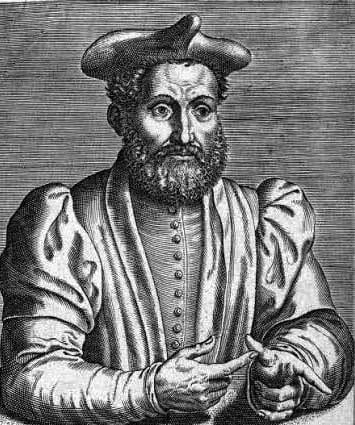
Guillaume Philandrier
(1505-1565)
Biography
Guillaume Philandrier (latinized as Guilielmus Philander; 1505–1565) stands as one of the most formidable intellectual bridges between the Italian High Renaissance and the French Renaissance scholar-architectural tradition. A profound philologist, diplomatic secretary, theologian, and pioneering architectural theorist, Philandrier's crowning achievement—his commentary on Marcus Vitruvius Pollio's De Architectura—fundamentally transformed early modern European architectural theory. Working at the intersection of humanist textual criticism and practical antiquarianism, Philandrier systematically codified the classical canon of the Five Orders of Architecture, providing the northern European continent with its first rigorous, philologically grounded, and iconographically illustrated guide to the classical antiquity of Rome. His career exemplifies the mid-sixteenth-century Renaissance ideal, wherein humanistic scholarship was directly applied to the material arts, bridging the divide between textual erudition and architectural practice.
Born in Châtillon-sur-Seine in Burgundy in 1505, Philandrier received an extraordinarily rigorous education in classical literature, Greek philology, and jurisprudence. Early in his formative years, he entered the intellectual orbit of the great French humanist Guillaume Budé, whose methodology of rigorous textual collation and philological archaeology profoundly shaped Philandrier's analytical mind. Philandrier's intellectual trajectory shifted decisively in the early 1530s when he entered the service of Georges d'Armagnac, the erudite Bishop of Rodez (later Cardinal and diplomat). As principal secretary and confidential advisor to Armagnac, Philandrier gained access to the highest echelons of diplomatic, ecclesiastical, and intellectual nobility across Europe. When Armagnac was appointed French Ambassador to the Republic of Venice by King Francis I in 1536, Philandrier accompanied his patron across the Alps, initiating an extended period of residency in the Italian peninsula that would define his life's work.
During his stay in Venice between 1536 and 1539, Philandrier immersed himself in the vibrant Venetian humanist network. He studied Greek under the guidance of the renowned scholar Marcantonio Flaminio and established close connections with the intellectual sphere surrounding the printer Paolo Manuzio, as well as the satirist Pietro Aretino and the architectural theorist Sebastiano Serlio. It was during this Venetian period that Philandrier began his intensive study of ancient architectural treatises and surviving classical monuments. Serlio's preliminary publications on the architectural orders (such as Book IV of his Tutte l'opere d'architettura, published in Venice in 1537) exercised an immediate influence on Philandrier, prompting him to combine textual scholarship on Vitruvius with visual and geometrical analysis.
In 1540, Cardinal Georges d'Armagnac was reassigned to Rome as the representative of the French Crown at the Papal Court of Paul III Farnese. Philandrier accompanied Armagnac to the Eternal City, an environment that provided an unprecedented opportunity for direct antiquarian research. In Rome, Philandrier became an active member of the celebrated Accademia della Virtù (also known as the Accademia Vitruviana), founded under the leadership of the Sienese humanist Claudio Tolomei and patronized by Cardinal Marcello Cervini (later Pope Marcellus II). The Accademia brought together the most brilliant minds of the era—including scholars, humanists, and artists such as Jacopo Barozzi da Vignola and Guillaume Du Choul—with the ambitious goal of producing a comprehensive, encyclopedic edition of Vitruvius accompanied by exhaustive archaeological commentaries, maps, and drawings of Roman ruins.
Philandrier took upon himself the primary responsibility for the textual critique of Vitruvius. He meticulously collated ancient manuscripts preserved in the Vatican Library and private Roman collections, comparing scribal errors, corrupt Latin terms, and obscure Greek borrowings. The fruits of this monumental labor appeared in Rome in 1544, published by the printer Andrea Dost, under the title In decem libros M. Vitruvii Pollionis de Architectura annotationes. Dedicated to King Francis I, this work was not merely a set of glosses, but a exhaustive, line-by-line critical commentary that elucidated Vitruvian terminology—ranging from technical details of masonry construction (*eustylos*, *pycnostylos*, *entasis*) to complex theories of acoustic vessels in ancient theaters and classical proportions. The 1544 Roman edition was illustrated with exquisite woodcuts that translated Vitruvius's notoriously obscure verbal descriptions into clear geometric and architectural diagrams.
Following the resounding success of the first edition, Philandrier returned to France and settled in the diocese of Rodez, where his patron Cardinal d'Armagnac bestowed upon him major ecclesiastical appointments, including Canon of Rodez Cathedral and Archdeacon of Saint-Antonin. However, Philandrier continued to refine his scholarly work. In 1552, he published a drastically expanded and revised edition of his commentary in Lyons, produced by the premier humanist printer Jean de Tournes. The 1552 Lyons edition of the Annotationes represents a masterpiece of Renaissance typography and book design, featuring detailed woodcut illustrations attributed to the circle of Bernard Salomon. In this edition, Philandrier incorporated a formal treatise on the Five Orders of Architecture (Tuscan, Doric, Ionic, Corinthian, and Composite), establishing precise mathematical ratios and modular systems for column shafts, capitals, bases, and entablatures. He was among the very first theorists to formally codify the Composite order alongside the traditional four described by Vitruvius, synthesizing Serlio's visual models with rigorous Latin scholarship.
Philandrier's contribution extended beyond theoretical literature into practical architectural patronage. In his role as Archdeacon and Canon at Rodez, he was commissioned to design the monumental upper storey and gable end of the West Facade of Rodez Cathedral. Completed around 1562, this extraordinary structure—often referred to as the clocher or Renaissance crest of the cathedral—seamlessly integrated classical Corinthian and Composite pilasters, entablatures, and a high Renaissance pediment atop a severe medieval Gothic edifice. This architectural intervention remains one of the most sophisticated examples of mid-sixteenth-century French Renaissance architectural design, directly reflecting the classical principles Philandrier had articulated in his writings.
The impact of Philandrier's work on European architecture was profound and immediate. His Latin commentary was widely utilized by contemporary translators and architects across Western Europe. When Jean Martin produced the first French translation of Vitruvius in 1547 (Architecture ou Art de bien bastir), he relied heavily on Philandrier's Latin notes and anatomical diagrams, effectively using Philandrier as the interpretive key to unlock Vitruvius for French stonemasons, master builders, and patrons. Philibert de L'Orme, Jacques Androuet du Cerceau, and later theorists such as Roland Fréart de Chambray and Claude Perrault all acknowledged Philandrier as the supreme philological authority on ancient architecture. Guillaume Philandrier passed away in Rodez on February 8, 1565, leaving behind a legacy that permanently embedded classical humanism and Vitruvian theory into the architectural fabric of Early Modern Europe.
Bibliography
La Ville de Mirmont, Henri de. "Guillaume Philandrier: sa vie et ses œuvres (1505–1565)." In Mélanges Jules Lair: études d'histoire et d'archéologie, 241–268. Paris: Alphonse Picard et Fils, 1906.
Fréart de Chambray, Roland. Parallèle de l'architecture antique avec la moderne. Edited by Louis Hautecœur. Paris: Éditions des Beaux-Arts, 1927, 45–52.
Lemerle, Frédérique. "Guillaume Philandrier et le Vitruve de 1544." Revue de l'Art, no. 109 (1995): 69–75.
Lemerle, Frédérique. "La version française des Annotations de Guillaume Philandrier." Gazette des Beaux-Arts, vol. 131 (1998): 199–212.
Lemerle, Frédérique. Les Annotations de Guillaume Philandrier sur les Decem Libres d'Architecture de Vitruve (Livres I à IV). Text, translation, and commentary. Paris: Éditions Picard, 2000, 1–348.
Pauwels, Yves. "L'architecture au goût italien: Philandrier et la diffusion du classicisme en France." Journal of the Warburg and Courtauld Institutes, vol. 64 (2001): 185–202.
Choné, Paulette. "Le cardinal Georges d'Armagnac et Guillaume Philandrier: Humanisme et mécénat entre Rome et Rodez." Bulletin de la Société de l'Histoire du Protestantisme Français, vol. 149 (2003): 311–335.
Lemerle, Frédérique. La Renaissance et Vitruve: L'assimilation des Ordres en France. Turnhout: Brepols Publishers, 2008, 115–145.
Rosenfeld, Myra Nan. "Guillaume Philandrier, the Accademia della Virtù, and the Codification of Architecture in Mid-Sixteenth-Century Italy and France." Architectural History, vol. 54 (2011): 45–78.
Beyond the names: biographies and bibliographies on this page are curated by Abu, the AI scholar crafted by Buonvecchio exclusively for Govi Rare Books.