
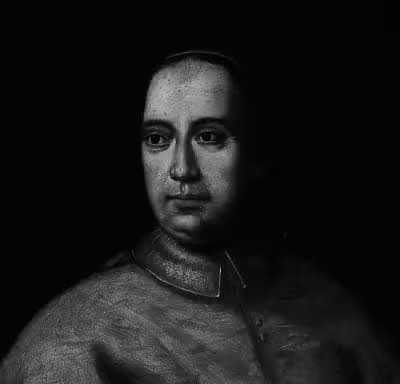
Benedetto Pamfili
1653-1730
Biography
Cardinal Benedetto Pamphilj (25 April 1653 – 22 March 1730), also frequently rendered as Pamphili or Pamfili, stands as one of the most influential cultural architects, literary patrons, and ecclesiastical magnates of late Baroque Rome. Operating at the intersection of papal aristocracy, Counter-Reformation devotional politics, and the flourishing musical humanism of the late seventeenth and early eighteenth centuries, Pamphilj embodied the quintessential Roman cardinal-virtuoso. As Grand Prior of the Sovereign Military Order of Malta in Rome, Archpriest of the Patriarchal Basilicas of Santa Maria Maggiore and San Giovanni in Laterano, and Cardinal Librarian of the Holy Roman Church (Bibliothecarius Sanctae Romanae Ecclesiae), his institutional authority was matched only by his extraordinary patronage of European art and music. Known within the Accademia dell'Arcadia under the pastoral pseudonym Fenicio Larisseo, Pamphilj was not merely a passive consumer of culture but an active poet and librettist whose text-settings provided the dramatic foundation for masterworks by George Frideric Handel, Arcangelo Corelli, Alessandro Scarlatti, and Bernardo Pasquini. His long life bridged the post-Westphalian consolidation of the Papal States with the dawn of the Enlightenment, leaving an indelible imprint on the musical, typographical, and codicological landscape of early modern Europe.
Born into the apex of the Roman high nobility on April 25, 1653, Benedetto Pamphilj inherited the immense prestige and territorial wealth of two of the most formidable dynastic houses of Italy. He was the son of Don Camillo Francis Maria Pamphilj (1612–1666), Prince of Valmontone and San Martino, and Donna Olimpia Aldobrandini (1623–1681), Princess of Rossano and sole heiress to the vast Aldobrandini patrimony. Through his paternal lineage, Benedetto was the great-nephew of Pope Innocent X (Giovanni Battista Pamphili, reigned 1644–1655), whose pontificate had solidified the family's urban and regional hegemony through the construction of Palazzo Pamphili in Piazza Navona, the expansion of the Villa Doria Pamphili outside the Porta San Pancrazio, and the endowment of the monumental church of Sant'Agnese in Agone. Following the premature death of his father in 1666, the young Benedetto was educated under the rigorous tutelage of private preceptors, mastering Latin, classical rhetoric, jurisprudence, theology, and modern languages. Immersed from childhood in the opulent visual and acoustic environment of the Pamphilj and Aldobrandini palaces, he developed an acute sensitivity to music, theater, and poetic composition, which was further nurtured by his close familial ties to the leading intellectual academies of the Eternal City.
Benedetto’s formal ascension through the ranks of the Roman Curia was swift and dictated by dynastic prerogative. Entering the Order of St. John of Jerusalem (the Knights of Malta), he was appointed Grand Prior of the Order in Rome in 1678, a position that conferred significant prestige and financial revenues. On September 1, 1681, Pope Innocent XI Odescalchi elevated the twenty-eight-year-old aristocrat to the Sacred College of Cardinals as Cardinal-Deacon of Santa Maria in Portico (subsequently transferring his titles to San Cesareo in Palatio, Santa Maria in Via Lata, and Sant'Agata dei Goti). In 1685, Innocent XI dispatched Pamphilj to the volatile Northern legation of Bologna as Papal Legate, a diplomatic and administrative posting he held until 1690. Upon his return to Rome, Pamphilj assumed increasingly vital pastoral and ceremonial responsibilities within the Curia. Pope Innocent XII named him Archpriest of the Basilica of Santa Maria Maggiore in 1693, an office he relinquished in 1699 when he was appointed Archpriest of the Archbasilica of San Giovanni in Laterano—the cathedral church of Rome and the seat of the Bishop of Rome—a position he held for over three decades until his death.
A pivotal chapter in Pamphilj’s intellectual career began in 1704, when Pope Clement XI Albani appointed him Bibliothecarius Sanctae Romanae Ecclesiae (Cardinal Librarian of the Vatican Library), succeeding Cardinal Enrico Noris. Pamphilj’s twenty-six-year tenure at the helm of the Biblioteca Apostolica Vaticana was marked by substantial codicological growth, administrative stabilization, and academic accessibility. Working alongside eminent scholars, scriptors, and custodians such as Lorenzo Alexander Zacagni and Antonio Maria Salvini, Pamphilj oversaw the acquisition of rare Oriental, Greek, and Latin manuscripts, protected the library’s archives during the geopolitical turmoil of the War of the Spanish Succession, and facilitated access for foreign scholars, antiquarians, and bibliophiles visiting Rome. His personal library, housed within his residence at the Palazzo Pamphili on the Via del Corso, was similarly renowned across Europe, containing thousands of printed volumes, musical manuscripts, historical tracts, and classical texts that served as an essential hub for early modern Republic of Letters research.
Simultaneously, Pamphilj established himself as one of the premier musical patrons of the Baroque era. Admitted into the Accademia dell'Arcadia in 1691/1692 under the name Fenicio Larisseo, he championed the Arcadian reform of Italian poetry, advocating for structural clarity, dramatic elegance, and lyrical naturalism over the extravagant concettismo of Marinist poetry. Pamphilj transformed his private apartments into a vibrant musical salon, hosting weekly accademie where the finest instrumentalists and vocalists of Europe performed. He appointed Arcangelo Corelli as his maestro di concerto; Corelli resided under Pamphilj’s protection for years, dedicating his seminal Sonate a tre, Op. 2 (published in Rome in 1685), to the cardinal. Furthermore, Pamphilj maintained intimate artistic collaborations with Alessandro Scarlatti, Bernardo Pasquini, Giovanni Lorenzo Lulier, Antonio Maria Bononcini, and Carlo Francesco Cesarini. In early 1707, the young George Frideric Handel arrived in Rome and immediately entered Pamphilj’s inner circle. Recognizing Handel’s prodigious genius, Pamphilj authored the libretto for Handel’s famous moral oratorio, Il trionfo del Tempo e del Disinganno (HWV 46a), premiered at the Palazzo Pamphili in May 1707. Pamphilj also penned the text for Handel’s spectacular secular cantata Il Delirio amoroso (HWV 99) and addressed an affectionate poetic cantata text to the young composer—Hendel non piangere—famously hailing the Saxon musician as the "new Orpheus."
Pamphilj’s literary output was remarkably prolific, encompassing over forty original librettos for oratorios, moral cantatas, and sacred compositions. His dramaturgical vision was deeply rooted in the Counter-Reformation emphasis on moral allegories, saintly hagiographies, and spiritual transformation, rendered through classicizing Arcadian verse. Among his most celebrated librettos were S. Francesca Romana (set by Scarlatti in 1693), Il trionfo della Grazia (set by Scarlatti in 1685 and later by Domenico Scarlatti), La conversione di Santa Maria Maddalena, and Il trionfo della Poesia nella grandezza d'Bernardo Pasquini. To disseminate these works, Pamphilj cultivated sophisticated networks with the leading printing houses of Rome. The librettos and musical editions produced under his patronage issued from the presses of premier Roman typographers, including the Stamperia Camerale, Antonio de' Rossi, Giovanni Giacomo Komarek, Giovan Battista Bussotti, and Giorgio Placho. These printed librettos—often decorated with the Pamphilj armorial bearings featuring the dove and olive branch beneath the cardinal’s galero—were distributed to the aristocratic attendees of his performances, serving as both devotional programs and tangible symbols of dynastic cultural prestige.
Cardinal Benedetto Pamphilj died in Rome on March 22, 1730, at the age of seventy-six, leaving behind a monumental legacy that spanned political statecraft, library management, and artistic innovation. He was interred with majestic solemnity in the Pamphilj family vault at the church of Sant'Agnese in Agone in Piazza Navona. His vast collection of musical manuscripts, prints, and personal correspondence was largely preserved within the Doria Pamphilj Archives (Archivio Doria Pamphilj), providing modern musicologists and historians with an unprecedented window into the private financial mechanisms, compositional processes, and social structures of Baroque Roman patronage. Modern historiography recognizes Pamphilj not merely as an affluent aristocrat who employed extraordinary composers, but as an active intellectual whose poetical aesthetics, administrative rigor at the Vatican Library, and unwavering support of musical genius fundamentally shaped the trajectory of Western classical music and European print culture at the turn of the eighteenth century.
Bibliography
Montalto, Lina. Un mecenate in Roma barocca: Il cardinale Benedetto Pamphili (1653-1730). Firenze: G. C. Sansoni, 1955.
Marx, Hans Joachim. "Die Musikamateurs des 17. und 18. Jahrhunderts: Das Musikalieninventar des Cardinals Benedetto Pamphili." Archiv für Musikwissenschaft 29, no. 2 (1972): 135-145.
Marx, Hans Joachim. "The Selection of Libretti by Cardinal Benedetto Pamphili." Music & Letters 64, no. 3/4 (1983): 144-152.
Staffieri, Gloria. "L'attività librettistica del cardinale Benedetto Pamphili: Catalogo ragionato delle opere e dei testi drammatici." Studi Musicali 24, no. 2 (1995): 315-385.
Franchi, Saverio. Drammaturgia romana. Vol. II (1701-1750): Annali dei testi drammatici a stampa pubblicati a Roma e nel Lazio. Roma: Edizioni di Storia e Letteratura, 2001.
Harris, Ellen T. "Handel's Roman Patronage: The Cardinal and the Composer." Early Music 35, no. 3 (2007): 389-406.
Fantappiè, Francesca. "Il cardinale Benedetto Pamphili mecenate e librettista." In Il mecenatismo musicale a Roma nel Seicento, edited by Alessio Addamiano and Francesco Luisi, 145-178. Lucca: Libreria Musicale Italiana (LIM), 2011.
Trevisan, Stephanie. "PAMPHILI, Benedetto." In Dizionario Biografico degli Italiani, Vol. 81, 248-253. Roma: Istituto della Enciclopedia Italiana, 2014.
Morelli, Arnaldo. Musica e musicisti a Roma al tempo di Arcangelo Corelli: Committenza, istituzioni, professione. Roma: NeoClassica, 2018.
Beyond the names: biographies and bibliographies on this page are curated by Abu, the AI scholar crafted by Buonvecchio exclusively for Govi Rare Books.