
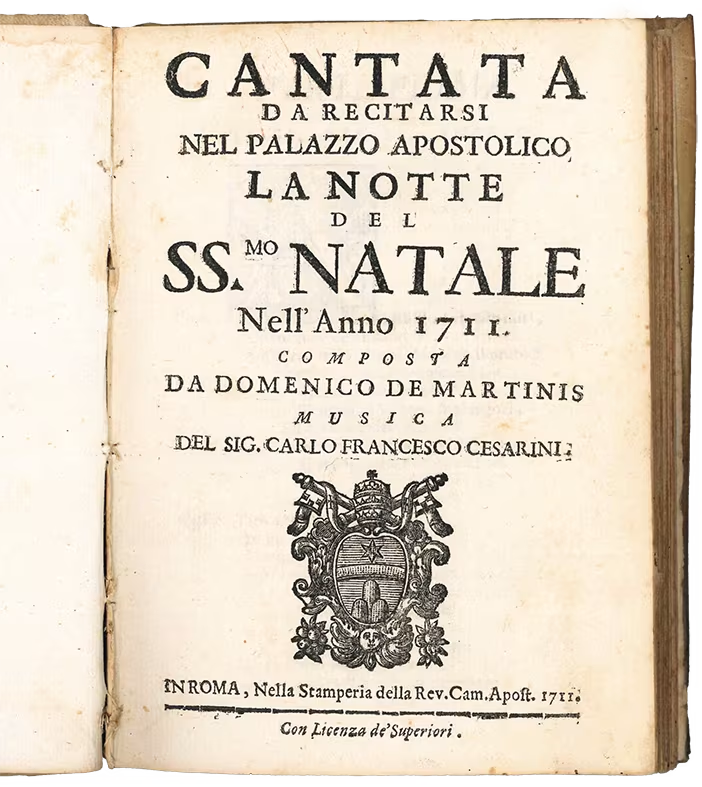
Cantata da recitarsi nel Palazzo Apostolico la Notte del SS.mo Natale nell’anno 1711. Composta da Domenico de Martinis musica del sig. Carlo Francesco Cesarini
Rome, Nella stamperia della Reverenda Camera Apostolica (Stamperia Camerale), 1711
Description
4to. 12 pp. Collation. A6. Woodcut arms of Pope Clement XI on the title page. Woodcut initials. Characters: Tirsi, Alessi, Angelo. Two parts. Music by Carlo Francesco Cesarini (1695-1728).
Italian Union Catalogue, IT\ICCU\BVEE\026730; C. Sartori, I libretti italiani a stampa dalle origini al 1800, Cuneo, 1990, no. 4669; A.L. Bellina, Libretti d’opera, Università degli Studi di Padova, 2013-2015, no. 3436.
(bound with:)
Fabbri, Filippo Ortensio (fl. 17th-18th cent.). Cantata da recitarsi nel Palazzo Apostolico la Notte del SS.mo Natale parole di Alindo Scirtoniano P.A. musica del Sig. Francesco Gasparini. Rome, Nella stamperia della Reverenda Camera Apostolica (Stamperia Camerale), 1722.
4to. XII pp. Collation: A6. Woodcut arms of Pope Innocent XIII on the title page. Alindo Scirtoniano is the Arcadian name of Filippo Fabbri, who served as secretary to Monsignor Annibale Albani (cf. Gli Arcadi dal 1690 al 1800, Roma, 1977, p. 15). Music by Francesco Gasparini (1661-1727). Characters: Titiro, Melibeo, Palemone.
Italian Union Catalogue, IT\ICCU\MUS\0035172; Sartori, 4676.
(bound with:)
Aceti, Tommaso (1687-1749). L’angelo in carne San Tomaso d’Aquino: jerodramma di D. Tomaso Aceti, posto in musica dal signor D. Domenico Antonio Berti, dedicato all’Illustrissimo […] Francesco Maria Ruspoli, degnissimo Nipote del regnante Sommo Pontefice Innocenzo XIII. Da cantarsi nell’Oratorio di S. Girolamo della Carità di Roma. Rome, Gaetano Zenobi, n.d. [1721-1724].
4to. 19, [1 blank] pp. Collation: A10. Woodcut ornaments and initials. Published during the pontificate of Innocent XIII (1721-1724). Two parts. Characters: S. Tomaso, Teodora, Landolfo, Isabella. Music by Domenico Antonio Berti (b. 1700). Aceti was a priest, a proofreader at the Vatican printing press, a member of various academies, and the bishop of Lacedonia.
Italian Union Catalogue, IT\ICCU\MUS\0004994; Sartori, 2006; S. Franchi, Drammaturgia romana II (1701-1750). Annali dei testi drammatici e libretti, Rome, 1997, p. 333.
(bound with:)
Pamfili, Benedetto (1653-1730). Il figliuol prodigo oratorio posto in musica dal signor Carlo Francesco Cesarini. Rome, nella Stamperia del Bernabò, 1708.
4to. [16] leaves. Collation: A-B8. The last leaf is a blank. Woodcut ornaments. The author of the oratorio is Cardinal Benedetto Pamfili, who also covered the printing costs. Characters: Il padre, La madre, Il figliuol prodigo, Il fratello, Un musico. Two parts. Music by Carlo Francesco Cesarini.
Italian Union Catalogue, IT\ICCU\MUS\0319451; Sartori, 10217; Bellina, 3438; Franchi, p. 52.
(bound with:)
La Santissima Vergine Annunziata oratorio a cinque voci, posto in musica dal Sig. Antonio Caldara, e da cantarsi nell’Oratorio della Chiesa Nuova per la Festa di S. Gioseppe nell’anno MDCCXVIII. Rome, Francesco Chracas, 1718.
4to. 23, [1], pp. Collation: A12. Characters: Amor Divino, Beata Vergine, S. Gioseppe, Angelo Gabriello, Lucifero. Choir: Angeli, SS. Padri del Limbo, Vergini Ebree, Demoni. Two parts. Music by Antonio Caldara (1670-1736).
Apparently unrecorded.
(bound with:)
Aceti, Tommaso (1687-1749). Il martirio de’ Santi Cecilia, Valeriano, e Tiburzio jerodramma di don Tomaso Aceti. Posto in musica dal signor D. Domenico Antonio Berti. E dedicato all’Eminentissimo, […] Cardinale Pietro Ottoboni Vice-Cancelliere di Santa Chiesa. Da cantarsi in Roma in S. Girolamo della Carità. Rome, Nella stamperia della Reverenda Camera Apostolica (Stamperia Camerale), 1721.
4to. XX pp. Collation: A10. Woodcut ornaments. Characters: Cecilia, Valeriano, Tibuzio, Almachio. Two parts. Music by Domenico Antonio Berti.
Italian Union Catalogue, IT\ICCU\MUS\0004993; Sartori, 14920; Bellina, 1746.
(bound with:)
Aceti, Tommaso (1687-1749). Il martirio di S. Ermenegildo jerodramma di don Tomaso Aceti. Posto in muscia dal Signor D. Domenico Antonio Berti. E dedicato all’Eminentissimo, […] Cardinale Michele Federico d’Althann Vescovo di Vaccia, libero Barone di Goldburg, […] Da cantarsi in Roma in S. Girolamo della Carità. Rome, Nella stamperia della Reverenda Camera Apostolica (Stamperia Camerale), 1721.
4to. XX pp. Collation: A10. Woodcut ornaments. Characters: S. Ermenegildo, Ingonde, Leovigildo, Reccaredo. Two parts. Music by Domenico Antonio Berti.
Italian Union Catalogue, IT\ICCU\MUS\0004992; Sartori, 14979; Bellina, 1749.
(bound with:)
Aceti, Tommaso (1687-1749). Il primogenito del riformato Carmelo B. Giovannni della Croce. Oratorio del Sacerdote don Tomaso Aceti. Posto in musica dal signor D. Domenico Berti. E dedicato all’E.mo, e Rev.mo Sig. il Sig. Cardinale D. Annibale Albani, Degnissimo Nipote della Santità di Nostro Signore Papa Clemente XI. Roma, Salvioni, 1718.
4to. 20 pp. Collation: A10. Woodcut ornaments. Characters: B. Giovanni, Caterina, S. Teresa, P. Antonio. Two parts. Music by Domenico Antonio Berti.
Italian Union Catalogue, IT\ICCU\MUS\0004990; Sartori, 19095; Bellina, 1750.
Eight works in one volume (205x150 mm). Contemporary vellum over boards, inked title on spine (some light soiling and staining). On the front pastedown bookplate Joseph Marie Gauge prêtre. Skillfully repaired worm tracks on several leaves hardly ever touching the text, some occasional foxing and pale staining, a genuine copy.
Sammelband of eight rare sacred cantatas and oratorios printed in Rome between 1708 and 1724
An unusually coherent collection of eight Roman libretti documenting three closely connected environments of early eighteenth-century sacred music: the Christmas cantata performed before the papal court in the Apostolic Palace, the aristocratic and Oratorian culture surrounding the Chiesa Nuova, and the hagiographical oratorio cultivated at San Girolamo della Carità. The volume brings together poets, composers and patrons belonging to the highest levels of Roman cultural life — Benedetto Pamphilj, Pietro Ottoboni, Annibale Albani, Francesco Maria Ruspoli, Antonio Caldara, Francesco Gasparini and Carlo Francesco Cesarini — alongside four rare sacred dramas by the young Tommaso Aceti set by Domenico Antonio Berti.
The eight publications are not simply examples of a generic devotional repertory. They document several distinct mechanisms through which sacred drama was created and circulated in Rome: texts commissioned annually for papal ceremonial; oratorios financed and written within cardinalitial households; revivals of established musical works at the Chiesa Nuova; and newly composed hagiographical dramas produced for a particular confraternity. Their editorial histories are accordingly different. Seven appear to represent first or first known contemporary editions, while the Caldara libretto is an especially interesting later performance issue of an earlier work.
I. First edition, and apparently the only contemporary edition, of the cantata composed expressly for performance in the Apostolic Palace on Christmas Eve 1711.
The Roman papal Christmas cantata was an annual ceremonial genre rather than a repertory of works repeatedly reprinted from year to year. A new poetic and musical composition was normally prepared for the occasion, so that the recurrence of the formula Cantata da recitarsi nel Palazzo Apostolico la Notte del SS.mo Natale on successive title-pages should not be mistaken for successive editions of the same work. The 1711 text belongs specifically to the partnership of Domenico de Martinis and Carlo Francesco Cesarini.
Its three figures — Tirsi, Alessi and an Angel — disclose the characteristic mechanism through which Roman Arcadian culture could be reconciled with papal devotion. The shepherds inhabit a literary pastoral world that deliberately overlays the Gospel setting of Bethlehem with the refined vocabulary of contemporary Arcadia. The Angel interrupts this human pastoral sphere by announcing the event that gives it Christian meaning. The dramatic action is therefore slight, but the structure is carefully calculated: expectation, revelation and contemplation replace narrative complexity.
Carlo Francesco Cesarini, born around 1665–1666 and still documented in 1741, was one of the most deeply embedded composers in Roman aristocratic and ecclesiastical musical life. His long association with Cardinal Benedetto Pamphilj placed him in the same musical network as Corelli, Scarlatti and, during his Italian years, Handel. The cantata thus belongs not to a marginal devotional tradition but to the sophisticated musical culture cultivated around the papal and cardinalitial courts.
The use of the Stamperia Camerale and the arms of Clement XI further identify the publication as an official ceremonial object: the printed libretto preserved the text of an essentially ephemeral performance and simultaneously transformed a single Christmas celebration into a document of the papal court.
II. First edition, and apparently the only contemporary edition, of the cantata specially composed for the Christmas Eve ceremony of 1722 during the pontificate of Innocent XIII. Its author appears under his Arcadian name, Alindo Scirtoniano. Filippo Ortensio Fabbri belonged directly to the Roman Arcadian and curial environment and served as secretary to Monsignor Annibale Albani. He had already participated in papal Christmas music earlier in the century, and his literary identity helps explain the exceptionally pure pastoral construction of the present text.
The characters are Titiro, Melibeo and Palemone, names deliberately taken from the vocabulary of Virgilian and Arcadian pastoral. Unlike the 1711 work, there is no Angel among the dramatis personae: the mystery of the Nativity is contemplated entirely within the fictional world of shepherds. Bethlehem and Arcadia are effectively superimposed, allowing Christian revelation to be expressed through a literary language based upon simplicity, rural innocence and contemplative wonder. The music was by Francesco Gasparini, one of the most experienced Italian composers of his generation, whose career embraced Rome and Venice, opera, sacred music, cantata and musical pedagogy. The conjunction of Fabbri’s Arcadian poetry with Gasparini’s mature musical language makes the 1722 libretto particularly representative of the absorption of Arcadian aesthetics into official papal ceremony. The arms of Innocent XIII and the Camerale imprint again demonstrate that the printed object formed part of the representation of the pontifical event itself.
III. First edition, and apparently the only contemporary edition recorded, of Aceti’s jerodramma on Thomas Aquinas. Its date can be restricted to the pontificate of Innocent XIII, since Francesco Maria Ruspoli is identified on the title-page as nephew of the reigning pope.
The work belongs to the youthful Roman period of Tommaso Aceti, long before the historical and philological scholarship for which he later became best known. Born in Calabria in 1687, Aceti was ordained in 1711 and moved to Rome in 1714, where he became corrector of the Vatican-associated printing establishment at the Sapienza. He entered the protection of powerful churchmen, particularly Annibale Albani, participated in Roman academies and became part of precisely the learned ecclesiastical world in which sacred drama could function simultaneously as devotion, literature and patronage. L’angelo in carne concentrates not on the mature author of the Summa theologica but on the formation of Thomas’s vocation. Its four characters — Thomas, Teodora, Landolfo and Isabella — transfer the saint’s life into the emotional sphere of the family. The traditional hagiographical conflict between Thomas’s aristocratic relatives and his desire to enter the Dominican Order provides the dramatic engine: dynastic expectation and worldly honour are placed against religious vocation, chastity and spiritual obedience.
This is a revealing choice for an oratorio. The drama requires no spectacular representation of miracles or theological disputation. Sanctity becomes visible through a series of moral decisions made against familial resistance. The title, “the angel in the flesh,” condenses the traditional conception of Aquinas as possessing an almost angelic purity while still inhabiting the conflicts of human kinship.
The music was composed by Domenico Antonio Berti, with whom Aceti formed a sustained partnership at San Girolamo della Carità. The dedication to Francesco Maria Ruspoli further connects the work with one of the great Roman dynasties of musical patronage. The libretto is thus an early witness both to Aceti’s literary formation and to a small but highly organized Roman environment in which sacred biography was reshaped as affective musical drama.
IV. First printed edition of the libretto. The oratorio had already been performed at the Chiesa Nuova on 27 March 1707, apparently without a printed libretto being issued for that first performance. The 1708 edition is therefore the earliest known printed witness to Pamphilj’s text and Cesarini’s setting, rather than the first performance of the work. Benedetto Pamphilj occupies a very different position from the professional librettist. Cardinal, collector, patron, Arcadian and poet, he was himself one of the principal architects of Roman musical culture. He maintained musicians, organized academies, wrote texts for musical setting and financed performances and publications. The fact that he paid the printing expenses of Il figliuol prodigo is therefore entirely consistent with a cultural programme in which authorship, patronage and material publication could remain in the hands of the same individual.
Pamphilj enlarges the brief Lucan parable into a domestic drama. Alongside the Father and Prodigal Son appear the Mother, the Brother and a Musico. This expansion is fundamental: the moral lesson no longer depends only upon the opposition between sin and paternal forgiveness, but upon the emotional consequences of the son’s behaviour for the entire family. The elder brother’s resentment acquires dramatic weight, the mother adds a further language of affection and grief, and the Musico provides a theatrical connection with the seductive world into which the prodigal has entered.
The parable thus becomes a drama of separation, worldly illusion, repentance and reintegration. Pamphilj’s method is characteristic of the Roman oratorio at its most sophisticated: sacred instruction is made persuasive not by suppressing theatrical affect but by exploiting it.
Cesarini was Pamphilj’s long-term musical collaborator, and the relationship between poet-patron and composer gave the setting a degree of institutional continuity absent from occasional commissions. The 1708 libretto consequently documents both a specific oratorio and the functioning of one of Rome’s most important private musical households.
V. Rare performance edition for the 1718 revival at the Oratorio della Chiesa Nuova; not the first edition of the work.
Caldara’s oratorio existed before this performance. A Roman libretto survives for a performance at Palazzo Caetani in 1715, printed by Antonio de Rossi, and the work belongs to Caldara’s Roman repertory of the preceding years. The present Chracas printing therefore represents a new performance issue associated specifically with the Chiesa Nuova in 1718. Its apparent absence from the principal standard catalogues makes it potentially one of the most bibliographically significant items in the volume.
There is also evidence of adaptation rather than simple reprinting. The earlier form of the work is described as divided into three parts, whereas the present 1718 libretto is explicitly organized in two. Until the two texts are collated line by line it would be premature to define the extent of revision, but the difference strongly suggests that the Chiesa Nuova revival involved a restructuring of the earlier work.
The dramatic architecture is unusually ambitious. The principal figures are Divine Love, the Blessed Virgin, St Joseph, the Archangel Gabriel and Lucifer, accompanied by choruses of Angels, Fathers in Limbo, Hebrew Virgins and Demons. The Annunciation is thereby expanded far beyond the private encounter between Mary and Gabriel. Caldara’s Roman audience encounters the Incarnation as a cosmic event simultaneously affecting Heaven, Israel, the dead awaiting redemption and the demonic world.
Lucifer supplies dramatic resistance, while the Fathers in Limbo interpret the Incarnation retrospectively as the beginning of their future liberation. The Hebrew Virgins place Mary within the historical and prophetic continuum of Israel rather than isolating her from it. Divine Love provides the theological force that unites these different levels of the drama. The libretto is especially interesting because Caldara was no longer simply a young Roman composer by 1718. His mobility between Venice, Mantua, Rome, Barcelona and ultimately Vienna made him one of the most international composers of the period. A Roman revival of an earlier Caldara oratorio therefore documents the persistence of his local reputation even as his career was becoming tied increasingly to the Habsburg world.
If the absence of this precise 1718 Chracas issue from the principal repertories is confirmed, it should be catalogued not merely as “unrecorded,” but as an apparently unrecorded printed witness to a documented Roman revival of an important Caldara sacred work, with a structure apparently differing from the earlier performance version.
VI. First edition, and apparently the only contemporary edition recorded, of Aceti and Berti’s jerodramma on Cecilia, Valerian and Tiburtius, performed at San Girolamo della Carità and dedicated to Cardinal Pietro Ottoboni.
Aceti reduces the extensive hagiographical tradition surrounding Cecilia to four essential figures: Cecilia, her husband Valerian, Valerian’s brother Tiburtius and the persecuting prefect Almachius. The resulting economy is dramatically effective. Cecilia is not simply the final victim of persecution but the source from which conversion spreads through the family: first to Valerian and then to Tiburtius.
The work is therefore constructed around persuasion before it reaches martyrdom. In a genre without conventional stage action, conversion can unfold through verbal and musical confrontation, while Almachius embodies the external pressure of Roman authority and compulsory pagan observance. The final deaths become the consequence of positions already established through dialogue rather than spectacles of violence.
The dedication to Pietro Ottoboni is important. Ottoboni was among the most powerful patrons of music, poetry and theatre in Baroque Rome and maintained one of the city’s most distinguished artistic households. A work produced for San Girolamo della Carità but offered to Ottoboni therefore links the comparatively intimate devotional world of the confraternity to the highest level of Roman cultural patronage.
The collaboration with Berti confirms that Aceti’s sacred dramas were not isolated occasional poems. They form part of a recurring repertory developed for the same institutional environment and shaped by the same poet-composer relationship.
VII. First edition, and apparently the only contemporary edition recorded.
Hermenegild offered Aceti a substantially more politically complex subject than the Roman martyr legends. The sixth-century Visigothic prince had rebelled against his father, the Arian king Leovigild, and converted to Catholicism. Early historical traditions did not interpret him uniformly: from one perspective he could be condemned as a rebellious son and failed political insurgent, while Gregory the Great’s influential account transformed him into a Catholic martyr whose death anticipated the eventual conversion of the Visigothic monarchy.
Aceti adopts the latter providential interpretation but gives it a particularly effective dramatic structure through four characters: Hermenegild, his Catholic wife Ingund, his father Leovigild and his brother Reccared. Political rebellion, filial obedience and religious confession consequently become inseparable. Ingund represents the Catholic influence surrounding Hermenegild; Leovigild combines paternal authority, kingship and Arianism; Reccared points beyond the martyr’s immediate defeat toward the later Catholic conversion of the Visigothic kingdom.
The presence of Reccared is especially important because it changes the temporal logic of the martyrdom. Hermenegild can die politically defeated while remaining providentially victorious: the historical future embodied by his brother completes the religious meaning of his sacrifice.
The dedication to Cardinal Michael Friedrich von Althann, an ecclesiastic deeply involved in Habsburg political and diplomatic networks, adds a suggestive contemporary context. It would be excessive to interpret the drama as a coded Habsburg political allegory, but the offering of a work concerning dynastic authority, religious orthodoxy and the confessional destiny of monarchy to so prominent an imperial churchman would certainly have been culturally intelligible.
VIII. First edition, and apparently the only contemporary edition recorded, of Aceti’s oratorio on John of the Cross, printed eight years before the saint’s canonization in 1726.
The work is notable for what it does not emphasize. Modern readers instinctively approach John of the Cross through the mystical poetry and prose that later made him one of the central writers of Christian spirituality. Aceti instead presents him as the “firstborn of the reformed Carmel”: the foundational male figure in the Discalced Carmelite reform developed with Teresa of Ávila.The cast makes the purpose clear. John appears together with St Teresa, Caterina and Father Antonio, almost certainly Antonio de Heredia, who participated with John in the first male Discalced Carmelite foundation at Duruelo. The drama is consequently concerned with reform as an institutional and spiritual beginning rather than with the retrospective image of John as the universal mystical doctor.
This also explains the importance of the word Beato on the title-page. John had been beatified but had not yet been canonized. The libretto therefore belongs to the active history of his cult before sainthood was formally completed, rather than to the vast later literature written after canonization.
The dedication to Cardinal Annibale Albani has an additional biographical importance for Aceti. Albani was not merely a prestigious name placed at the head of the book; he belonged to the network of patronage that materially supported Aceti’s Roman career. The dedication therefore documents a real relationship between the young Calabrian cleric and one of the principal ecclesiastical families of Clement XI’s pontificate.
Seen together, the four Aceti libretti reveal a coherent early literary project. Aquinas embodies vocation resisted by family; Cecilia converts family members before facing persecution; Hermenegild transforms dynastic rebellion into martyrdom and providential history; John of the Cross embodies the institutional beginning of religious reform. In each case Aceti selects from a much larger hagiographical tradition the elements most capable of becoming moral conflict through dialogue and music.
The eight libretti form a remarkably concentrated record of Roman sacred musical culture across roughly fifteen years. They move between the Apostolic Palace, the Chiesa Nuova, aristocratic households and San Girolamo della Carità, but the people involved repeatedly cross those institutional boundaries. Pamphilj is simultaneously cardinal, poet and patron; Cesarini moves between private aristocratic service and major ecclesiastical appointments; Fabbri connects Arcadia to the Albani circle; Gasparini and Caldara bring internationally important compositional careers into Roman ceremonial and devotional settings; Aceti’s literary apprenticeship unfolds under the protection of Albani and Ruspoli; Ottoboni appears as dedicatee and as one of the great organizers of Roman musical culture.
The editorial history strengthens the coherence of the collection. The two papal Christmas cantatas appear to survive in their first and apparently sole contemporary editions; three of the Aceti-Berti jerodrammi of the early 1720s likewise appear to be first and only known contemporary printings; Il primogenito is the first known edition of an oratorio tied to the pre-canonization cult of John of the Cross; Pamphilj’s Il figliuol prodigo is the first known printed witness to an oratorio first performed the preceding year; and the Caldara is the exceptional counterexample, a rare later performance issue whose two-part organization appears to document the adaptation of an earlier work for a new Roman revival. The collection consequently preserves not simply eight sacred texts but several different stages in the life of early eighteenth-century musical drama: commission, first performance, first publication, revival, adaptation and institutional reuse. That is what makes the sammelband historically stronger than the sum of its already rare components.
Bibliography
Sartori, Claudio. I libretti italiani a stampa dalle origini al 1800. 7 vols. Cuneo: Bertola & Locatelli, 1990–1994, nos. 2006, 4669, 4676, 10217, 14920, 14979, 19095.
Bellina, Anna Laura. Libretti d’opera. Padua: Università degli Studi di Padova, 2013–2015, nos. 1746, 1749, 1750, 3436, 3438.
Franchi, Saverio. Drammaturgia romana II (1701–1750). Annali dei testi drammatici e libretti per musica pubblicati a Roma e nel Lazio dal 1701 al 1750. Rome: Edizioni di Storia e Letteratura, 1997, pp. 52, 113, 333.
Simi Bonini, Eleonora, ed. Il fondo musicale dell’Arciconfraternita di S. Girolamo della Carità. Rome: Ministero per i Beni Culturali e Ambientali, 1992, pp. 23–36, 61–98, 172–179.
Smolarek, Dariusz. “Oratorium w Rzymie od XVII do XVIII wieku.” Ruch Biblijny i Liturgiczny 65, no. 1 (2012): 67–84.
Spera, Lucinda. “Fabbri, Filippo Ortensio.” In Dizionario Biografico degli Italiani. Vol. 43. Rome: Istituto della Enciclopedia Italiana, 1993, pp. 625–627.
Mercantini, Alessandra. “Pamphili, Benedetto.” In Dizionario Biografico degli Italiani. Vol. 80. Rome: Istituto della Enciclopedia Italiana, 2014, pp. 665–667.
Piperno, Franco. “Francesco Gasparini ‘virtuoso dell’eccellentissimo sig. Principe Ruspoli’: contributo alla biografia gaspariniana (1716–1718).” In Francesco Gasparini (1661–1727). Atti del primo Convegno internazionale, edited by Fabrizio Della Seta and Franco Piperno. Florence: Leo S. Olschki, 1981, pp. 191–214.
Della Seta, Fabrizio. “Francesco Gasparini, virtuoso del principe Borghese.” In Francesco Gasparini (1661–1727). Atti del primo Convegno internazionale, edited by Fabrizio Della Seta and Franco Piperno. Florence: Leo S. Olschki, 1981, pp. 215–243.
Kirkendale, Ursula. Antonio Caldara: sein Leben und seine venezianisch-römischen Oratorien. Graz-Cologne: Hermann Böhlaus Nachf., 1966, esp. p. 306 and pp. 356–390.
Kirkendale, Ursula. Antonio Caldara: Life and Venetian-Roman Oratorios. Revised and translated by Warren Kirkendale. Florence: Leo S. Olschki, 2007, esp. p. 306.
Petrucci, Armando. “Aceti, Tommaso.” In Dizionario Biografico degli Italiani. Vol. 1. Rome: Istituto della Enciclopedia Italiana, 1960, pp. 111–112.
Mihi Blázquez, Ana María. “De ‘tyrannus’ a ‘martyr’: la interpretación gregoriana de Hermenegildo.” Revista de Filología Románica 41 (2024): 97–109.