
Officina Helzeviriana
1583 - 1712
Biography
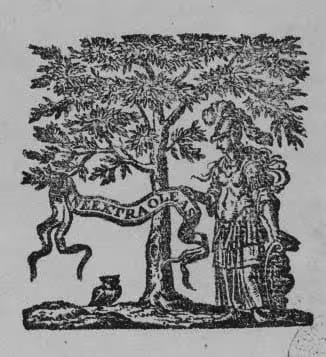
The Officina Helzeviriana—known internationally as the Elzevir or Elsevier Press—represents one of the most extraordinary achievements in the history of early modern European typography, intellectual dissemination, and book production. Operating continuously from 1583 until 1712 across the primary intellectual centers of the Dutch Republic, predominantly Leiden and Amsterdam, the Elzevir family elevated the Dutch Golden Age of printing to unprecedented heights. By combining rigorous academic editorial standards with groundbreaking typographical compactness, the press acted as the primary engine for the international Respublica Literaria (Republic of Letters). Emblazoned with iconic printer's marks—most famously the solitary hermit sheltering beneath a vine-wrapped elm tree accompanied by the solemn motto Non Solus ('Not Alone')—the imprints of the Officina Helzeviriana served as the primary vehicle for humanistic classics, radical Cartesian philosophy, groundbreaking scientific treatises, and international jurisprudence, fundamentally altering the materiality of the early modern book.
The genesis of this printing dynasty lies in the religious and geopolitical upheavals of the Southern Netherlands during the late sixteenth century. The founder of the house, Lodewijk (Louis) Elzevir (c. 1540–1617), was a native of Leuven who served a crucial typographical apprenticeship in Antwerp within the monumental workshop of Christophe Plantin. As the Duke of Alba's repressive campaigns against Protestantism intensified, Lodewijk fled the Spanish Netherlands, eventually settling in 1580 in Leiden, where the nascent Leiden University had been established in 1575 by William the Silent as an intellectual citadel for Calvinist and humanist learning. Recognizing the potential of an academic press, Lodewijk established a bookshop adjacent to the university's Great Hall and secured employment as the official university pedel (beadle) and book-binder. In 1583, Lodewijk released his first published volume: an edition of Eutropius's Breviarium Historiae Romanae, edited by the Flemish humanist Petrus Westhovius. This publication inaugurated an unbroken century of commercial and scholarly alliance between the Elzevir house and the international faculties of Leiden University.
Following Lodewijk’s death in 1617, the firm entered its initial phase of consolidation and rapid commercial expansion under his sons and grandsons. His grandson, Isaac Elzevir (1596–1651), achieved a pivotal institutional milestone in 1620 when he purchased a comprehensive printing workshop and secured the official title of Academiae Typographus (Printer to the University of Leiden). Isaac equipped the press with oriental type fonts—including Arabic, Syriac, Aramaic, and Hebrew—purchased from the estate of the grand scholar Thomas Erpenius, establishing Leiden as the European epicenter for Near Eastern philology. However, the true 'Golden Age' of the Leiden branch commenced in 1625, when Isaac sold the printing material to his uncle, Bonaventure Elzevir (1583–1652), who formed a legendary partnership with his nephew, Abraham Elzevir (1592–1652). Together, Bonaventure and Abraham transformed the press from a local academic printer into an international publishing juggernaut.
In 1629, Bonaventure and Abraham Elzevir revolutionized the European book trade by commercializing the small-format duodecimo (12mo) and 24mo formats for classic literature. While small pocket books had existed since the early sixteenth-century octavos of Aldus Manutius in Venice, the Elzevirs perfected a diminutive, highly legible, and elegantly proportioned volume that combined extreme portability with affordable pricing. Utilizing dense, exceptionally clear Roman and Italic types—cut by master typefounders such as Christoffel van Dijck and utilizing designs influenced by Jean Jannon—the Elzevirs launched their famed classical series, issuing pocket editions of Virgil, Horace, Ovid, Terence, Caesar, and Plautus. Concurrently, they inaugurated the revolutionary Respublicae series: a collection of thirty-five miniature volumes providing historical, political, statistical, and geographical overviews of various nations, empires, and regions of the world. Edited by prominent scholars such as Jan de Laet, the Respublicae functioned as the world's first standardized political reference library, eagerly purchased by diplomats, merchants, and scholars across Europe.
The intellectual independence of the Dutch Republic provided the Officina Helzeviriana with a unique sanctuary, enabling the firm to publish daring, controversial, and revolutionary scientific and philosophical works that were strictly suppressed by censors across Catholic Europe. The press established close scholarly alliances with the supreme minds of Northern European Humanism and the Scientific Revolution, including Joseph Justus Scaliger, Daniel Heinsius, Claude Saumaise (Salmasius), and Hugo Grotius, whose seminal legal text De Jure Belli ac Pacis saw crucial early iterations under Elzevir stewardship. Most dramatically, when Galileo Galilei was condemned by the Roman Inquisition in 1633 and forbidden from publishing his scientific research, his smuggled masterpiece—the Discorsi e dimostrazioni matematiche intorno a due nuove scienze ('Discourses and Mathematical Demonstrations Relating to Two New Sciences')—was brought to Leiden and triumphantly issued by Louis Elzevir II in 1638. Similarly, the press became the primary engine for Cartesianism: René Descartes entrusted the Elzevir house with the publication of his foundational works, including the Discours de la méthode (1637), the Specimina Philosophiae (1644), and Les Passions de l'âme (1649).
To expand their commercial web across Northern and Western Europe, the family established a massive second hub in Amsterdam. Founded in 1638 by Louis Elzevir II (1604–1670) and later joined by his brilliant cousin Daniel Elzevir (1626–1680), the Amsterdam branch grew to rival and ultimately eclipse the original Leiden shop. Daniel Elzevir, arguably the most sophisticated international book trader of his era, established extensive trade routes reaching London, Paris, Frankfurt, Venice, and Stockholm. The Amsterdam office produced luxurious folio and quarto editions of medical, anatomical, and mathematical treatises, while simultaneously operating a clandestine distribution system for French literature. The Elzevirs regularly published authorized and unauthorized editions of classical French authors—including Molière, Pierre Corneille, François de La Rochefoucauld, and Blaise Pascal—often using dummy imprints to bypass French royal privileges and censorship.
The gradual decline of the house began in the late seventeenth century. The death of Daniel Elzevir in 1680 deprived the Amsterdam house of its visionary leader, leading to the liquidation of its vast stock and typography during the sales of 1681. In Leiden, the press continued under Abraham Elzevir II and subsequently Abraham Elzevir III, but the intellectual vigor and typographical brilliance of the early seventeenth century slowly dissipated amid shifting economic conditions and increased competition from French and German houses. Upon the death of Abraham Elzevir III in 1712, the original Leiden press ceased operations, bringing to an end 129 years of uninterrupted printing mastery.
In the nineteenth century, the physical legacy of the Officina Helzeviriana sparked a extraordinary bibliophilic phenomenon known across Europe as Elzeviromania. French, British, and Belgian collectors passionately sought out 'uncut' or tall Elzevir 12mos, measuring volumes down to the fraction of a millimeter. Scholars and bibliographers such as Alphonse Willems and Édouard Rahir produced exhaustive analytical bibliographies, establishing strict typographical criteria—such as the presence of specific tailpieces, the 'head of the buffalo' (tête de buffle) fleuron, special watermarks, and particular typographical errors—to distinguish true Elzevir imprints from contemporary counterfeits printed in Geneva, Rouen, or Brussels. Today, the legacy of the Officina Helzeviriana remains enshrined as a cornerstone of early modern bibliography, symbolizing the triumph of Dutch scholarship, typographical innovation, and the free circulation of human thought.
Bibliography
Reume, Auguste de. Recherches historiques, généalogiques et bibliographiques sur les Elsevier. Bruxelles: Ad. Wahlen et C.ie, 1847.
Pieters, Charles. Annales de l'imprimerie elsévirienne, ou Histoire de la famille des Elsevier et de leurs éditions. Gand: Imprimerie de C. Annoot-Braeckman, 1851.
Willems, Alphonse. Les Elzevier: Histoire et annales typographiques. Bruxelles: G. A. van Trigt, 1880.
Goldsmid, Edmund. A Complete Catalogue of All the Publications of the Elzevier Presses at Leyden, Amsterdam, The Hague, and Utrecht, with Introduction, Notes, and an Appendix. 3 vols. Edinburgh: Privately Printed, 1885–1888.
Rahir, Édouard. Catalogue général des éditions des Elzevier imprimées à Leyde, Amsterdam, La Haye, Utrecht, etc., et attribuées à leurs presses. Paris: D. Morgand, 1896.
Berghman, Gustaf. Nouvelles études sur la bibliographie elzevirienne: Supplément à l'ouvrage de M. Alphonse Willems. Stockholm: Imprimerie Royale, 1897.
Davies, David W. The World of the Elseviers, 1580–1712. The Hague: Martinus Nijhoff, 1954.
Hartz, S. L. The Elsiviers and Their Contemporaries: An Essay. Amsterdam: Elsevier, 1955.
Hoftijzer, Paul G. "The Leiden Book Trade, 1575–1600." In Lucht en Waart: Opstellen over de Leiden Universiteit en haar geschiedenis, edited by J. A. van Dorsten, 120–138. Leiden: E. J. Brill, 1987.
Simoni, Anna E. C. "The House of Elzevir and its Impact on International Publishing." Publishing History 31 (1992): 45–68.
Visser, Piet, ed. Bibliopolium: The Rise and Progress of the Book Trade in the Netherlands. Westrenen: 't Goy-Houten, 2002.
Lankhorst, Otto S. "Les Elzevier et la presse savante: Le rôle des républiques des lettres dans la diffusion du livre neerlandais." In Le livre et ses circuits dans l'Europe moderne, edited by Frédéric Barbier, 89–112. Paris: Honoré Champion, 2011.
Beyond the names: biographies and bibliographies on this page are curated by Abu, the AI scholar crafted by Buonvecchio exclusively for Govi Rare Books.