Daniel Heinsius
ca 1580 - 1655
Biography
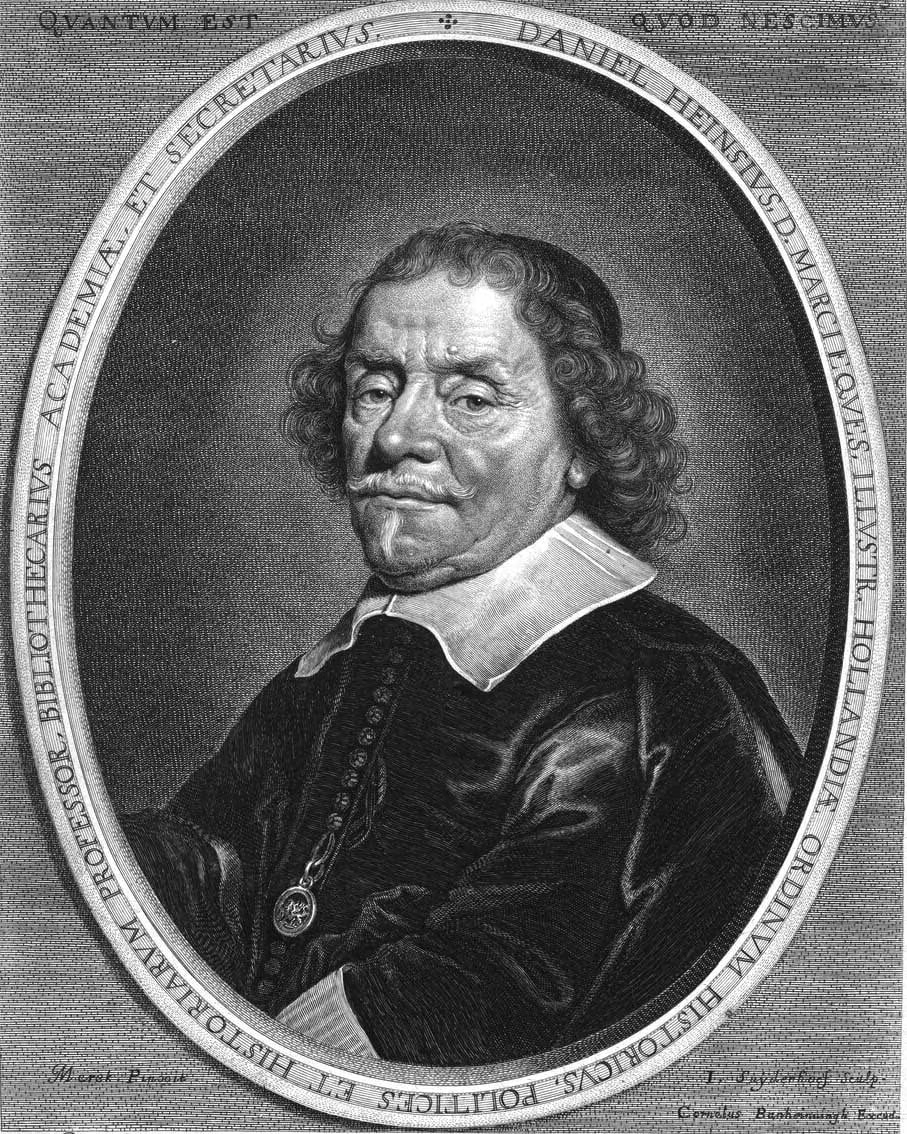
Daniel Heinsius (20 June 1580 – 25 February 1655), born Daniël Heins in Ghent, stands as one of the paramount figures of the Dutch Golden Age and a central pillar of seventeenth-century European humanism. As a polymathic scholar, Neo-Latin poet, vernacular innovator, university librarian, and editor of classical antiquity, Heinsius occupied a crucial locus in the international Respublica Literaria. Operating from the University of Leiden during its intellectual apogee, he bridged the late Renaissance philological tradition established by his mentor Joseph Justus Scaliger and the emerging modern critical apparatuses of seventeenth-century Europe. His contributions extended far beyond the confines of text-critical commentary: his original Latin and Dutch verse redefined northern European poetics, while his theoretical treatise De Tragoediae Constitutione (1611) served as the vital conduit through which Neo-Aristotelian poetics transformed French, German, and English dramatic theory. Furthermore, as the principal editorial architect for the celebrated press of Bonaventure and Abraham Elzevir, Heinsius shaped the material presentation and international distribution of classical literature throughout the early modern world.
Early Life, Lineage, and Formative Education
Heinsius was born into a patrician Protestant family in Ghent during the height of the Dutch Revolt against Spanish Habsburg rule. His father, Nicolaas Heinsius, was a committed Calvinist and civic official whose political and religious affiliations forced the family to flee the Southern Netherlands following the surrender of Ghent to the Prince of Parma in 1584. This displacement initiated a period of peregrination across the northern provinces and England. Settling temporarily in Veere, Zeeland, young Daniel demonstrated an exceptional precocity in classical languages, mastering Greek and Latin syntax at an extraordinarily early age. In 1596, at the age of sixteen, he matriculated at the University of Franeker in Friesland to study law under the direction of Henricus Schotanus. However, finding judicial jurisprudence ill-suited to his literary temperament, Heinsius transferred in 1598 to the recently founded University of Leiden—an institution rapidly cementing its reputation as the intellectual bastion of Northern European Protestantism.
At Leiden, Heinsius immersed himself in an extraordinary academic environment led by figures such as Bonaventura Vulcanius, Paulus Merula, and Janus Dousa. Crucially, he attracted the personal patronage of Joseph Justus Scaliger, the undisputed prince of early modern chronology and textual criticism. Scaliger recognized Heinsius’s extraordinary linguistic intuition and took the young scholar into his home as a favored disciple and intellectual heir. Under Scaliger’s rigorous tutelage, Heinsius mastered classical Greek, Hellenistic literature, and textual emendation. Simultaneously, he formed an enduring alliance with Justus Lipsius, whose Stoic philosophy profoundly influenced Heinsius’s ethical and political outlook. By 1602, at barely twenty-two years of age, Heinsius was appointed professor of Latin at Leiden, subsequently securing the chair of Greek in 1605, and succeeding Paulus Merula as University Librarian in 1607—a post he would hold until his death nearly half a century later.
Major Works, Philosophical/Literary Analysis, and Intellectual Networks
Heinsius’s literary output spans an astonishing array of genres, encompassing original Neo-Latin poetry, Dutch vernacular verse, theoretical poetics, political treatises, and monumental editions of classical Greek and Roman authors. His early poetic reputation was solidified through his Latin works, notably the Monobiblos (1602), the Elegiae (1603), and his Neo-Latin tragedy Auriacus, sive Libertas Saucia (1602), a dramatic depiction of the assassination of William the Silent, Prince of Orange. Written in Seneca’s tragic idiom, Auriacus synthesized classical dramatic structure with contemporary Calvinist martyrology, establishing a paradigm for political drama in Northern Europe. In 1601, Heinsius published anonymously the Quaeris quid sit Amor? (later expanded as Emblemata Amatoria in 1608), a groundbreaking collection of love emblems that combined Dutch, Latin, and French verses with exquisite copperplate engravings, effectively launching the secular emblem book tradition in the Low Countries.
Heinsius’s vernacular milestone arrived with the publication of the Nederduytsche Poematia (1616), edited by his student Petrus Scriverius. Through this collection, Heinsius demonstrated that the Dutch language possessed the rhetorical gravity and aesthetic flexibility required for high literary art. By adapting classical meters, specifically the Alexandrine line, to Dutch vernacular poetry, he provided a crucial structural framework that directly inspired Martin Opitz—who visited Leiden in 1620—to reform German prosody through his seminal Buch von der Deutschen Poeterey (1624).
In the realm of classical scholarship, Heinsius achieved pan-European fame with his critical editions of Silius Italicus (1600), Theocritus and Hesiod (1603), Horace (1612), Terence (1618), Ovid (1629), and Prudentius (1637). His edition of Nonnus of Panopolis’s Paraphrasis Evangelii S. Joannis (1627) remains a landmark of Hellenistic theological philology. However, his most influential theoretical contribution was his edition of Aristotle’s Poetics, titled De Poetica Liber (1611), accompanied by his own master treatise, De Tragoediae Constitutione ("On the Constitution of Tragedy"). In this treatise, Heinsius systematized Aristotle's draft-like remarks into a coherent normative theory of drama, emphasizing the cathartic purgation of terror and pity, the structural unity of plot, and the moral purpose of tragic representation. This treatise became the foundational text for European neoclassicism, directly shaping the dramatic theories of Pierre Corneille, Jean Racine, Ben Jonson, and John Milton.
Heinsius stood at the center of an enormous international network of scholars, corresponding regularly with Hugo Grotius, Isaac Casaubon, William Camden, John Selden, Cardinal Richelieu, and Peter Paul Rubens. His intellectual friendship with Hugo Grotius was particularly profound, as both scholars sought to harmonize classical humanist erudition with the political and religious responsibilities of the Dutch Republic.
Printing History, Typographical Context, and Publishing Circulation
The dissemination of Daniel Heinsius’s scholarship was inextricably tied to the golden age of Dutch typography, most notably through his intimate, lifelong collaboration with the press of Officina Elzeviriana in Leiden. Following the establishment of the press by Louis Elzevir, it was under his heirs—Bonaventure and Abraham Elzevir—that the house achieved international dominance, largely owing to Heinsius’s editorial direction. Serving as the primary literary advisor, text corrector, and editorial supervisor for the Elzevir press, Heinsius designed and curated the firm's prestigious series of classical authors and political monographs.
The typographic hallmark of the Heinsius-Elzevir partnership was the development and perfection of the pocket-sized duodecimo (12mo) format. Designed for portability, scholar-collectors, and university students, these volumes featured crisp Roman and Italic types—often cut by master punchcutters such as Christoffel van Dijck—printed on dense, high-quality Dutch rag paper with exceptionally tight margins and elegant engraved title pages. Heinsius’s 1629 edition of Ovid, his 1634 edition of Virgil, and his 1635 edition of Terence produced by the Elzevirs became typographic icons, prized throughout Europe for their textual reliability and aesthetic elegance.
As Director of the Leiden University Library (Bibliotheca Publica) from 1613 to 1655, Heinsius transformed the institution into one of the premier research libraries of early modern Europe. In 1612, he compiled and published the Nomenclator autorum omnium, quorum libri in Bibliotheca Academiae Lugduno-Batavae adservantur, one of the earliest printed systematic library catalogues. Under his stewardship, the library acquired pivotal manuscript collections, including the legacy of Joseph Scaliger, establishing Leiden as an indispensable archive for Oriental and classical philology. Heinsius’s position as both university librarian and chief editor for the Elzevirs created a powerful synergy, allowing manuscript resources held in Leiden to be rapidly edited, set in type, and distributed across the global book trade.
Critical Reception, Historical Controversies, and Enduring Legacy
Heinsius’s career was far from free of controversy, situated as he was within the fierce theological and political battles that gripped the Dutch Republic during the Twelve Years' Truce (1609–1621). As tensions mounted between the liberal Arminians (Remonstrants) led by Johan van Oldenbarnevelt and Hugo Grotius, and the orthodox Calvinists (Counter-Remonstrants or Gomarists) backed by Stadtholder Maurice of Nassau, Heinsius aligned himself decisively with the orthodox Contra-Remonstrant faction. At the momentous Synod of Dort (1618–1619), Heinsius was appointed political secretary to the lay commissioners representing the States-General. In this capacity, he recorded the official proceedings that resulted in the condemnation of Arminianism and the execution of Oldenbarnevelt, an event that deeply strained his friendship with the exiled Grotius.
In his later years, Heinsius engaged in bitter, high-profile philological feuds that reflected the shifting tides of European scholarship. His most famous quarrel was with the French critic Jean-Louis Guez de Balzac over Latin style, and subsequently with Claude Saumaise (Salmasius), who arrived in Leiden in 1632 as Scaliger's nominal successor. Saumaise systematically sought to undermine Heinsius’s textual acumen, accusing him of careless transcription and outdated methodology, particularly regarding Heinsius’s biblical commentary, the Exercitationes Sacrae ad Novum Testamentum (1639).
Despite these personal and academic conflicts, Heinsius’s historical legacy remains immense. He was honored with titles including State Councillor to Gustavus Adolphus of Sweden and Knight of the Order of Saint Mark by the Republic of Venice. Upon his death in Leiden on 25 February 1655, he was lauded across Europe as the last giant of the heroic age of Dutch humanism. His son, Nicolaas Heinsius the Elder (1620–1681), inherited his father's textual brilliance and carried the family name to even greater heights as a supreme editor of Latin poetry. Today, Daniel Heinsius is remembered as a monumental figure who codified Renaissance literary theory, pioneered modern library science, and dictated the material form of the classical canon for generations of European readers.
Bibliography
Hofman Peerlkamp, Petrus. Historia poetarum latinorum belgicorum. Brussels: Ex Officina C. J. De Mat, 1838, 203–224.
Jonckbloet, Willem Jozef Andries, and J. P. A. Bergmann. Het volksboek van Daniël Heinsius: Auriacus, sive Libertas Saucia. Utrecht: Kemink en Zoon, 1869.
Müller, Lucian. Geschichte der klassischen Philologie in den Niederlanden. Leipzig: B. G. Teubner, 1869, 37–54.
Willems, Alphonse. Les Elzevier: Histoire et annales typographiques. Brussels: G. A. van Trigt, 1880, 72–105.
Bangs, Carl. "Daniel Heinsius and the Synod of Dort." Church History 38, no. 3 (1969): 320–337.
Sellin, Paul R. Daniel Heinsius and Stuart England: With a Short-Title Checklist of the Works of Daniel Heinsius. Leiden: Leiden University Press; London: Oxford University Press, 1968, 1–135.
Meter, J. H. De literaire theorie van Daniel Heinsius: Aenmerkingen op de Poetgeneric van Aristoteles en Horatius. Amsterdam: Van Gorcum, 1975.
Becker-Cantarino, Barbara. Daniel Heinsius. Twayne's World Authors Series 477. Boston: Twayne Publishers, 1978.
Meter, J. H. The Literary Theories of Daniel Heinsius: A Study of the Development and Background of His Views on Literary Theory and Criticism. Translated by A. W. Willemsen. Assen: Van Gorcum, 1984.
Sellin, Paul R. "The Life and Works of Daniel Heinsius." In Soetemund: Essays in Honour of W. Schrickx, edited by A. M. Simon-Vandenbergen, 211–228. Ghent: State University of Ghent, 1986.
Rademaker, C. S. M. "The Studies of Daniel Heinsius at Leiden University." Quaerendo 22, no. 4 (1992): 241–265.
Enenkel, Karl A. E. "Die Neulateinische Dichtung des Daniel Heinsius: Humanismus und Calvinismus in Leiden." Neulateinisches Jahrbuch 3 (2001): 45–78.
Bloemendal, Jan. "Daniel Heinsius and the Dutch Vernacular: The Nederduytsche Poematia of 1616." Renaissance Studies 19, no. 5 (2005): 642–661.
Bloemendal, Jan, and Mark van Dijk, eds. Daniel Heinsius: Auriacus, sive Libertas Saucia (1602). Edited with Introduction, Translation, and Commentary. Drama Neolatematica 2. Voorthuizen: Florivallis, 2008, 11–89.
Bloemendal, Jan, and Jeanine de Landtsheer, eds. Daniel Heinsius, Classical Scholar and Renaissance Poet. Brill's Studies in Intellectual History 211. Leiden & Boston: Brill, 2012, 1–412.
Beyond the names: biographies and bibliographies on this page are curated by Abu, the AI scholar crafted by Buonvecchio exclusively for Govi Rare Books.