
Johann Grüninger
(1455 – 1533)
Biography
Johann Grüninger belongs among the most important printer-publishers of Strasbourg during the transition from the incunable age to the mature commercial book culture of the early sixteenth century. His historical importance rests neither on the invention of a new typographical technology nor on allegiance to a single intellectual movement, but on the extraordinary breadth with which he exploited the possibilities already opened by movable type. Classical texts, university commentaries, devotional literature, sermons, vernacular narratives, satire, practical medicine, distillation manuals, geographical works, and polemical religious writing all passed through his press, often accompanied by unusually ambitious programmes of woodcut illustration.
Over roughly half a century, his workshop became one of the principal places in the Upper Rhine where the medieval commentary book, the humanist edition, the technical manual, the illustrated vernacular bestseller, and eventually the Renaissance atlas could coexist within the same commercial enterprise. The older estimate of 254 identified Grüninger productions was already acknowledged to be incomplete, and modern cataloguing has only reinforced the impression of exceptional productivity.
The name itself requires clarification. Grüninger was not born at Strasbourg, as older derivative accounts sometimes state, but around 1455 at Markgröningen in Württemberg. His family name was Reinhard or Reinhart, and he adopted the form Grüninger from his place of origin, appearing in contemporary contexts under several Latinized and orthographically variable forms, including Johannes Reinhardus, Johannes de Grüningen, Grieninger, Gruninger and related spellings. No secure evidence supports the picturesque claim that he had been formally trained as both bookbinder and engraver, and the early stages of his technical education remain obscure.
What is documented is that he had established himself in Strasbourg by 1481, initially in the Schlauchgasse, acquired civic rights in 1482, and issued his first dated book in 1483, the Historia scholastica of Petrus Comestor, printed in association with the otherwise little-known Heinrich von Ingweiler. Later he transferred the business to premises at the Sandplatz, creating a workshop that remained closely connected with his family until the final years of his life.
Strasbourg was an exceptionally favourable environment for such an enterprise. A free imperial city situated on the Rhine and connected commercially with Basel, Speyer, Nuremberg, Frankfurt and the French-speaking lands, it had acquired an important printing culture during the first generation after Gutenberg. Grüninger entered a market already containing experienced competitors, including Johann Prüss and, later, Matthias Hupfuff, yet his catalogue developed a distinctive breadth. He printed for clerical and university readers in Latin, for urban readers in German, for students of the classics, for physicians and practitioners, and for consumers of popular narrative.
His international commercial connections included printers and booksellers such as Anton Koberger at Nuremberg, Johann Amerbach and Martin Flach at Basel, Peter Drach at Speyer, and others. The workshop’s identity emerged less from specialization in one intellectual field than from the combination of large-scale illustration, reusable typographical resources, learned editorial collaboration, and a remarkably flexible sense of the market.
One of the earliest important indications of this strategy is Grüninger’s edition of the German Gart der Gesuntheyt, or Gart der Gesundheit, produced around 1485–1486. The work belonged to the rapidly expanding vernacular literature of plants, remedies and practical medicine, and its success demonstrated that technical or quasi-scientific information could command an audience far beyond university-trained physicians.
The edition was heavily illustrated with woodcuts, and Grüninger developed a compact two-column arrangement in which images could be placed close to the relevant text. That apparently simple typographical decision proved extremely effective: visual identification and written explanation were made to reinforce one another, while the economy of the page reduced paper consumption. The same fundamental architecture would later reappear in his medical and distillation books, so that the herbal should be regarded not merely as an early product of the press but as part of the evolution of Grüninger’s visual method.
The enormous increase in the workshop’s illustrative ambition becomes unmistakable in the 1496 edition of Terence, Terentius cum directorio vocabulorum, sententiarum, artis comice, glosa interlineali, printed at Strasbourg on 1 November. This folio brought together the ancient comedies with a highly developed scholarly apparatus involving the commentary traditions of Aelius Donatus, Guy Jouenneaux and Josse Badius Ascensius. The page was conceived simultaneously as classical text, grammatical lesson, lexical repertory and visual interpretation. More remarkable still was the extraordinary series of woodcut illustrations, traditionally counted in the hundreds, in which small figure blocks and scenic components were repeatedly recombined to represent characters and episodes from the plays. The Library of Congress notes that these component blocks could be assembled in slightly different combinations, producing differences even among copies belonging to the same edition.
That modular system is particularly important bibliographically because it exposes the mechanics of Grüninger’s workshop more clearly than a conventional sequence of independent full-page images would. The same stock figure could become a different dramatic character through its position, surrounding figures and accompanying labels, so that illustration was generated through recombination rather than through the cutting of an entirely new block for every scene. The book was effectively constructing a visual vocabulary of theatre. A 1499 Grüninger Terence, redacted by Johannes Curtius of Ebersbach, retained the same general commentary-and-illustration conception but represented another setting and editorial stage, with a large cut at the opening of each play and smaller illustrations accompanying scenes. The 1496 and 1499 impressions therefore belong to an editorial sequence rather than being interchangeable manifestations of the same book; the survival of extensive manuscript annotation in individual copies further confirms their pedagogical use.
Two years after the first Terence came Grüninger’s 1498 Horace, another major demonstration of how classical learning and visual book design could be combined. Edited by the humanist Jakob Locher, the Opera incorporated an abridged synthesis of the commentaries of Pomponius Porphyrio, Pseudo-Acro, Cristoforo Landino, and Antonio Mancinelli, while illustrations were explicitly presented as appropriate to the sense and musical character of the odes. The edition thus differs fundamentally from a bare classical text. Locher’s editorial mediation, the inherited commentary tradition, and the images all work together to determine how Horace is read. The book exemplifies a recurrent Grüninger strategy: rather than competing primarily through typographical austerity, his press increased the utility and attractiveness of the classical text by accumulating interpretative resources around it.
This same strategy explains Grüninger’s unusually productive relationship with Sebastian Brant, one of the leading Strasbourg humanists and the author of the Narrenschiff. Brant’s importance to the Grüninger press should not be reduced to supplying isolated prefatory material. He participated in the intellectual construction of several ambitious classical books, among them the illustrated Boethius associated with Grüninger in 1501 and, above all, the monumental Virgil of 1502. The alliance brought together two different forms of professional expertise: Brant’s humanist authority and Grüninger’s capacity to coordinate text, commentary, visual narrative and large-scale material production. The result was one of the characteristic partnerships between scholar and printer in the early northern Renaissance.
Before the Virgil, however, Grüninger produced another book that demonstrates the striking breadth of his list. Hieronymus Brunschwig’s Liber de arte distillandi de simplicibus, printed at Strasbourg on 8 May 1500, was the first printed manual devoted specifically to the distillation of medicinal waters. Written principally in German, it transformed knowledge of plants, furnaces, vessels, distillation techniques and therapeutic preparations into a heavily illustrated practical handbook. The edition comprised more than two hundred leaves and an extensive sequence of woodcuts; later bibliographical tradition counts nearly three hundred illustrations or impressions within Grüninger’s programme. The significance of the images is functional rather than merely decorative. Plants, vessels, furnaces and processes appear close to the relevant instructions, allowing the reader to move between verbal description and visual representation.
Brunschwig’s relationship with Grüninger subsequently became an entire publishing programme. In 1505 the press issued the Medicinarius, combining Brunschwig’s material with a German rendering of parts of Marsilio Ficino’s medical writings prepared by Johann Adelphus Müling. Grüninger returned to related material in later impressions, including the 1509 Medicinarius, while Brunschwig’s much larger Liber de arte distillandi de compositis appeared from the press in 1512. The later volume expanded the field from the distillation of simples to compound remedies and other medical materials, becoming a substantial illustrated folio. The genealogy from the vernacular herbal to the 1500 “small book” of distillation and then to the enlarged medical publications of 1505–1512 is particularly useful for understanding Grüninger’s commercial practice: a successful field was not exhausted in a single title but developed through new compilations, larger books and the reuse or adaptation of visual resources.
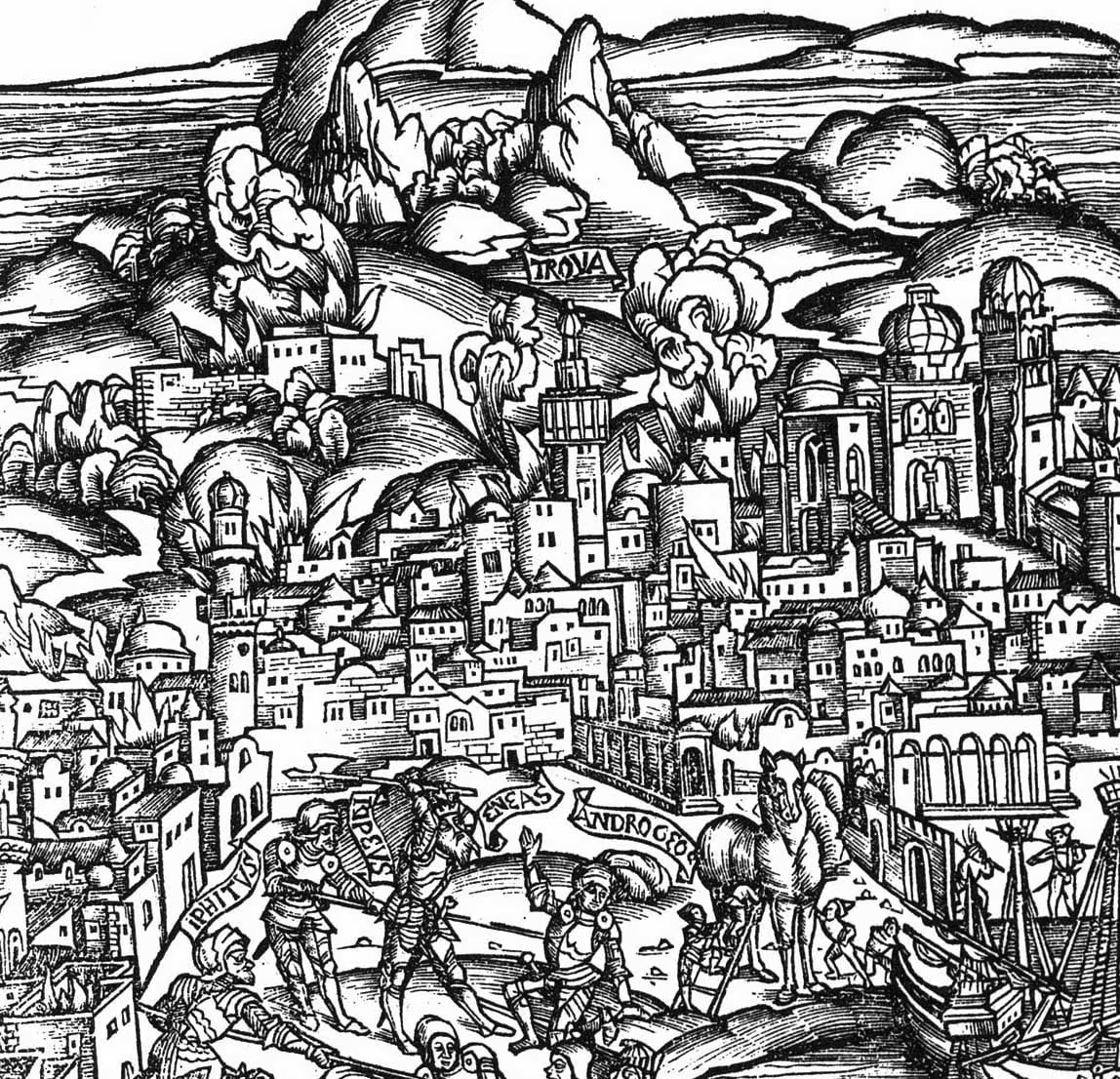
The summit of Grüninger’s classical illustrated publishing came with Virgil’s Opera, completed on 28 August 1502. Edited by Sebastian Brant, the imposing edition assembled Virgil with a substantial commentary tradition that included Servius, Donatus, Cristoforo Landino, Antonio Mancinelli and other learned material, as well as Maffeo Vegio’s continuation of the Aeneid. More than two hundred woodcuts provided an almost continuous visual interpretation of Virgilian narrative and mythology. The importance of the volume lies in the deliberate union of a densely glossed scholastic-humanist text with a systematic iconographic programme. Where the 1496 Terence had exploited modular dramatic figures, the Virgil required a far more elaborate narrative repertory capable of representing landscapes, journeys, battles, cities, gods and episodes from the entire Virgilian corpus.
Its subsequent history demonstrates how successfully the iconographic programme could detach itself from the Strasbourg book in which it originated. The woodblocks were reused for the Lyon Virgil printed by Jacques Sacon in 1517, which retained the Grüninger illustrations while placing them within another typographical and commercial context. Still more strikingly, scenes from the 1502 woodcuts served as models for a later cycle of Limoges enamels depicting episodes from the Aeneid. The imagery devised for an illustrated humanist book thus migrated from Strasbourg letterpress and woodcut into another medium and another artistic centre. The Virgil therefore occupies an important place not only in the history of classical publishing but in the broader history of printed images as vehicles through which Renaissance iconography travelled.
The workshop’s illustrated programme was never stylistically uniform. Grüninger employed or commissioned material associated at different moments with artists including Hans Baldung Grien, Hans Schäufelin, Urs Graf and Hans Wechtelin, while other cuts were produced by anonymous specialists working within or around the printing shop. Early illustrations could be comparatively crude; by the later 1490s and opening years of the sixteenth century the level of design had risen dramatically. At the same time, the economic value of the woodblock encouraged repeated reuse. Grüninger sometimes redeployed existing blocks in later publications whose subjects did not perfectly correspond to the original designs. What might look to a modern viewer like inconsistency was part of the material economy of a large early printing house: the block was an expensive capital asset and possessed a commercial life independent of the first book for which it had been cut.
This creates a particularly rich field for the study of edition genealogy. An illustration first devised for a classical edition could migrate into another printing; a set of blocks might survive long enough to pass to a different printer or city; individual figures could be recombined; and later impressions might reveal deterioration, recutting or altered use. With Grüninger, identifying the textual edition is consequently only one part of bibliographical reconstruction. The history of the woodblocks may follow a different trajectory from the letterpress text, and in some of his most important books that visual genealogy is essential to understanding the publication.
Grüninger’s relationship with Johannes Geiler von Kaysersberg, Strasbourg’s celebrated preacher, illustrates another side of the press. Numerous Geiler sermons and devotional works were printed by Grüninger or produced through intermediaries connected with the shop, especially the physician and writer Johann Adelphus Müling. The relationship was not always straightforwardly authorial. Some sermons were reconstructed from notes or published without Geiler’s authorization, and Geiler could object to the liberties taken by editors who converted his oral preaching into books. Grüninger’s press thus provides unusually good evidence for the complicated transformation of sermon culture into print, where authorship could be shared among preacher, auditor, translator, compiler and printer. Editions from 1512 onward, including sermons on the Assumption, the Passion and later collected material, carried Geiler’s voice well beyond the audience that had heard him in Strasbourg.
The same commercial flexibility brought Grüninger into the world of German popular narrative. The 1515 Strasbourg Eulenspiegel belongs to one of the most famous textual traditions associated with his milieu. Earlier forms of the Till Eulenspiegel stories certainly existed, and scholarship postulates earlier printed stages, including lost impressions; the 1515 edition is nevertheless the earliest substantial surviving witness to the expanded High German tradition. Its illustration history is especially notable because some of the early Strasbourg cuts associated with Eulenspiegel, including the title image preserved in the 1515 printing, have been connected with the youthful work of Hans Baldung Grien. Later Grüninger-family editions continued the tradition, and Christoph Grüninger is documented as producing an Eulenspiegel edition in 1531. The case therefore spans more than an isolated bestseller: it links an unstable popular-text tradition, the reuse of images and a printing family extending into the next generation.
The religious upheaval of the 1520s altered the Strasbourg book market profoundly, and here the image of Grüninger as a neutral disseminator of Reformation literature requires substantial correction. Unlike many of the city’s printers, he did not align himself with the evangelical Reformation and remained essentially Catholic. His press became an important vehicle for anti-Lutheran authors, above all Thomas Murner. In December 1522 Grüninger printed Murner’s ferocious satirical poem Von dem grossen Lutherischen Narren, one of the most visually and rhetorically aggressive Catholic responses to the Reformation. He also printed Murner’s dispute concerning Henry VIII and Luther and other controversial literature opposed to evangelical reform.
Yet Grüninger’s confessional position should not be translated into the idea of a narrowly ideological press. Printing was his trade, and the Strasbourg market was too diverse for a successful printer to act solely as the propagandist of one faction. Earlier in his career he had already experienced political intervention when controversial writing connected with Murner brought municipal scrutiny, and during the Reformation he continued to print secular works, popular literature, classical texts and practical books alongside Catholic polemic. Older evidence even associates his shop with the anti-Murner dialogue Karsthans, although the precise attribution of anonymous Reformation printing is notoriously difficult. His own colophonic remarks reveal awareness that the printer earned his living by producing materially saleable books even when the confessional politics surrounding them were dangerous. The catalogue is therefore best understood as Catholic in personal and polemical alignment, but commercially broader than a purely confessional label can express.
This tension between conviction and commerce makes Grüninger especially useful for understanding Strasbourg during the Reformation. Many printing histories divide presses too cleanly into Catholic and Protestant camps, whereas an established workshop possessed inventories, debts, woodblocks, type, employees, customers and commercial relationships formed decades before Luther. Grüninger had been printing Geiler, Brant, Terence, medical manuals and popular narratives long before the new confessional divide, and those parts of the business did not vanish in 1517. The Reformation altered his list but did not erase the economic structure of the workshop.
His final decade produced another of the press’s most important contributions to European book history: the Strasbourg editions of Ptolemy’s Geographia. Grüninger printed a major Ptolemaic atlas in 1522, using maps prepared by Lorenz Fries, who reduced and adapted much of the cartographic material associated with the celebrated Waldseemüller Strasbourg edition of 1513 while adding new geographical work of his own. The woodblocks created for the 1522 production remained usable publishing assets and became the basis of the revised Strasbourg edition of 1525.
The 1525 Claudii Ptolemaei Geographicae enarrationis libri octo is especially important because it brought together several strands of German Renaissance cartography and humanism. Grüninger printed the book at Strasbourg at the expense of Johann Koberger, while the Latin text was associated with Willibald Pirckheimer’s translation and the scholarly legacy of Regiomontanus. The atlas comprised twenty-seven traditional Ptolemaic maps and twenty-three modern maps, principally derived through Fries from Waldseemüller but supplemented by important new cartography. Among its most celebrated features are maps representing Southeast Asia and East Asia, while Fries’s world map within the volume is notable as the first world map in an edition of Ptolemy to employ the name “America.”
The edition’s significance lies as much in genealogy as in individual cartographic novelties. The “modern” maps do not constitute an entirely new atlas conceived independently in 1525; they represent a chain of transmission running from the Waldseemüller material of 1513 through Fries’s reduced versions of 1522 to the reused and partly revised blocks of 1525. A copy of the 1525 Ptolemy therefore embodies several chronological layers of cartographic knowledge simultaneously. The ancient geographical structure of Ptolemy coexists with early sixteenth-century discoveries, while woodblocks created for one publishing project acquire renewed commercial and scientific life in another. For Grüninger, who had been recycling literary and illustrative blocks for decades, the atlas was in some respects the grandest expression of a workshop practice already deeply familiar to him.
The Ptolemy also makes clear how far Grüninger’s enterprise had developed from the relatively modest Strasbourg books of the 1480s. Producing a large cartographic folio required coordination among translator, editor, cartographer, block cutter, printer, financier and bookseller. The surviving imprint makes the division between printer and financial publisher unusually explicit: Grüninger performed the printing while Johann Koberger supplied the investment. In the commercial history of the early atlas this distinction is fundamental, because the intellectual and material identity of a book could be distributed among several actors rather than concentrated in a single “publisher” in the modern sense.
By this point the Grüninger workshop was also a family operation. His sons Bartholomäus, Wolfgang and Christoph worked in or around the business. Christoph is associated with the 1531 Eulenspiegel, while Bartholomäus later continued printing independently and issued, among other books, further material from the Brunschwig tradition. Johann himself died around 1533 rather than on a securely documented precise date. That year Wolfgang and Bartholomäus sold the family’s Sandplatz property to the printer Peter Schöffer, marking the effective end of the founding generation of the Strasbourg enterprise.
Seen across the full chronology of the press, Grüninger’s importance becomes considerably more precise than the conventional description of him as a prolific early printer. The Gart der Gesuntheyt established a successful relationship between vernacular practical knowledge and illustration; the 1496 Terence transformed classical comedy into a visually articulated pedagogical book; the 1498 Horace joined ancient and Renaissance commentary with an iconographic programme; the 1500 Brunschwig established one of the principal printed traditions of early distillation literature; the 1502 Virgil became one of the great illustrated classical editions of the northern Renaissance and generated an image tradition that crossed both cities and media; the Eulenspiegel brought the workshop into the genealogy of one of the most durable German popular narratives; the Murner books placed it directly within the confessional warfare of the Reformation; and the 1522–1525 Ptolemies carried Grüninger’s visual publishing practice into the highest level of contemporary cartography.
The workshop’s internal history is equally revealing. Its greatest books were collaborative constructions involving humanists such as Sebastian Brant, Jakob Locher and Josse Badius; physicians and technical writers such as Hieronymus Brunschwig and Johann Adelphus; preachers such as Geiler von Kaysersberg; polemicists such as Thomas Murner; artists and block designers including Hans Baldung and other major Upper Rhine draughtsmen; and commercial partners extending from Strasbourg to Nuremberg, Basel, Speyer and Lyon. Grüninger’s own intellectual contribution should therefore not be confused with authorship of the texts he printed. His importance lay in recognizing which kinds of texts could be turned into viable books and in repeatedly constructing the material machinery—types, page designs, illustrations, stock blocks, commercial partnerships and reprint strategies—that allowed them to circulate.
His editions also resist any attempt to judge the press solely by typographical refinement. Contemporary and later critics noted inaccuracies and declining textual care in some of the later books, and Grüninger was entirely capable of reusing illustrations in contexts where their semantic fit was imperfect. Yet the very practices that could produce textual or iconographic roughness also made possible the scale of his operation. He treated the printing house as a repository of reusable intellectual and visual capital. Commentary could migrate between editions, woodcuts could acquire new narrative functions, successful medical titles could generate enlarged successors, and cartographic blocks could pass from one atlas state to another. The resulting books are often more revealing about the economics and mechanics of early modern publishing than would be a perfectly isolated sequence of newly manufactured editions.
For the history of illustration in particular, Grüninger occupies a position of exceptional importance. The changing relationship between text and picture can be followed almost chronologically through his books: the simpler herb and devotional cuts of the 1480s, the combinatory stage machinery of the 1496 Terence, the visual exegesis of the Horace, the technical images of the Brunschwig manuals, the mature narrative cycles of the Virgil, Baldung’s interventions in popular literature, and finally the geographically exacting woodcut maps of the Ptolemy. This progression is not a simple march from “primitive” toward “Renaissance” illustration; the visual form changes because the communicative problem changes. A medicinal plant, a comedy, a Latin ode, a distillation vessel, an epic voyage and a geographical coordinate system require different relationships between image and text, and Grüninger’s press repeatedly adapted to those differences.
His position within the Reformation likewise appears clearer when viewed against this longer editorial history. Grüninger was not fundamentally a Reformation printer who happened to retain Catholic sympathies; by the time Luther’s controversy transformed Strasbourg’s press, Grüninger had already spent nearly four decades developing a large and diverse publishing enterprise. His decision to continue printing Catholic polemic therefore represents the persistence of an older Strasbourg intellectual world—Geiler, Brant, Murner and late medieval-humanist reform—inside a city whose younger presses were increasingly aligned with evangelical change. The anti-Lutheran books of the 1520s are historically significant precisely because they were produced by the same workshop that had created the richly illustrated humanist classics around 1500.
Johann Grüninger’s career thus spans three major phases of early European print culture without fitting comfortably into only one of them. He began as an incunable printer formed within the late medieval world of scholastic, devotional and practical books; became one of the most ambitious producers of illustrated humanist and technical editions around the turn of the century; and ended his career printing confessional polemic and Renaissance cartography in a Strasbourg transformed by the Reformation and the discovery of the wider world. Few individual presses make that transition so materially visible. The continuity is the workshop itself: its accumulated woodblocks, types, commercial relationships, editorial collaborators and inherited stock allowed successive intellectual cultures to be translated into books, while the changing editions reveal how quickly both the market and the meaning of print were evolving.
Bibliography
Fries, Lorenz. Uslegung der Mercarthen oder Cartha Marina. Strasbourg: Johann Grüninger, 1527.
Kristeller, Paul. Die Strassburger Bücher-Illustration im XV. und im Anfange des XVI. Jahrhunderts. Leipzig: E. A. Seemann, 1888.
Stehlin, Karl. Regesten zur Geschichte des Buchdrucks bis zum Jahre 1500. Basel, 1891.
Schmidt, Charles. Répertoire bibliographique strasbourgeois jusque vers 1530. Vol. 1: Jean Grüninger 1483–1531. Strasbourg: J. H. Ed. Heitz, 1894.
Heitz, Paul. Zierinitialen in Drucken des Johannes Grüninger (1483–1531) und des Johannes Herwagen (1522–1528). Strasbourg: J. H. Ed. Heitz, 1897.
Sudhoff, Karl. “Die Herkunft des Strassburger Druckers Johann Grüninger.” Zeitschrift für Bücherfreunde 4 (1900–1901): 440.
Claudin, Anatole. Histoire de l’imprimerie en France aux XVe et XVIe siècles. 4 vols. Paris: Imprimerie Nationale, 1900–1914.
Sitzmann, Édouard. “Grüninger, Johann.” In Dictionnaire de biographie des hommes célèbres de l’Alsace. Vol. 1, 654–656. Rixheim, 1909.
Römer, Hermann. “Hans Grüninger und die Buchdruckerfamilie Reinhard aus Markgröningen.” In Markgröningen im Rahmen der Landesgeschichte. I: Urgeschichte und Mittelalter, 278–329. Markgröningen: Renczes, 1933.
Ritter, François. Répertoire bibliographique des livres imprimés en Alsace au XVIe siècle. Strasbourg: Heitz, 1934–.
Cohn, Wilhelm. Einblattdrucke der Strassburger Druckerei Johann Grüninger. Strasbourg, 1937.
Schramm, Albert, and Maria Möller, eds. Der Bilderschmuck der Frühdrucke. Vol. 20: Die Straßburger Drucker. 2: Johann Grüninger. Leipzig, 1937.
Daillon, Jean. “Jean Grüninger, imprimeur-éditeur à Strasbourg.” Arts et métiers graphiques 65 (1938): 41–46.
Ritter, François. Catalogue des incunables alsaciens de la Bibliothèque Nationale et Universitaire de Strasbourg. Strasbourg: Heitz, 1938.
Mambelli, Giuliano. Gli annali delle edizioni virgiliane. Florence: Leo S. Olschki, 1954.
Ritter, François. Histoire de l’imprimerie alsacienne aux XVe et XVIe siècles. Strasbourg and Paris: F.-X. Le Roux, 1955.
Rabb, Theodore K. “Sebastian Brant and the First Illustrated Edition of Vergil.” Princeton University Library Chronicle 21, no. 4 (1960): 187–199.
Johnson, Hildegard Binder. Carta Marina: World Geography in Strassburg, 1525. Minneapolis: University of Minnesota Press, 1963.
Hirsch, Rudolf. Printing, Selling and Reading, 1450–1550. Wiesbaden: Otto Harrassowitz, 1967.
Ritter, François. “Grüninger, Johann.” In Neue Deutsche Biographie. Vol. 7, 201. Berlin: Duncker & Humblot, 1966.
Geldner, Ferdinand. Die deutschen Inkunabeldrucker: Ein Handbuch der deutschen Buchdrucker des XV. Jahrhunderts nach Druckorten. Vol. 1: Das deutsche Sprachgebiet. Stuttgart: Anton Hiersemann, 1968.
Irtenkauf, Wolfgang. “Um die Herkunft des Johann Grüninger aus Markgröningen.” Ludwigsburger Geschichtsblätter 24 (1972): 65–74.
Febvre, Lucien, and Henri-Jean Martin. The Coming of the Book: The Impact of Printing, 1450–1800. Translated by David Gerard. London: NLB, 1976.
Chrisman, Miriam Usher. Lay Culture, Learned Culture: Books and Social Change in Strasbourg, 1480–1599. New Haven and London: Yale University Press, 1982.
Riße, Robert, ed. Johannes Reinhard alias Hans Grüninger, der Frühdrucker aus Markgröningen: Von der schreibenden Zunft zum industriell gefertigten Buch. Markgröningen: Arbeitskreis Geschichtsforschung und Denkmalpflege Markgröningen, 1990.
Gotzkowsky, Bodo. “Volksbücher”: Prosaromane, Renaissancenovellen, Versdichtungen und Schwankbücher. Bibliographie der deutschen Drucke. Bibliotheca Bibliographica Aureliana. Baden-Baden: Valentin Koerner, 1991.
Karrow, Robert W., Jr. Mapmakers of the Sixteenth Century and Their Maps: Bio-Bibliographies of the Cartographers of Abraham Ortelius, 1570. Chicago: Speculum Orbis Press for the Newberry Library, 1993, esp. 191–204 on Lorenz Fries.
Martin, Henri-Jean. The History and Power of Writing. Translated by Lydia G. Cochrane. Chicago: University of Chicago Press, 1994.
Gaskell, Philip. A New Introduction to Bibliography. New Castle, DE: Oak Knoll Press, 1995.
McKitterick, David. Print, Manuscript and the Search for Order, 1450–1830. Cambridge: Cambridge University Press, 2003.
Gautier Dalché, Patrick. “The Reception of Ptolemy’s Geography (End of the Fourteenth to Beginning of the Sixteenth Century).” In The History of Cartography. Vol. 3, Part 1: Cartography in the European Renaissance, edited by David Woodward, 285–364. Chicago: University of Chicago Press, 2007.
Suerbaum, Werner. Handbuch der illustrierten Vergil-Ausgaben 1502–1840: Geschichte, Typologie, Zyklen und kommentierter Katalog der Holzschnitte und Kupferstiche zur Aeneis in Alten Drucken. Hildesheim and New York: Georg Olms, 2008.
Taape, Tillmann. “Distilling Reliable Remedies: Hieronymus Brunschwig’s Liber de arte distillandi (1500) Between Alchemical Learning and Craft Practice.” Ambix 61, no. 3 (2014): 236–256.
Reske, Christoph. Die Buchdrucker des 16. und 17. Jahrhunderts im deutschen Sprachgebiet: Auf der Grundlage des gleichnamigen Werkes von Josef Benzing. 2nd rev. and expanded ed. Wiesbaden: Harrassowitz, 2015.
Muller, Frederik. “Was Lorenz Fries’s 1525 Strasbourg Ptolemy Atlas Complete? Or Were Two Maps Omitted?” Imago Mundi 70, no. 1 (2018): 1–26.
Zimmermann-Homeyer, Catarina. Illustrierte Frühdrucke lateinischer Klassiker um 1500: Innovative Illustrationskonzepte aus der Straßburger Offizin Johannes Grüningers und ihre Wirkung. Wolfenbütteler Abhandlungen zur Renaissanceforschung 36. Wiesbaden: Harrassowitz, 2018.
Beyond the names: biographies and bibliographies on this page are curated by Abu, the AI scholar crafted by Buonvecchio exclusively for Govi Rare Books.