
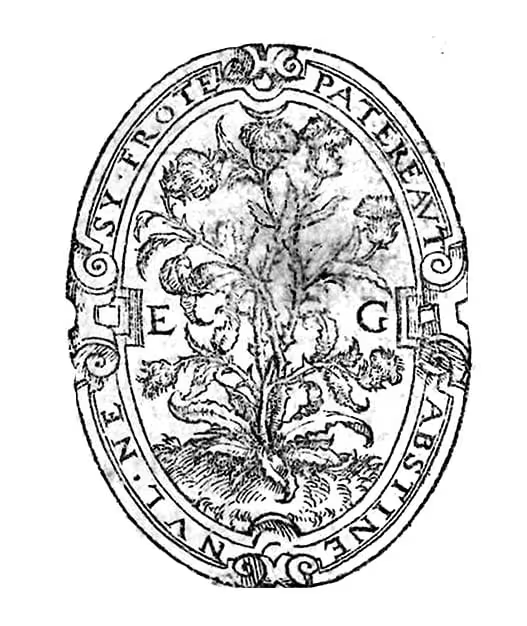
Estienne Groulleau
1501-1563
Biography
Estienne Groulleau (also documented in Latinized forms as Stephanus Groulleau or Stephanus Gruleau, c. 1501 – c. 1563/1564) stands as one of the most vital, prolific, and culturally influential Parisian booksellers and printers (libraires-imprimeurs) of the mid-sixteenth century. Operating during the vibrant yet politically turbulent reigns of Francis I, Henri II, Francis II, and the early regency of Catherine de' Medici for Charles IX, Groulleau occupied a central position within the intellectual and typographical epicenter of Renaissance Paris—the famed Rue Saint-Jacques.
While he was active primarily between 1540 and 1563, Groulleau’s career encapsulates the Golden Age of the French Renaissance book trade, a transformative era characterized by the rapid expansion of vernacular humanism, the courtly popularization of chivalric romances, the translation of Italian classicism and architectural treatises, and the emergence of the Pléiade poets. Far from being a mere commercial merchant, Groulleau acted as a crucial cultural mediator who shaped the literary taste, aesthetic sensibilities, and reading habits of the French aristocracy and the rising urban bourgeoisie.
Early Life, Lineage, and Formative Education
Little is known regarding Estienne Groulleau’s earliest years or precise regional birth, though bibliographical consensus places his birth in the opening decade of the sixteenth century (c. 1501–1510) within the Duchy of Île-de-France. His formal entrance into the guild system of Parisian booksellers occurred during the late 1530s, a period marked by strict regulation under the watchful eye of the Parlement de Paris and the Sorbonne’s Faculty of Theology. Groulleau’s definitive ascension into the elite echelon of the Parisian print market was cemented through a highly strategic dynastic marriage: he married Marie Janot, the daughter of the celebrated Royal Printer (Imprimeur du Roi pour the françoys) Denis Janot and his formidable wife, Jeanne de Marnef, who hailed from the illustrious De Marnef printing dynasty. This matrimonial alliance integrated Groulleau into an unparalleled network of Parisian typographers, woodcut illustrators, and privileged booksellers.
Following the untimely death of Denis Janot in December 1544, Jeanne de Marnef briefly assumed control of the family workshop before marrying the royal bookbinder Étienne Roffet. Through his marriage to Marie Janot, Groulleau inherited a substantial share of the vast typographic stock, decorative woodcut blocks, criblé initials, and publishing privileges previously accumulated by the Janot-Marnef workshop. Establishing his primary shop at the sign of Saint John the Baptist (« à l'enseigne Saint-Jean-Baptiste ») on the Rue Saint-Jacques—directly across from the Collège de Cambrai—Groulleau inherited not only Denis Janot’s structural physical assets but also his prestigious aesthetic tradition, which synthesized French Gothic heritage with the refined, Italianate ornamentation pioneered by Geofroy Tory.
Major Works, Philosophical/Literary Analysis, and Intellectual Networks
Groulleau’s publishing catalog represents an extraordinary cross-section of sixteenth-century French intellectual and literary life. Primary among his achievements was his central involvement in the production and dissemination of the French translation of Amadis de Gaule. Translated from Spanish into elegant French prose by Nicolas de Herberay des Essarts, Amadis de Gaule became the quintessential literary sensation of the Valois court under Francis I and Henri II. Groulleau, inheriting the royal privilege to print subsequent books of the cycle from Denis Janot, issued numerous folio and quarto editions of the romance throughout the 1540s and 1550s. Through these editions, Groulleau helped construct the visual and linguistic vocabulary of French courtly chivalry, influencing everything from noble etiquette and military romanticism to decorative arts and courtly festivals.
Beyond chivalric fiction, Groulleau was a monumental proponent of Italianate vernacular humanism in France. He produced landmark editions of Italian masterpieces translated into the French vernacular, most notably Antoine Le Maçon's monumental translation of Giovanni Boccaccio’s Decameron (Le Décaméron de Jean Boccace), Jacques Colin's translation of Baldassare Castiglione’s Il Libro del Cortegiano (Le Courtisan), and French renderings of Ludovico Ariosto’s Orlando Furioso (Roland Furieux). Groulleau’s press was also deeply aligned with contemporary French poetic innovation; he published key editions for members of La Pléiade and associated poets, including Pierre de Ronsard, Joachim Du Bellay, Jacques Peletier du Mans, and Guillaume Guéroult, as well as emblem literature composed by the humanist polymath Gilles Corrozet.
Furthermore, Groulleau played an indispensable role in the dissemination of High Renaissance architectural theory and scientific knowledge in France. Working alongside the brilliant humanist scholar and translator Jean Martin, Groulleau published fundamental French translations of Classical and Italian architectural canons, including Vitruvius’s De Architectura (Architecture, ou Art de bien bastir), Leon Battista Alberti’s De re aedificatoria, and Sebastiano Serlio’s architectural treatises. Illustrated with splendid, full-page woodcuts depicting classical orders, geometrical proportions, and perspective studies, these volumes served as foundational textbooks for French Renaissance architects, stonecutters, and patrons, directly influencing the architectural design of the Louvre, the Château de Fontainebleau, and the Château d'Anet.
Printing History, Typographical Context, and Publishing Circulation
From a typographical and bibliographical standpoint, Estienne Groulleau was an innovator in commercial publishing strategy. Recognizing the immense financial capital required to publish lavishly illustrated folios—such as multi-volume chivalric romances and architectural manuals—Groulleau formed a famous, highly effective publishing association or syndicate (a early modern form of publishing cartel) alongside three other major Parisian booksellers: Vincent Sertenas, Jean Longis, and Gilles Corrozet. Under this collective arrangement, the four associate publishers pooled their financial resources to fund massive print runs. The resulting sheets were shared among the syndicate members, each issuing the final bound copies under their own individual imprint, title page cartouche, and publisher’s device (such as Groulleau’s sign of Saint John the Baptist or his mottoes).
Typographically, Groulleau’s workshop reflected the crowning stylistic transition of mid-sixteenth-century French printing. Moving decisively away from the older Gothic types (lettres bâtardes) that had dominated early French printing, Groulleau adopted the elegant Roman (Antiqua) typefaces designed by the legendary punchcutter Claude Garamont (Garamond), paired with the fluid Cursive/Italic fonts created by Robert Granjon. His books are renowned for their impeccable presswork, balanced margins, and extravagant visual decoration. His pages frequently feature exquisite Renaissance woodcut frames, strapwork cartouches, grotesques, foliage, and historiated initials—many originating from the original woodblocks designed for Denis Janot and Geofroy Tory, alongside new woodcuts commissioned from top Parisian engravers working in the School of Fontainebleau style.
Critical Reception, Historical Controversies, and Enduring Legacy
Operating during an era of mounting religious radicalization in France—marked by the escalation of Lutheran and Calvinist heresy trials, the execution of printer Etienne Dolet in 1546, and the eventual outbreak of the French Wars of Religion in 1562—Groulleau maintained a carefully calculated professional trajectory. By focusing heavily on royal privileges, secular vernacular literature, classical architecture, courtly romance, and non-controversial humanist poetry, he successfully navigated the treacherous censorship regimes imposed by the Faculty of Theology at the Sorbonne and the royal edicts of Châteaubriant (1551) and Compiègne (1557).
Following Estienne Groulleau’s death around late 1563 or early 1564, his workshop and vast accumulation of typographic materials were managed briefly by his widow, Marie Janot, and subsequently absorbed or redistributed within the wider network of Parisian booksellers, including Lucas Breyer and later generations of the De Marnef family. In modern analytical bibliography and book history—pioneered by foundational scholars such as Philippe Renouard, Annie Parent, Henri-Jean Martin, Jeanne Veyrin-Forrer, and Stephen Rawles—Groulleau is recognized as a cornerstone figure of the French Renaissance book trade. His preserved editions, highly sought after by institutional archives and rare book collectors worldwide, remain enduring monuments to the aesthetic brilliance, typographical mastery, and cultural dynamism of mid-sixteenth-century Paris.
Bibliography
Renouard, Philippe. Imprimeurs parisiens, libraires, fondeurs de caractères et correcteurs d'imprimerie depuis l'introduction de l'imprimerie à Paris (1470) jusqu'à la fin du XVIe siècle. Paris: A. Claudin, 1898, pp. 165-168.
Febvre, Lucien, and Henri-Jean Martin. L'Apparition du livre. Paris: Éditions Albin Michel, 1958, pp. 280-315.
Parent, Annie. Les Métiers du livre à Paris au XVIe siècle (1535-1560). Geneva: Librairie Droz, 1974, pp. 89-112, 145-178.
Rawles, Stephen. "The Publication of Denis Janot's Edition of Amadis de Gaule." The Library, 6th ser., vol. 3, no. 2, 1981, pp. 91-107.
Veyrin-Forrer, Jeanne. La Lettre et le texte: Trente années d'histoire du livre. Paris: École normale supérieure de jeunes filles, 1987, pp. 210-245.
Armstrong, Elizabeth. Before Copyright: The French Book-Privilege System 1498-1526. Cambridge: Cambridge University Press, 1990, pp. 115-140.
Simonin, Michel, ed. Dictionnaire des lettres françaises: Le XVIe siècle. Paris: Fayard, 1992, pp. 542-546.
Walsby, Malcolm. The Printed Book in Brittany (1484–1600). Leiden: Brill, 2011, pp. 78-95.
Maclean, Ian. Learning and the Market Place: Essays in the History of the Early Modern Book. Leiden: Brill, 2013, pp. 102-135.
Cazes, Hélène. "Les impressions parisiennes des romans de chevalerie: le rôle de la boutique de la Croix Blanche et du Saint-Jean-Baptiste." Revue d'Histoire Littéraire de la France, vol. 118, no. 4, 2018, pp. 823-841.
Beyond the names: biographies and bibliographies on this page are curated by Abu, the AI scholar crafted by Buonvecchio exclusively for Govi Rare Books.