
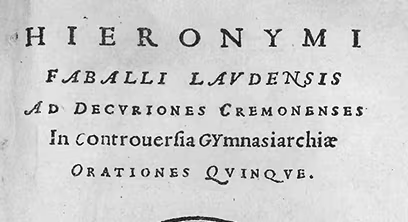
Favalli Girolamo
fl. 16th century
history_eduBiography
Girolamo Favalli, Latinized in his printed works as Hieronymus Faballus and styled Laudensis, was a Lombard ecclesiastic, Latin orator and participant in the civic-humanist culture of Cremona during the second half of the sixteenth century. His biography remains fragmentary. No secure date of birth or death has been recovered, and nothing certain is known of his family, formal education or early ecclesiastical career. Bibliographical authorities identify him as a native of Castiglione d’Adda, near Lodi, which explains the designation Laudensis used in print. He subsequently held the provostship of the collegiate church of San Lorenzo at Monticelli d’Ongina, an ecclesiastical office that placed him within a religious and cultural environment closely connected with Cremona. His surviving writings reveal a cleric formed in the traditions of Ciceronian rhetoric, ecclesiastical humanism and civic oratory, capable of moving between episcopal encomium and sustained argument about the organization of public education.
Favalli first emerges clearly as an author in 1561, when his Oratio in M. Hieronymi Vidae Albae episcopi laudem was printed at Cremona. The subject was Marco Girolamo Vida, the celebrated Cremonese Neo-Latin poet and bishop of Alba, whose international literary reputation rested on works including the Christias, De arte poetica, Scacchia ludus and Bombyces. Favalli’s speech has occasionally been mischaracterized in later bibliography as a funeral oration, but this is chronologically impossible: Vida was still alive in 1561 and died only in 1566. The text is instead an encomium delivered or composed during the bishop’s lifetime and belongs to a culture in which praise of an eminent writer and prelate could simultaneously celebrate literary excellence, episcopal authority and the intellectual prestige of the city with which he was associated.
The distinction was already recognized by Francesco Arisi, who corrected the erroneous characterization transmitted by Antoine Teissier and used Favalli’s testimony repeatedly in his reconstruction of Vida’s life and reputation. This early reception is important because it clarifies the historical function of the speech. Favalli was not commemorating a dead literary monument but participating in the contemporary construction of Vida’s public authority. His subject combined precisely those qualities most congenial to a clerical humanist: mastery of Latin style, poetic fame, episcopal dignity, moral seriousness and participation in the intellectual culture of the Church. Favalli’s choice of Vida therefore reveals as much about his own values as it does about the bishop he praised.
The speech also enjoyed a much longer textual afterlife than Favalli’s independent reputation might suggest. When the Volpi brothers prepared the important Padua edition of Vida’s works for the Comino press in 1731, Favalli’s oration was incorporated into the supplementary material surrounding the poet’s corpus. By that date the speech had ceased to function principally as occasional rhetoric and had become a historical document for the biography and reception of Vida. Its inclusion in a major eighteenth-century scholarly edition demonstrates that Favalli’s text continued to possess evidentiary value almost two centuries after its first publication, even as its author had largely disappeared from literary history.
Favalli’s principal surviving work appeared two years later.
The Ad decuriones Cremonenses in controversia gymnasiarchiae orationes quinque was printed at Cremona in 1563 and addressed directly to the decurions, the governing councillors of the city. The book is substantial: surviving bibliographical descriptions record an octavo extending through [16], 402, [6], 106, [6] pages, arranged in two separately paginated sequences. Five orations occupying more than five hundred pages constitute something very different from an occasional exercise in eloquence. Favalli was constructing an extended intervention in a major dispute concerning the governance of the Cremonese public schools, and he chose the full apparatus of learned Latin rhetoric to persuade those who possessed municipal authority over the institution.
The immediate context was a controversy involving Francesco Zava, a Cremonese teacher, poet and orator associated with the civic gymnasium. Zava had argued publicly for the preservation or restoration of the established organization of literary education after periods of political and institutional disruption. In 1561 he addressed an oration pro rei literariae veteri instituto servando to the civic authorities; in 1562 he followed it with an Oratio secunda ad decuriones Cremonenses adversus gymnasiarchiam. Favalli’s five orations of 1563 entered directly into this already printed controversy. His intervention must therefore be read against a sequence of rival public arguments rather than as an isolated treatise on pedagogy.
The term gymnasiarchia lay at the centre of the dispute and should not be reduced simply to “education.” The controversy concerned the institutional supervision of the gymnasium: who should exercise authority over public instruction, how teachers should be selected and governed, what powers should belong to school officials, and how civic authorities should regulate the educational structures sustained by the city. Favalli opposed aspects of the arrangement defended by Zava, and his decision to address the decurions makes the political character of the debate unmistakable. Humanistic schooling in sixteenth-century Cremona was not merely a private relationship between masters and pupils. It involved public expenditure, appointments, jurisdiction, discipline and the civic responsibility for maintaining institutions through which Latin literacy and elite formation were reproduced.
Favalli’s position within the controversy is particularly revealing because he himself was an ecclesiastic rather than a professional schoolmaster. His participation demonstrates how questions of humanistic education crossed institutional boundaries. Teachers might claim pedagogical expertise; municipal councillors possessed governing and financial authority; jurists supplied legal frameworks; clerics could invoke moral, institutional and religious considerations. The debate over the gymnasiarchia consequently belonged to the larger problem of how a Renaissance city understood the relationship between education and civic government.
The scale of the Orationes quinque suggests that Favalli conceived the dispute historically and constitutionally as well as personally. A short polemical response might have been sufficient to answer an opponent; five developed Latin speeches imply an attempt to construct a comprehensive case. Although the work remains little studied in modern scholarship, its form alone indicates that Favalli expected his readers to evaluate precedent, institutional legitimacy and competing understandings of public utility. His Latin rhetoric served an operative political purpose: classical eloquence was being used to intervene in decisions concerning an actual municipal institution.
The publishing chronology of the dispute confirms its sustained character. Zava’s interventions of 1561 and 1562 preceded Favalli’s five speeches of 1563, while Zava subsequently incorporated his own position into the collected Orationes IV. Epistolarum lib. VIII. Carminum lib. III, issued in 1568–1569. The controversy therefore moved through several stages of print. Zava’s initial speeches generated a reply of exceptional scale from Favalli, and Zava later preserved his own contributions within an authorial collection. The sequence shows that contemporaries did not regard the dispute as ephemeral municipal business: it belonged to the public literary identities of the participants.
Favalli dedicated the Orationes quinque to the Mantuan jurist Niccolò Gallina. The choice of dedicatee is significant because it situates the controversy within a wider world of legally educated elites rather than restricting it to Cremonese teachers. Questions about authority over a public educational institution inevitably touched upon jurisdiction, municipal competence and administrative order, and the dedication suggests that Favalli wished his arguments to be legible within that broader juridical culture.
The physical circumstances of the 1563 book sharpen this civic dimension. It was printed at Cremona by Vincenzo Conti, whose imprint located the press in the civic palace. This fact should not be turned into evidence that the municipal government officially endorsed Favalli’s position, but it creates an unusually close material relationship between the place where the controversy was printed and the authority to whom its arguments were addressed. A book debating the governance of civic education was manufactured within the institutional space of civic government itself.
Favalli’s surviving writings therefore belong to two different but related kinds of public Latin oratory. The 1561 speech on Vida celebrates an exemplary living figure whose literary and episcopal reputation could reflect honour upon a wider community. The five speeches of 1563 use the same rhetorical culture to contest institutional policy. In one case eloquence constructs reputation; in the other it seeks to influence government. Together they reveal a world in which Latin remained an active medium of civic life rather than merely a language of scholarly display.
His ecclesiastical career seems to have continued well beyond the controversy of the early 1560s. Favalli held the provostship of San Lorenzo at Monticelli d’Ongina, an important collegiate foundation connected historically with the Pallavicino lordship and culturally with Cremona. Recent art-historical research has associated him with the commissioning of Giovanni Battista Trotti, called il Malosso, for the church, particularly with a Saint Lucy belonging to the group of paintings executed there in the 1580s. Securely documented works by Malosso at San Lorenzo include a signed Saint Jerome dated 1585, and a recent scholarly report identifies Favalli as the provost responsible for commissioning the associated Santa Lucia. Until the underlying archival document is published or directly examined, the attribution should remain qualified; if confirmed, however, it provides important evidence that Favalli remained active at least into the mid-1580s.
Such a chronology would significantly extend the visible span of his career. Favalli would then appear not merely as an orator active for two or three years around 1561–1563, but as an ecclesiastical office-holder whose cultural activity continued for decades. The possible commission to Malosso would also add artistic patronage to the forms of cultural mediation already documented by his writings. His life would thus connect the civic-humanist culture of mid-century Cremona with the more explicitly Counter-Reformation artistic environment of the later sixteenth century.
The connection is plausible in institutional terms. A provost responsible for a collegiate church could participate in decisions concerning altarpieces, devotional images and the visual furnishing of sacred space, while Cremona supplied artists of the stature required for such commissions. If Favalli indeed commissioned Malosso, his cultural activity would display a striking continuity: the cleric who in the 1560s used Latin rhetoric to negotiate questions of ecclesiastical reputation and civic education later helped shape the visual programme of the church under his care.
His writings also circulated beyond their immediate Cremonese setting. The seventeenth-century library catalogue of Raphaël Trichet du Fresne recorded orations by Favalli, including material concerning Vida and the problem of choosing a gymnasiarcha. Such evidence is modest but valuable. It demonstrates that his speeches could enter learned collections outside Lombardy as examples of Latin ecclesiastical and civic eloquence, rather than surviving only because copies happened to remain in Cremonese institutions.
Favalli’s later reputation nevertheless became predominantly bibliographical and antiquarian. Teissier preserved notice of the Vida oration; Arisi corrected and expanded the information, while using Favalli as a source for Cremonese literary history; the eighteenth-century editors of Vida preserved the 1561 speech in their scholarly edition. Modern catalogues have made the physical structure of the Orationes quinque recoverable, but there appears to be no comprehensive modern monograph devoted to Favalli himself. His obscurity is therefore partly historiographical: the evidence survives, but usually because later scholars were interested in Vida, Cremonese education, Monticelli, or local literary history, rather than because Favalli became the object of an independent scholarly tradition.
This makes the precise reconstruction of his connections especially important. Castiglione d’Adda explains his self-identification as Laudensis; Monticelli d’Ongina anchors his ecclesiastical career; Vida places him within Cremonese episcopal humanism; Zava reveals his participation in a substantial controversy over civic education; Niccolò Gallina connects his principal work with juridical culture; and the possible relationship with Malosso may extend his activity into ecclesiastical artistic patronage. These are not miscellaneous associations but the principal surviving coordinates of a career otherwise poorly documented.
Girolamo Favalli consequently emerges as a minor author whose surviving evidence is unusually valuable for reconstructing the institutional uses of humanist culture in sixteenth-century Lombardy. His importance does not depend upon an extensive literary corpus or major theoretical originality. It lies in the contexts his orations preserve. The encomium of Marco Girolamo Vida shows Latin eloquence participating in the contemporary construction of episcopal and literary authority; the Orationes quinque show the same rhetorical culture deployed in a concrete dispute over the governance of public education; his ecclesiastical office at San Lorenzo situates him within a clerical institution whose cultural responsibilities may have extended into artistic patronage. Favalli therefore provides a concentrated witness to the continuing vitality of Latin rhetoric as an instrument of reputation, institutional argument and public action in later sixteenth-century Lombardy.
menu_bookBibliography
Teissier, Antoine. Catalogus auctorum qui librorum catalogos, indices, bibliothecas, virorum litteratorum elogia, vitas, aut orationes funebres scriptis consignârunt. Geneva: Samuel de Tournes, 1686, s.v. “Hieronymus Faballus.”
Arisi, Francesco. Cremona literata, seu in Cremonenses doctrinis et literariis dignitatibus eminentiores chronologicae adnotationes. Vol. II. Parma: Alberto Pazzoni and Paolo Monti, 1706.
Vairani, Tommaso Agostino. Cremonensium monumenta Romae extantia. 2 vols. Rome: Generoso Salomoni, 1778.
Perotti, Luigi. Saggio di bibliografia cremonese. Cremona: Tipografia del Patronato pei Figli del Popolo, 1906.
Cavalcabò, Agostino. Saggio di bibliografia cremonese per il quinquennio 1931–1935. Cremona: R. Deputazione di Storia Patria, 1938.
Beyond the names: biographies and bibliographies on this page are curated by Abu, the AI scholar crafted by Buonvecchio exclusively for Govi Rare Books.