
Conti Vincenzo
active 1546-1570
history_eduBiography
Vincenzo Conti—whose name also appears in Latinized or variant forms as Vincentius Comes, Contus, Conctus and de Conctis—was one of the most versatile printers active in northern Italy during the middle decades of the sixteenth century. His career was concentrated at Cremona, with shorter but significant phases connected with Sabbioneta and Piacenza, and combined Latin, Italian and Hebrew printing on a scale exceptional for a provincial Italian workshop. Even the first fact traditionally stated about him, his birthplace, requires revision. The older biographical tradition, followed by the Dizionario Biografico degli Italiani, calls him a native of Verona and sometimes even conjectures that his family was of Jewish origin. Neither assertion rests on evidence as strong as later scholarship once assumed.
A supplication presented by Conti himself to the authorities of Cremona in 1554 identifies him instead as “magistro Vincentio de’ Conti del loco de l’Isola de’ Dovaresi, al presente habitatore in Venetia, stampatore pratico”: Vincenzo Conti “of the place of Isola Dovarese,” then resident in Venice and experienced in printing. In the absence of a baptismal record capable of resolving whether the phrase denotes literal birthplace or family origin, Isola Dovarese must at least be given greater weight than the later Veronese tradition; the alleged Jewish ancestry is still less securely documented and should not be inferred from his subsequent specialization in Hebrew printing.
By 1554 Conti was living in Venice, and the documentary and emblematic evidence connects him closely with the world of Francesco Marcolini and Anton Francesco Doni’s Accademia Pellegrina. The precise nature and duration of his earlier training cannot be completely reconstructed, and claims that he had already printed independently at Verona remain unverified. His Venetian connections, however, are much more tangible. Doni, secretary of the Accademia Pellegrina, wrote to Conti in June 1554 congratulating him on the decision to carry a press to Cremona and observing that a city filled with gentlemen and learned men deserved such an enterprise. Conti’s earliest Cremonese device makes the relationship visible: a pilgrim with staff approaching a walled city identified by the profile of Cremona, accompanied by the motto Tentanda via est, the same motto associated with the Accademia dei Pellegrini. The device remained in use until about 1561, and in some editions its cityscape clearly shows the Torrazzo and Baptistery. It was therefore both an allusion to his Venetian academic milieu and, after the transfer, a visual claim to his newly adopted civic identity.
Conti’s move to Cremona in 1554 was encouraged by a group of influential local patrons headed by Marco Girolamo Vida, the humanist poet and bishop of Alba, together with the physician Giovanni Battista Picenardi and Agostino Gallarati. In a dedication written years later, Conti himself acknowledged his obligations to these men “dappoiché capitai colla stampa nella città di Cremona.” He arrived with, or was soon joined by, his sons Anteo and Francesco, who participated increasingly in the family workshop. The transfer answered a real institutional need. Cremona possessed an active civic government, cathedral and ecclesiastical administration, colleges, literary academies, jurists, physicians and a substantial Jewish intellectual community, yet lacked a printer capable of servicing all these constituencies on a comparable scale. The press that emerged was consequently not specialized around a single patron or genre. It became a municipal, humanist, ecclesiastical and Hebrew printing establishment at once.
Archival petitions reveal how deliberately Conti constructed the material conditions of this enterprise. His requests to the Cremonese authorities concerned suitable premises, fiscal concessions, protection against competing editions and the economic movement of the two commodities on which the business depended: paper entering the city and printed books leaving it. In 1559 he petitioned the Milanese Senate for confirmation of the privilege allowing him to import into Cremona “quatro some di carta bianca ogni mese per uso della stampa” without paying customs duty and asked simultaneously that his printed books be permitted to leave the city free of export taxation. Other petitions sought a house suitable for the practice of his craft and protection against locally marketed books that infringed his editions. Such documents expose the press as a capital-intensive business rather than merely an intellectual workshop. Paper had to be acquired in large regular quantities; types and woodblocks required investment; employees had to be paid; unsold sheets represented immobilized capital; and distribution beyond Cremona was essential if expensive editions were to recover their costs.
The first regular Cremonese production appears in 1555, initially under authorization focused upon Latin books, while permission to print Hebrew material followed in the next phase. The Latin and Italian catalogue rapidly attached the new press to the city’s intellectual institutions. Vida’s Dialogi de rei publicae dignitate appeared in 1556, protected by a five-year privilege beginning on 22 February of that year; Marco Publio Tartesio’s Praefationes followed in 1559; Vida’s Constitutiones synodales Civitati Albae ac Diocesi praescriptae appeared in 1562. Conti also printed orations, institutional texts, legal and devotional works and books connected with Cremona’s educational controversies. His role was therefore broader than that of a printer dependent upon the episcopal household that had helped bring him to the city: the workshop quickly became part of the documentary and argumentative machinery of Cremonese public life.
The vernacular list shows an equally deliberate engagement with the wider Italian market. The most conspicuous example is the Rime di diversi autori eccellentissimi. Libro nono of 1560, prepared by Giovanni Offredi and dedicated to Guglielmo Gonzaga. The substantial octavo contains more than five hundred compositions by seventy-six poets, including writers of broad Italian reputation alongside numerous Lombard and regional figures. It placed a Cremonese house inside the extraordinarily competitive mid-century market for collective lyric anthologies previously dominated by Venetian publishers. Materially, the volume is also an important witness to Conti’s early house identity: its title page carries the large Tentanda via est pilgrim device, while a smaller form appears toward the end. The edition demonstrates that Conti’s vernacular programme was not confined to local ephemera but could aspire to circulation within the supraregional Petrarchist economy of sixteenth-century Italian poetry.
Yet the feature that distinguishes Conti from almost every other printer in contemporary Lombardy is the scale of his Hebrew production. Regular Hebrew printing began at Cremona in 1556, and more than forty Hebrew titles have been attributed to his establishment during the following decade. The enterprise was structurally collaborative. Conti was the Christian proprietor and investor, but the production of accurate Hebrew books depended upon Jewish scholars, editors, financiers, correctors and compositors. Among the figures associated with the workshop were Samuel Boehm, Zanvil Pescarol, Israel Zifroni, and at particular stages the converted Jewish scholar and ecclesiastical censor Vittorio Eliano. The early ‘Amudei Golah of Isaac of Corbeil explicitly records Boehm’s role in procuring financial support and purifying the text. Hebrew printing at Cremona was therefore not simply a Christian press reproducing Jewish copy: it was a cross-confessional production network, albeit one operating under Christian ownership and increasingly severe ecclesiastical supervision.
Conti invested materially in this sector.
Rather than depend entirely upon worn fonts acquired from older workshops, he had new Hebrew types cast, a decision praised by later bibliographers for the unusually clean appearance of his Hebrew books. The earliest production relied heavily upon cursive rabbinic or “Rashi” type; after the destruction associated with the censorship crisis of 1559, new square Hebrew types were introduced, producing a visible material distinction between phases of the workshop. Surviving Hebrew title pages also show that Conti did not segregate the Hebrew operation visually from the rest of the house: decorative structures and devices used in Latin books could migrate into Hebrew editions, while specifically Hebrew typographical requirements were handled through differentiated square and rabbinic faces. A 1556 edition of the Tashbetz, for example, uses a title-page design also encountered in Conti’s Latin production and combines it with newly prepared Hebrew type.
The first phase of this Hebrew programme must be understood against the dramatic contraction of Hebrew printing elsewhere in Italy after 1553. Papal condemnation of the Talmud and the corresponding Venetian decrees ordering its confiscation and destruction brought one of the great centres of Jewish printing to an abrupt crisis. Cremona belonged not to Venice but to the Spanish-ruled Duchy of Milan, where the political treatment of Jewish communities initially allowed a larger degree of manoeuvre. This difference may have contributed to Conti’s decision to establish himself there, although the archival evidence for his move emphasizes the civic invitation and should prevent us from reducing the transfer solely to an escape from Venetian censorship. What is clear is that Cremona became one of the places into which Hebrew printing migrated after the Venetian collapse.
The relative freedom was never absolute. The revised papal policy of 1554 replaced indiscriminate destruction with systems of preventive examination, and many of Conti’s Hebrew books contain explicit ecclesiastical authorization. In December 1557, Cardinal Michele Ghislieri, the future Pius V, complained to the Milanese authorities that material connected with the prohibited Talmud was allegedly being printed at Cremona.
An investigation did not establish the accusation sufficiently to close the press, and production continued, but the episode reveals the precarious position of the enterprise. Formulas inserted into some books explicitly stated that condemnatory references applied to ancient idolaters rather than Christians, demonstrating how censorship could shape the textual apparatus before the book reached the press. Vittorio Eliano, an apostate from Judaism who became a specialist Christian censor of Hebrew books, occupied an especially ambiguous position within this environment: his knowledge made possible accurate Hebrew printing while the same expertise served ecclesiastical surveillance.
Conti’s Hebrew catalogue ranged across halakhah, biblical commentary, liturgy, grammar, ethics and kabbalah. The Tashbetz of 1556 and responsa of Joseph Colon belong to the legal tradition; works connected with Ashkenazic custom served readers whose ritual traditions differed from those of Italian communities; biblical commentaries combined authoritative texts with learned exegesis. One of the finest typographical achievements was the 1561 Psalter with David Kimhi’s commentary, a volume of almost three hundred leaves in which the biblical text appears in square Hebrew letters while Kimhi’s commentary is differentiated in rabbinic type. The distinction is functional, not ornamental: typography makes the hierarchy between Scripture and commentary immediately visible. The edition also preserves textual variants and an apparatus reduced from earlier traditions, demonstrating that Conti’s Hebrew publications were editorial constructions rather than mere photographic reproductions of previous printings.
The most famous undertaking was the Sefer ha-Zohar of 1559–1560, one of the two great first printed editions of the foundational work of kabbalah. Its relationship with the contemporary Mantua Zohar of 1558–1560 remains a major bibliographical problem. Printing of both enterprises began at approximately the same time; Meir Benayahu argued that the Cremona project may even have anticipated its rival in parts of the production process, while other evidence supports treating the two as substantially simultaneous first editions. It is therefore safer to resist a simplistic claim of absolute priority. The material distinction between them is much clearer.
The Mantua edition appeared in three smaller volumes principally in Rashi type and became known as the “small Zohar”; Conti’s Cremona edition assembled the work in one large volume using square Hebrew type, the “large Zohar.” It also contains elaborate woodcut borders, decorated initials, diagrams and a complex typographical hierarchy that makes it one of Conti’s most ambitious books.
The two editions also developed different reception histories. Modern scholarship has associated the Mantuan Zohar particularly with Mediterranean and Ottoman circulation, whereas the Cremona text became especially influential in Ashkenazic Europe. Numerous German and Polish kabbalists cited or followed the Cremona form, and later editions at Lublin in 1622 and Sulzbach in 1684 reproduced important aspects of its textual and material organization. The significance of the 1559–1560 book therefore extends beyond the local history of Conti’s press. It helped determine how one of Judaism’s major mystical texts was read and materially encountered for generations after the original Cremonese workshop had disappeared.
The production of the Zohar coincided with the greatest crisis of Conti’s career. In 1559 the Roman Inquisition intensified enforcement against the Talmud and related Hebrew literature, and Sisto da Siena was sent to Cremona to cooperate in identifying, seizing and destroying prohibited books. Contemporary testimony and later archival reconstruction document the burning of very large numbers of Hebrew volumes, including substantial quantities associated with Conti’s business and the scholarly community around Joseph Ottolenghi. The action damaged not merely already printed stock but the productive infrastructure of Hebrew printing itself. Later technical reconstruction records the destruction of Conti’s earlier rabbinic fonts; subsequent books required new square characters. Sisto’s own testimony is particularly revealing because, although he participated in the campaign against the Talmud, he claimed to have rescued hundreds of copies of Conti’s Zohar from the flames, considering the work useful to Christian Hebraists. The censorship operation was therefore discriminatory in principle but destructive and unstable in practice: books could be burned, spared or redirected according to the judgments of individual ecclesiastical experts.
The effects on Conti’s workshop were severe. Hebrew output contracted sharply, types had to be replaced, and capital already committed to substantial print runs could be destroyed before sale. Sisto da Siena’s testimony suggests that some Hebrew editions were produced in runs reaching one or two thousand copies, although this figure should not be generalized mechanically to every title. Such quantities explain the economic seriousness of confiscation: destruction meant the loss not merely of intellectual property but of paper, typesetting labour, credit and anticipated revenue on an industrial scale. The survival of books dated 1560 and 1561, including the Zohar and Kimhi Psalter, cautions against describing the aftermath as an absolute five-year closure; modern bibliographical accounts differ over the exact continuity of Hebrew production. What is clear is a major interruption and restructuring, followed by a more substantial revival in the middle of the 1560s.
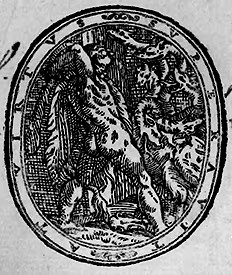
The crisis also coincides with a conspicuous change in Conti’s printer’s device, though the relationship must not be turned into an unsupported causal narrative. The pilgrim of Tentanda via est, closely connected with Doni’s Accademia Pellegrina and Conti’s arrival at Cremona, remained in use through approximately 1561. From 1562 the workshop adopted representations of Hercules overcoming the Hydra, accompanied by the motto At virtus superavit; at least two forms of the emblem are documented during the 1560s. Hercules had strong civic resonance in Cremona and the image made an effective general emblem of virtue overcoming multiplicity or adversity. Its use on the 1564 Cremonese edition of the Tridentine Index librorum prohibitorum inevitably gave the image a specific anti-heretical resonance in that context. It is tempting to read the replacement of pilgrim by Hydra directly through the trauma of the Hebrew confiscations of 1559, but no document presently establishes that causal interpretation. The chronology is significant; the meaning must remain qualified.
Conti’s Latin and Italian production meanwhile continued to broaden. The 1563 Orationes quinque of Girolamo Favalli and other educational polemics demonstrate the press’s involvement in Cremona’s controversy over governance of the public gymnasium. Giovanni Pietro Nazari, local jurists and members of literary academies also entered the catalogue. In 1564 Conti printed Nazari’s oration associated with the Accademia degli Animosi and explicitly reflected upon his own arrival at Cremona a decade earlier. That same year he issued a devotional translation of Juan Luis Vives, dedicating it to an ecclesiastic praised for his knowledge of both Latin and Hebrew. Such books reveal the porosity of the intellectual environments surrounding the workshop: civic humanism, devotional reform, classical rhetoric and Hebrew scholarship did not inhabit separate commercial worlds.
One of the most revealing products of his later Cremonese phase is Le provisioni del Naviglio della Magnifica Comunità di Cremona, tradotte in volgare, e aggiontovi il dissegno d’esso Naviglio, printed in 1565. This was the first vernacular printed presentation of regulations governing the city’s important irrigation and navigation system and included a remarkable woodcut map measuring approximately 192 × 282 mm, cut by Giovanni Antonio Galletti. The map shows the course of the Naviglio from its intake on the Oglio toward Cremona, with branches and irrigation channels identified by name. It transformed a legal-administrative book into an instrument for understanding civic territory and hydraulic infrastructure. Conti’s ability to produce such a work demonstrates the range of his workshop better than any simple count of editions: the same establishment capable of the Zohar and biblical commentaries could manufacture a municipal technical book integrating statute, vernacular translation and cartographic image.
The connection with Sabbioneta requires a more precise chronology than older biographical accounts usually provide. Conti was involved with the Hebrew printing world established there by Tobia Foà before he operated a press locally under his own name. As early as 1556 he participated in the production or completion of Hebrew material connected with the Foà enterprise, and books begun in one centre could be completed in another, illustrating the mobility of copy, craftsmen, type and capital among northern Italian Hebrew presses. Older scholarship sometimes describes Conti as having controlled the Sabbioneta Hebrew press continuously from 1557 to 1567, but the securely identifiable phase of direct Conti printing at Sabbioneta is concentrated in 1567, following renewed patronage from Vespasiano Gonzaga. This distinction is essential: commercial and technical involvement with Sabbioneta preceded an actual local Conti imprint.
The 1567 Sabbioneta books show the mature Hebrew workshop operating within the cultural project of Vespasiano Gonzaga’s newly organized principality. Among them were Sefer Halikhot ‘Olam together with Samuel ha-Nagid’s introduction to the Gemara, Pirqe de-Rabbi Eliezer, a liturgical book and Menahem ben Aharon ibn Zerah’s Tzedah la-Derekh, the latter edited with the participation of Israel Zifroni of Guastalla. Conti also produced Latin and vernacular material serving the administrative and courtly environment of Sabbioneta. The episode illustrates another characteristic of his career: he could transplant not simply individual titles but an entire multilingual productive system, adapting it to a small princely capital whose bureaucratic, educational and confessional needs differed markedly from those of Cremona.
The Sabbioneta phase was brief. By 1568 evidence indicates that Conti remained connected with both Sabbioneta and Cremona through the work of his sons, but in 1569 he opened a further operation at Piacenza. There his programme shifted decisively away from Hebrew printing toward Latin and Italian works, ducal legislation and material serving the civic and administrative requirements of the Farnese state. Among the surviving productions is the 1569 decree of Alessandro Farnese concerning urban building and property, whose title page explicitly names Vincenzo Conti at Piacenza. He also issued or reissued the Ordini et bandi ducali generali. The geographical expansion from Cremona to Sabbioneta and Piacenza therefore followed no single pattern: Hebrew specialist production was concentrated where political conditions and skilled labour allowed it, while the Piacenza enterprise relied upon the more conventional market for governmental, legal, religious and literary print.
The date of Conti’s death can now be narrowed more closely than the older tradition allowed. The Dizionario Biografico gives 1570, whereas modern Hebrew bibliography often gives 1569. A particularly useful piece of evidence is supplied by the Latin translation of the Opuscula of Serafino da Fermo, printed at Piacenza with the names of Vincenzo and Francesco Conti in 1570. Modern study of the edition notes explicitly that Vincenzo died while the enterprise was in progress and that his son Francesco completed it; the translator’s long dedication is dated 1569. The most defensible reconstruction therefore places Conti’s death at Piacenza in late 1569, or at the very latest during the transition into 1570, rather than assuming that the appearance of his name in a 1570 imprint proves that he was still alive when the book was completed.
The workshop survived through his sons. Francesco Conti continued printing until his death in 1576, while Anteo later entered partnership with Giovanni Bazachi from 1578. The inherited visual identity was modified rather than abandoned: the successors combined elements of the old Conti device with a Cerberus accompanied by the motto Fida custodia. Such continuity should not be read as evidence that the workshop remained unchanged. The death of Vincenzo, the disappearance of the great Cremonese Hebrew enterprise and the subsequent redistribution of family equipment and commercial relationships altered the character of the business. Yet the continued use of inherited devices, stock and professional connections shows that Conti had created something larger than a sequence of individually commissioned books: he had established a family typographical enterprise capable of outliving its founder.
The historical importance of Vincenzo Conti lies most clearly in the way his workshop joined cultural sectors normally treated separately. He entered Cremona through a network of humanists and civic patrons; built a business dependent upon municipal privileges, paper supply and transregional distribution; printed Vida, Tartesio, lyric anthologies, educational polemics, synodal legislation and hydraulic regulations; and simultaneously created one of the most productive Hebrew presses in sixteenth-century Italy. That Hebrew enterprise was possible only through cooperation with Jewish financiers, editors and compositors, yet it remained vulnerable to Christian censorship, investigation, confiscation and destruction. The 1559 crisis altered both stock and typographical resources, while the subsequent revival required new fonts and a reshaped production programme.
His career is equally important because the material evidence allows unusually close observation of how a sixteenth-century press adapted to political pressure. The pilgrim of Tentanda via est belongs to the Venetian academic network from which Conti entered Cremona; Hercules and the Hydra belong to the mature house of the 1560s; the Hebrew fonts divide production before and after the censorship crisis; civic petitions expose the quantities of paper necessary to sustain the establishment; the large Cremona Zohar and the smaller Mantuan rival preserve competing strategies for the first printed transmission of a foundational mystical text; the Provisioni del Naviglio demonstrate that the same technical organization could turn municipal administration into an illustrated territorial book. These are not incidental details surrounding Conti’s biography. They constitute the evidence through which his actual historical activity can be reconstructed.
Conti was consequently neither simply a “Christian printer of Hebrew books” nor merely the first durable printer of Renaissance Cremona. His workshop functioned as a meeting point between municipal government, humanist authorship, Catholic ecclesiastical institutions, Jewish scholarship and international book distribution. Its significance lies precisely in that unstable conjunction. Hebrew and Latin specialists, clerics, rabbis, civic officials, poets, lawyers and princely patrons all depended upon the same material infrastructure of type, paper, woodblocks, credit and labour. The censorship campaigns that destroyed Conti’s stock demonstrate the fragility of this system; the persistence of his books from the Rime and Vida to the Zohar, Kimhi Psalter and Provisioni del Naviglio demonstrates its extraordinary productive range. Vincenzo Conti’s press is therefore one of the clearest sixteenth-century examples of how printing could bind together communities that confessional politics simultaneously sought to separate.
menu_bookBibliography
Bianchi, Isidoro. Sulle tipografie ebraiche di Cremona. Cremona, 1807.
De Rossi, Giovanni Bernardo. Annali ebreo-tipografici di Cremona. Parma: Stamperia Imperiale, 1808.
Benayahu, Meir. Hebrew Printing at Cremona: Its History and Bibliography. Jerusalem: Ben-Zvi Institute and Mossad Harav Kook, 1971. [In Hebrew.]
Ricciardi, Roberto. “Conti, Vincenzo.” In Dizionario Biografico degli Italiani, vol. 28. Rome: Istituto della Enciclopedia Italiana, 1983.
Fumagalli, Pier Francesco. Tipografia ebraica a Cremona 1556–1576. Mostra bibliografica. Presentation by Giuliano Tamani. Cremona: Biblioteca Statale di Cremona; Rome: Istituto Poligrafico e Zecca dello Stato, 1985.
Rangognini, Enzo. “Vincenzo Conti tra Sabbioneta e Cremona.” Annali della Biblioteca Statale e Libreria Civica di Cremona 40 (1989): 11–54.
Barbisotti, Rita. “Due contratti per la stampa di libri ebraici a Cremona nel 1558 e 1559.” Strenna dell’A.D.A.F.A. 31 (1991): 69–94.
Barbisotti, Rita. “Ipotesi su Vincenzo Conti, stampatore cremonese del Cinquecento.” Strenna dell’A.D.A.F.A. 34 (1994): 91–116.
Barbisotti, Rita. “I sequestri di libri ebraici a Cremona e le tribolazioni di Vincenzo Conti.” Strenna dell’A.D.A.F.A. 42 (2002): 25–38.
Tamani, Giuliano. “Libri ebraici stampati a Sabbioneta (1551–1557, 1567).” Materia giudaica 25 (2020): 321–330.
Beyond the names: biographies and bibliographies on this page are curated by Abu, the AI scholar crafted by Buonvecchio exclusively for Govi Rare Books.