
Lelio Dalla Volpe
1685 - 1749
Biography
Lelio Antonio Gaetano Dalla Volpe was born in Bologna on 17 September 1685, the son of Antonio Maria Dalla Volpe and Domenica Buzighelli, and died there on 6 October 1749. He became the most important Bolognese printer-bookseller of his generation, but his historical significance cannot be reduced to typographical elegance or to a handful of celebrated illustrated books. Over three decades he constructed a business in which printing, publishing, bookselling, copperplate illustration, music publishing and scholarly distribution were increasingly coordinated within the same enterprise.
The achievement was especially consequential in Bologna, where the book market of the early eighteenth century was comparatively weak, heavily dependent upon ecclesiastical, civic and aristocratic patronage, and unable to offer printers the scale of commercial demand available in Venice. Dalla Volpe’s success lay in adapting to precisely those conditions: he combined reliable institutional and devotional work with more speculative scholarly and illustrated projects, cultivated authors and academies, sold books produced elsewhere, invested in graphic material and gradually made his shop an important intermediary between Bolognese intellectual life and the wider European republic of letters.
Nothing sufficiently precise is known of his education or apprenticeship to justify constructing a formal typographical training for him. He appears on the Bolognese printing scene in 1720 already described by subsequent documentation as experienced in the craft. On 8 May 1721 he entered a limited partnership with the papermaker Giuseppe Avanzi; the contract characterized the two as practised respectively in printing and papermaking. The arrangement is revealing because paper was normally one of the largest expenses involved in handpress production, and the alliance brought two interdependent stages of manufacture into a common financial structure. Additional investors supplied capital, an arrangement particularly important in a market where substantial books might require large advances long before sales recovered the cost of paper, type, labour and illustration. Dalla Volpe soon withdrew from this first partnership, but the episode already demonstrates the commercial understanding that would mark his mature career: printing was not an isolated mechanical act but a business dependent upon materials, credit, patronage and distribution.
After establishing himself independently, he built the secure portion of his catalogue through commissions from religious orders, ecclesiastical institutions and private patrons. Sermons, theses, ceremonial publications and devotional works produced a regular if unspectacular income and allowed him to undertake larger projects carrying greater financial risk. His first substantial publication was the Barnabite Teodoro Francesco Roero’s three-volume Theologia moralis Regularium, issued between 1720 and 1723. Its commercial potential was confirmed almost immediately when the Venetian Baglioni press reprinted it in 1724 and 1725. For a comparatively new Bolognese printer, this was an important success: Dalla Volpe had identified a theological work capable of moving beyond the local market into the broader Italian trade. The pattern would recur throughout his career. Stable ecclesiastical production financed or supported ventures whose intellectual prestige far exceeded their immediate profitability.
His business expanded beyond the printing office into bookselling. By the 1730s he operated a substantial shop in a house belonging to the Fantuzzi family, beneath the portico of the Scuole, in an area traditionally associated with stationers and booksellers and strategically positioned near the university and Bologna’s learned institutions. He sold his own publications together with books obtained from other Italian and foreign markets. Later accounts transformed the shop into an almost legendary literary salon, and the more picturesque nineteenth-century recollections should not be accepted uncritically; nevertheless, contemporary and archival evidence supports its importance as a meeting place for Bolognese scholars and visitors. The combination of workshop and shop gave Dalla Volpe an unusual informational advantage. He could observe what scholars were reading, discover forthcoming projects, obtain foreign publications, hear controversies at first hand and gauge the probable audience for an edition before committing capital to it. The shop was therefore not merely a retail outlet but part of the editorial intelligence of the firm.
The business remained financially demanding. In 1732 Dalla Volpe contracted a substantial interest-bearing loan from Girolamo Gandolfi, who functioned as an unobtrusive financial partner until 1735. Only in that year did Dalla Volpe become sole proprietor of the increasingly successful enterprise. This chronology is worth preserving because the later prestige of the house can obscure how dependent early eighteenth-century publishing remained upon credit. The most elegant Dalla Volpe editions were made possible by a structure that balanced minor printing, book retailing, loans, patronage and expensive long-term projects. His career is consequently a useful corrective to any image of the enlightened printer as an autonomous intellectual entrepreneur detached from ordinary financial constraints.
The relationship that most decisively changed the intellectual scale of his enterprise was with the Istituto delle Scienze of Bologna, created in 1711 through the initiative of Luigi Ferdinando Marsili. Dalla Volpe did not immediately possess an official monopoly over its publications and had to compete with established Bolognese printers, especially Costantino Pisarri. His success was gradual. What he achieved during his lifetime was not the formal position later enjoyed by his son Petronio, but something in practice almost as important: he became the printer most closely identified with the Institute’s ambitious programme of communicating experimental and mathematical knowledge beyond Bologna. The distinction between father and son is essential, because the formal arrangement making the Dalla Volpe press the privileged institutional printing establishment belongs to 1756, seven years after Lelio’s death.
The decisive publication was the first volume of the De Bononiensi scientiarum et artium Instituto atque Academia commentarii in 1731. Its three separately articulated parts were reportedly produced in a print run of approximately one thousand copies, substantial by contemporary Bolognese standards. The Commentarii gave permanent form to research presented within the Institute and supplied copies suitable for exchange with academies, universities and scholars abroad. The series eventually extended to seven tomes issued between 1731 and 1791, but only its early phase belongs personally to Lelio; later volumes were products of the continuing family establishment. This distinction matters because the imprint “Lelio dalla Volpe” persisted as an institutional and commercial identity after the founder’s death. The first volume nevertheless established the model: scientific communication required accurate typography, mathematical and scientific figures, tables, reliable presswork and enough copies to enter the international system of learned exchange. Dalla Volpe’s contribution was material and editorial rather than scientific, but without that material mediation experimental knowledge could not circulate effectively.
The association with the Institute brought Dalla Volpe into sustained contact with figures central to Bolognese intellectual culture, including Eustachio Manfredi, Francesco Maria Zanotti, Giampietro Zanotti, Francesco Algarotti, Girolamo Baruffaldi and Flaminio Scarselli. His catalogue never acquired the ideological uniformity sometimes retrospectively imposed upon Enlightenment publishing. Orthodox theological and devotional works continued beside mathematics, natural philosophy, poetry, art history and music. This coexistence was not a contradiction but one of the conditions under which learned publishing functioned within the Papal States. Dalla Volpe could serve ecclesiastical patrons and simultaneously provide Bologna with access to international scientific literature. His skill consisted less in publicly challenging institutional structures than in using them to sustain a press sufficiently versatile to circulate material far beyond their intellectual boundaries.
This international role became especially explicit during the 1740s. From 1740 the house undertook a Bolognese re-edition of the Commentarii Academiae Scientiarum Imperialis Petropolitanae, originally published by the Imperial Academy at St Petersburg. Beginning in 1741, Dalla Volpe also issued in French a sequence of papers drawn from the Philosophical Transactions of the Royal Society of London, covering work from the early 1730s and continuing in publication through 1749. Such projects were fundamentally different from printing the local proceedings of the Bologna Institute. They turned the Bolognese workshop into an importing mechanism for foreign scientific knowledge, allowing Italian readers access to material originating in northern European academies without depending upon the original editions. The press thus operated in both directions: Bologna exported its science through the Institute’s Commentarii and imported scientific research through re-edition and translation.
The visual arts constituted an equally important part of Dalla Volpe’s publishing identity. He collected prints and copperplates and was reputed to possess some skill in drawing, though the evidence does not warrant reconstructing him as a professional artist. What mattered commercially was his understanding that illustrated publication required coordination between two materially distinct systems: relief-printed letterpress and separately printed intaglio plates. Designers, engravers and copperplate printers had to be commissioned and scheduled alongside compositors and pressmen, and the sheets ultimately had to be assembled into a coherent volume. By the end of his life the calcographic sector of the enterprise was regarded as superior to that of most local competitors.
An early landmark was Ferdinando Galli Bibiena’s Direzioni a’ giovani studenti nel disegno dell’architettura civile, first printed by Dalla Volpe in 1725 and again in 1731. The book belonged to Bologna’s celebrated tradition of architectural perspective, theatrical design and quadratura, and its pedagogical purpose made image indispensable to argument. Geometrical and perspectival procedures could not adequately be conveyed by verbal explanation alone. Dalla Volpe’s publication thus demonstrates an aspect of illustrated book production that recurs throughout his catalogue: the plate was not ornamental supplementation but a technical component of knowledge.
The same principle operated on a grander institutional scale in Giampietro Zanotti’s two-volume Storia dell’Accademia Clementina di Bologna of 1739. The work combined institutional history, biography of artists and visual commemoration of the academy. Its engraved apparatus helped transform the publication into a material monument to Bolognese artistic culture. The principal documented engravers include Giovanni Lorenzini, Sante Manelli and Giovanni Lodovico Quadri; these names should replace vague or incorrect attributions to better-known Bolognese artists who may have been connected with the academy but were not therefore responsible for the plates. The distinction is bibliographically important because the illustrated book is itself a collaborative artefact whose designers, engravers, printers and publisher occupy different roles.
Dalla Volpe’s most celebrated publishing success was the 1736 Bertoldo con Bertoldino e Cacasenno in ottava rima. The undertaking reworked the popular prose narratives associated with Giulio Cesare Croce and Adriano Banchieri into a poem of twenty cantos composed by different writers and surrounded it with arguments, allegories, annotations and a sophisticated visual programme. Dalla Volpe possessed copperplates made by Giuseppe Maria Crespi for an earlier project, but their condition made them unsuitable for the intended edition; he therefore had Lodovico Mattioli reproduce Crespi’s inventions. The 1736 book contains twenty full-page etchings together with numerous etched tailpieces and transformed a body of popular comic literature into a deliberately luxurious illustrated volume. Surviving institutional descriptions identify Dalla Volpe as publisher, Mattioli as etcher and Crespi as the inventor whose images underlay the engraved series.
The history of the Bertoldo reveals Dalla Volpe acting as a true editor-publisher, not merely as the owner of presses. The project required him to coordinate the choice and restructuring of text, contributions by multiple poets, notes and allegories, adaptation of an existing visual cycle, commissioning of new plates and the commercial presentation of the resulting object. Its success generated three further impressions between 1736 and 1741, with the later sequence including a three-volume form and Bolognese dialect material. The value created by the 1736 edition therefore lay not simply in having printed a familiar story attractively, but in having converted a widely known vernacular narrative into a book whose textual and visual components could support repeated commercial reconfiguration.
Music provided another distinctive strand of the enterprise. In 1720 Dalla Volpe issued Angelo Michele Bertalotti’s Regole utilissime per apprendere il canto fermo, a pedagogical work repeatedly reprinted during the eighteenth century. His shop also sold musical publications inherited from or produced by earlier Bolognese firms such as the Monti and Silvani houses; in 1735 he advertised this stock through an Indice delle opere di musica stampate che si vendono alla Stamperia di Lelio Della Volpe in Bologna. This document is especially revealing because it demonstrates that the musical business depended as much upon retailing and inherited stock as upon new production. The bookshop allowed a current printer to extend the commercial life of editions produced by earlier firms.
His most important musical relationship was with Giovanni Battista Martini. Dalla Volpe published Martini’s Litanie e antifone a quattro voci con violino, opus 1, in 1734, initiating an association that would become one of the defining programmes of the family press. He followed it with other Bolognese musical publications, including work by Giuseppe Aldrovandini Perti, and from the mid-1740s the house increasingly exploited engraving for music rather than relying solely upon movable music type. Engraved notation allowed greater flexibility in the placement of notes and complex musical signs and aligned the music list with the firm’s already strong calcographic resources.
The chronology must nevertheless be guarded carefully. Many famous books carrying the imprint “Lelio dalla Volpe” were published after Lelio himself had died and belong to the management of his son Petronio. Martini’s Duetti da camera of 1763, Dissertatio de usu progressionis geometricae in musica in the 1770s, the Esemplare o sia saggio fondamentale pratico di contrappunto of 1774–1775, and most of the monumental Storia della musica all belong to this later period. The first volume of the Storia della musica appeared in 1757, eight years after Lelio’s death; subsequent volumes followed in 1770 and 1781. Their continued use of the paternal name reflects the enduring commercial identity of the house, not the personal activity of its founder.
The same discipline is necessary when discussing the press’s technical reputation. Contemporary and later writers praised the clarity and elegance of Dalla Volpe’s impressions, and by 1749 his business possessed skilled workmen and an unusually strong calcographic department. There is, however, no adequate evidence that Lelio personally invented a press, revolutionized type manufacture, systematically imported one specific typographic style from Rome or Venice, or relied exclusively upon paper from a named manufacturing centre. His 1721 partnership with Avanzi proves that paper supply mattered to him but cannot identify the origin of every sheet used during a thirty-year career. Dalla Volpe’s achievement was not technical invention in the narrow sense. It was the sustained coordination of available technologies at a high level of quality.
His books likewise do not exhibit a single inflexible visual formula. The typography could become spacious and monumental in institutional folios, compact in devotional or academic work, technically functional in music, or subordinate to elaborate intaglio programmes in illustrated volumes. This adaptability is a better measure of his editorial intelligence than attempts to define a rigid “Dalla Volpe style.” The material form was adjusted to the function of the text and to the market for which the edition was intended.
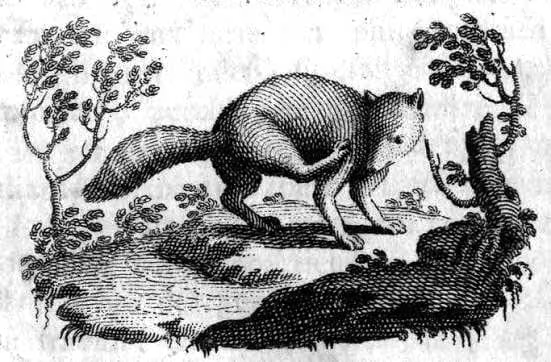
The house used several forms of the proprietor’s name—Lelio dalla Volpe, Lelio della Volpe and the Latin Laelius a Vulpe—and the fox naturally lent itself to speaking visual and verbal devices. Yet neither address nor device should be generalized from one copy to the entire output without examination. Dalla Volpe’s long career involved changing imprints, institutional associations and production arrangements. For bibliographical description, the exact wording of the title page, publisher’s formula, engraved or typographical ornaments and any issue-specific features must be recorded directly from the copy rather than normalized retrospectively.
By the time Lelio Dalla Volpe died on 6 October 1749, the firm had become financially stable, intellectually prestigious and technically well equipped. It passed to his son Petronio Dalla Volpe, born in 1721 and already experienced within the family business. Petronio did much more than preserve the inheritance. He developed the typefounding and production structure, assumed responsibility for additional workshops and in 1756 entered the formal arrangement that made the Dalla Volpe operation the official printing establishment of the Istituto delle Scienze. The subsequent history of the house—extending through major scientific and musical publications to Petronio’s death in 1794—is therefore a second generation built upon foundations established by Lelio rather than a seamless continuation of the founder’s personal activity.
The distinction sharpens rather than diminishes Lelio’s historical position. His achievement was to establish the editorial ecology within which the later house could flourish. He connected the workshop to the Institute of Sciences, the Accademia Clementina, Bolognese musicians, ecclesiastical patrons and authors; developed a bookshop capable of importing and redistributing publications; invested in copperplate production; built collaborative relationships with engravers and scholars; and demonstrated through projects as different as the Commentarii, Bibiena, Zanotti and Bertoldo that one Bolognese enterprise could address international science, art instruction, popular literature and music without losing economic coherence.
Lelio Dalla Volpe consequently occupies an important place in the history of eighteenth-century Italian publishing not because he invented a new technology or imposed a revolutionary intellectual programme, but because he made the printing house function as an institutional mediator of knowledge. The laboratory and academy needed accurate proceedings; the art academy needed images and biography; architects needed diagrams; musicians needed notation; popular literature could be converted into a luxurious illustrated commodity; foreign science required translation and republication; scholars and buyers required a shop through which books moved into and out of Bologna. Dalla Volpe brought these activities into one commercial structure and made them mutually sustaining. In doing so he created one of the material systems through which Bolognese intellectual culture could acquire durable printed form and participate in the European circulation of eighteenth-century knowledge.
Bibliography
Muzzi, Salvatore. “La bottega di Lelio Dalla Volpe. Conversazioni letterarie.” In Almanacco statistico bolognese per l’anno 1839 dedicato alle donne gentili, 211–219. Bologna, 1839.
Muzzi, Salvatore. La stampa in Bologna: sommario storico pubblicato in occasione del Secondo Congresso tipografico italiano. Bologna: Regia Tipografia, 1869.
Parisini, Federico. Della vita e delle opere di padre Giambattista Martini. Bologna: Regia Tipografia, 1887, especially pp. 32–33.
Flori, Ezio. “Di Giulio Cesare Croce e del suo ‘Bertoldo’.” L’Archiginnasio 18 (1923): 137–181.
Rondinini, Ada. “Lelio Dalla Volpe e l’edizione del ‘Bertoldo’.” L’Archiginnasio 23 (1928): 191–207.
Sorbelli, Albano. Storia della stampa in Bologna. Bologna: Nicola Zanichelli, 1929.
Vatielli, Francesco. Arte e vita musicale a Bologna: studi e saggi. Bologna: Nicola Zanichelli, 1929, especially pp. 164–168, 173–174, 181.
Sartori, Claudio. Dizionario degli editori musicali italiani: tipografi, incisori, librai-editori. Florence: Leo S. Olschki, 1958, p. 59.
Varignana, Franca. “La fortuna editoriale del Bertoldo crespiano.” In Le collezioni d’arte della Cassa di Risparmio in Bologna. I disegni, vol. I, edited by Andrea Emiliani, 421–430. Bologna: Cassa di Risparmio in Bologna, 1973.
Canterzani, Giambattista. Catalogo ragionato dei libri a stampa pubblicati in Bologna dai tipografi Lelio e Petronio Dalla Volpe, disposto con l’ordine cronologico della loro pubblicazione. Edited by Marco Bortolotti and Alessandro Serra. Bologna: CLUEB, 1979.
Bortolotti, Marco, and Alessandro Serra. “La Stamperia dell’Istituto e i Dalla Volpe.” In I materiali dell’Istituto delle Scienze, 167–178. Bologna, 1979.
Colombo, Enzo. “Catalogo delle edizioni di Lelio e Petronio Dalla Volpe possedute dalla Biblioteca dell’Archiginnasio.” L’Archiginnasio 75 (1980): 77–301.
Colombo, Enzo. “Edizioni Dalla Volpe presso la Biblioteca musicale ‘G. B. Martini’ di Bologna.” L’Archiginnasio 76 (1981): 65–77.
Colombo, Enzo. “Immagini devozionali uscite dalla tipografia Dalla Volpe conservate nella Biblioteca comunale dell’Archiginnasio.” L’Archiginnasio 78 (1983): 39–42.
Tavoni, Maria Gioia, and Nicola Balata. “Dalla Volpe, Lelio Antonio Gaetano.” In Dizionario Biografico degli Italiani, vol. 32, 61–63. Rome: Istituto della Enciclopedia Italiana, 1986.
Tavoni, Maria Gioia. “Dalla Volpe, Petronio.” In Dizionario Biografico degli Italiani, vol. 32, 63–65. Rome: Istituto della Enciclopedia Italiana, 1986.
Tavoni, Maria Gioia. “Tipografi e produzione libraria.” In Produzione e circolazione libraria a Bologna nel Settecento: avvio di un’indagine. Atti del V Colloquio, Bologna, 22–23 febbraio 1985, 91–242. Bologna: Istituto per la storia di Bologna, 1987.
Fregni, Euride. “Libri e botteghe di libri.” In Produzione e circolazione libraria a Bologna nel Settecento: avvio di un’indagine. Atti del V Colloquio, Bologna, 22–23 febbraio 1985, 295–310. Bologna: Istituto per la storia di Bologna, 1987.
Tongiorgi Tomasi, Lucia. “Libri illustrati a Bologna nel Settecento: editori, stampatori, artisti e connoisseurs.” In Produzione e circolazione libraria a Bologna nel Settecento: avvio di un’indagine. Atti del V Colloquio, Bologna, 22–23 febbraio 1985, 311–356. Bologna: Istituto per la storia di Bologna, 1987.
Alma Mater Librorum: nove secoli di editoria bolognese per l’Università. Bologna: CLUEB–Il Mulino–Nuova Alfa Editoriale–Zanichelli, 1988.
Tavoni, Maria Gioia. “Sulla circolazione libraria a Bologna.” In Libro, editoria, cultura nel Settecento italiano, edited by Alberto Postigliola, 80–82. Rome: Società Italiana di Studi sul Secolo XVIII, 1988.
Tortorelli, Gianfranco. “Editori e tipografi a Bologna e dintorni.” La Bibliofilía 95 (1993): 255–276.
Beyond the names: biographies and bibliographies on this page are curated by Abu, the AI scholar crafted by Buonvecchio exclusively for Govi Rare Books.