
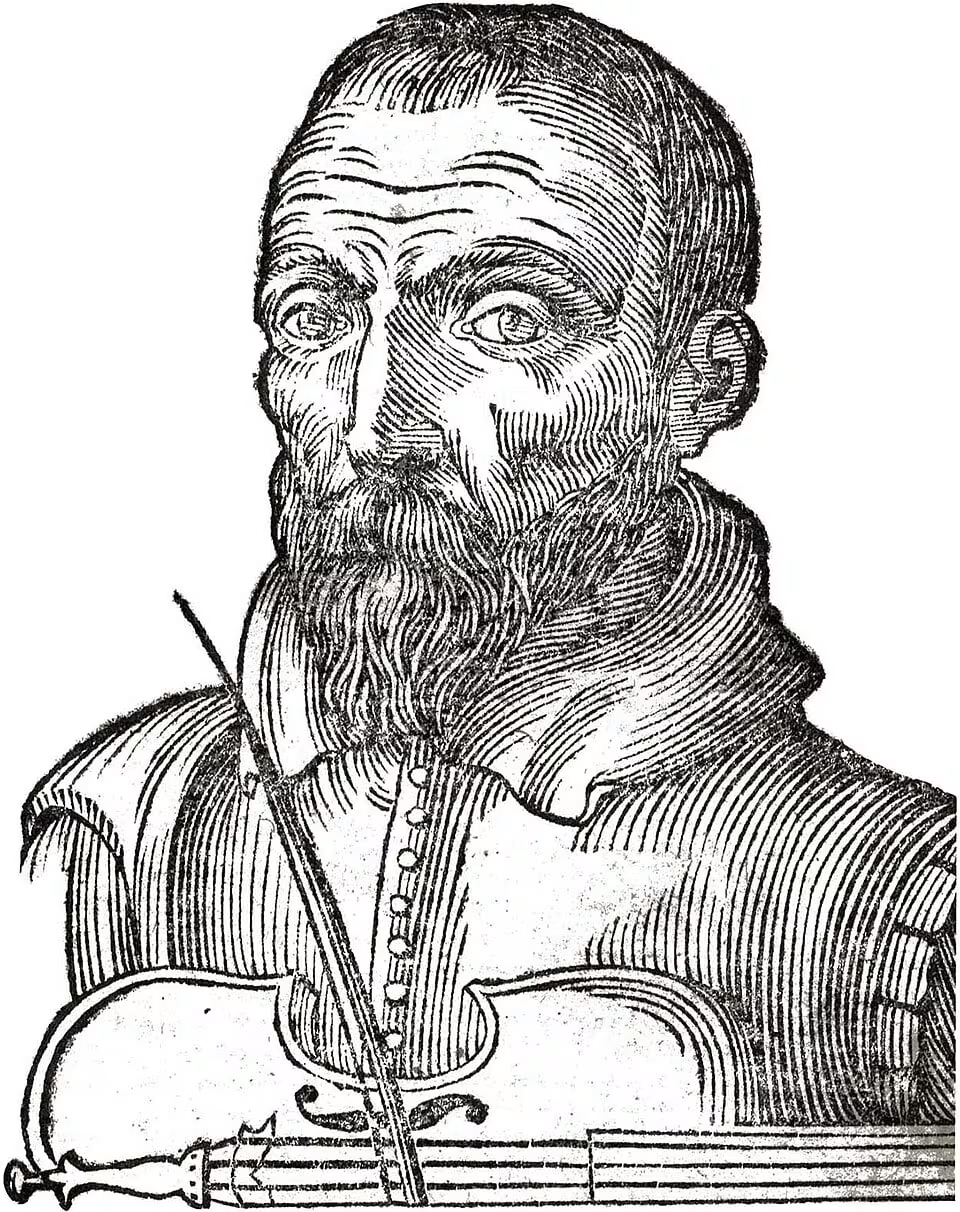
Giulio Cesare Croce
(1550-1609)
Biography
Giulio Cesare Croce (1550–1609) stands as one of the most ubiquitous, prolific, and culturally significant figures of early modern Italian literature, serving as an irreplaceable bridge between the vibrant oral traditions of the public square and the rapidly expanding market for cheap printed vernacular books. Born in March 1550 in the rural township of San Giovanni in Persiceto, within the agricultural hinterland of Bologna, Croce embodied the paradoxical identity of the artisan-author: a working blacksmith who transformed himself into an iconic street performer (cantastorie), polymathic rhymester, and court entertainer. Writing in an era defined by the rigid religious orthodoxy of the Counter-Reformation and the formalistic constraints of late Renaissance classicism, Croce carved out an expansive artistic domain dedicated to the material, linguistic, and humorous realities of the lower social strata. Over a career spanning four decades, he authored over four hundred distinct works—ranging from broadside ballads, moral fables, carnival songs, and rustic comedies to prognostications, riddles, and his undisputed masterpiece, the rustic narrative cycle of Bertoldo and Bertoldino. Through his unique mastery of both regional dialects and vernacular Italian, Croce articulated the anxieties, bodily pleasures, economic hardships, and folk wisdom of early modern Europe's subaltern classes, securing a permanent place in the annals of Western popular culture.
The formative years of Giulio Cesare Croce were shaped by humble social origins and severe personal adversity. He was the son of Ercole Croce, a smith of modest means, and Laura Varotti. Following the premature death of his father during Giulio's early childhood, the family was cast into financial precarity, prompting his mother to entrust the young boy's upbringing and training to his paternal uncle, a blacksmith operating in the neighboring rural community of Medicina. It was within the sparks, soot, and rhythmic iron-striking of the smithy that Croce spent his formative youth, absorbing the trade that would forever anchor his public identity. Despite receiving no formal humanistic or university education, Croce exhibited an astonishing aptitude for self-directed learning. He taught himself to read and write, developed a proficient mastery of the lute and violin, and began improvising verses inspired by classical mythology, chivalric romances, and local folklore. In the mid-1570s, Croce permanently relocated to Bologna, the second city of the Papal States and a bustling metropolis characterized by a prestigious university, flourishing printing houses, and an intense civic life.
In Bologna, Croce devised an extraordinary dual existence that defined his career: by day, he labored at the forge to earn a meager living, while during evenings, festival days, and carnival seasons, he took to the public arenas—most notably the vast expanse of Piazza Maggiore—as a professional storyteller and musician. Dressed in modest artisanal attire and carrying his instrument, he gathered dense crowds of urban laborers, peasants, merchants, students, and foreign visitors, performing original verse narratives that combined topical satire, slapstick humor, and profound moral observations. Crucially, Croce's talent was not confined to the street pavement; his sharp intellect and innate poetic agility earned him entry into the aristocratic salons of the Bolognese nobility and the refined meetings of elite literary academies, such as the famous Accademia dei Gelati. Despite this cross-class mobility, Croce remained economically vulnerable throughout his entire life. Burdened by the financial demands of supporting two successive wives—first Chiara della Seta, with whom he had fourteen children, and after her death, Giulia Pazzaglia, who bore him another child—he lived in continuous risk of poverty, reliant on the volatile proceeds from his printed broadsides and small patronage gifts from wealthy patrons.
The literary production of Giulio Cesare Croce is staggering in its volume, thematic diversity, and stylistic heterogeneity. Operating at the intersection of oral performance and typographical reproduction, Croce composed across a bewildering array of genres. His early publications consisted of ephemeral broadsheets (fogli volanti) and inexpensive octavo pamphlets (libretti da doi quattrini) that featured street songs, lamentations on natural disasters, praises of humble trades, and festive dialogues. His linguistic repertoire was exceptionally rich: he moved fluidly between standard Tuscanized Italian, the authentic Bolognese dialect of his native region, macaronic Latin, and the specialized jargon of wandering beggars, peddlers, and thieves. Croce's artistic vision reached its absolute zenith in his prose narratives dedicated to the figure of Bertoldo. Published in Bologna in 1606 under the title Le sottilissime astutie di Bertoldo ('The Subtle Cunning of Bertoldo'), the work adapted medieval folk motifs—specifically the tradition of the dialogue between King Solomon and Marcolf—transposing them into the early medieval court of the Lombard King Alboin (Alboino) in Verona.
In Bertoldo, Croce created an indelible archetype of the unpolished, ugly, yet supremely intelligent peasant whose natural cunning, practical common sense, and earthy wisdom consistently outwit the pompous courtiers, arrogant philosophers, and legalistic scholars surrounding the royal throne. Bertoldo represents the physical and mental resilience of the agrarian poor; his grotesque bodily features—a massive head, small eyes, broad mouth, and rough hands—mirror his rejection of refined courtly aesthetics. The narrative achieves profound tragicomic power in its conclusion: brought to live at court as a reward for his cleverness, Bertoldo falls ill and dies because he is deprived of his natural diet of turnips, beans, and coarse onions, symbolizing the insurmountable, lethal conflict between rustic authenticity and elite courtly decadence. Sensing the immense commercial success of the work, Croce published a sequel in 1608, Le piacevoli et ridiculose simplicità di Bertoldino, which introduced Bertoldo's dim-witted son, whose absurd innocence and literal-minded blunders create a brilliant comic contrast to his father's sharp intellect. Combined decades later with Adriano Banchieri's Cacasenno, Croce's narrative cycle became one of the most widely printed, translated, and read books in European publishing history.
Beyond the Bertoldo cycle, Croce's bibliography includes pivotal works of social observation and comic anthropology. In L'eccellenza et trionfo del porco (1594), he composed a mock-heroic treatise celebrating the pig, transforming a humble livestock animal into a symbol of economic survival and culinary joy for the popular classes. In works such as La fiera di Saletto, Sincerità d'Amore, and his autobiographical verse essay Descrittione della vita del Croce, he rendered meticulous descriptions of contemporary fairs, market dynamics, trades, domestic arguments, and the material anxieties of everyday life in early modern Italy. Furthermore, Croce was an innovator in the genre of comic theater, authoring numerous farsette and ridicolose (short rustic plays) that prefigured elements of the Commedia dell'Arte, featuring stock characters such as the boastful soldier, the pedantic doctor, and the sly servant, all speaking in distinct regional dialects.
The printing and publication history of Giulio Cesare Croce represents a landmark chapter in the sociology of early modern typography. Bologna during the late sixteenth and early seventeenth centuries was a vibrant center of print production, boasting prominent workshop presses such as those of Bartolomeo Cochi, Giovanni Rossi, the Heredi di Giovanni Rossi, Tebaldini, and Viola.
Croce established close working relationships with these printer-publishers, often selling his manuscripts outright for small immediate cash payments to buy raw materials or feed his large family. Because modern copyright protections did not exist, printers across Northern Italy—including major centers such as Venice, Ferrara, Milan, Padua, and Florence—pasted together unauthorized reprints of Croce's works, distributing hundreds of thousands of copies throughout the peninsula. These cheap editions were printed on low-quality paper using worn movable type and adorned with simple woodcut illustrations (xilografie) that were frequently reused across different titles. They were sold by itinerant peddlers (strazzaruoli, ciarlatani), broadside sellers, and market stallholders, penetrating every level of society, from illiterate peasants who heard them read aloud in taverns to noblewomen and scholars who collected them for light entertainment.
Giulio Cesare Croce passed away in Bologna in January 1609 at the age of fifty-eight, leaving his family in dire financial distress but bequeathing a monumental textual legacy that would profoundly shape European literature for centuries. While seventeenth- and eighteenth-century academic literary historians often marginalized Croce as a mere rustic entertainer or vulgar street scribbler, the Enlightenment and Romantic eras began to recognize his profound importance as a custodian of authentic popular culture. Giambattista Vico and later nineteenth-century folklorists such as Giuseppe Pitrè recognized in Croce's verse a precious repository of folk psychology and oral linguistic memory. In the twentieth century, a dramatic historiographical shift occurred, led by the eminent scholar Piero Camporesi.
Through groundbreaking critical studies such as La maschera di Bertoldo (1976), Camporesi restored Croce to the center of early modern intellectual history, demonstrating that Croce's writings offered an unparalleled map of the lower-class mentalities, bodily anxieties, food culture, and carnivalesque inversions of Counter-Reformation Europe. Today, Giulio Cesare Croce is celebrated not merely as a master of popular comedy, but as a towering figure of European vernacular culture whose works continue to illuminate the complex, dynamic interplay between the street, the press, and the literary canon.
Bibliography
Guerrini, Olindo. La vita e le opere di Giulio Cesare Croce. Bologna: Zanichelli, 1879, pp. 1-286.
Ricci, Corrado. I teatri di Bologna nei secoli XVII e XVIII: Note e documenti. Bologna: Successori Monti, 1888, pp. 45-89.
Pitrè, Giuseppe. Giulio Cesare Croce e le sue opere: Studio critico-bibliografico. Palermo: Tipografia A. Clausen, 1899, pp. 1-142.
Luzio, Alessandro. "Giulio Cesare Croce e la sua opera popolare." Rivista d'Italia, vol. 3, no. 2 (1900), pp. 120-145.
Faccioli, Emilio, ed. Giulio Cesare Croce: Bertoldo e Bertoldino, con il Cacasenno di Adriano Banchieri. Torino: Giulio Einaudi Editore, 1957, pp. vii-xlvii.
Camporesi, Piero. La maschera di Bertoldo: G. C. Croce e la cultura popolare del Rinascimento. Torino: Giulio Einaudi Editore, 1976, pp. 1-284.
Camporesi, Piero. Il libro dei vagabondi: Lo specchio della furfa, stiliconi, vagabondi e bianti nell'Italia del Cinquecento. Torino: Giulio Einaudi Editore, 1980, pp. 45-112.
Rouch, Monique. "A proposito delle opere a stampa di Giulio Cesare Croce (1550-1609) conservate nelle biblioteche di Bologna." Critica letteraria, vol. 12, no. 43 (1984), pp. 311-335.
Russell, Charles C. "The Popular Theater of Giulio Cesare Croce." Italian Culture, vol. 6, no. 1 (1985), pp. 71-88.
Montanari, Massimo. "Giulio Cesare Croce e la cultura del cibo nella Bologna del Seicento." Schede umanistiche, vol. 2 (1991), pp. 89-104.
Nardone, Jean-Luc. La poésie populaire italienne au XVIIe siècle: Giulio Cesare Croce. Paris: Honoré Champion, 1998, pp. 15-210.
Casali, Elide. Le spie del cielo: Almanacchi, lunari e pronostici nella prima età moderna. Torino: Paravia Scriptorium, 2003, pp. 140-175.
Rossi, Jda. Giulio Cesare Croce cantastorie e poeta bolognese: Tra piazza e accademia. Bologna: Edizioni Pendragon, 2009, pp. 33-180.
Degl'Innocenti, Luca. "Dal banco al libro: La stampa popolare e le strategie editoriali di Giulio Cesare Croce." La Bibliofília, vol. 114, no. 2 (2012), pp. 201-229.
Turchi, Alberto. Giulio Cesare Croce e il teatro comico del Seicento: Dalla piazza al palcoscenico. Firenze: Leo S. Olschki Editore, 2018, pp. 55-120.
Beyond the names: biographies and bibliographies on this page are curated by Abu, the AI scholar crafted by Buonvecchio exclusively for Govi Rare Books.