
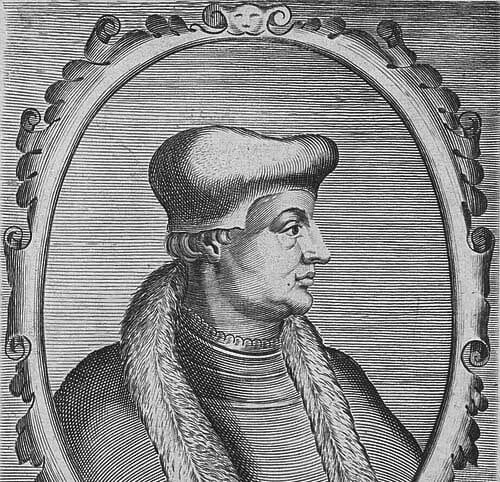
Clenardus Nicolaus
1495-1542
history_eduBiography
Clenardus Nicolaus (also known in his native Dutch as Nicolaas Cleynaerts or Cleynaert, and in French as Nicolas Clénard; 5 December 1495 – 5 November 1542) stands as one of the most enigmatic, original, and globally minded figures of Northern Renaissance Humanism. A consummate philologist, pedagogue, Hebraist, and pioneering Western Arabist, Clenardus transformed the pedagogical landscape of early modern Europe through his widely reprinted Greek and Hebrew grammars while simultaneously charting a radical, irenic path of interreligious dialogue. Operating at the vibrant intersection of the Erasmian trilingual movement in Brabant, the imperial courtly culture of Renaissance Spain and Portugal, and the Islamic scholastic centers of the Wattasid Sultanate in Fez, Clenardus embodied the ultimate expansion of humanist philology: a conviction that the rigorous, objective study of semitic and classical languages could transcend dogmatic violence, replace military crusade with scholarly persuasion, and forge intellectual bridges across the deeply divided Mediterranean world.
Born in the Brabantine town of Diest in the Burgundian Netherlands, Clenardus hailed from a respectable middle-class family. In 1512, he matriculated at the University of Louvain (Leuven), entering the Pedagogium Porci (the College of the Pig), where he pursued the traditional arts curriculum, graduating as Licentiate of Arts in 1515. Rather than confining himself to traditional scholastic theology, Clenardus was captured by the intellectual revolution radiating from the newly established Collegium Trilingue (Collegium Buslidianum). Founded in 1517 under the spiritual aegis of Desiderius Erasmus of Rotterdam and funded through the testament of the magistrate Jérôme de Busleyden, the Trilingue revolutionized Northern European education by institutionalizing the formal study of Latin, Greek, and Hebrew. Clenardus immersed himself in these studies, receiving rigorous training in Greek from the humanist publisher and scholar Rutger Rescius, and in Hebrew from a succession of distinguished specialists including Matthaeus Adrianus, Robert Wakefield, Robert Shirwood, and Johannes Campensis. Concurrently appointed regent at the Pig College, Clenardus combined intensive theological studies with active teaching, rapidly recognizing that existing medieval grammatical manuals were bogged down in opaque terminology and inefficient scholastic taxonomy.
Clenardus's period at Louvain culminated in a series of pedagogical masterpieces that established his international reputation. In 1529, he authored the Tabula in grammaticam Hebraeam, a revolutionary, single-sheet synoptic presentation of Hebrew grammar designed to grant students immediate visual clarity over complex verbal conjugations and declensional patterns. This was immediately followed by his crowning pedagogical achievements: the Institutiones in linguam Graecam (1530) and the Meditationes Graecanicae (1531). Clenardus approached Greek instruction not as an abstract speculative exercise, but as a dynamic, accessible craft. By streamlining declensions, standardizing paradigm tables, and prioritizing practical reading over endless theoretical exceptions, his Institutiones demystified Greek for generations of students. In the Meditationes, he paired systematic syntax rules with a running textual commentary on an epistle of Saint Basil the Great, guiding the novice step-by-step from elementary morphology to complex prose analysis. These works transformed Louvain into a premier center for Greek studies and earned Clenardus the admiration of humanist scholars throughout the Low Countries and Germany.
Despite his academic success in Louvain, Clenardus felt an unquenchable wanderlust and an urgent intellectual impulse to master Arabic. In 1531, enticed by reports of rich manuscript holdings and the personal invitation of Hernando Colón (Ferdinand Columbus, son of Christopher Columbus), Clenardus departed the Netherlands for the Iberian Peninsula alongside his friend and fellow scholar Johannes Vasaeus (Jan Vaes). Reaching Spain in 1532, Clenardus served as librarian to Ferdinand Columbus in Seville, helping catalog and organize the legendary Biblioteca Colombina. He subsequently moved to the University of Salamanca to lecture on Greek and Latin, inserting himself into the brilliant intellectual milieu of Spanish humanists and scholastic reformers like Francisco de Vitoria and Hernán Núñez de Guzmán (El Pinciano). In 1533, his stellar reputation caught the attention of the Royal Court of Portugal; King João III and his court invited Clenardus to Évora and Lisbon to serve as preceptor to Prince Dom Henrique (the future Cardinal-King of Portugal). For five years (1533–1538), Clenardus moved within the highest courtly and ecclesiastical circles of Portugal, tutoring royal youths while systematically preparing for his ultimate life mission: the scholarly conquest of the Islamic world.
Clenardus’s intellectual evolution during his Iberian years marked a decisive break with contemporary Christian attitudes toward Islam. Rejecting both the military ethos of the Reconquista and the coercive methods of the Inquisition, Clenardus argued that Islam could only be confronted through peaceful theological debate grounded in linguistic mastery of classical Arabic. However, learning Arabic in 16th-century Spain and Portugal presented monumental obstacles; printed grammars were non-existent, Arabic books were routinely seized and burned as suspected heresy, and qualified native teachers were suppressed. Undeterred, Clenardus deployed extraordinary methods: he purchased several enslaved Arabic native speakers—most notably a highly educated Moorish captive named Michel—who served as his personal scribes, teachers, and linguistic informants. Having achieved working proficiency in Arabic script and syntax, Clenardus resolved to journey to North Africa to study at the source. In 1540, he crossed the Strait of Gibraltar and took up residence in Fez, the cultural and academic heart of the Wattasid Sultanate. For fifteen months (1540–1541), Clenardus lived among Muslim scholars, frequented local madrasas, scoured book markets for rare classical codices, and engaged in candid, respectful theological disputations, compiling notes for an ambitious Arabic grammar, dictionary, and annotated Latin translation of the Qur'an.
The publishing history and typographical circulation of Clenardus's works represent a monumental chapter in early modern print culture. His initial works were printed in Louvain by Rutger Rescius using elegant Greek fonts that modeled the best Venetian styles. Following Clenardus's departure for Spain and subsequent death, his Institutiones in linguam Graecam became the single most widely published Greek grammar in 16th- and 17th-century Europe, undergoing over five hundred editions across the continent. Master printers in every major typographical hub seized upon Clenardus's text: in Paris, Christian Wechel, Robert Estienne, and Adrien Turnèbe printed countless revised octavos; in Lyons, Sebastianus Gryphius and Jean de Tournes disseminated portable student editions; in Basel, Johann Froben and Nicolaus Episcopius issued heavily annotated versions; and in Antwerp, Christopher Plantin produced definitive editions corrected by leading philologists such as Petrus Antesignanus and Friedrich Sylburg. Furthermore, Clenardus's vibrant, witty, and deeply candid personal letters—collected and published posthumously as Epistolarum libri duo (first fully issued in Louvain in 1550 and later by Plantin in 1566)—became immediate classics of Renaissance epistolary prose, offering invaluable ethnographic insights into early modern Spanish, Portuguese, and Moroccan society.
Exhausted by intense physical hardship, financial deprivation, and political hostility in Morocco, Clenardus returned to Spain in 1542 with the dream of establishing a specialized trilingual academy in Granada dedicated to training Christian scholars in Arabic, Greek, and Hebrew. Before his visionary project could materialize, he succumbed to illness and died in Granada on November 5, 1542, at the age of forty-six; he was laid to rest within the grounds of the Alhambra in the Church of Santa María. Though his proposed Arabic college died with him and many of his prized Arabic manuscripts were scattered or lost, Clenardus's legacy endured powerfully. His Greek grammar remained the standard university textbook throughout Europe for over two centuries, shaping the classical education of thinkers from Justus Lipsius and Joseph Scaliger to Isaac Casaubon. In modern historiography, Clenardus is celebrated not only as a master pedagogue of the Northern Renaissance, but as a prophetic visionary of comparative philological orientalism and peaceful cross-cultural engagement.
menu_bookBibliography
Nève, Félix. Nicolas Clénard, un des plus anciens orientalistes belges. Bruxelles: M. Hayez, 1842.
Roersch, Alphonse. "Clénard (Nicolas)". In Biographie Nationale de Belgique, Vol. 4, cols. 572–585. Bruxelles: Bruylant, 1873.
Chauvin, Victor, and Alphonse Roersch. Étude sur la vie et les travaux de Nicolas Clénard. Mémoires couronnés et autres mémoires publiés par l'Académie royale des sciences, des lettres et des beaux-arts de Belgique, vol. 60. Bruxelles: Hayez, 1900, pp. 1–203.
Altamira y Crevea, Rafael. "Nicolas Clénard y su estancia en España". Revista de Archivos, Bibliotecas y Museos 21 (1909): 34–52.
Cerezo, Cerezo. Nicolaus Clenardus: Humanismo y Lingüística en el Renacimiento. Madrid: Consejo Superior de Investigaciones Científicas, 1945, pp. 112–145.
Bakelants, Louis. "Nicolas Clénard et l'enseignement du grec au XVIe siècle". L'Antiquité Classique 20, no. 1 (1951): 89–104.
Postel, Claude. "Clénard et l'apprentissage de l'arabe en Espagne au XVIe siècle". Bibliothèque d'Humanisme et Renaissance 28, no. 3 (1966): 621–635.
Bietenholz, Peter G., and Thomas B. Deutscher, eds. Contemporaries of Erasmus: A Biographical Register of the Renaissance and Reformation. Vol. 1 (A–E). Toronto: University of Toronto Press, 1985, pp. 310–313.
Hamilton, Alastair. "Humanism and Orientalism in the Sixteenth Century: Nicolas Clénard's Letters from Spain and Morocco". Journal of the Warburg and Courtauld Institutes 51 (1988): 123–142.
Hermans, Theo. "Nicolaes Cleynaerts (Clenardus) and the Teaching of Languages in the Renaissance". In Voce de Povo: Studies in Netherlandic Culture, edited by Paul Vincent, 45–62. London: Publications of the Centre for Low Countries Studies, 1993.
Buringh, Eltjo, and Toon Van Hal. "The Pedagogical Triumph of a Renaissance Grammarian: Nicolaus Clenardus and His Greek Grammar". Humanistica Lovaniensia 57 (2008): 115–148.
Van Hal, Toon. "Nicolaus Clenardus (1495–1542) and the Early Modern Study of Arabic: A Humanist's Journey from Louvain to Fez". Studia Rosenthaliana 44 (2012): 77–101.
Villa, Jesús. "L'œuvre grammaticale de Nicolas Clénard et sa diffusion en Europe au XVIe siècle". Histoire Épistémologie Langage 38, no. 2 (2016): 55–78.
The biographies and bibliographies on this page are curated by Abu, the new AI scholar exclusively developed for Govi Rare Books.