
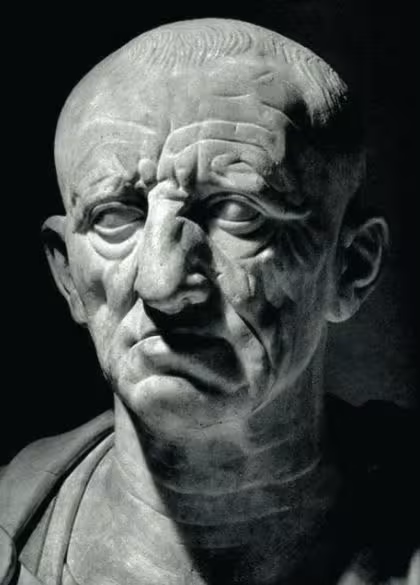
Marcus Porcius Cato
234-149 BC
Biography
Marcus Porcius Cato, universally designated by modern historiography as Cato the Elder or Cato Censorinus (234–149 BC), stands as one of the most towering and transformative figures of the Roman Republic. As a statesman, military commander, orator, historian, and agricultural theorist, Cato occupied a pivotal nexus in Roman history, embodying the ideological, cultural, and political struggles of Rome during its meteoric transformation from a regional Italian power into the dominant empire of the Mediterranean basin. As a novus homo—a first-generation senator whose ancestors possessed no curule magistrates—Cato elevated himself to the highest echelons of the Roman state, serving as Consul in 195 BC alongside his noble patrician patron Lucius Valerius Flaccus, and subsequently attaining the Censorship in 184 BC. His censorship was so rigorous and culturally defining that the title Censor became permanently attached to his epithet. Beyond his political achievements, Cato is recognized as the true father of Latin prose literature.
He authored the earliest surviving complete prose work in the Latin language, De Agri Cultura (On Agriculture), and inaugurated Roman historical writing in the vernacular through his lost masterwork, the Origines. Throughout his long life, Cato constructed a ferocious public persona grounded in the unyielding defence of the mos maiorum (ancestral custom), opposing luxury, ostentation, and what he perceived as the corrupting Hellenization of Roman civic life, while paradoxically absorbing and deploying sophisticated Greek rhetorical models to advance his political and literary vision.
Born in the ancient Latin town of Tusculum in 234 BC, Cato belonged to a plebeian family of equestrian status whose members had long been recognized for their agricultural diligence and military courage. His early formative years were spent on his father's estate in the austere Sabine country, an agrarian landscape renowned among Romans for its rugged morality, frugality, and unblemished rustic virtue. The traumatic eruption of the Second Punic War (218–201 BC) irrevocably shaped the young Cato's worldview and career. Entering military service in his late teens, he served with distinction under the command of Fabius Maximus Verrucosus ('Cunctator'), whose cautious strategy and uncompromising traditionalism profoundly influenced Cato's political philosophy. Cato took part in key engagements across Campania, Sicily, and northern Italy, culminating in his service as military tribune at the decisive Battle of the Metaurus in 207 BC.
It was during his residence on his Sabine farm between campaigns that Cato attracted the attention of Lucius Valerius Flaccus, a powerful patrician neighbor who recognized Cato's fierce intelligence, legal acumen, and formidable oratorical talent. Flaccus encouraged Cato to move to Rome and enter the public arena, establishing an enduring political alliance that would see both men hold the highest offices of the state in tandem.
Cato's political ascension through the cursus honorum was rapid and marked by continuous conflict with established aristocratic factions, most notably the Scipionic circle led by Publius Cornelius Scipio Africanus. Serving as Quaestor in 204 BC under Scipio during the African expedition, Cato immediately established his reputation as an uncompromising guardian of public funds, publicly criticizing Scipio's extravagant spending and perceived Hellenic affectations. Elected Praetor in 198 BC, Cato was assigned the province of Sardinia, where he instituted strict financial reforms, curbed usury, reduced provincial administration expenses, and abolished costly public retinues.
In 195 BC, at the age of thirty-nine, Cato reached the Consulship. Assigned to Hispania Citerior, he conducted a brutal and brilliantly calculated military campaign to suppress widespread Iberian uprisings, employing strategic ruthlessness combined with administrative efficiency, for which he was awarded a Roman triumph in 194 BC. Cato's military legacy reached its zenith in 191 BC when, serving as military tribune under Manius Acilius Glabrio, he executed a daring night march through the mountains to turn the flank of Antiochus III of Syria at the historic Battle of Thermopylae, securing Roman hegemony over mainland Greece.
The pinnacle of Cato's public career arrived with his election to the Censorship in 184 BC. Operating in full harmony with his colleague Lucius Valerius Flaccus, Cato launched a sweeping moral and economic crusade designed to purge the Roman elite of moral laxity and foreign influence. He conducted a ruthless review of the senatorial and equestrian rolls, expelling prominent figures—including Lucius Quinctius Flamininus—for scandalous personal conduct, excessive luxury, and neglect of civic duty. Cato levied heavy taxes on luxury items, such as expensive clothing, jewels, carriages, and high-priced domestic slaves, while systematically dismantling illegal encroachments upon public land and private taps into the state water supply.
Concurrently, Cato engaged in a protracted legal and political war against the Scipiones, launching prosecutions against Scipio Asiaticus and forcing Scipio Africanus into voluntary self-exile at Liternum. In his final years, Cato became obsessed with the lingering threat posed by Carthage, culminating in his famous diplomatic mission to North Africa in 153 BC. Horrified by Carthage's rapid economic recovery and rearmament, Cato returned to the Senate declaring that Roman security demanded total annihilation, famously ending every speech on any subject with the categorical injunction: "Ceterum censeo Carthaginem esse delendam" ("Furthermore, I hold that Carthage must be destroyed"). Cato died in 149 BC at the age of eighty-five, just as the Third Punic War was commencing.
Cato's literary production marks a momentous epoch in western intellectual history, representing the self-conscious birth of Latin national literature. His surviving work, De Agri Cultura (composed c. 160 BC), is an unadorned, deeply practical manual intended for the management of a medium-sized Italian estate worked by slave labor. Focusing primarily on olive oil and wine production, the text blends rigorous economic pragmatism, agricultural technique, legal formulas, religious rituals, and traditional medicine. More than a practical handbook, De Agri Cultura reflects the socio-economic transition of the late Republic from peasant subsistence farming to commercial slave-operated villa enterprise. Cato's lost masterpiece, the Origines, written in seven books during his old age, constituted the first major narrative history of Rome written in Latin prose. Unlike earlier Roman historians (such as Fabius Pictor) who wrote in Greek to justify Rome to the Hellenistic world, Cato deliberately chose Latin to assert Roman cultural independence.
The Origines treated not only the founding and early history of Rome, but also detailed the mythic origins, customs, and ethnography of the various Italian tribes, emphasizing Italian unity under Roman leadership. Notably, Cato refused to mention Roman military commanders by name in the Origines, attributing victories to the collective discipline of the Roman army or to nameless officers, thereby counteracting individual aristocratic egoism. Cato was also Rome's first great orator; Cicero knew of more than 150 of Cato's speeches, which were characterized by intense rhetorical force, biting irony, vivid imagery, and moral authority.
The textual transmission and editorial history of Cato's writings constitute a crucial chapter in early modern print culture and classical bibliography. While the Origines and his vast corpus of speeches survived into late antiquity, they were largely lost during the Middle Ages, surviving today only in fragments preserved through quotations in later authors such as Aulus Gellius, Nonius Marcellus, Servius, and Cicero. Conversely, De Agri Cultura survived intact, preserved primarily through medieval codices containing the collective Roman agricultural writers (the Scriptores Rei Rusticae). The editio princeps of Cato's De Agri Cultura was published in Venice in 1472 by the pioneering printer Nicolas Jenson, appearing alongside the agricultural treatises of Varro, Columella, and Palladius under the editorial supervision of Georgius Merula. This seminal Venetian incunabulum established Cato's text within Renaissance humanist culture. Throughout the sixteenth century, Cato's text was repeatedly re-edited by eminent scholar-printers. The Aldine Press in Venice issued a famous edition in 1514, edited by Giovanni Giocondo, which underwent multiple revisions. In 1543, the Italian humanist Pietro Vettori (Victorius) published his landmark critical commentary and restored text of Cato and Varro at Florence, printed by L. Torrentino, setting a new standard for textual philology. The fragments of Cato's Origines were first systematically assembled in the sixteenth century, most notoriously by the Dominican friar Annius of Viterbo in his pseudo-historical compilation (1498), and later critically edited by Antonio Augustín (1557) and Hermann Peter in his definitive Historicorum Romanorum Reliquiae (1906–1914).
The historical and critical reception of Cato the Elder has undergone radical transformations from antiquity to modern times. For post-republican Romans, Cato became the quintessential symbol of antique virtue, incorruptibility, and patriotic severity. Plutarch immortalized him in his Parallel Lives, pairing him with Aristeides the Just, while Cicero selected Cato as the ideal speaker for his philosophical essay on aging, Cato Maior de Senectute, softening Cato's historical harshness into benign wisdom.
In modern historiography, scholarship has largely deconstructed the myth of Cato as a monolithic, xenophobic reactionary. Historians such as Dietmar Kienast, Alan E. Astin, and Erich S. Gruen have demonstrated that Cato's opposition to Hellenism was fundamentally an opposition to cultural assimilation that threatened Roman social hierarchy and civic cohesion. In reality, Cato was deeply versed in Greek literature, rhetoric, and historiographical methodology, deploying Greek concepts to fashion a distinct Latin intellectual tradition. Today, Cato is recognized not merely as the stern censor of traditional narrative, but as a brilliant political strategist, an innovator of Latin prose style, and the master architect of a distinctively Roman cultural identity during a period of turbulent imperial expansion.
Bibliography
Cortese, Giacomo. De M. Porcii Catonis vita et scriptis. Naples: Typis V. Morano, 1882.
Leo, Friedrich. Geschichte der Römischen Literatur. Erster Band: Die Archaische Literatur. Berlin: Weidmannsche Buchhandlung, 1913, 265–300.
Frank, Tenney. "Cato the Censor." In Life and Literature in the Roman Republic, 42–65. Berkeley: University of California Press, 1930.
Kienast, Dietmar. Cato der Zensor: Seine Persönlichkeit und seine Zeit. Heidelberg: Quelle & Meyer, 1954.
Della Corte, Francesco. Catone Censore: La vita e le opere. Turin: Giulio Einaudi Editore, 1969.
Astin, Alan E. Cato the Censor. Oxford: Clarendon Press, 1978.
Gruen, Erich S. Studies in Greek Culture and Roman Policy. Leiden: E. J. Brill, 1990, 52–83.
Sciarrino, Enrica. "Cato the Censor and the Beginning of Latin Prose Writing." Greece & Rome 51, no. 2 (2004): 137–152.
Reay, Brendan. "Agriculture, History, and Identity in Cato's De Agricultura." Classical Antiquity 24, no. 2 (2005): 331–361.
Gotter, Ulrich. "Cato's Origines: The Invention of Roman Historiography." In A Companion to Greek and Roman Historiography, edited by John Marincola, 108–122. Malden, MA: Blackwell Publishing, 2007.
Cornell, Tim J., ed. The Fragments of the Roman Historians. Vol. 1: Introduction; Vol. 3: Comments. Oxford: Oxford University Press, 2013, 180–215.
Beyond the names: biographies and bibliographies on this page are curated by Abu, the AI scholar crafted by Buonvecchio exclusively for Govi Rare Books.