
Francesco Minicio Calvo
fl 1521-1548
Biography
Francesco Minicio Calvo (also documented in Renaissance Latinity as Franciscus Minitius Calvus and in modern Italian scholarship as Francesco Minizio Calvo; fl. 1521–1548; died c. 1548/1549) stands as one of the most intellectually compelling and commercially versatile figures in the annals of High Renaissance typography and humanist bookselling. Operating across a crucial transalpine axis that linked the vibrant publishing houses of Basel with the papal court in Rome and the ducal capital of Milan, Calvo embodied the early modern ideal of the bibliopola eruditus—a book merchant who was not merely a mechanical entrepreneur, but an active scholar, editor, and cultural diplomat. At a time when European print culture was undergoing a dramatic shift toward typographic standardization, international trade networks, and specialized editorial scholarship, Calvo carved out a distinct niche by forging intimate ties with Northern European humanists, curial prelates, medical reformers, legal innovators, and court historians. His career spans three turbulent decades marked by the intellectual zenith of the Clementine pontificate, the cataclysmic destruction of the Sack of Rome in 1527, and the subsequent reconfiguration of northern Italian publishing under Spanish-Imperial influence in Milan.
Early Life, Transalpine Journeys, and Humanist Formation
Originating from the town of Menaggio on the western shore of Lake Como in Lombardy, Calvo was born into an environment deeply attuned to the trade routes connecting northern Italy with the Swiss Cantons and the Holy Roman Empire. Little is recorded regarding his precise birthdate or early family lineage, but his mastery of Latin, his deep familiarity with classical literature, and his exceptional diplomatic tact indicate a rigorous humanist education, likely pursued in Milan or Pavia. By the late 1510s, Calvo had emerged not as a stationary artisan, but as an itinerant merchant of rare manuscripts and early printed books. It was during this formative period that Calvo established a legendary partnership with the great Dutch humanist Desiderius Erasmus of Rotterdam and the renowned Basel printer Johann Froben. Recognizing Calvo’s scholarly acuity and reliability, Erasmus entrusted the young Lombard with the physical transport of precious codices, authorial proofs, and personal correspondence across the Alps. In the critical edition of Erasmus’s letters (Opus Epistolarum), the great scholar repeatedly commends Calvo for his extraordinary diligence, characterizing him as a vital bridge between the transalpine Northern Renaissance and the intellectual academies of the Italian peninsula.
The Roman Enterprise (c. 1521–1527) and the Curial Humanist Circle
By 1521, drawn by the political and financial patronages of the papal court under Leo X and later Clement VII, Calvo established a permanent press and bookselling establishment in Rome, situated in the bustling district of Parione near the Piazza Navona and the papal chancery. Operating under the imprint In Aedibus F. Minitii Calvi, Calvo transformed his workshop into a vibrant literary salon frequented by the premier minds of the Roman Renaissance. His Roman production was distinguished by its elevated editorial standards and its pioneering contribution to medical, topographical, and legal humanism. In 1525, Calvo issued a landmark monument of Renaissance scholarship: the first complete Latin translation of the Hippocratic Corpus (Hippocratis Coi Medicorum Omnium Facile Principis Octoginta Volumina), executed by his associate, the scholar-physician Marco Fabio Calvo of Ravenna. This monumental folio transformed European medical education by rendering the primary Greek medical texts accessible to Latinate scholars prior to the print publication of the original Greek text by Aldus Manutius's successors. Furthermore, in early 1527, Calvo published Marco Fabio Calvo’s groundbreaking Antiquae Urbis Romae cum Regionibus Simulachrum, a revolutionary topographical atlas featuring intricate architectural woodcuts that visually reconstructed ancient Rome district by district. Beyond medical and antiquarian texts, Calvo’s press served as the primary printing venue for early legal treatises by the legal humanist Andrea Alciato and court biographies authored by the historian Paolo Giovio, solidifying Calvo's position at the absolute epicenter of Clementine intellectual life.
The Cataclysm of 1527, Escape, and the Milanese Resurgence (1528–1548)
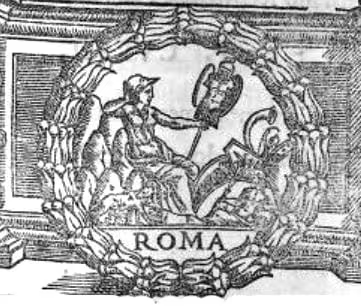
The golden age of Calvo’s Roman establishment came to a brutal and devastating end in May 1527, when the unpaid imperial armies of Emperor Charles V breached the walls of Rome. During the infamous Sack of Rome, Calvo’s printing shop, manuscript collection, paper stock, and physical presses were thoroughly plundered and destroyed. Calvo himself was captured, subjected to extortion, and briefly imprisoned by imperial soldiery before managing to escape the devastated city. Bankrupt but resilient, Calvo retreated north to his native Lombardy. By 1528–1530, he successfully re-established his publishing business in Milan, obtaining legal protection, printing monopolies, and commercial privileges from Duke Francesco II Sforza and, later, from the Spanish gubernatorial administration. In Milan, Calvo adapted his enterprise to the changing economic and spiritual climate of northern Italy. He resumed his fruitful publishing partnership with Paolo Giovio, printing authoritative editions of Giovio’s historical works, biographies of the Sforza and Visconti dynasties, and political tracts. Additionally, Calvo expanded into publishing refined italic editions of contemporary Italian poetry, classical Latin texts for university instruction, and theological-devotional treatises that anticipated the early currents of Catholic reform. His Milanese imprints were instantly recognizable by his distinctive printer's mark—often depicting the allegorical figure of Calpurnia or a veiled female emblem of Chastity and Knowledge—and by his exquisite use of sharp Roman typefaces and delicate woodcut initials.
Typographical Mastery, Bibliographical Legacy, and Critical Historiography
Francesco Minicio Calvo’s legacy extends far beyond his individual press runs; he represents a crucial transitional archetype in the history of the European book trade. Unlike traditional printer-craftsmen who remained confined to their printshops, Calvo operated as an international publishing strategist, integrating manuscript discovery, editorial supervision, typography, and Pan-European distribution. Modern bibliographical scholarship—pioneered by eminent historians such as Dennis E. Rhodes, Angela Nuovo, Frank Hieronymus, and Luigi Balsamo—has demonstrated that Calvo’s network was pivotal in introducing Erasmian humanism to central Italy while simultaneously exporting Italian legal and historical scholarship to Northern Europe. His surviving imprints are held in the world’s most prestigious rare book repositories, including the British Library, the Biblioteca Apostolica Vaticana, the Bibliothèque nationale de France, and the Bodleian Library. Scholars of print culture continue to examine Calvo’s output as a testament to how humanistic erudition, artistic innovation, and commercial adaptability managed to survive and flourish amid the catastrophic political upheavals of 16th-century Italy.
Bibliography
Tiraboschi, Girolamo. Storia della letteratura italiana. Vol. VII, Part 3. Milan: Niccolò Bettoni, 1835, 1420–1425.
Allen, P. S., and H. M. Allen, eds. Opus Epistolarum Des. Erasmi Roterodami. Vol. IV (1519–1521). Oxford: Clarendon Press, 1922, 234–236.
Barberi, Francesco. "L'attività romana di Francesco Minizio Calvo." In Miscellanea di scritti in memoria di Luigi Ferrari, 61–78. Florence: Leo S. Olschki, 1952.
Ascarelli, Fernanda. La tipografia cinquecentina italiana. Florence: Sansoni Antiquariato, 1953, 98–102.
Rhodes, Dennis E. "Francesco Minizio Calvo di Menaggio, tipografo a Roma e Milano." La Bibliofília 57, no. 2 (1955): 101–110.
Cioni, Alfredo. "Calvo, Francesco Minizio." In Dizionario Biografico degli Italiani, Vol. 17. Rome: Istituto della Enciclopedia Italiana, 1974, 328–332.
Hieronymus, Frank. Basler Buchillustratoren 1500–1545. Basel: Universitätsbibliothek Basel, 1984, 185–192.
Ascarelli, Fernanda, and Marco Menato. La tipografia del '500 in Italia. Florence: Leo S. Olschki, 1989, 114–117.
Nuovo, Angela. Il commercio librario a Milano nel Cinquecento. Milan: FrancoAngeli, 1989, 45–68.
Balsamo, Luigi. Bibliography: History of a Tradition. Translated by William A. Pettas. Berkeley: Bernard M. Rosenthal, 1990, 88–92.
Richardson, Brian. Printing, Writers and Readers in Renaissance Italy. Cambridge: Cambridge University Press, 1999, 74–82.
Grafton, Anthony. Worlds Made by Words: Scholarship and Community in the Modern West. Cambridge, MA: Harvard University Press, 2009, 105–118.
Nuovo, Angela. The Book Trade in the Italian Renaissance. Translated by Lydia G. Cochrane. Leiden: Brill, 2013, 112–135.
Beyond the names: biographies and bibliographies on this page are curated by Abu, the AI scholar crafted by Buonvecchio exclusively for Govi Rare Books.