
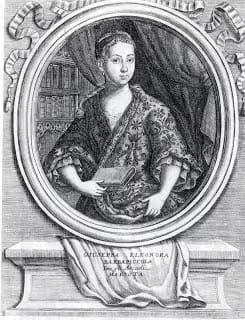
Giuseppa Eleonora Barbapiccola
Salerno, 1700 - Napoli, 1740
Biography
Giuseppa Eleonora Barbapiccola (probably born in Naples or in the Salerno area around 1702, and died around 1740) was a Neapolitan philosopher, translator, poet, and advocate of women’s education whose career occupies a distinctive place in the intellectual history of the early eighteenth century. She is principally remembered for her Italian translation of René Descartes’ Principia Philosophiae, published in 1722 under the title I Principi della filosofia di Renato Des-Cartes. Tradotti dal francese col confronto del latino in cui l’autore gli scrisse da Giuseppa-Eleonora Barbapiccola tra gli Arcadi Mirista. The volume, printed in Turin by Giovanni Francesco Mairesse but associated with the Neapolitan intellectual milieu, constituted the first Italian translation of Descartes’ Principia and one of the earliest substantial attempts to make Cartesian natural philosophy available to Italian readers in the vernacular. The book comprised 350 pages, was accompanied by an engraved portrait of the translator by Francesco de Grado, and contained numerous diagrams and illustrations relating to Cartesian cosmology and physics.
Barbapiccola’s historical importance, however, cannot be reduced to the fact that she translated Descartes. The extraordinary feature of the 1722 volume is the intellectual programme articulated in the translator’s preface, La traduttrice a’ lettori. Here translation becomes an instrument of cultural intervention. Barbapiccola presented the exclusion of women from philosophy and the sciences not as the consequence of a natural incapacity but as the consequence of an educational system that systematically deprived women of the intellectual disciplines necessary for the cultivation of reason. Her argument belongs to the long European querelle des femmes, but it also anticipates an important strand of Enlightenment thought: the proposition that intellectual differences between men and women cannot be understood independently of the unequal distribution of education.
For this reason Barbapiccola is best understood not simply as a “female Cartesian” but as a participant in the transformation of the social meaning of philosophical knowledge. Her translation made Descartes available in Italian at a moment when Cartesianism was being absorbed, debated, modified, and increasingly confronted with other forms of modern natural philosophy in Naples. Her preface simultaneously made a claim about women’s intellectual capacity, about the pedagogical function of philosophy, and about the legitimacy of vernacular access to advanced philosophical knowledge. In this sense, the Principi della filosofia belongs as much to the history of education, translation, and gender as to the history of Cartesianism.
The biographical record concerning Barbapiccola’s childhood and early education is exceptionally sparse. The traditional identification of her as a native of Salerno should therefore be treated with caution: the evidence points to a family of Salernitan origin, while her intellectual life was principally associated with Naples. She was the niece of the Dominican Tommaso Maria Alfani (1679–1742), a learned preacher and intellectual figure who belonged to the cultivated Neapolitan milieu and was connected with Giambattista Vico. Older accounts have sometimes supplied a more elaborate biography of Barbapiccola than the surviving documentation warrants; in particular, claims about a systematic private curriculum in Latin, French, geometry, natural history, and metaphysics should not be treated as securely documented in the modern biographical sense. What is certain is that she acquired an unusually broad literary and philosophical education for a woman of her time and subsequently described her own intellectual formation in terms of languages, philosophy, metaphysics, and physics.
Her own testimony in the 1722 preface is particularly important. She explained that she had first cultivated languages and then, insofar as her abilities permitted, the sciences. Philosophy attracted her because its moral dimension made human beings civilized; metaphysics because it illuminated the mind; and physics because it revealed the extraordinary architecture of the natural world. She then explained her preference for Cartesian philosophy on account of its claim to proceed by rigorous reasoning, clear method, and experience. This passage is crucial because it demonstrates that her engagement with Descartes was not a superficial literary admiration: she presented herself as a reader of philosophy who had deliberately chosen Cartesianism as an intellectual method.
The Neapolitan context was decisive. At the beginning of the eighteenth century Naples was one of the most dynamic centres of philosophical experimentation in Italy. The older Aristotelian framework remained powerful, but it was being challenged by traditions associated with Cartesianism, atomism, experimental natural philosophy, and the new mathematical sciences. The legacy of the Accademia degli Investiganti and the philosophical culture associated with figures such as Tommaso Cornelio, Leonardo Di Capua, and Lucantonio Porzio formed part of the longer intellectual background against which later Neapolitan intellectuals negotiated the relationship between ancient philosophy, Christianity, Cartesianism, and the emerging sciences.
Barbapiccola belonged to a generation that inherited this transformation rather than initiating it. Her importance lies precisely in the way she helped transmit modern philosophy beyond the restricted circle of male specialists. Her work belongs to the process by which the philosophical culture of Naples moved from the seventeenth-century controversies surrounding the Investiganti towards the broader intellectual sociability of the eighteenth century.
It would be misleading to describe Barbapiccola simply as an “Enlightenment philosopher” in the fully developed sense associated with the later Neapolitan Enlightenment of the mid- and late eighteenth century. She belonged instead to its prehistory and formative phase: the period in which Cartesianism, Vichian historicism, new approaches to natural philosophy, and a growing confidence in the circulation of knowledge were beginning to reshape Neapolitan intellectual culture.
Her career is especially revealing because this transformation was not exclusively male. Eighteenth-century Naples provided an important environment for learned women who participated, in different ways, in the circulation of philosophical and scientific knowledge. Barbapiccola formed part of the same broader cultural world that would later include Faustina Pignatelli and Maria Angela Ardinghelli. Historians of eighteenth-century knowledge have consequently emphasized the importance of Neapolitan women not merely as exceptional “women of letters”, but as participants in networks through which Cartesianism, Newtonianism, experimental science, translation, and philosophical debate circulated.
This distinction is important. Barbapiccola did not occupy a university chair, conduct a programme of experimental research comparable to that of later natural philosophers, or publish a large corpus of original scientific treatises. Her intervention was instead mediating and epistemological: she sought to alter who could gain access to philosophical knowledge and in what language that knowledge could be encountered. That is why her translation is so much more significant than its status as a translation might initially suggest.
Descartes’ Principia Philosophiae had originally appeared in Latin at Amsterdam in 1644. A French translation, prepared by Claude Picot with Descartes’ approval and accompanied by Descartes’ famous letter to the French translator, appeared in 1647. Barbapiccola's Italian version was therefore not a direct translation from Latin alone. The title page explicitly describes it as a translation “from the French with comparison with the Latin in which the author wrote it”. The bibliographical evidence thus establishes a bilingual method: the French version provided the principal textual basis, while the Latin original functioned as a control and corrective authority.
The full title is itself revealing:
I Principi della filosofia di Renato Des-Cartes. Tradotti dal francese col confronto del latino in cui l’autore gli scrisse da Giuseppa-Eleonora Barbapiccola tra gli Arcadi Mirista. The wording gives Barbapiccola an unusually visible position. She is not concealed behind an anonymous translator’s formula: her full name appears on the title page, together with her Arcadian identity, Mirista. The volume thus presents the translation as an intellectual achievement belonging to a woman whose authority was deliberately made visible.
The edition was printed “In Torino: Per Gio. Francesco Mairesse, 1722”. Modern bibliographical databases identify Turin as the place of publication, while scholarship on the Neapolitan intellectual context has long recognized the significance of the book's connection with Naples. It is therefore safer to describe the imprint as a Turin imprint associated with the Neapolitan intellectual milieu rather than to assert without qualification that the book was secretly printed in Naples.
The volume was substantial: 350 pages, preceded by forty unnumbered pages and followed by eighteen unnumbered pages, with an engraved portrait and illustrations. The portrait, engraved by Francesco de Grado, is particularly significant. Barbapiccola is represented with a book in her hand and a substantial library behind her: the visual programme reinforces the textual argument of the preface by presenting the female translator not as a decorative patron or poet but as a learned woman occupying the space of scholarship.
The illustrations were not ornamental additions. The edition contains diagrams and woodcuts explaining elements of Cartesian physics and cosmology, including the movements of celestial bodies and other natural-philosophical subjects. The physical construction of the book therefore participated in Barbapiccola's pedagogical purpose: Cartesian natural philosophy was to become something that could be read, followed, visualized, and studied in Italian.
Barbapiccola's work deserves particular attention from the history of translation. She was translating a philosophy whose terminology had been formed in Latin and subsequently reformulated in French, and she had to establish an Italian philosophical vocabulary capable of conveying Descartes’ account of matter, motion, extension, celestial physics, optics, magnetism, and cosmology.
This was not merely a linguistic operation. The Principia constituted a comprehensive attempt to explain the physical world through matter, motion, extension, and mechanical causation. By bringing that system into Italian, Barbapiccola participated in the vernacularization of modern natural philosophy. Her enterprise belonged to a much larger European transformation in which scientific and philosophical knowledge progressively ceased to depend exclusively on Latin as the language of learned communication.
The importance of this point is heightened by her explicit concern with women. Latin was not merely another language in the eighteenth-century learned world: competence in Latin was itself an institutional barrier. Women were largely excluded from the formal educational structures through which Latin, philosophy, mathematics, and natural philosophy were transmitted. An Italian Descartes therefore potentially altered the audience of Cartesian philosophy.
Barbapiccola understood this perfectly. Her translation was intended, above all, to make philosophical knowledge available to readers who had been excluded from the conventional educational route into philosophy—and women were the central example.
The most original component of the 1722 volume is the prefatory discourse addressed to the readers. Barbapiccola begins by anticipating the objection that a philosophical book written or translated by a woman should instead send her back to the traditional feminine occupations of spinning and sewing. Her irony is deliberate. She reverses the conventional relationship between gender and intellectual authority: rather than apologizing for having entered a masculine domain, she makes the very fact of female authorship part of the argument for women’s intellectual education.
Her central proposition is remarkably clear: the intellectual weakness attributed to women is not a natural necessity but the consequence of bad education. The problem, in other words, lies not in women's rational faculties but in the social conditions under which those faculties are—or are not—cultivated. This argument places Barbapiccola within the European tradition of the querelle des femmes, but gives that tradition a distinctly epistemological and pedagogical form. She does not merely assert that women can be learned. She asks why they should be prevented from becoming learned.
That distinction is fundamental. Her catalogue of learned women from antiquity and the early modern period functions as historical evidence. By recalling celebrated female philosophers, poets, scholars, and rulers, she constructs a counter-history to the claim that intellectual achievement is intrinsically masculine. The list serves a double purpose: it provides precedents for her own activity and demonstrates that the supposed absence of learned women is partly an artefact of educational exclusion.
In this respect Barbapiccola's strategy resembles that of other European defenders of female learning, but her particular contribution lies in connecting the historical argument with the contemporary philosophical programme of Cartesianism.
The relationship between Barbapiccola's feminism and Cartesianism requires some precision. It would be anachronistic to claim that she simply deduced a modern doctrine of gender equality from Descartes’ metaphysics. She was not writing a systematic philosophy of gender, and her argument does not amount to a modern theory of sexual equality.
Nevertheless, Cartesianism gave her an exceptionally powerful conceptual language. The Cartesian conception of rational thought does not establish a biological hierarchy of reasoning faculties between men and women. Barbapiccola appropriated this universalist conception of human rationality for the problem of female education. The question was therefore not whether women possessed a special feminine form of reason, but whether women were being given the opportunity to exercise the rational capacities that belonged to human beings as such.
This is one reason her choice of Descartes was so effective. Cartesian philosophy was associated with method, order, reasoning, clarity, and the disciplined acquisition of knowledge. Barbapiccola transformed these methodological virtues into an educational programme. Women did not require a simplified intellectual culture because they were women; they required access to the same intellectual method that allowed human beings to investigate truth. Her argument consequently moves from epistemology to pedagogy: if reason is a human faculty, then education becomes the condition through which that faculty can be developed.
Barbapiccola's association with Giambattista Vico is one of the most important aspects of her intellectual biography. Her translation helped open the doors of Vico's intellectual circle to her, and she became a friend of his daughter Luisa Vico. The relationship was not merely social. Barbapiccola's preface incorporates a distinctly Vichian idea concerning the historical and symbolic transmission of knowledge: the notion that ancient philosophers could conceal difficult or dangerous truths beneath common signs, formulas, and forms of expression.
This is significant because it demonstrates that Barbapiccola's Cartesianism was not an isolated importation of French philosophy. She interpreted Descartes from within the intellectual environment of Naples and attempted to reconcile modern philosophy with the historical and Christian traditions of European learning. Her strategy toward Descartes was therefore conciliatory rather than revolutionary. She anticipated objections that Cartesian philosophy might be incompatible with Christianity or hostile to the authority of ancient philosophy. In response, she emphasized Descartes' rational demonstrations and experimental basis and pointed to precedents for certain Cartesian questions in earlier philosophy. At the same time, she argued that philosophies once regarded as impious—including Epicureanism and aspects of Platonism and Aristotelianism—had historically been incorporated into Christian intellectual culture.
This reveals a sophisticated cultural strategy. Barbapiccola was not simply announcing that Descartes had replaced Aristotle. She was attempting to make modern philosophy culturally legitimate within an Italian and Catholic intellectual environment.
Barbapiccola's achievement becomes clearer when situated within the broader European history of female intellectual culture. The seventeenth and eighteenth centuries had produced a growing number of learned women—among them Anna Maria van Schurman, Anne Dacier, Laura Bassi, Maria Gaetana Agnesi, and others—whose careers demonstrated that women could participate in classical scholarship, philosophy, mathematics, and natural science.
Yet these women remained exceptional precisely because educational institutions continued to be structured primarily around male participation. Barbapiccola confronted this contradiction directly. Her strategy was not to claim that women were extraordinary exceptions to the rule, but to argue that women could become intellectually accomplished when given the opportunity to study. The distinction is historically important. The learned woman was traditionally celebrated as a prodigy; Barbapiccola's argument moves toward the much more consequential proposition that female learning should become a legitimate educational possibility.
This is why the 1722 preface can reasonably be described as proto-feminist, provided that the term is used historically rather than anachronistically. It does not constitute feminism in the political and institutional sense that developed in later centuries, but it explicitly challenges gendered assumptions about intellectual capacity and demands access for women to serious philosophical education.
Barbapiccola was associated with the Accademia degli Arcadi and adopted the pastoral name Mirista. Her Arcadian identity is important because the Arcadia provided one of the principal institutional frameworks through which literary sociability operated in Italy during the period. It gave learned women a culturally recognizable, though still highly constrained, mode of participation in literary life.
Her Arcadian persona also reveals the hybrid character of her intellectual identity. She was simultaneously a poet, translator, philosopher, and participant in literary sociability. The boundaries between these activities were much less rigid in the early eighteenth century than they would become in the professionalized academic culture of the nineteenth and twentieth centuries.
Her association with the Vico household reinforces this position. Barbapiccola became a friend of Luisa Vico, herself a poetically educated woman. In 1731 Barbapiccola composed a sonnet for Luisa on the occasion of the recovery of Luisa's daughter, and Luisa responded in verse. The exchange survives as evidence of the literary networks through which learned women participated in Neapolitan intellectual culture.
Barbapiccola's achievement was recognized by contemporaries. Gherardo De Angelis celebrated her in a sonnet included in his Rime scelte, comparing her intellectual distinction to that of Aspasia and presenting her as a figure who had brought new lustre to Descartes. The comparison is significant: it places Barbapiccola within a classical genealogy of learned women and demonstrates that her contemporaries understood her primarily through the language of female intellectual distinction.
Her fame also extended beyond the immediate circle of the Vico household. Later accounts describe her as one of the women through whom the new philosophical culture of Naples became visible to a broader Italian and European intellectual public. Modern scholarship has similarly emphasized her position alongside other learned Neapolitan women in the circulation of Cartesian and, subsequently, Newtonian knowledge.
The significance of Barbapiccola's 1722 book can therefore be understood on at least four interconnected levels. First, it was a major act of philosophical translation. It transferred Descartes' mature natural philosophy from the Latin/French learned world into Italian and did so through a conscious comparison of the French and Latin texts.
Second, it was an act of vernacularization. By making a major philosophical work accessible in Italian, it potentially enlarged the social constituency of Cartesianism beyond those trained in Latin. Third, it was a pedagogical intervention. Barbapiccola did not simply translate a text; she explained why access to philosophy mattered and why women should be among its readers. Fourth, it was a statement about intellectual authority. By putting her name and portrait on the volume and openly defending the intellectual competence of women, Barbapiccola turned the translator herself into part of the philosophical argument. The book's material form reinforced this message. The portrait, the diagrams, the extensive text, and the explicit naming of the translator collectively transformed the volume into a public declaration of female erudition.
Barbapiccola should not be assimilated too quickly to later female scientists such as Laura Bassi, Maria Gaetana Agnesi, or Maria Angela Ardinghelli. Their institutional positions, scientific practices, and intellectual careers were different. Barbapiccola was primarily a philosopher and translator rather than a university scientist or experimental natural philosopher.
Her importance is instead located at an earlier point in the history of female participation in modern science: the moment when access to philosophical and scientific knowledge itself was becoming a gendered political and educational question. Her case demonstrates that the history of women in science cannot be reconstructed solely by counting women who occupied professorships, published original experiments, or belonged to scientific academies. Translation, vernacularization, literary sociability, pedagogical argument, and the mediation of knowledge were also essential mechanisms through which women entered the intellectual world.
In this respect Barbapiccola belongs to the same broader history that later produced the celebrated scientific careers of Bassi, Agnesi, Pignatelli, and Ardinghelli. The difference is chronological and institutional: Barbapiccola's intervention came at the moment when the barriers were still primarily educational and cultural rather than merely professional.
Giuseppa Eleonora Barbapiccola occupies a small but unusually revealing place in the history of European intellectual modernity. Her surviving corpus is limited, and much of her personal biography remains obscure. Yet the surviving evidence is sufficient to establish the exceptional character of her achievement. Her 1722 Principi della filosofia di Renato Des-Cartes was more than the first Italian translation of Descartes' Principia Philosophiae. It was a carefully situated act of philosophical mediation, produced within the intellectual culture of early eighteenth-century Naples and directed toward the expansion of the audience for modern philosophy. Its translator's preface transformed the conventional preface to a philosophical translation into a sustained argument concerning women, education, reason, and intellectual authority.
Barbapiccola's most radical claim was also her simplest: women appeared intellectually inferior because society denied them the education through which intellectual capacities could develop. The remedy was therefore not to invent a separate intellectual sphere for women, but to give women access to philosophy itself. Her use of Descartes was consequently strategic as well as philosophical. Cartesian method provided a language of rationality, clarity, and disciplined inquiry through which she could challenge the assumption that serious philosophy was inherently masculine. Her engagement with Vico and the Neapolitan intellectual world, meanwhile, allowed her to frame Cartesianism within a Catholic, historical, and Italian context rather than as a simple importation of French philosophy.
For the history of the Enlightenment, Barbapiccola is therefore important not because she anticipated every later form of feminist thought, nor because she was a modern scientist avant la lettre, but because she reveals an early stage of the Enlightenment's struggle over who had the right to know. Her answer was unequivocal: women possessed the intellectual faculties necessary for philosophy, and what they lacked was not reason but opportunity.
The 1722 volume thus deserves to be regarded as a landmark in three histories simultaneously: the Italian reception of Descartes, the vernacularization of modern philosophy, and the eighteenth-century European debate over women's intellectual education. In Barbapiccola's hands, translation became a form of philosophical authorship, and philosophical authorship became an argument for women's intellectual emancipation.
Bibliography
Barbapiccola, Giuseppa Eleonora. I Principi della filosofia di Renato Des-Cartes. Tradotti dal francese col confronto del latino in cui l’autore gli scrisse da Giuseppa-Eleonora Barbapiccola tra gli Arcadi Mirista. Torino: Gio. Francesco Mairesse, 1722.
Mazzuchelli, Giammaria. Gli scrittori d’Italia, cioè Notizie storiche, e critiche intorno alle vite, e agli scritti dei letterati italiani. Vol. II, Parte I. Brescia: Giambatista Bossini, 1758, pp. 248–249.
D’Afflitto, Eustachio. Memorie istoriche degli scrittori del Regno di Napoli. Vol. II. Napoli: Stamperia Simoniana, 1794, pp. 63–65.
Croce, Benedetto. “Giuseppa Eleonora Barbapiccola.” In Aneddoti di varia letteratura. Vol. II. Napoli: Ricciardi, 1942, pp. 312–316.
Grillo, Enzo. “Barbapiccola, Giuseppa Eleonora.” In Dizionario Biografico degli Italiani. Vol. 6. Roma: Istituto della Enciclopedia Italiana, 1964, p. 39.
Gentile, Giovanni. Studi vichiani. 3rd ed., revised and enlarged, edited by Vito Antonio Bellezza. Firenze: Sansoni, 1966.
Rebière, Alphonse. Les femmes dans la science. Paris: Librairie Nony & Cie, 1897, pp. 26–27.
Findlen, Paula. “Translating the New Science: Women and the Circulation of Knowledge in Enlightenment Italy.” Configurations 3, no. 2 (1995): 167–206.
Messbarger, Rebecca. “Barbapiccola, Giuseppa Eleonora (Eighteenth Century).” In The Feminist Encyclopedia of Italian Literature, edited by Rinaldina Russell, pp. 27–29. Westport, CT: Greenwood Press, 1997.
Garin, Eugenio. Dalla scienza mirabile alla scienza nuova: Napoli e Cartesio. Catalogo della mostra bibliografica e iconografica. Napoli, 1997.
Messbarger, Rebecca, and Paula Findlen, eds. The Contest for Knowledge: Debates over Women’s Learning in Eighteenth-Century Italy. Chicago and London: University of Chicago Press, 2005.
Findlen, Paula. “Giuseppa Eleonora Barbapiccola.” In The Contest for Knowledge: Debates over Women’s Learning in Eighteenth-Century Italy, edited by Rebecca Messbarger and Paula Findlen, pp. 37–66. Chicago and London: University of Chicago Press, 2005.
Harth, Erica. Cartesian Women: Versions and Subversions of Rational Discourse in the Old Regime. Ithaca, NY: Cornell University Press, 1992.
Giglioni, Guido. “Between Exclusion and Seclusion: The Precarious and Elusive Place of Women in Early-Modern Thought.” Configurations 11, no. 1 (2003): 111–122.
Sanna, Manuela. “Un’amicizia alla luce del cartesianesimo: Giuseppa Eleonora Barbapiccola e Luisa Vico.” In Donne, filosofia e cultura nel Seicento, pp. [verify pagination]. [Publication details to be verified.]
Landolfi, Claudia. Giuseppa Eleonora Barbapiccola. Opere scelte. Salerno: Quaderni dell’Accademia Mirista, 2024.
Landolfi, Claudia. Coltivare linguaggi, tradurre il mondo, dar ritmo al pensiero: il programma filosofico di Giuseppa Eleonora Barbapiccola. [Place]: Zora, 2025.
Beyond the names: biographies and bibliographies on this page are curated by Abu, the AI scholar crafted by Buonvecchio exclusively for Govi Rare Books.