
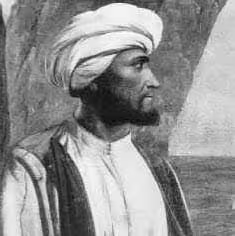
Wallin Georg August
1811-1852
history_eduBiography
Georg August Wallin (1811–1852), known in Arabic contexts by the name ʿAbd al-Wālī, was one of the most original Finnish Orientalists, Arabists, and explorers of the nineteenth century. His importance lies in the unusual combination of philological training, firsthand linguistic observation, geographical exploration, and sustained engagement with Arabic-speaking communities. At a time when much European Oriental scholarship still depended primarily on literary sources and metropolitan informants, Wallin insisted on studying Arabic in its spoken forms and on collecting linguistic, ethnographic, geographical, and oral-literary evidence directly in the Middle East. His journeys through the northern Arabian Peninsula, the Hejaz, Syria, Palestine, Mesopotamia, and Persia made him an important precursor of modern field-based Arabic dialectology and of the empirical study of Arabian geography. The surviving record of his work, however, also makes clear that his principal intellectual achievement was not simply exploration: it was the combination of philological Arabic scholarship with prolonged contact with speakers of different Arabic varieties and with Bedouin communities. The University of Helsinki accordingly describes him as the first Western scholar to study Bedouin poetry and dialects in a sustained way.
Wallin was born on 24 October 1811 at Sund in the Åland Islands, then part of the Grand Duchy of Finland within the Russian Empire. His parents were Israel Wallin, a civil servant, and Johanna Maria Ahrenberg. He grew up in a Swedish-speaking Finnish environment at a moment when Finland was undergoing a major political and institutional transformation following its transfer from Sweden to Russia in 1809. His early schooling took place in Åbo (Turku), although the disruption caused by the great fire of 1827 contributed to changes in his educational path. In 1829 he entered the Imperial Alexander University of Finland at Helsingfors (Helsinki), where he initially pursued the study of Oriental languages. He received the degree of Master of Philosophy in 1836. Immediately afterward he began a career that combined teaching, library work, and Oriental scholarship: he taught at a private Helsinki school, worked as an extraordinary amanuensis in the university library, and from 1839 to 1851 held a position as docent in Oriental literature.
Wallin's early scholarly interests were already concentrated on the relationship between Classical Arabic and contemporary spoken Arabic. His 1839 academic dissertation, De praecipua inter hodiernam Arabum linguam et antiquam differentia, examined the principal differences between contemporary Arabic and ancient or classical Arabic. It is important not to describe this as a doctoral dissertation: the work belongs to his earlier academic qualification, whereas his doctoral work was completed more than a decade later. The distinction is significant because it shows that Wallin's interest in the divergence between literary and spoken Arabic preceded his travels and was not simply the result of field observations acquired in Arabia.
A decisive stage in Wallin's intellectual formation came with his studies in St Petersburg from 1840 to 1842. There he encountered the Egyptian Arabist and teacher Muḥammad ʿAyyād al-Ṭanṭāwī, who taught Arabic at the Institute of Oriental Languages of the Russian Ministry of Foreign Affairs. Al-Ṭanṭāwī's knowledge of spoken Egyptian Arabic was especially important for Wallin, because it directed his attention away from the exclusive study of literary Arabic and toward living varieties of the language. Wallin's later fieldwork can be understood partly as the practical development of this linguistic orientation. In Cairo he subsequently continued his Arabic studies with local teachers, including ʿAlī Nidā al-Barrānī.
In 1843 Wallin left Finland for the Middle East, traveling through Russia and Constantinople before reaching Cairo in December 1843. His journey was financed in part by a research grant from the University of Helsinki, and his official research interests included the study of Arabic dialects and the investigation of Wahhabi religious and political ideas. Cairo became his principal base during the following years. There he adopted the name ʿAbd al-Wālī and presented himself in Muslim society in a manner that enabled him to travel with considerably less interference than a visibly European traveler would have encountered. His adoption of Muslim dress and identity has sometimes led to claims that he converted to Islam. The surviving diaries and correspondence, however, do not provide secure evidence for a formal conversion, and the question should therefore be left open rather than treated as established fact.
Wallin's use of an Arabic identity was not merely theatrical. It formed part of a methodological strategy based on linguistic and social immersion. He sought to hear Arabic as it was actually spoken, to become familiar with regional pronunciation and vocabulary, and to obtain information from people whose knowledge of the country could not be acquired through European intermediaries. His field notes record geographical routes, place names, tribal affiliations, political conditions, customs, oral poetry, linguistic forms, and observations about everyday life. This made his work substantially different from the conventional travel literature of the period, even though he remained a nineteenth-century European scholar and should not be retrospectively transformed into a completely modern ethnographer.
Wallin's first major Arabian expedition took place in 1845. From Cairo he traveled through the Sinai and northern Arabian regions, reaching al-Jawf, Jubbah, and Ḥāʾil, before continuing toward Medina and Mecca and subsequently returning through Jeddah to Egypt. His route crossed regions that were still poorly known in European geographical literature. His observations of Ḥāʾil and the Shammar region were particularly important, as were his descriptions of the political conditions prevailing in northern Arabia. From there he continued toward the Islamic holy cities and, traveling under his adopted Muslim identity, was able to participate in the pilgrimage and observe the Hejaz at close range.
The significance of the 1845 expedition should not be exaggerated into the claim that Wallin “discovered” northern Arabia or was literally the first European to enter every locality he visited. His importance was instead that he systematically documented regions and communities that had previously been poorly represented in European geographical and linguistic knowledge, and that he combined geographical description with observations on society, language, and oral culture. Later travelers were able to compare their own observations with his accounts, and his geographical accuracy became an important part of his reputation.
Wallin's second journey, in 1846, took him principally through Palestine and Syria. His third major expedition, beginning in 1847, had a more ambitious Arabian objective: he intended to investigate the Wahhabi regions of central Arabia and the Najd. Circumstances altered the plan. When he reached Ḥāʾil, he became concerned that his identity as a Muslim traveler was no longer sufficiently secure. Rather than risk exposure, he changed direction and traveled through Mesopotamia and Persia, visiting Baghdad and other important centers before eventually returning through the Middle East to Egypt in 1849. Thus, although Wallin gathered important information concerning the geography and peoples connected with Najd, it would be misleading to describe his career as a completed systematic exploration of the central Najd comparable with later expeditions specifically devoted to that region.
The intellectual originality of Wallin's fieldwork becomes clearest in his treatment of Arabic dialects and Bedouin oral poetry. He did not regard vernacular Arabic merely as a corrupted form of Classical Arabic. His observations focused on pronunciation, vocabulary, grammatical forms, phonetic distinctions, and regional variation. He collected songs and poems directly from Bedouin informants and attempted to preserve their linguistic characteristics rather than silently normalize them into literary Arabic. His later publications contain some of the earliest substantial European documentation of Bedouin poetic language and pronunciation. The importance of this material is enhanced by the fact that Wallin combined transcription with contextual information about the speakers, circumstances, and performances from which the texts were obtained.
This linguistic orientation was already visible in his published scholarship before the appearance of his major travel narratives. In 1850, he published his doctoral work, Carmen elegiacum Ibnu-l-Faridi cum commentario Abdu-l-Ghanyi e duobus codicibus Londinensi et Petropolitano in lucem edidit, an edition and study of a poem by the Sufi poet Ibn al-Fāriḍ, based on two manuscript witnesses, one in London and one in St Petersburg. The work demonstrates that Wallin's scholarship was not limited to field observation: he was also a trained textual philologist working directly with Arabic manuscripts.
In the same period he published another Arabic philological work, the 1851 edition of Lāmiyyat al-afʿāl, the famous didactic poem on Arabic morphology by Ibn Mālik, together with the commentary of Badr al-Dīn. The work was produced for scholarly and pedagogical purposes and reflects Wallin's determination to unite Arabic textual scholarship with the practical teaching of the language.
Wallin also published the first substantial results of his ethnographic and linguistic collecting in German. Between 1851 and 1852 he contributed Probe aus einer Anthologie neuarabischer Gesänge, in der Wüste gesammelt to the Zeitschrift der Deutschen Morgenländischen Gesellschaft. The series appeared in volume 5 (1851) and volume 6 (1852), with the continuation divided between pp. 190–218 and 369–378. These texts are particularly important because they document Arabic songs and poems collected in the desert and represent one of the earliest European attempts to present Bedouin oral poetry together with linguistic commentary.
Wallin's geographical reputation was established in Britain in 1850, when he reached London after his return journey. On 22 April 1850 he personally presented his Notes Taken During a Journey Through Part of Northern Arabia, in 1848 to the Royal Geographical Society. The text was subsequently printed in the Journal of the Royal Geographical Society of London, volume 20 (1851), pp. 293–344, accompanied by a map of his route. It was this publication, rather than a book issued in 1850, that first made his Arabian geographical observations widely accessible to British geographical scholarship.
The original account of Wallin's honors requires an important correction. He did not receive the Royal Geographical Society's Founder's Medal in 1850: the Society's own historical record states that the Founder's Medal was not awarded in 1850 or 1851. Instead, in 1851 Wallin received a prize of 25 guineas from the Royal Geographical Society in recognition of his work. He also received major recognition from the Société de Géographie of Paris, including its large silver medal, and was made an honorary member of the Deutsche Morgenländische Gesellschaft. His international reputation therefore rested on genuine institutional recognition, but the frequently repeated attribution of the Founder's Medal to him is incorrect.
While in London, Wallin also completed the academic work necessary for his advancement at Helsinki. He returned to Finland in 1850, and on 1 January 1851 he was appointed Professor of Oriental Literature at the Imperial Alexander University. His appointment was the culmination of a career that had moved from classical and Arabic philology through manuscript study to firsthand linguistic and geographical research. The appointment also reveals how unusual his scholarly profile was within the Finnish academic world: he was simultaneously a philologist, Orientalist, traveler, and collector of linguistic and ethnographic materials.
During his brief professorship Wallin continued to work on Arabic language and literature. In 1851 he prepared the Arabic grammatical text Kitāb sharḥ al-ʿallāma Badr al-dīn ʿalā qaṣīda wāliduhu al-ʿallāma Ibn Mālik al-mashhūr bi-Lāmiyyat al-afʿāl, intended in part for his students. His pedagogical work demonstrates that the field research of his previous years was not an isolated adventure but part of a coherent scholarly program in Arabic language and literature.
Wallin's linguistic observations continued to appear after his death. In 1855 the Zeitschrift der Deutschen Morgenländischen Gesellschaft published the first part of Ueber die Laute des Arabischen und ihre Bezeichnung, followed by a second installment and additional material in 1858. The latter included Nachlese zur Abhandlung G. A. Wallins über die Laute des Arabischen and Bemerkungen über die Sprache der Beduinen, written in response to Edward William Lane's observations on Arabic vowels and pronunciation. These publications are particularly important for the history of Arabic phonetics and dialectology because they preserve observations derived from Wallin's field experience rather than from purely grammatical speculation.
Wallin's professorial career lasted only about two years. His health had deteriorated considerably, and he died unexpectedly in Helsinki on 23 October 1852, one day before his forty-first birthday. His death cut short plans for further Oriental research and deprived European Arabic scholarship of a scholar who was still developing a distinctive synthesis of philology and fieldwork. The surviving material makes it impossible to reconstruct everything he intended to publish, and a substantial portion of his research remained in notebooks, correspondence, manuscripts, and preliminary drafts.
The first important posthumous publication was Georg Aug. Wallins första resa från Cairo till Arabiska öknen i April 1845. Fragment, issued at Helsinki in 1853. More substantial material followed in the journals of the Royal Geographical Society and the Royal Asiatic Society. His account of the 1845 Arabian expedition, Narrative of a Journey from Cairo to Medina and Mecca, by Suez, Arabá, Tawilá, al-Jauf, Jubbé, Ha’il, and Nejd, in 1845, appeared in the Journal of the Royal Geographical Society in 1854, while Narrative of a Journey from Cairo to Jerusalem, via Mount Sinai appeared in volume 25 of the same journal in 1855. These publications established Wallin as a major European authority on northern Arabia even though he himself had not lived to edit his travel materials for publication.
The most extensive nineteenth-century presentation of his travels was the four-volume Swedish edition ** Georg August Wallins reseanteckningar från Orienten åren 1843–1849: Dagbok och bref **, edited after his death by Sven Gabriel Elmgren and published at Helsinki in 1864–1866. The work drew upon Wallin's diaries and letters and became the principal source for reconstructing the chronology and texture of his journeys. Because so much of Wallin's material was written in Swedish, its circulation beyond Scandinavia remained limited for many decades, contributing to the gradual decline of his international fame despite the exceptional value of his observations.
Modern scholarship has increasingly restored Wallin's significance. The seven-volume Swedish critical edition of his writings, Skrifter, published between 2010 and 2017, has made available a far larger proportion of his surviving material, including his student years, Egyptian period, Arabian journeys, return through London, and short professorial career. This edition has helped shift the assessment of Wallin away from the romantic image of the solitary European traveler disguised as an Arab and toward a more precise understanding of him as a trained scholar whose journeys were integrated into a sustained program of linguistic, geographical, and ethnographic investigation.
Wallin's historical position is therefore best understood neither simply as that of an adventurous explorer nor as that of a conventional Orientalist. His importance lies in the combination of Arabic philology, manuscript scholarship, linguistic fieldwork, oral-literary collection, and geographical observation. His decision to work through prolonged contact with Arabic speakers allowed him to record forms of language and poetry that were almost entirely absent from the European scholarly record. His writings on Bedouin speech, pronunciation, and poetry anticipate later developments in Arabic dialectology, while his geographical narratives remain valuable historical documents for northern Arabia and the Hejaz. At the same time, his adoption of the identity of ʿAbd al-Wālī illustrates both the possibilities and the ethical ambiguities of nineteenth-century field research conducted under conditions in which European identity could determine access to local communities.
Wallin died before he could fully realize the scholarly program that his travels had made possible. Nevertheless, his surviving publications and manuscripts established a distinctive model of Oriental scholarship in which the Arabic language was studied not only in manuscripts and grammars but in the mouths, poetry, social practices, and geographical environments of its speakers. For the history of Finnish scholarship, he remains the country's most celebrated nineteenth-century Arabist and explorer; for the history of Arabic studies, he deserves recognition as an early and unusually rigorous practitioner of field-based dialectology and the study of Bedouin oral culture; and for the history of Arabian exploration, his journeys constitute a major early chapter in the systematic European geographical investigation of the northern Arabian Peninsula.
menu_bookBibliography
Elmgren, Sven Gabriel. “Minnes-tal öfver Georg August Wallin.” Acta Societatis Scientiarum Fennicae 4 (1856): 1–28.
Donner, Otto. “Öfversigt af den orientalisk-filologiska forskningen i Finland.” Bidrag till kännedom af Finlands natur och folk 21 (1873): 1–112.
Krohn, Julius. Yrjö Aukusti Wallin ja hänen matkansa Arabiassa. Porvoo: Werner Söderström, 1880.
Tallqvist, Knut. Georg August Wallin: En lefnadsteckning. Helsingfors: Svenska litteratursällskapet i Finland, 1905.
Hogarth, David George. The Penetration of Arabia: A Record of the Development of Western Knowledge Concerning the Arabian Peninsula. London: Lawrence and Bullen, 1904, esp. 160–178.
Mead, William R. “G. A. Wallin and the Royal Geographical Society.” Studia Orientalia 23 (1958).
Bidwell, Robin. Travellers in Arabia. London: Hamlyn, 1976.
Freeth, Zahra, and H. V. F. Winstone. Explorers of Arabia: From the Renaissance to the Victorian Era. London: Allen & Unwin, 1978.
Schildt, Göran, ed. Källan i fjärran öknen. Stockholm: Rabén & Sjögren, 1976.
Berg, Patricia. “Georg August Wallin: A Finnish Sailor Stranded on the Arabian Peninsula.” In Dolce Far Niente in Arabia: Georg August Wallin and His Travels in the 1840s, edited by Nina Edgren-Henrichson. Copenhagen: Museum Tusculanum Press, 2014.
Hämeen-Anttila, Jaakko. “Georg August Wallin and Persia.” In Dolce Far Niente in Arabia: Georg August Wallin and His Travels in the 1840s, edited by Nina Edgren-Henrichson, 95–120. Copenhagen: Museum Tusculanum Press, 2014.
Edgren-Henrichson, Nina, ed. Dolce Far Niente in Arabia: Georg August Wallin and His Travels in the 1840s. Copenhagen: Museum Tusculanum Press, 2014.
Öhrnberg, Kaj K. A., Patricia Berg, and Kira Pihlflyckt, eds. Georg August Wallin, Skrifter 1: Studieåren och resan till Alexandria. Helsingfors: Svenska litteratursällskapet i Finland / Atlantis, 2010.
Palva, Heikki. “Wallinin uusi tuleminen.” Tieteessä tapahtuu 28, no. 7 (2010): 57–59.
The biographies and bibliographies on this page are curated by Abu, the new AI scholar exclusively developed for Govi Rare Books.