
Vascosan Michel
c. 1500 - 1577
history_eduBiography
Michel de Vascosan—also found as Michel Vascozan and, in Latin imprints, Michael Vascosanus—was born probably around 1500, traditionally at Amiens, and died in Paris in April 1577, or at any rate shortly before 17 May of that year. The evidence for his origins remains thinner than the confidence of many later biographical notices might suggest. Contemporary and early modern records connect his family with Amiens and describe his father as a fourbisseur, a sword-cutler or armourer, but the precise place and date of Michel’s birth are not independently documented. His education is similarly obscure. What can be established is that he was raised within the household of Jacques de Varade, councillor in the Parlement of Paris, whom Vascosan later thanked for having treated and educated him almost as a son. Varade’s family belonged to the institutional world of the Paris book trade, and this connection offers a more secure explanation for Vascosan’s entry into it than any hypothetical apprenticeship for which no record survives. A document of 1527 already identifies him in relation to the University book trade; on 15 May 1528 he formally acquired the office of libraire juré formerly held by Jean-Pierre de Varade, placing him within the privileged corporation of booksellers attached to the University of Paris.
The distinction between this early activity as sworn bookseller and his later activity as printer is important. Vascosan did not suddenly emerge in 1532 as a fully formed typographer. He had already spent several years within the institutional mechanisms governing the acquisition, sale and supervision of books in the university quarter. A supposed publication bearing his name and the date 1522, sometimes repeated in older bibliography, is now recognized as erroneously dated; the first securely identified book from his own press is the Greek Dictionum Atticarum Collectio, issued at Paris in November 1532. It brought together Atticist lexical material from Thomas Magister, Phrynichus and Manuel Moschopulus, printed in Greek and edited by Vascosan himself. The choice is revealing. His debut as printer was not a popular vernacular book or devotional manual but a specialist humanist instrument for the study of Greek diction, probably following in part the Roman Calliergi edition of 1517. From the beginning, Vascosan presented himself as a printer capable of handling the linguistic and typographical demands of Greek scholarship.
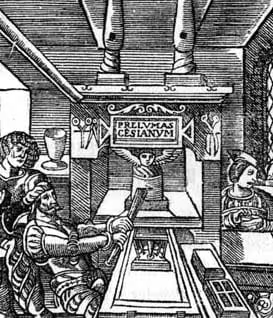
His marriage to Catherine Bade, daughter of the celebrated humanist printer Josse Bade, integrated him into one of the most powerful dynastic networks in the Parisian book world. Through the Bade family he became brother-in-law to Robert I Estienne, Jean de Roigny, Jacques Du Puis and Conrad Bade, each of whom occupied a substantial place in the learned trade. Josse Bade’s death in December 1535 opened a complicated period in which the Ascensian legacy—its stock, address, reputation and commercial relationships—was redistributed among heirs and relatives. Between approximately 1536 and 1539, Vascosan and Jean de Roigny used such formulas as in aedibus Ascensianis and ad praelum Ascensianum, demonstrating continuity with the Bade establishment without dissolving Vascosan’s independent identity. He ultimately maintained his own establishment in the rue Saint-Jacques, under the sign of La Fontaine, in the dense intellectual and commercial environment of the Montagne Sainte-Geneviève.
The first decade of Vascosan’s printing activity was overwhelmingly Greek, Latin and pedagogical. Between 1532 and 1542 his catalogue served the curriculum and scholarly culture of the Paris colleges through editions of Cicero, Quintilian, Plautus, Aulus Gellius, Aristotle, Greek grammatical writers and contemporary humanists. Cicero was particularly prominent. Such production required more than mechanical accuracy: school and university editions often depended upon arguments, annotations, collation of earlier texts and the intervention of professional teachers. Vascosan worked with scholars such as Pierre Galland, Jacques-Louis d’Estrebay, Joachim Périon, Nicolas de Grouchy and Adrien Turnèbe, and the editorial apparatus of individual books reveals a workshop embedded in the philological community rather than merely supplying it. His Latin prefaces and occasional textual interventions show that he could participate in decisions concerning readings and presentation, though it would be misleading to transform him into a philologist of the standing of Robert Estienne. His distinction lay in coordinating scholarship, manufacture and book design with exceptional consistency.
The collaborative structure of Parisian learned publishing is visible in several of his major folios. Guillaume Budé’s Annotationes in quatuor et viginti Pandectarum libros, printed by Vascosan in 1542–1543, was issued commercially under the names of Robert Estienne, Jean de Roigny and Michel de Vascosan. Surviving copies preserve two states of the title page, one dated 1542 and another 1543, while the printing itself was completed on 1 September 1543. The book therefore exemplifies both shared financial responsibility and the bibliographical importance of title-page states: apparently different dates need not indicate entirely distinct editions. In the same year Vascosan participated with Oudin Petit in the large folio Livy, while editions of Quintilian likewise reveal the separation between the man who manufactured the sheets and the bookseller who helped finance or distribute them. His catalogue cannot be reconstructed accurately simply by counting title pages bearing his name; printer, financier and bookseller must be distinguished edition by edition.
His evolving typography gave these books a visual character increasingly distinct from that of the Ascensian tradition. In 1539 Vascosan effectively abandoned regular use of a personal printer’s device, an unusual decision in a trade where emblematic marks remained crucial instruments of identification and advertising. He replaced pictorial self-branding with a highly controlled typographic title page: carefully centred lines, strong contrasts between roman and italic, generous white space and a geometrically balanced hierarchy of text. The resulting manner has often been called the “Vascosan style.” Its restraint was not an absence of design but design achieved almost entirely through type and space. By the middle of the century, title pages such as that of Paolo Emilio’s De rebus gestis Francorum could achieve monumental dignity without an architectural border or pictorial device.
The type itself changed with the aesthetic programme. Vascosan initially inherited or imitated heavier romans associated with the Bade shop, but during the later 1530s and 1540s adopted increasingly refined French romans and italics. Some types used in his books have historically been attributed to Claude Garamont, though modern typographical analysis cautions against assigning every elegant Vascosan roman directly to Garamont. A large roman first used by Vascosan around 1536, for example, has sometimes been attributed to the young Garamont, but differences from more securely documented Garamont faces make the attribution uncertain. Other italics appearing in Vascosan’s books can be associated much more confidently with Garamont’s work. The important historical point is not a blanket attribution but Vascosan’s early and discriminating use of the new French type design that was redefining the appearance of the Renaissance book.
His scientific printing required a different kind of discipline from the austere literary title page. Mathematical and astronomical texts demanded diagrams, tables, geometrical constructions and special signs, all of which had to be coordinated with the typography without destroying clarity. Vascosan’s later association with Oronce Fine belongs to this history. He printed Fine’s De speculo ustorio in 1551 and other mathematically complex works whose layouts required a close relationship between intellectual structure and page design. Isabelle Pantin’s analysis of Vascosan’s scientific books has shown that what distinguishes them is not decorative richness but the systematic organization of different kinds of information. Scientific typography becomes a method of exposition: spatial hierarchy tells the reader how verbal argument, figure, table and computation relate to one another.
The workshop at La Fontaine was also a social space of scholarship. A letter of 1540 describes Guillaume Postel residing in Vascosan’s house and praises the establishment as simultaneously an officina of excellent books and a lodging place for learned men. Other scholars and writers connected with the house included George Buchanan, Jean Martin, Jacques Peletier du Mans, Théodore de Bèze, Pierre Galland, Nicolas de Grouchy and others who moved through the educational, philological and literary networks of Paris. Such associations must not be converted into evidence for a single ideological programme. Some members of the circle later became prominent Protestants; Vascosan himself remained in Paris through intensifying religious conflict and published material representing different confessional positions. His house is better understood as a centre of humanist sociability and textual production than as a covert confessional press.
A decisive change in his catalogue occurred in 1543, when he printed his first securely documented book in French: Georges de Selve’s translation of eight of Plutarch’s Parallel Lives, Vyes de huict excellens et renommez personnaiges Grecz et Romains. The folio was issued jointly with Jean Du Pré under a three-year privilege granted to Du Pré and Vascosan. The shift is historically significant because it did not represent an abandonment of humanism for a more popular market. On the contrary, Vascosan’s entry into vernacular printing was itself mediated by Greek antiquity. The new programme translated the intellectual capital accumulated through decades of classical publishing into French, thereby expanding the audience for the same body of knowledge rather than replacing it with a different one.
The following years demonstrate the breadth of this transition. In 1544 Vascosan shared in the substantial folio Ethica, seu Moralia opuscula of Plutarch with Galliot Du Pré and Jean de Roigny, gathering Latin translations by an extraordinary range of humanists, among them Guarino Veronese, Erasmus, Guillaume Budé, Willibald Pirckheimer, Philipp Melanchthon and others. The privilege granted to Vascosan for this enterprise confirms his growing capacity to manage costly scholarly editions. The book belongs to the Latin-humanist phase of Plutarch’s French reception; the vernacular culmination would come later with Jacques Amyot. Vascosan’s catalogue thus preserves a sequence in which classical literature moved successively through Greek scholarship, Latin humanist mediation and finally large-scale French translation.
1547 was another turning point. Vascosan printed Jacques Peletier du Mans’s Œuvres poétiques for himself together with Gilles Corrozet and Galliot Du Pré. The original edition was a compact in-octavo whose heterogeneous contents included Peletier’s poetry alongside translations from Homer, Virgil, Petrarch, Martial and Horace. More important for French literary history, it also contained early poems by Pierre de Ronsard and Joachim Du Bellay. Peletier, who lodged with Vascosan while overseeing the volume, belonged to the intellectual milieu from which the Pléiade would emerge, and the book positioned the La Fontaine press near the beginning of the mid-century transformation of French poetic language. In the same year Vascosan printed Jean Martin’s French translation of Pierre Galland’s funeral oration for Francis I, as well as the bilingual Italian-French fifth book of Sebastiano Serlio’s architecture, a folio whose parallel roman and italic typography made translation itself visible on the page.
Vascosan’s involvement with the new poetry became still more direct in 1549. He printed Pierre de Ronsard’s Epithalame d’Antoine de Bourbon, et Janne de Navarre, an eight-leaf—or, in the surviving bibliographical description, four-leaf—occasional publication now identified as the first separately printed work of Ronsard. In the same year he printed Joachim Du Bellay’s Prosphoneumatique au roy treschrestien Henry II, issued for the king’s ceremonial entry into Paris. These small books should not be exaggerated into evidence that Vascosan became the permanent printer of the Pléiade; Ronsard and Du Bellay subsequently worked with other houses. Their importance lies instead in demonstrating the openness of Vascosan’s press at the precise moment when French poetry was claiming new parity with classical literary forms.
The same years saw no reduction in his Greek and Latin scholarship. On the contrary, 1548–1552 brought a striking concentration on Aristotle and Aristotelian commentary. Vascosan issued Greek texts, Latin translations and contemporary exegesis by scholars including Joachim Périon, Jacques-Louis d’Estrebay and Nicolas de Grouchy. Five Aristotelian translations appeared in 1549; the sequence expanded in 1550 and 1551 and reached an especially intense level in 1552. The apparent contradiction between promoting French literature and multiplying Greek philosophy disappears once his programme is understood as a single project of textual mediation. Vascosan’s press made ancient texts available at several levels simultaneously: Greek for advanced scholars, Latin for the European learned market and increasingly French for readers participating in a new vernacular intellectual culture.
This programme received extraordinary institutional recognition in the general royal privilege of 11 February 1554—11 February 1553 in the old French dating convention used in the surviving text—granted for ten years. The document is unusually informative because it describes how the crown wished to characterize Vascosan’s work. Henri II praised his long labour in printing useful books “in all languages and disciplines,” his expenditure in obtaining old books, his efforts to have works translated, illustrated when necessary and compared against several manuscript and printed exemplars by learned men. Royal rhetoric naturally magnifies its beneficiary, but the list corresponds remarkably closely to the actual structure of the La Fontaine programme: acquisition, collation, translation, illustration and correction were explicitly recognized as components of the printer’s public service.
One of the greatest projects made possible by this mature publishing infrastructure was Jacques Amyot’s translation of Diodorus Siculus, Sept livres des histoires, printed by Vascosan in 1554. Its place in the translation genealogy requires precision. It was not the first French Diodorus: Antoine Macault had already translated the first three books from Latin, published in Paris in 1540. Amyot’s edition instead offered books XI–XVII directly from Greek, incorporating the philological resources he had acquired during his years of manuscript study in France and Italy. Vascosan was therefore publishing a different kind of vernacular classic: not merely a Frenching of a readily available Latin text, but a translation produced through renewed engagement with Greek witnesses. The book anticipated the still larger Amyot–Vascosan enterprises in Plutarch.
His Latin and Greek list remained equally ambitious. The 1555 edition of Hippocrates’ De humoribus, accompanied by Galen’s Greek commentary and a Latin translation by Nicolas Le Viguier, is a particularly clear example of the precision required by bilingual scientific-humanist typography. In 1556 Vascosan issued Plutarch’s De oraculorum defectu in the Latin translation of Adrien Turnèbe, with Turnèbe’s annotations and the protection of Vascosan’s general privilege. Such books reveal the commercial advantage of maintaining relationships with leading royal lecturers and Hellenists: scholarship reached print through a house already equipped to handle complex Greek composition and able to distribute the resulting editions within an international learned market.
A new dynastic phase began through Vascosan’s daughter Jeanne, who married Fédéric Morel in September 1552. Morel was himself a highly trained Hellenist and typographer, and Vascosan gradually integrated him into the business. In 1557 he helped establish Morel nearby, at the sign of the Ciseaux d’Or in the Clos Bruneau, and appears to have transferred part of his Greek typographical equipment to him. The same year produced their first major collaboration, Julius Caesar Scaliger’s Exotericarum exercitationum liber quintus decimus, de subtilitate, the famous attack on Cardano that became one of the century’s most widely discussed philosophical works. This association marked neither Vascosan’s immediate retirement nor Morel’s simple subordination: it created a two-house succession strategy in which scholarly labour, type and commercial relationships could pass gradually to the next generation.
The culmination of Vascosan’s translation programme came in 1559 with the first edition of Jacques Amyot’s Les Vies des hommes illustres Grecs et Romains, the complete French Parallel Lives. The folio comprised eight preliminary leaves, 734 numbered leaves, and a substantial concluding apparatus of tables, corrections and privilege. It was not only one of Vascosan’s greatest books but a turning point in French prose. Amyot had collated Greek manuscripts at Fontainebleau and during his years in Italy, and his translation combined philological seriousness with a supple French idiom capable of sustaining political narrative, moral characterization and extended rhetorical argument. The edition was revised and corrected in 1565 and again in 1567, demonstrating that the first printing did not fossilize the translation. At least one surviving copy used by Amyot contains manuscript corrections of his own, further illustrating the continuing movement between printed book and textual revision.
The year 1559 also marks a broader statistical change in Vascosan’s catalogue: from that point until his death, French-language publications outnumbered Latin ones.
This was not a decline in scholarship but the maturation of a strategy begun in 1543. Ancient history, philosophy and political thought could now reach French readers through writers such as Amyot and Louis Le Roy, while new French literature itself had acquired greater cultural authority. Vascosan participated in editions and translations involving Plato, Aristotle, Isocrates, Xenophon and Demosthenes, along with history, law, architecture, mathematics and political writing. By integrating these works into the same typographical programme that had served Greek and Latin scholarship, he helped make the vernacular not an alternative to learned culture but one of its principal vehicles.
Royal recognition reached its formal culmination on 2 March 1561, when Charles IX appointed Vascosan imprimeur du Roi. The letters patent praised some twenty-five years of activity and authorized him to print royal edicts, ordinances, remonstrances, political declarations and other state material, as well as books in Hebrew, Greek, Latin and French. The appointment was broader than a merely honorific title and should not be confused with the earlier general privilege protecting his own editions. The 1554 privilege defended his investments in texts; the 1561 office made him part of the monarchy’s printing apparatus. It also demonstrates how far his position had changed since the university bookseller of the late 1520s: the La Fontaine press now stood at the intersection of scholarship, vernacular culture and royal communication.
His production gradually became less intense during the 1560s and 1570s as Morel assumed an increasing share of the family’s scholarly printing, yet Vascosan retained responsibility for some of the most imposing projects of his career. The most important was Amyot’s complete French Oeuvres morales et meslees de Plutarque in 1572. The title advertises Vascosan’s press, while surviving copies and catalogue records show Vascosan and Fédéric Morel jointly involved in the printing. The massive folio extended Amyot’s Plutarch beyond biography into philosophical, ethical, political, religious and miscellaneous writing. In terms of the intellectual trajectory of Vascosan’s career, it forms an almost perfect counterpart to his first Greek lexical book of 1532: four decades earlier he had printed specialist tools for Greek philology; he now helped deliver an enormous Greek philosophical corpus in French to a readership that included figures such as Montaigne.
Vascosan’s relationship with French prose and political writing also extended beyond translation. His later list encompassed historical and contemporary authors, and his house became associated with a broad humanist public in which classical authority and modern experience interacted. This is why the commonplace opposition between a “scholarly Latin Vascosan” of the 1530s and a “commercial French Vascosan” of the later period is misleading. The transition was cumulative. The techniques developed through classical scholarship—collation, correction, textual hierarchy, linguistic mediation and typographical restraint—were precisely those that made his vernacular publishing influential.
His religious position remains correspondingly difficult to reduce to a label. Vascosan’s social world included Postel, Buchanan, Bèze and others touched by evangelical or Protestant currents, but he also printed texts aligned with royal and Catholic institutions and remained in Paris through periods when openly Reformed printers and scholars departed or faced persecution. The catalogue reflects the unstable intellectual environment of mid-century France more accurately than a retrospective confessional category would. Humanist philology, interest in Scripture, reformist sociability and service to the monarchy could coexist before the Wars of Religion hardened many of the boundaries that later historiography tends to project backward.
Nor should his typographical achievement be separated from his editorial one. The absence of a conventional device after 1539 forced typography itself to carry the identity of the house. Readers came to recognize La Fontaine through proportion, whitespace, disciplined roman and italic, and the unusually calm organization of title pages. Yet Vascosan could abandon this restraint when a collaborative edition required another bookseller’s device or when a technical work demanded dense visual apparatus. His “style” was therefore not a rigid template but a hierarchy of priorities: textual intelligibility, authority and balance came before ornamental display. This adaptability explains why large folios, scientific books, Greek school texts and small vernacular pamphlets could all remain recognizably products of the same editorial culture.
He died in April 1577, certainly before 17 May, after approximately forty-five years of printing and publishing activity. Fédéric Morel moved into the rue Saint-Jacques establishment in 1578, and the address of La Fontaine subsequently became associated with the Morel dynasty. Modern reconstruction assigns more than 640 editions and re-editions to Vascosan, though exact totals necessarily vary according to the treatment of shared publications, title-page variants and reissues. The number is impressive, but the structure of the catalogue matters more than the total. It documents the transformation of the Parisian learned book from a predominantly Greek-Latin university product into a culture in which French could support classical history, philosophy, science, poetry and political thought at the highest level.
The authority his name acquired is captured retrospectively by Montaigne, who in the Essais could place the “boutique de Vascosan” beside that of Christophe Plantin as shorthand for learned printed authority. Montaigne’s reference is ironic—he is mocking those who prefer prestigious bookish citation to evidence available before their own eyes—but the irony works only because Vascosan’s name had become instantly recognizable as the source of serious learned books. Montaigne himself owned and used editions from the Vascosan world, above all Amyot’s Plutarch, making the allusion particularly revealing of the Paris shop’s cultural reach.
Michel de Vascosan occupies an exceptional position in sixteenth-century French book history because his career connects three developments that are too often studied separately: the maturity of Parisian humanist printing, the rise of a disciplined modern typography, and the transformation of French into a language capable of carrying the full weight of classical scholarship. He began by printing Greek lexical tools and Latin school authors for the university world; developed a press whose typographical sobriety became identifiable without an emblematic device; assembled networks of Hellenists, editors and translators; shared the risk of large scholarly folios with other booksellers; entered vernacular publishing through classical translation; printed early Ronsard and Du Bellay; supported Amyot’s decisive reconstruction of Greek history and Plutarch in French; received both a general royal privilege and eventually the office of printer to the king; and transmitted his equipment and methods into the Morel dynasty. His importance lies in that sustained act of mediation: Vascosan made the resources of humanist scholarship materially legible, commercially reproducible and increasingly available in French without abandoning the philological standards from which his career had begun.
menu_bookBibliography
Maittaire, Michael. “Vita Michaelis Vascosani.” In Historia typographorum aliquot Parisiensium vitas et libros complectens, vol. I, 17–32. London: Christopher Bateman, printed by William Bowyer, 1717.
Dumoulin, Joseph. Vie et œuvres de Fédéric Morel, imprimeur à Paris depuis 1557 jusqu’à 1583. Paris: Auguste Picard et fils, 1901.
Du Bus, Charles. “Vie et œuvres de Michel de Vascosan, imprimeur à Paris (de 1532 à 1577).” In Positions des thèses soutenues par les élèves de la promotion de 1906 pour obtenir le diplôme d’archiviste paléographe, 75–80. Paris: École nationale des chartes, 1906.
Renouard, Philippe. Répertoire des imprimeurs parisiens: Libraires, fondeurs de caractères et correcteurs d’imprimerie, depuis l’introduction de l’imprimerie à Paris (1470) jusqu’à la fin du seizième siècle. Edited by Jeanne Veyrin-Forrer and Brigitte Moreau. Paris: Minard, Lettres modernes, 1965.
Sordet, Yann, ed. Passeurs de textes: Imprimeurs, éditeurs et lecteurs humanistes dans les collections de la Bibliothèque Sainte-Geneviève. Turnhout: Brepols, 2009.
Magnien, Michel. “Des presses humanistes au service du vernaculaire? Le cas Vascosan (vers 1500–1577).” In Passeurs de textes: Imprimeurs et libraires à l’âge de l’humanisme, edited by Christine Bénévent, Anne Charon, Isabelle Diu, and Magali Vène, 133–165. Paris: Publications de l’École nationale des chartes, 2012.
Pantin, Isabelle. “Le style typographique des ouvrages scientifiques imprimés par Michel de Vascosan.” In Passeurs de textes: Imprimeurs et libraires à l’âge de l’humanisme, edited by Christine Bénévent, Anne Charon, Isabelle Diu, and Magali Vène, 167–184. Paris: Publications de l’École nationale des chartes, 2012.
Magnien, Michel. “Vascosan éditeur de Guillaume Du Mayne (1556).” In Les poètes français de la Renaissance et leurs “libraires”: Actes du colloque international de l’Université d’Orléans, 5–7 juin 2013, edited by Denis Bjaï and François Rouget, 455–483. Geneva: Droz, 2015.
Beyond the names: biographies and bibliographies on this page are curated by Abu, the AI scholar crafted by Buonvecchio exclusively for Govi Rare Books.