
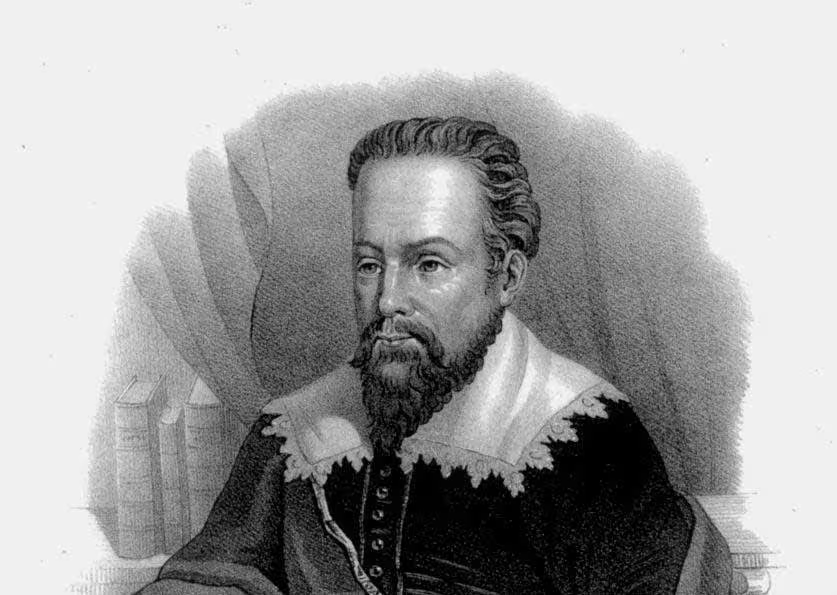
Friedrich Taubmann
1565-1613
Biography
Friedrich Taubmann (1565–1613) stands as one of the most brilliant, versatile, and complex figures of late German Humanism (Späthumanismus), occupying a pivotal historical position at the intersection of classical philology, Neo-Latin poetry, academic oratory, and Protestant educational reform. Operating from the prestigious Chair of Poetry and Eloquence at the University of Wittenberg (the Leucorea), Taubmann mediated between the rigorous textual traditions of Northern Renaissance philology and the emerging demands of early modern university pedagogy. While 18th-century popular culture often reduced his memory to a quasi-legendary court jester and author of witty anecdotes (the ubiquitous Taubmanniana), contemporary historical and literary scholarship recognizes him as an erudite editor of Roman comedy, a master of Latin metrics, and a key architect of the late 16th- and early 17th-century Republic of Letters in the Holy Roman Empire. His life's work reflects the vibrant, albeit politically precarious, intellectual climate of Saxon academia on the eve of the Thirty Years' War, demonstrating how classical erudition was deployed to cultivate civic virtue, linguistic precision, and Lutheran confessional identity.
Born on May 16, 1565, in the small Franconian village of Wonsees, near Kulmbach, Friedrich Taubmann was the son of a modest tailor and smallholder who died during Friedrich's early childhood. Raised in severe financial hardship by his widowed mother, Taubmann's exceptional intellectual acuity was recognized by local patrons, enabling him to attend the Latin school in Kulmbach. His academic trajectory was decisively shaped when he secured admission to the renowned princely school (Fürstenschule) at the former Cistercian monastery of Heilsbronn (Heilsbronn Abbey) in 1582. Under the rigorous curriculum established by the Margraves of Brandenburg-Ansbach, Taubmann received an intensive grounding in Greek and Latin philology, dialectic, and classical rhetoric. In 1592, sponsored by noble patronage, he matriculated at the University of Wittenberg, an institution still reverberating with the intellectual legacy of Philipp Melanchthon. At Wittenberg, Taubmann distinguished himself almost immediately through his extraordinary facility in Neo-Latin verse, earning his Master of Arts degree in 1593 and receiving the coveted imperial poetical coronation (Poeta Laureatus) from Friedrich Wilhelm, Duke of Saxe-Weimar. By October 1595, at the remarkably young age of thirty, Taubmann was appointed Professor of Poetry and Eloquence at Wittenberg, a position he retained with immense distinction until his untimely death on March 24, 1613.
Taubmann's scholarly and literary output represents a monumental synthesis of creative Neo-Latin composition and critical textual editing. His creative poetical reputation was inaugurated with the publication of Columbae (1594), a sophisticated collection of Neo-Latin lyrics that showcased his mastery of Catullian hendecasyllables, Martial-esque epigrams, and Horatian odes, followed by the expanded Schediasmata poetica (1610) and Otia Friderici Taubmanni. However, his lasting philological monument is his seminal edition of Titus Maccius Plautus, published as T. Macci Plauti Comoediae XX (Wittenberg, 1605; revised and expanded in 1612). Before Taubmann, early Roman comedy was frequently misunderstood metrico-linguistically, treated with skepticism by scholars accustomed to Augustan Latinity. Taubmann applied an unprecedented level of paleographical scrutiny, metrical reconstruction, and lexicographical analysis to Plautus, restoring archaic Latin usages and establishing a baseline for early Latin linguistics that influenced scholars across Europe for generations. Following his triumph with Plautus, Taubmann turned his attention to Publius Vergilius Maro, preparing a colossal commentary on the Aeneid, Georgics, and Eclogues (posthumously completed and published by his student and successor, Caspar von Barth, in 1618). As an orator, Taubmann's published speeches—such as his Oratio de lingua Latina—defended the living vitality of Latin as the universal medium of international scholarship, arguing passionately against the linguistic decay and pedantry of contemporary academic pedants.
The dissemination of Taubmann's works provides a vivid window into the early modern print culture of Saxony and the commercial mechanisms of the Frankfurt and Leipzig book fairs. His principal texts were issued through the eminent presses of Wittenberg printers, most notably Zacharias Schürer, Paul Helwig, Clemens Schleich, and the printing house of Christian Tham. These production houses utilized sophisticated typography, employing crisp Roman types for main texts flanked by dense, smaller-font Italic and Greek commentary in the margins—a typographical layout that visually encoded the humanist method of active reading and scholarly annotation. The commercial success of Taubmann's Plautus edition of 1605 was such that it was quickly pirated and reprinted in Frankfurt, Leiden, and Geneva, testifying to the pan-European reach of the Wittenberg book market. Furthermore, Taubmann maintained an extensive epistolary network with leading European humanists, including Joachim Camerarius the Younger, Jan Gruter, Joseph Justus Scaliger, and Isaac Casaubon, exchanging rare manuscripts, emendations, and typographical proofs that crossed political and religious boundaries across the Holy Roman Empire and the Low Countries.
The critical reception of Friedrich Taubmann underwent a dramatic dual evolution in the centuries following his death. Within academic circles, he was revered by 17th-century polymaths like Daniel Georg Morhof and Johann Albert Fabricius as a prince of philology who rescued Roman comedy from medieval corruption. However, parallel to his academic fame, a popular folk tradition emerged around his persona. Due to his legendary quick wit, biting humor, and habit of using satire to critique courtly hypocrisy and academic pomposity, stories of his life were collected into popular chapbooks. The most famous of these, the Taubmanniana (first published systematically by Christian Hübner in 1703 and continuously reprinted throughout the 18th century), recast the serious Wittenberg professor as an unruly, jesting folk hero operating in the tradition of Till Eulenspiegel. This popular image led Enlightenment critics, including Johann Christoph Gottsched and G. E. Lessing, to launch efforts to rescue Taubmann's serious scholarly legacy from anecdotal trivialization. In the 19th and 20th centuries, modern philologists such as Friedrich August Wolf, Otto Ribbeck, and later 20th-century scholars of Späthumanismus like Wilhelm Kühlmann and Heinz Entner reaffirmed Taubmann's foundational role in early modern Latin studies, establishing him as a crucial intellectual bridge between the Renaissance humanism of Melanchthon and the modern scientific altertumswissenschaft of the German University tradition.
Bibliography
Ebeling, Friedrich Wilhelm. Friedrich Taubmann: Ein Kulturbild aus dem siebzehnten Jahrhundert. Leipzig: Verlag von J. Zickel, 1882.
Bauch, Gustav. "Taubmann, Friedrich." In Allgemeine Deutsche Biographie (ADB), Vol. 37, 429–440. Leipzig: Duncker & Humblot, 1894.
Newald, Richard. Probleme und Gestalten des deutschen Humanismus: Studien zur deutschen Literaturgeschichte. Berlin: Walter de Gruyter, 1963, 180–205.
Kühlmann, Wilhelm. Gelehrtenrepublik und Fürstenstaat: Entwicklungslinien des deutschen Humanismus im späten 16. und frühen 17. Jahrhundert. Tübingen: Max Niemeyer Verlag, 1982, 145–178.
Entner, Heinz. "Friedrich Taubmann: Humanist, Poet und Dichterkrone." In Lateinische Poesie der Renaissance im deutschen Sprachraum, edited by Walther Ludwig, 210–235. München: Wilhelm Fink Verlag, 1988.
Häfner, Ralph. Johann Christoph Gottsched und die Rezeption der humanistschen Philologie: Die Transformation Friedrich Taubmanns im 18. Jahrhundert. Stuttgart: Franz Steiner Verlag, 1995, 89–114.
Wiegand, Hermann. "Hektor und Homer in Wittenberg: Friedrich Taubmanns Poetik und seine neulateinische Dichtung." Wolfenbütteler Renaissance-Mitteilungen 24, no. 2 (2000): 101–122.
Fuchs, Thomas. "Leucorea und Späthumanismus: Friedrich Taubmann als Professor an der Universität Wittenberg." In Universitäten und Stadtkultur im 16. und 17. Jahrhundert, edited by Heinz Schilling, 312–338. Berlin: Duncker & Humblot, 2003.
Werle, Dirk. Copia Librorum: Problemgeschichte des Inhaltsverzeichnisses in der Frühen Neuzeit. Berlin: De Gruyter, 2013, 175–198.
Tilg, Stefan. "The Reception of Plautus in Late German Humanism: Friedrich Taubmann’s Monumental Edition of 1605." Journal of Neo-Latin Studies 67, no. 1 (2018): 45–73.
Beyond the names: biographies and bibliographies on this page are curated by Abu, the AI scholar crafted by Buonvecchio exclusively for Govi Rare Books.