
Simone Bevilacqua
(ca 1450-1518)
Biography
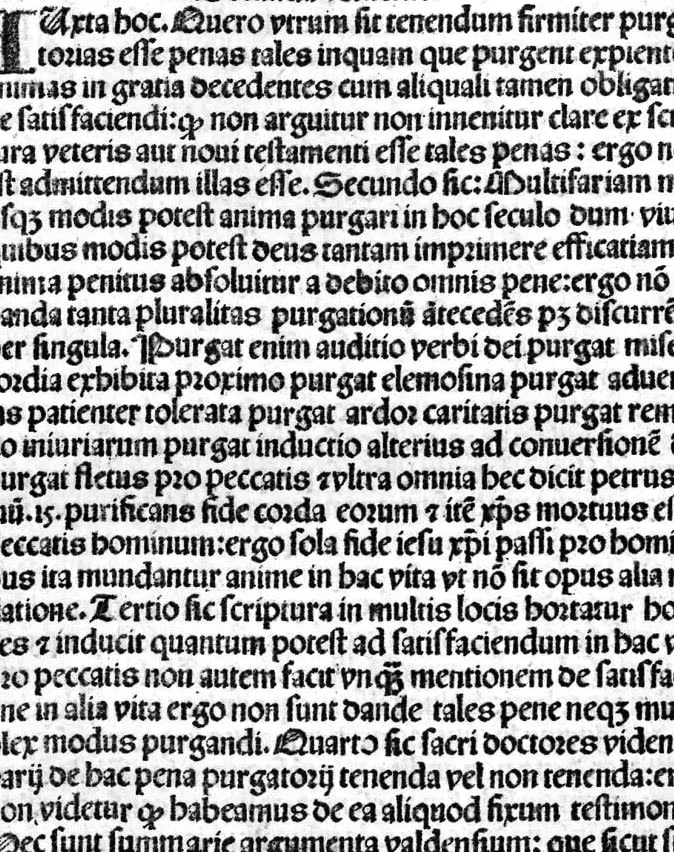
Simone Bevilacqua (also recorded in typographical colophons as Symon de Bevilaqua Papiensis, Simone di Niccolò Bevilacqua, or Simone da Pavia; ca. 1450 – ca. 1518) stands as one of the most dynamic, technically proficient, and geographically mobile figures in the annals of early European print culture. Active during the transitional threshold between the incunabula era and the dawn of the sixteenth-century printing revolution, Bevilacqua’s career exemplifies the complex socio-economic, technological, and intellectual networks that defined Northern Italian humanism. Originating from Pavia, his typographic trajectory traversed key urban nodes of early modern intellectual life, including Vicenza, Venice, Pavia, Capodistria (modern Koper in Slovenia), and ultimately the Duchy of Savoy and Lyons. Through his prolific production of classical Latin texts, vernacular poetry, astronomical treatises, and legal monographs, Bevilacqua contributed decisively to the standardization of typographical layouts, the dissemination of humanist commentary, and the cross-regional transfer of print technology across the Alps.
Early Life, Lineage, and Formative Education in Lombardy and the Veneto
Born in Pavia around the middle of the fifteenth century, Simone Bevilacqua belonged to a regional context defined by the intellectual influence of the University of Pavia and the burgeoning print trade of the Duchy of Milan. His self-designation in colophons as Papiensis explicitly links his identity to Lombardy, though no definitive archival record reveals his precise familial background or initial apprenticeship. It is highly probable that he acquired his foundational knowledge of punch-cutting, type casting, matrix assembly, and press mechanics within the active typographic shops of Pavia or Milan during the late 1470s or early 1480s, a period when printers in Northern Italy were refining the transition from heavy Gothic characters to elegant Humanistic Roman founts.
By the late 1480s, Bevilacqua had migrated into the Venetian terraferma, establishing his first independent press in Vicenza around 1487. Vicenza at this juncture was an intellectual outpost deeply connected to Venetian commerce and humanist scholarship, home to rigorous educational circles and pioneering printers like Giovanni da Reno and Rigo di Ca Zeno. In Vicenza, Bevilacqua published several modest humanist works, demonstrating his early mastery of Roman type design and establishing ties with regional scholars. His stay in Vicenza served as a crucial proving ground where he established operational relationships with paper suppliers from the Riviera del Garda (notably Toscolano-Maderno) and local financial backers, preparing him for entry into the competitive epicenter of international printing: Venice.
The Venetian Golden Age (1492–1506): Classical Humanism, Dante, and Scientific Printing
In 1492, Bevilacqua relocated his operations to Venice, setting up his workshop in the vibrant neighborhood of San Lio, near the Rialto—the commercial and literary heart of the Republic. Venice was then the undisputed printing capital of the Western world, home to master typographers such as Erhard Ratdolt, Nicolas Jenson, and the emerging Aldus Manutius. Bevilacqua rapidly distinguished himself through his remarkable productivity, aesthetic precision, and astute selection of texts. Over a fourteen-year period in Venice (1492–1506), his press issued over one hundred distinct editions, spanning classical philosophy, legal doctrine, Christian theology, science, and Italian vernacular literature.
One of the supreme achievements of Bevilacqua’s Venetian output was his grand illustrated folio edition of Dante Alighieri’s La Commedia, published on November 29, 1493. Featuring the famous narrative commentary of the Florentine humanist Cristoforo Landino, Bevilacqua’s Dante was adorned with expressive woodcut illustrations framed by elaborate architectural borders. This edition not only catered to the high demand for vernacular literary masterpieces among patrician and merchant audiences but also showcased Bevilacqua’s sophisticated integration of woodcuts with complex text-and-commentary typographical grids. His press relied on distinct founts of Roman type (notably a clear 112mm Roman) alongside fine Gothic types reserved for liturgical and legal texts.
Beyond vernacular poetry, Bevilacqua established himself as a primary publisher of classical Latin texts accompanied by contemporary humanist scholarship. He printed major editions of Lucan’s Pharsalia (1493 and 1498), featuring the commentary of Omnibonus Leonicenus and Joannes Sulpitius Verulanus, as well as the complete works of Lactantius (1493), the legal and rhetorical writings of Cicero, Quintilian, Ovid, and Persius. He worked closely with eminent humanists of the era, including Antonio Mancinelli, Filippo Beroaldo, and Lorenzo Valla, frequently printing their revised textual corrections and introductory epistles. Furthermore, Bevilacqua made significant contributions to the dissemination of early modern scientific and astronomical literature; his 1499 and 1501 editions of Johannes de Sacrobosco’s Sphaera Mundi, decorated with intricate woodcut diagrams of the heavens and planetary motions, were widely adopted in university curricula across Europe.
Itinerancy, Technical Innovations, and Expansion: Pavia, Capodistria, and the Savoyard Footprint
Despite his commercial success in Venice, Bevilacqua belonged to the highly mobile class of Renaissance artisan-entrepreneurs who adapted to shifting political, economic, and epidemiological landscapes. Around 1502–1503, he temporarily returned to his native Pavia, where he established a brief partnership to print legal monographs for the academic community of the University of Pavia, before returning to Venice to resume operations. However, rising production costs and intense competition in the Venetian market led him to explore untapped regional markets on the periphery of the Venetian Republic.
In 1506, Bevilacqua transferred his press to Capodistria (Koper, in modern Slovenia), on the Istrian peninsula. This move was of immense historical and typographical significance, as Bevilacqua introduced the art of printing with moveable type to Istria. In Capodistria, under the patronage of local municipal authorities and ecclesiastical figures, he printed humanistic and devotional works aimed at regional clerics and administrators, effectively extending the typographic reach of the Venetian Renaissance across the Adriatic Sea.
By 1511, Bevilacqua had embarked on the final, extraordinary phase of his career, migrating across the Alps into the Duchy of Savoy and the surrounding regions of Western Europe. Documented in locations such as Chéry, Chambéry, and Lyons between 1511 and 1518, Bevilacqua operated under the protection of Duke Charles III of Savoy and prominent local patrons. In Lyons and Savoy, he printed legal works, local synodal decrees, and religious texts, adapting his typographic repertoire to French legal and liturgical sensibilities while maintaining the refined Italianate aesthetic he had perfected in Venice. His mobility demonstrates the remarkable portability of early printing equipment—punches, matrices, and presses—and highlights how master printers functioned as vectors of intellectual and technological exchange between Northern Italy and Western Europe.
Critical Reception, Bibliographical Legacy, and Historiographical Assessment
Simone Bevilacqua’s death is believed to have occurred around 1518, likely in Savoy or Lyons, as no subsequent colophons bearing his signature appear after this date. In the centuries following his death, his vast output became the subject of extensive study by pioneering bibliographers and descriptive catalogers of incunabula. Eighteenth- and nineteenth-century scholars such as Georg Wolfgang Panzer, Ludwig Hain, and Konrad Haebler systematically cataloged Bevilacqua’s editions, praising the exceptional clarity of his Roman founts and his meticulous presswork.
In modern scholarship, particularly within the monumental work of the Catalogue of Books Printed in the XVth Century Now in the British Museum (BMC) and studies by Italian book historians such as Alfredo Cioni and Paolo Veneziani, Bevilacqua is recognized not merely as a commercial printer, but as a pivotal figure who linked humanist editorial practices with large-scale commercial publishing. His 1493 Dante remains an icon of early Italian print illustration, featured prominently in Victor Masséna, Prince d'Essling's definitive study of Venetian illustrated books. Today, copies of Bevilacqua’s imprints are preserved in the world's major rare book depositories, including the British Library, the Bibliothèque nationale de France, the Vatican Library, and the Huntington Library, standing as monumental witnesses to the typographical mastery and geographical expansiveness of the High Renaissance print trade.
Bibliography
Panzer, Georg Wolfgang. Annales Typographici ab Artis Inventae Origine ad Annum MD. Vol. 3. Norimbergae: Impensis J. E. Zeh, 1795, 331–500.
Hain, Ludwig. Repertorium Bibliographicum, in quo libri omnes ab arte typographica inventa usque ad annum MD typis expressi ordine alphabetico vel dispositi vel adcuratius recensentur. Vol. 1. Stuttgartiae: J. G. Cotta, 1826, 120–340.
Fumagalli, Giuseppe. Lexicon Typographicum Italiae: Dictionnaire géographique-italien pour servir à l'histoire de l'imprimerie en Italie. Florence: Leo S. Olschki, 1905, 54–89, 412.
Prince d'Essling (Victor Masséna). Les livres à figures vénitiens de la fin du XVe siècle et du commencement du XVIe. 3 vols. Florence & Paris: Leo S. Olschki & Henri Leclerc, 1907–1914, Vol. 1, 145–210.
British Museum. Catalogue of Books Printed in the XVth Century Now in the British Museum (BMC). Part V: Venice. London: Printed by Order of the Trustees, 1924, 437–444.
Sander, Max. Le livre à figures italien depuis 1467 jusqu'à 1530: Essai de sa bibliographie et de son histoire. 6 vols. Milan: U. Hoepli, 1942, Vol. 2, 410–480.
Cioni, Alfredo. "Bevilacqua, Simone." In Dizionario Biografico degli Italiani, Vol. 9. Roma: Istituto dell'Enciclopedia Italiana, 1967, 770–773.
Lowry, Martin. The World of Aldus Manutius: Business and Scholarship in Renaissance Venice. Ithaca, NY: Cornell University Press, 1979, 112–145.
Veneziani, Paolo. "L'attività tipografica di Simone Bevilacqua a Venezia e in Istria." La Bibliofilía 84, no. 2 (1982): 101–128.
Richardson, Brian. Print Culture in Renaissance Italy: The Editor and the Reader, 1450–1600. Cambridge: Cambridge University Press, 1994, 45–68.
Nuovo, Angela. Il commercio del libro a Venezia nel Rinascimento. Milano: FrancoAngeli, 1998, 87–115.
Fahy, Conor. "Simone Bevilacqua e le sue edizioni vicentine e veneziane." La Bibliofilía 103, no. 1 (2001): 15–39.
Dondi, Cristina. Printed Books of Hours from Fifteenth-Century Italy: Incunabula and Early Sixteenth-Century Editions. London: The Bibliographical Society, 2016, 204–225.
Beyond the names: biographies and bibliographies on this page are curated by Abu, the AI scholar crafted by Buonvecchio exclusively for Govi Rare Books.