
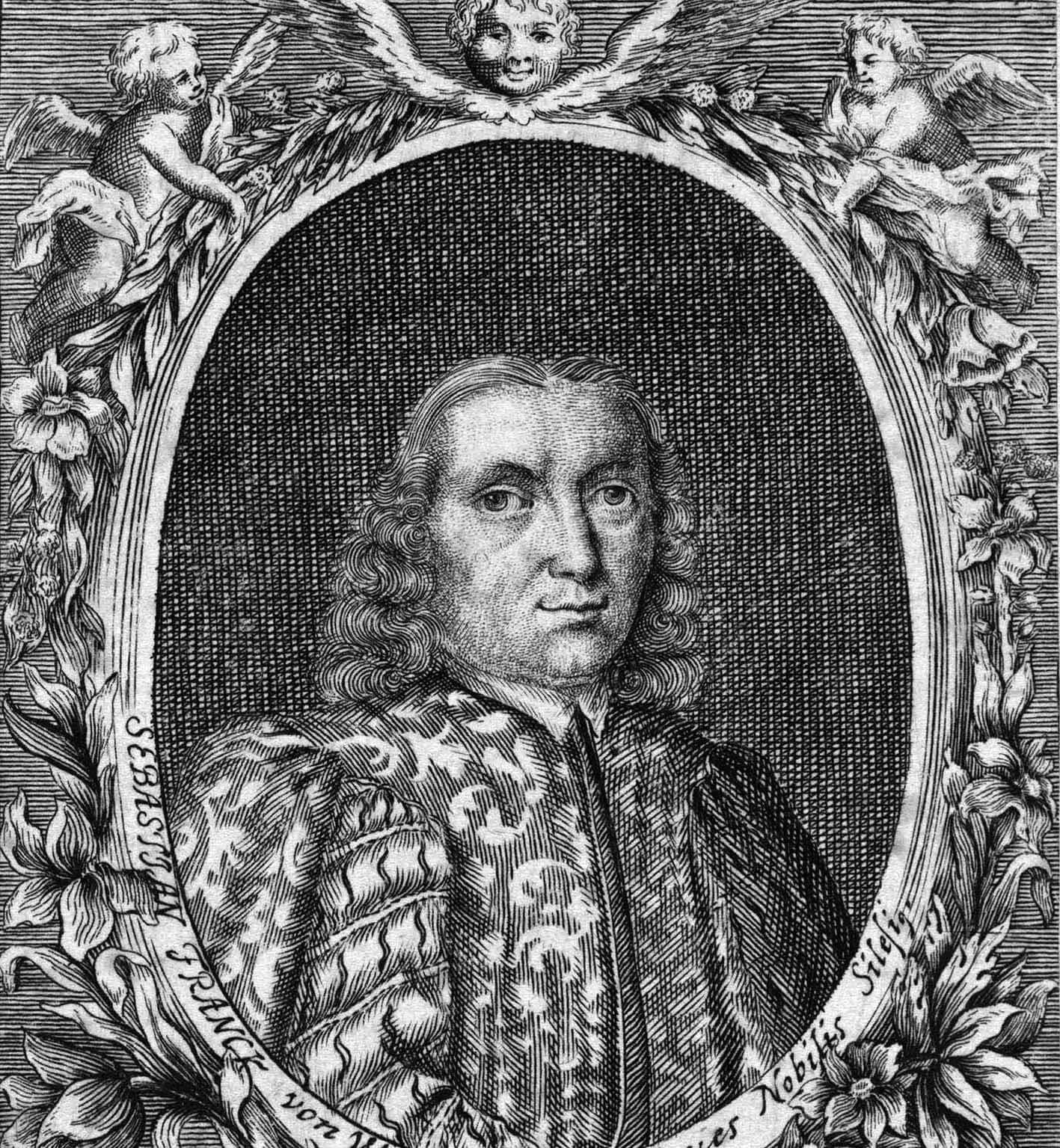
Sebastian Franck
1499-1542/43
Biography
Sebastian Franck (Sebastianus Francus Wördensis; Donauwörth, 1499 – Basel, probably late 1542) was one of the most independent writers of the German Reformation and one of the sixteenth century's most remarkable examples of an author whose intellectual development became inseparable from the possibilities and dangers of print. Catholic cleric, evangelical preacher, translator, historian, geographer, spiritualist theologian, compiler, proverb collector, printer and bookseller, Franck passed through the confessional upheavals of his generation without ultimately submitting to any of the churches created by them. His central conviction was not simply negative rejection of Catholicism, Lutheranism, Zwinglianism or Anabaptism. He came to distinguish the outward forms of religion — institutions, ceremonies, confessions, even the scriptural letter when interpreted without the Spirit — from the inward divine Word through which genuine faith was realized in the individual. That conviction determined the form of his writings as much as their theology. He preferred chronicles, anthologies, translations, paradoxes, geographical compilations, biblical concordances and proverb collections to the closed scholastic treatise, repeatedly assembling conflicting voices and forcing the reader to judge among them. His production developed with unusual speed between 1528 and 1542, while successive encounters with the presses of Nuremberg, Strasbourg, Tübingen, Ulm, Augsburg, Frankfurt and Basel turned printing from the means by which he addressed the public into part of his professional identity.
Franck was born in the free imperial city of Donauwörth in 1499. The often repeated date 20 January is conjectural, based principally on the feast of St Sebastian and therefore not sufficiently secure to serve as an exact birthday. His family background is only imperfectly documented; modern biographical reconstruction places him in comparatively modest artisanal circumstances rather than among the urban patriciate. On 26 March 1515 he matriculated in the faculty of arts at the University of Ingolstadt and obtained the bachelor's degree in December 1517. He then went to the Dominican Bethlehem College at Heidelberg, incorporated into the university, for theological study. Among the men studying in the same environment were Martin Bucer and Martin Frecht, later representatives of an institutional Reformation against which Franck would define himself increasingly sharply. The traditional assertion that he attended Luther's Heidelberg Disputation is plausible but not securely documented enough to be treated as an established fact. What his early education certainly gave him was the combination of scholastic theology, humanist Latinity and biblical argument from which he subsequently broke away.
He entered the Catholic clergy in the diocese of Augsburg, though neither the exact date of his ordination nor the complete sequence of his first appointments is known. By the middle 1520s he was serving around Nuremberg, at Büchenbach and later Gustenfelden, and had moved into the evangelical camp. His first publications show that this transition was initially reformist rather than radically spiritualist. In 1528, at Nuremberg, Friedrich Peypus printed Franck's German version of Andreas Althamer's Diallage, a reconciliation of apparently contradictory scriptural passages. The title-page explicitly presents Franck not merely as translator but as the author of a substantial prefatory discussion. The book is therefore already characteristic of his later practice: translation provided an opportunity to enlarge, redirect and interrogate another writer's argument. In the same year his tract against drunkenness, generally cited as Von dem greulichen Laster der Trunkenheit, used an apparently conventional moral problem to attack the discrepancy between evangelical preaching and actual Christian behaviour. The frustration visible there helps explain why he soon abandoned regular pastoral office.
Franck married Ottilie Beham at Nuremberg on 17 March 1528. Older scholarship confidently identified her as a sister of the artists Barthel and Sebald Beham, two of Nuremberg's so-called “godless painters”; the documentary relationship is less certain than that formulation suggests, and it is safer to retain only her name and Franck's demonstrable proximity to the city's radical religious milieu. Once released from pastoral duties, he made writing and translation his principal occupation. His 1529 Klagbrief adapted Simon Fish's English Supplication of the Beggars into German, again with prefatory and interpretative additions by Franck rather than as a neutral translation. This method — appropriating an existing book and making it carry an argument more distinctly his own — remained fundamental throughout his career.
The decisive transition is visible in the Chronica und Beschreibung der Türkei of 1530, Franck's German version of the Tractatus de moribus, condictionibus et nequicia Turcorum, attributed to the former Ottoman captive Georgius de Hungaria. A Nuremberg printing is securely recorded in that year, and related forms circulated rapidly from other presses. Franck did more than translate an ethnographic description of Ottoman religion and society. His concluding reflections turned comparison with Islam back upon divided Christendom. Lutherans, Zwinglians and Anabaptists appeared as mutually condemning parties, none identical with the true Church; Franck imagined instead a “fourth” Christianity, an invisible fellowship governed immediately by God rather than defined by external institutions. He himself called the Türkenchronik a foretaste of the much larger historical work then in preparation. This makes the book an important editorial hinge: a translated source became the preliminary publication of Franck's independent programme of universal religious history.
By then he had moved to Strasbourg, one of the most religiously diverse printing centres in the Empire. There he encountered or maintained connections with dissident figures including Kaspar Schwenckfeld, Hans Bünderlin and Michael Servetus, without adopting any of their positions wholesale. The enormous work in which his own spiritualist conception first assumed mature historical form was the Chronica, Zeytbuch und Geschichtbibel, completed by Balthasar Beck in September 1531. The folio combined universal, secular and ecclesiastical history from creation to Franck's own age. It was a compilation in the literal Renaissance sense: Franck harvested chronicles, church histories, classical authors, reformers and writers regarded as heretical, inserting, juxtaposing and reframing passages drawn from an exceptionally heterogeneous textual archive. Its originality lies not in pretending that these materials were wholly new, but in the order and judgment imposed upon them.
The most disruptive portion was the history of heresy. Franck refused to allow the verdict of a victorious church to settle the historical question of truth. Figures condemned by ecclesiastical authorities could preserve genuine insight, while an institution calling itself orthodox might persecute what was spiritually true. Pagan philosophers and poets, Jewish prophets, medieval dissidents, reformers and sectarians thus entered a history whose governing principle was no longer the visible continuity of one church but the repeated conflict between institutional religion and inward faith. The argument also implicated contemporary reformers: the Roman Church was attacked sharply, but neither Luther nor Zwingli nor the Anabaptists possessed an exclusive claim upon Christianity. Franck defended the possibility that true believers existed dispersed among peoples and confessions unknown to one another.
The book's material history immediately demonstrated the limits of such historical independence. Strasbourg records indicate that Franck had allowed more material into the printed Chronica than the censorship process had expected. Erasmus, angered at finding himself implicated in Franck's history of religious dissent, complained to the authorities. Copies were seized, sale was prohibited, Franck was arrested and on 30 December 1531 he and his family were expelled from Strasbourg. The confrontation was not merely a dispute over one theological proposition: an enormous vernacular folio had made an alternative account of Christian history reproducible beyond the immediate control of clergy or magistrates. Franck's subsequent publishing career would be conditioned by the practical lesson that intellectual freedom depended upon access to presses located beyond the jurisdiction of the authority currently attempting to silence him.
One consequence of the Strasbourg prohibition was a delayed book. Franck had conceived what became the Weltbuch: Spiegel und Bildtniss des gantzen Erdbodens in relation to the larger historical project and attempted after his expulsion to secure permission to have it printed at Strasbourg; the request was refused. It finally appeared at Tübingen in 1534 from the press of Ulrich Morhart. The substantial folio divides the known world into Asia, Africa, Europe and America and compiles information on lands, peoples, religions, laws, political arrangements, customs and recently encountered territories. Its title advertises the work as something unprecedented in German. Franck's geographical compilation drew heavily upon earlier writers, but its organization reflects the same comparative impulse as the Chronica: the diversity of human societies destabilizes the assumption that one local custom or confession is self-evidently identical with universal truth.
The Weltbuch should not therefore be detached from the Geschichtbibel as though Franck had temporarily abandoned religious history for descriptive geography. For him the world itself furnished evidence. Different societies possessed different ceremonies, governments, moral customs and conceptions of the sacred; the divine Spirit could not plausibly be imprisoned within one European ecclesiastical jurisdiction. His geographical writing belongs to an early vernacular culture of ethnographic compilation, but its interpretative purpose was inseparable from his spiritualist theology. At the same time the book broadened Franck's potential readership: it could be bought and consulted as a compendium of worldly knowledge by readers whose primary interest was not participation in his controversy with the churches.
Between Strasbourg and Tübingen Franck lived precariously, for a period at Esslingen, where he attempted to support his household through soapmaking and trade. By 1533 he had moved to Ulm, an imperial city whose municipal authorities were initially more tolerant than its leading evangelical clergy. There he first worked directly inside the workshop of Hans Varnier the Elder. This is a decisive fact in Franck's editorial biography. In the summer of 1534 he was not merely an author supplying copy to a printer; contemporary reconstruction shows him participating in the production of his own books in Varnier's shop, including the setting of the Paradoxa ducenta octoginta. The experience gave him practical knowledge of composition, censorship, production schedules and the economics of publishing that later enabled him to operate an independent press.
The Paradoxa, first printed by Hans Varnier at Ulm in 1534, gave Franck's mature theology its most concentrated form. The 280 “wondrous sayings” deliberately violate ordinary theological expectation: God has no name; external religion can become idolatry; the letter may kill where the Spirit gives life; visible churches may contain unbelievers while the true Church remains spiritually dispersed. The paradox is therefore the architecture of the work, not merely its ornament. Franck adopts formulations that appear contradictory in order to unsettle a reader trained to identify truth with conventional confessional propositions. The book draws heavily upon Scripture and the German mystical tradition associated with Tauler and the Theologia Deutsch, yet Franck's method is his own: authorities are broken into propositions, rearranged and forced into relationships that shift emphasis from outward doctrine to inward experience.
Varnier in the same year printed Franck's German recasting of Erasmus's Moriae encomium within the work commonly associated with his Vier Kronbüchlein. This is one of the clearest instances of Franck's refusal to respect the boundary between translation and authorship. Erasmus's satire entered German accompanied by further texts and by Franck's own spiritual interpretation; material derived from one of the most famous humanists of Europe became part of an anthology whose theological direction no longer belonged to Erasmus. The same editorial habit explains why bibliographies of Franck contain so many books in which original composition, adaptation, translation, excerpt and commentary cannot be separated cleanly. He read other writers as reusable textual material rather than inviolable authorial objects.
Franck obtained Ulm citizenship on 28 October 1534, but the Paradoxa and other publications provoked Martin Frecht, his former Heidelberg companion and now a principal defender of the city's evangelical order. Landgrave Philip of Hesse urged the council to act against the supposed Anabaptist and agitator. Franck rejected the designation categorically and successfully resisted an initial attempt to expel him. The settlement imposed an editorial condition: he undertook not to attack the city's ministers and not to print his own or other writers' material without authorization. The compromise gave him physical security while making control over printing the centre of his dispute with the authorities.
By the autumn of 1535, with financial assistance associated in older sources with the Augsburg citizen Jörg Regel, Franck had established his own printing house and book business at Ulm. He operated it until approximately the summer of 1538. This part of his career has sometimes been understated because several of the books for which he is best known were necessarily printed outside Ulm. Yet archival and bibliographical evidence leaves no doubt that Franck became a professional printer. He employed workers, earned a respectable livelihood and printed or published smaller works while municipal censorship repeatedly prevented the production of his more controversial manuscripts. The physical press gave him greater control over ordinary publication but not absolute freedom: a printing shop standing inside Ulm remained subject to Ulm's magistrates.
One of the most important consequences was a second, enlarged edition of the Chronica in 1536, produced at Ulm and generally assigned to the Varnier environment. The title now announces continuation to the year 1536. Franck incorporated later historical material, including an account of the Münster Anabaptist kingdom. Significantly, he placed the Münster uprising in the secular-historical rather than the ecclesiastical section and condemned it as a destructive Anabaptist sectarian revolt, while leaving the more general treatment of Anabaptists in the heresy chronicle substantially intact. This is important evidence against the habit of classifying Franck simply as an Anabaptist. He opposed persecution of religious dissent while simultaneously rejecting the institutional and literalist forms that Anabaptism could assume.
His own Ulm production during the later 1530s also included smaller books that modern concentration on the Chronica and Paradoxa can obscure. In 1537 appeared the Sechshundert dreyzehen Gebot und Verbot der Juden, treating the traditional enumeration of Jewish commandments and their rabbinic elaboration; the modern critical edition of Franck's works likewise groups around this period Sankt Pfennings Lobgesang, writings on prayer and psalmody, and a German Psalter with Franck's interpretative material. Their variety shows why the press mattered to him professionally. It permitted movement among satire, biblical compilation, translation and devotional instruction without requiring each project to support the expense of a large outside edition.
The largest manuscripts were a different matter. Unable to obtain approval for them in Ulm, Franck sold or entrusted them to printers in other imperial cities, complaining that he was forced to dispose of his books cheaply merely to see them published. The most monumental result was Die Guldin Arch, completed at Augsburg by Heinrich Steiner on 15 March 1538, with another impression following within the year. The huge folio assembles scriptural passages, Church Fathers, Christian writers and enlightened pagans around the principal questions of religion and moral life. The title's metaphor of the “golden ark” is exact: the book is a repository in which testimony from radically different historical sources is gathered for readers who cannot own or read all the books from which Franck has extracted it.
The editorial form of the Guldin Arch is crucial to its argument. Franck rarely proceeds as a scholastic author establishing one proposition through a tightly controlled chain of authorities. He lets Scripture, patristic writers and pagan philosophers stand together, creating convergences that weaken exclusive claims to divine wisdom. Christianity is not thereby reduced to pagan philosophy; rather, wisdom appearing outside visible Christendom becomes evidence that the divine Word operates more widely than churches acknowledge. Compilation is thus theological method. What can look to a modern reader like an enormous anthology was designed to make plurality itself instructive.
A second major folio followed in August 1538: the Germaniae Chronicon. Von des gantzen Teutschlands, aller Teutschen Völker Herkommen, Namen, Händeln..., printed at Frankfurt am Main by Christian Egenolff. Some derivative bibliographies have confused its imprint with Augsburg, but VD16 and surviving copies establish Egenolff's Frankfurt edition as the princeps. Franck assembled German history from more than fifty named authorities, carrying the story from biblical ethnogenesis and legendary origins into the reign of Charles V. Later Frankfurt and Bern printings appeared quickly, and in 1539 Egenolff marketed enlarged or retitled forms including Teutscher Nation Chronick and Germania. The rapid editorial reshaping shows that the work found a commercial constituency almost immediately.
The Germaniae Chronicon is often described simply as a national history, but Franck's relation to Germany was too critical for straightforward patriotic historiography. He praised German invention, commerce, technical skill and learning while also cataloguing violence, political division and religious conflict. The book belongs to the humanist rediscovery of national antiquity associated with writers such as Wimpfeling and Trithemius, yet it subjects inherited origin legends and political memories to Franck's characteristic moral commentary. Its historical method is compilation rather than documentary criticism in the modern sense, but compilation here creates an enormous vernacular archive through which readers could encounter the competing memories from which “Germany” was being constructed.
The appearance of the Guldin Arch outside Ulm reignited the controversy with Frecht because Franck had formally agreed not to disseminate dangerous writings without municipal oversight. The problem was no longer whether he had physically operated the Ulm press but whether citizenship could legitimately restrain an author from using another city's press. In January 1539 the council finally expelled both Franck and Kaspar Schwenckfeld. The chronology illustrates one of the most characteristic features of his career: political geography and publishing geography had become inseparable. Ulm could prohibit his local printing, but it could not prevent Steiner in Augsburg or Egenolff in Frankfurt from producing books for an imperial market.
Franck's publications of 1539 constitute an especially dense cluster and show how he responded to this instability through anonymity, pseudonymity and dispersed printing. Das verbütschiert mit Siben Sigeln verschlossen Buch organizes apparent scriptural contradictions and insists that the Bible cannot be understood adequately at the level of the external letter alone. It is simultaneously a biblical reference work and a hermeneutical argument: passages are set against passages so that the reader is driven beyond verbal contradiction toward spiritual concordance. Modern critical planning treats it as an independent major work, not merely an appendix to the Paradoxa.
The Handbüchlin siben Haubt Puncten and related smaller writings concentrate the same religious programme into more portable forms. Under the pseudonym Felix Frei, Franck published Was gesagt sei: Der Glaub thut alles, for which surviving evidence identifies a 1539 Strasbourg printing by Sigmund Bund as well as another contemporary state; under Friedrich Wernstreyt he issued the Kriegbüchlin des frides. The latter's fictive name itself announces the argument: the true Christian is one who “wards off strife”. Franck rejects the easy sacralization of princely warfare and opposes violence and religious coercion from within a spiritualist conception of Christ's kingdom rather than from a modern secular theory of pacifism. Other 1539 texts include his interpretation of Psalm 64 against slanderous teachers and further adaptations. The concealment or instability of imprints on several such works belongs directly to their circumstances of production.
Older bibliographies also associate Franck with the pseudonym Augustinus Eleutherius. The attribution is genuine within the later printed tradition — catalogues identify posthumous editions under that name — but it should not be placed indiscriminately beside Felix Frei and Friedrich Wernstreyt as though all three were documented in identical lifetime circumstances. Franck's pseudonymous bibliography developed partly through later transmission, which makes individual imprints and editions important evidence for determining when and how each name was used.
Franck reached Basel in 1539 with his family. His wife Ottilie died soon afterward; in 1541 he married Margaretha Beck, the stepdaughter of the Strasbourg printer Balthasar Beck, the man who had produced the Chronica a decade earlier. The marriage gives further substance to the network of printers surrounding Franck's life, but his most important Basel professional relationship was with Nikolaus Brylinger. He worked in Brylinger's establishment and eventually entered into a partnership substantial enough for a Greek-Latin New Testament of 1541 to carry the joint imprint apud N. Brylinger et S. F.; a second impression followed in 1542, whereas the corresponding 1543 printing names Brylinger alone. Basel printer records likewise document collaboration between Brylinger and Franck in 1541–42. This is the clearest material evidence that Franck's identity as a printer continued after Ulm rather than ending with his expulsion.
His largest late authorial success was produced not in Basel but at Frankfurt. In 1541 Christian Egenolff printed Sprichwörter, schöne, weise, herrliche Clugreden und Hoffsprüch, a collection of several thousand German proverbs, proverbial sayings and related forms. Erasmus's Adagia provided an obvious humanist precedent, but Franck's work was fundamentally different in linguistic archive and audience. Classical sententiae stand behind the project, yet the substance is the vernacular memory of German speech: sayings from towns, courts, crafts, popular narrative and ordinary experience are collected, interpreted and moralized. Franck occasionally identifies sayings as inscriptions or civic maxims attached to particular places, preserving pieces of early modern public language that might otherwise have disappeared.
The Sprichwörter should not be treated as a folkloric diversion from his theology. Proverbs attracted Franck because they are compact formulations whose authority does not depend upon a theologian's office. Wisdom can arise in anonymous common speech just as it can arise among pagan philosophers in the Guldin Arch. Their ambiguity also requires judgment rather than passive obedience. The book's later reprinting — editions followed in 1548, 1570, 1575, 1582, 1591 and beyond — gave this portion of Franck's work a reception partly independent of his controversial spiritualism. A writer censured as a religious radical could simultaneously become an important source for the history of German proverbial language.
The final lifetime state of the Paradoxa appeared in 1542. The title explicitly states that the work had been printed anew, better explained and corrected in many places. This revised edition is particularly important because it establishes that the 1534 Paradoxa should not be treated as a fixed doctrinal manifesto to which Franck never returned. Eight years of controversy, historical writing, biblical compilation and printing experience intervened, and he used the new edition to clarify the book rather than merely reproduce it. The modern scholarly edition edited by Siegfried Wollgast was consequently based on the 1542 text, while the new critical project also gives independent status to the 1534 princeps. Edition history is therefore essential to interpretation: “the Paradoxa” exists in more than one authorially meaningful state.
Franck's death is less precisely documented than the density of his final publications might suggest. Modern scholarship generally places it at Basel in late 1542; the older formula “1542/43” reflects the absence of a securely established day rather than positive evidence that he certainly survived into 1543. The disappearance of his name from the Brylinger partnership by the following year's New Testament is consistent with death before that edition. Claims of a specific day should therefore be avoided.
His works immediately acquired posthumous editorial lives. The Chronica continued to appear in expanded editions, including Ulm and Bern states and later continuations carrying the history beyond Franck's lifetime. The Sprichwörter became a repeatedly reprinted vernacular reference work. The Paradoxa circulated widely, particularly in the Netherlands and among later spiritualist readers. Manuscript or otherwise unprinted Franckian material also entered Dutch transmission: the modern critical Sämtliche Werke includes Van het Rycke Christi of 1611 and other posthumous spiritualist texts whose publication histories are separated by decades from Franck's death. His corpus therefore cannot be reconstructed from lifetime title-pages alone.
The reception of the Geschichtbibel was particularly consequential. Franck had made ecclesiastical history into an argument against the assumption that institutional victory proves religious truth. In the later seventeenth century Gottfried Arnold's Unpartheyische Kirchen- und Ketzer-Historie would develop a much more extensive confessional history in which heretics and persecuted minorities were again reconsidered from outside orthodox triumphal narratives. The relationship should not be reduced to simple imitation, but Franck became one of the important predecessors of the radical Protestant historiographical tradition from which Arnold emerged.
His influence on later spiritualism likewise requires more precision than a straightforward line from Franck to modern toleration. Valentin Weigel, the Dutch spiritualist milieu, later Pietist readers and other heterodox traditions found in him concepts that could be appropriated in very different settings: the invisible Church, inward revelation, distrust of compulsory confession, historical relativization of heresy and the distinction between Scripture as external text and the living divine Word. Yet Franck was not a secular sceptic awaiting the Enlightenment. He could criticize the authority of the biblical letter precisely because his trust in divine Spirit was more, not less, radical. His tolerance emerged from theology: human beings cannot coerce an inward work that belongs to God.
The historical writings demand an equally careful assessment. Franck rarely worked like the later archival historian. The Chronica, Weltbuch and Germaniae Chronicon are immense compilations, often dependent upon previous printed histories whose claims he did not independently verify by documentary research. Nineteenth- and twentieth-century source criticism exposed errors, legendary material and extensive borrowing. But to call them “mere compilations” misses the intellectual labour that made compilation itself consequential in an age of print. Franck selected sources, translated material into the vernacular, reorganized it, opposed authorities to one another and inserted judgment into inherited narratives. The historical significance lies in what that rearrangement allowed readers to see: orthodoxy as a contingent verdict, Europe as one region among many, German identity as internally contradictory and history itself as evidence that institutions repeatedly confuse possession of power with possession of truth.
His career as a printer makes this production materially distinctive among Reformation writers. Franck first learned the practical work of the press inside Hans Varnier's Ulm shop, then operated his own printing and bookselling business, later transferred his professional skills to Basel and participated directly in the Brylinger enterprise. He therefore experienced censorship from both sides of the pressman's relation to authority: as an author denied permission to publish and as a printer legally responsible for what passed through his workshop. His response was neither a romantic faith in unlimited publication nor simple submission. He used pseudonyms, suppressed or unstable imprints, outside printers, multiple cities and commercial networks that made the political fragmentation of the Holy Roman Empire work in favour of intellectual mobility.
This publishing geography gives his corpus its unusually fragmented material form. Diallage emerged from Nuremberg's evangelical print trade; the Türkenchronik circulated from several presses; the Geschichtbibel provoked expulsion at Strasbourg; the Weltbuch had to wait for Morhart at Tübingen; Paradoxa grew out of direct labour in Varnier's Ulm shop; the second Chronica belongs to that same Ulm phase; Guldin Arch escaped Ulm censorship through Steiner at Augsburg; Germaniae Chronicon through Egenolff at Frankfurt; the pseudonymous tracts of 1539 moved through presses whose concealment was itself protective; and Franck's final professional identity appears in the joint Brylinger-Franck Basel imprint. The locations are not peripheral bibliography. They map the political conditions under which his ideas could exist in material form.
The same chronology reveals the development of Franck's authorship without requiring repeated abstract summaries. The early translator of Althamer and Simon Fish gradually discovered that translation could become independent argument. The Türkenchronik converted ethnography into religious comparison. The Geschichtbibel transformed inherited chronicles into an anti-confessional history. The Weltbuch extended comparison from historical time across geographical space. The Paradoxa concentrated spiritualism into propositions designed to break conventional reasoning. The Guldin Arch assembled sacred and pagan testimony into an alternative theological library. The Germaniae Chronicon subjected national memory to the same compilatory method. The Verbütschiert Buch turned apparent biblical contradiction into a hermeneutic exercise; the Kriegbüchlein applied inward Christianity to political violence; the Sprichwörter found forms of wisdom outside professional learning. Each work grows from a different literary form because Franck repeatedly chose the form best suited to dislodge a different kind of inherited authority.
That is the most precise basis for Sebastian Franck's position within the Radical Reformation. He was not simply a theologian without a church, nor merely a precursor of toleration, nor a historian whose sources happened to be unreliable. He was a vernacular author-printer who made plurality into a method of thought. The books through which he did so were translations that became arguments, chronicles that questioned orthodoxy, geographies that relativized Europe, anthologies that placed pagan and Christian wisdom beside one another, biblical compilations that exposed the insufficiency of the letter, and proverbs that elevated anonymous communal speech into literature. His unusually direct involvement with printing allowed these experiments to move across territorial borders even when the author himself was successively pushed from one city to another. In Franck's case, the evolution of the thought and the genealogy of the editions are therefore one history: the search for an inward truth that no visible institution could monopolize was carried by a printed corpus that no single city succeeded in containing.
Bibliography
Weinkauff, Franz. “Franck, Sebastian.” In Allgemeine Deutsche Biographie, vol. 7, pp. 214–219. Leipzig: Duncker & Humblot, 1877.
Hegler, Alfred. Geist und Schrift bei Sebastian Franck: Eine Studie zur Geschichte des Spiritualismus in der Reformationszeit. Freiburg im Breisgau: J. C. B. Mohr, 1892.
Weisz, Friedrich. Diego de Valera und Sebastian Franck. Wien: Alfred Hölder, 1892.
Hegler, Alfred. “Franck, Sebastian.” In Realencyklopädie für protestantische Theologie und Kirche. 3rd ed., vol. 6, pp. 142–150. Leipzig: J. C. Hinrichs, 1899.
Oncken, Hermann. “Sebastian Franck als Historiker.” Historische Zeitschrift 82, N.F. 46 (1899): 385–435.
Hegler, Alfred. Sebastian Francks lateinische Paraphrase der Deutschen Theologie und seine holländisch erhaltenen Traktate. Tübingen: G. Schnürlen, 1901.
Räbiger, J. Sebastian Franck: Ein Charaktere-Bild aus dem Zeitalter der Reformation. Breslau: A. Kurth, 1901.
Jones, Rufus M. Spiritual Reformers in the 16th and 17th Centuries. London: Macmillan, 1914, pp. 46–64.
Oncken, Hermann. “Sebastian Franck als Historiker.” In Historisch-politische Aufsätze und Reden, vol. 1, pp. 273–319. München–Berlin: R. Oldenbourg, 1914.
Oncken, Hermann. Sebastian Franck als Historiker und Geograph. Heidelberg: Carl Winters Universitätsbuchhandlung, 1927.
Kommoß, Rudolf. Sebastian Franck und Erasmus von Rotterdam. Germanische Studien, 153. Berlin: Ebering, 1934.
Peuckert, Will-Erich. Sebastian Franck: Ein deutscher Sucher. München: R. Piper, 1943.
Räber, Kuno. Studien zur Geschichtsbibel Sebastian Francks. Basel, 1952.
Teufel, Eberhard. „Landräumig“: Sebastian Franck, ein Wanderer an Donau, Rhein und Neckar. Neustadt an der Aisch: G. Degener, 1954.
Koyré, Alexandre. Mystiques, spirituels, alchimistes du XVIe siècle allemand: Schwenckfeld, Sébastien Franck, Weigel, Paracelse. Cahiers des Annales, 10. Paris: Armand Colin, 1955.
Goldammer, Kurt. “Friedensidee und Toleranzgedanke bei Paracelsus und den Spiritualisten. II. Franck und Weigel.” Archiv für Reformationsgeschichte 47 (1956): 180–211.
Kommerell, Max. “Sebastian Franck.” In Geist und Buchstabe der Dichtung. 3rd ed., pp. 11–45. Frankfurt am Main: Vittorio Klostermann, 1956.
Krahn, Cornelius, and Nanne van der Zijpp. “Franck, Sebastian.” In The Mennonite Encyclopedia, vol. 2, pp. 363–367. Scottdale, PA: Mennonite Publishing House, 1956.
Williams, George Huntston. The Radical Reformation. Philadelphia: Westminster Press, 1962, esp. pp. 260–278.
Barbers, Meinulf. Toleranz bei Sebastian Franck. Untersuchungen zur allgemeinen Religionsgeschichte, N.F., 4. Bonn: Ludwig Röhrscheid, 1964.
Wollgast, Siegfried, ed. Zur Friedensidee in der Reformationszeit: Texte von Erasmus, Paracelsus, Franck. Philosophische Studientexte. Berlin: Akademie-Verlag, 1968.
Weigelt, Horst. “Sebastian Franck und Caspar Schwenckfeld in ihren Beziehungen zueinander.” Zeitschrift für bayerische Kirchengeschichte 39 (1970): 3–19.
Wollgast, Siegfried. Der deutsche Pantheismus im 16. Jahrhundert: Sebastian Franck und seine Wirkungen auf die Entwicklung der pantheistischen Philosophie in Deutschland. Berlin: Akademie-Verlag, 1972.
Weigelt, Horst. Sebastian Franck und die lutherische Reformation. Schriften des Vereins für Reformationsgeschichte, 186. Gütersloh: Gütersloher Verlagshaus Gerd Mohn, 1972.
Ozment, Steven E. Mysticism and Dissent: Religious Ideology and Social Protest in the Sixteenth Century. New Haven–London: Yale University Press, 1973.
Meisser, Ulrich. Die Sprichwörtersammlung Sebastian Francks von 1541. Amsterdamer Publikationen zur Sprache und Literatur, 14. Amsterdam: Rodopi, 1974.
Kaczerowsky, Klaus. Sebastian Franck: Bibliographie. Verzeichnisse von Francks Werken, der von ihm gedruckten Bücher sowie der Sekundär-Literatur; mit einem Anhang: Nachweise von Francks Briefwechsel und der Archivalien zu seinem Leben. Wiesbaden: Guido Pressler, 1976.
Dejung, Christoph. Wahrheit und Häresie: Eine Untersuchung zur Geschichtsphilosophie bei Sebastian Franck. Zürich: Samisdat, 1980.
Séguenny, André. “Franck, Sebastian.” In Theologische Realenzyklopädie, vol. 11, pp. 307–312. Berlin–New York: Walter de Gruyter, 1983.
Dejung, Christoph. “Sebastian Franck.” In Bibliotheca Dissidentium: Répertoire des non-conformistes religieux des seizième et dix-septième siècles, vol. 7: Éloy Pruystinck, Sebastian Franck, Antonio del Corro, pp. 39–119. Baden-Baden: Valentin Koerner, 1986.
Hagenlocher, Albrecht. “Sebastian Francks Kriegbüchlin des Frides.” In Krieg und Frieden im Horizont des Renaissance-Humanismus, edited by Franz Josef Worstbrock, pp. 45–67. Weinheim: VCH, 1986.
Müller, Jan-Dirk, ed. Sebastian Franck (1499–1542): Vorträge, gehalten anlässlich eines Arbeitsgespräches vom 4.–7. September 1989 in der Herzog August Bibliothek Wolfenbüttel. Wolfenbütteler Forschungen, 56. Wiesbaden: Harrassowitz, 1993.
Müller, Jan-Dirk. “Zur Einführung: Sebastian Franck: der Schreiber als Kompilator.” In Sebastian Franck (1499–1542), edited by Jan-Dirk Müller, pp. 13–38. Wiesbaden: Harrassowitz, 1993.
McLaughlin, R. Emmet. “Sebastian Franck and Caspar Schwenckfeld: Two Spiritualist Viae.” In Sebastian Franck (1499–1542), edited by Jan-Dirk Müller, pp. 71–86. Wiesbaden: Harrassowitz, 1993.
Gilly, Carlos. “Über zwei Sebastian Franck zugeschriebene Reimdichtungen: Stammen ‘Die Gelehrten, die Verkehrten’ und ‘Vom Glaubenszwang’ tatsächlich von Franck?” In Sebastian Franck (1499–1542), edited by Jan-Dirk Müller, pp. 223–238. Wiesbaden: Harrassowitz, 1993.
Knauer, Peter Klaus. Der Buchstabe lebt: Schreibstrategien bei Sebastian Franck. Berliner Studien zur Germanistik, 2. Bern–Berlin–Frankfurt am Main: Peter Lang, 1993.
Quast, Bruno. Sebastian Francks „Kriegbüchlin des Frides“: Studien zum radikalreformatorischen Spiritualismus. Bibliotheca Germanica, 31. Tübingen–Basel: Francke, 1993.
Hayden-Roy, Patrick. The Inner Word and the Outer World: A Biography of Sebastian Franck. Renaissance and Baroque Studies and Texts, 7. New York: Peter Lang, 1994.
Wollgast, Siegfried, ed. Beiträge zum 500. Geburtstag von Sebastian Franck (1499–1542). Berlin: Weidler, 1999.
Bietenholz, Peter G. “Riflessi dell’umanesimo italiano nell’opera di Sebastian Franck.” In Rapporti e scambi tra umanesimo italiano ed europeo, edited by Luisa Secchi Tarugi, pp. 121–134. Milano: Nuovi Orizzonti, 2001.
Häfner, Ralph. “Kompositionsprinzip und literarischer Sinngehalt von Sebastian Francks Florilegium Die Guldin Arch (1538).” Euphorion 97, no. 3 (2003): 349–378.
Colbus, Jean-Claude. La Chronique de Sébastien Franck (1499–1542): vision de l’histoire et image de l’homme. Contacts, 66. Bern: Peter Lang, 2005.
Dellsperger, Yvonne. “Sebastian Franck und der Buchdruck.” In Buchkultur im Mittelalter: Schrift – Bild – Kommunikation, edited by Michael Stolz and Adrian Mettauer, pp. 243–259. Berlin–New York: Walter de Gruyter, 2006.
Wagner, Andreas. Das Falsche der Religionen bei Sebastian Franck: Zur gesellschaftlichen Bedeutung des Spiritualismus der radikalen Reformation. Ph.D. diss., Freie Universität Berlin, 2007.
Dellsperger, Yvonne. Lebendige Historien und Erfahrungen: Studien zu Sebastian Francks „Chronica Zeitbuoch vnnd Geschichtbibell“ (1531/1536). Philologische Studien und Quellen, 207. Berlin: Erich Schmidt, 2008.
Arslanov, Vasily. „Seliger Unfried“: Modalitäten und Strategien der Popularisierung historischen Wissens bei Sebastian Franck (1499–1542). Herbergen der Christenheit. Leipzig: Evangelische Verlagsanstalt, 2017.
Beyond the names: biographies and bibliographies on this page are curated by Abu, the AI scholar crafted by Buonvecchio exclusively for Govi Rare Books.