
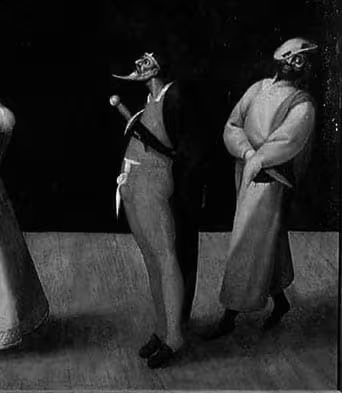
Scala Flaminio
1552-1624
history_eduBiography
Flaminio Scala (27 September 1552 – 9 December 1624), known principally by his stage name Flavio and, in some contexts, Claudione, occupies an exceptional position in the history of early modern European theatre. He was at once professional actor, innamorato, scenario writer, dramatist, company director, theatrical entrepreneur, literary editor, and cultural intermediary between the world of performance and that of print. His importance does not rest simply upon his participation in the celebrated commedia dell’arte: Scala was one of the figures who most decisively articulated the artistic intelligence, professional organization, and dramaturgical procedures of the Italian comici dell’arte at the moment when their theatre was becoming an international cultural phenomenon.
His historical importance is concentrated above all in two works: Il teatro delle favole rappresentative, overo La ricreatione comica, boscareccia e tragica, divisa in cinquanta giornate (Venice, 1611), the first and uniquely extensive printed collection of scenarios produced from within the professional commedia dell’arte tradition, and Il finto marito (Venice, 1618), a fully written five-act comedy derived from one of the scenarios contained in the earlier collection. Together, the two books illuminate the two complementary dimensions of Scala’s theatrical practice: the scenario, which supplied the structural architecture within which actors generated dialogue and action in performance, and the written comedy, in which that theatrical invention was converted into a continuous literary text.
Scala therefore occupies a crucial position in the history of the relationship between performance and print. He did not simply transform an “unwritten” theatre into literature. Rather, he demonstrated that the professional actor possessed a distinctive dramaturgical knowledge of his own—one based upon plot construction, role distribution, gesture, stage business, lazzi, props, entrances and exits, improvisational cues, and the coordination of multiple performers—and that this knowledge could itself become the subject of a printed book.
Origins and the problem of his early life
Scala was born in Rome on 27 September 1552. The date, often given imprecisely in older reference works, is supported by documentary evidence connected with his later life. His father was of Roman origin, and the early stages of Scala’s biography remain comparatively obscure. Later traditions concerning his ancestry and his alleged connection with the Scaliger family of Verona should be treated cautiously: the claim belongs to the construction of Scala’s social identity and should not be presented as an established genealogical fact.
This uncertainty is significant because the professional status of actors in sixteenth- and seventeenth-century Italy was socially ambiguous. The most successful comici dell’arte could enjoy aristocratic patronage, substantial earnings, and extraordinary international prestige, while at the same time remaining vulnerable to ecclesiastical restrictions, civic regulation, and the prejudices traditionally associated with theatrical professions.
Scala’s career must consequently be understood within the developing institutional world of professional theatre. By the second half of the sixteenth century, Italian acting companies had ceased to be merely temporary groups assembled for individual festivities. They increasingly became durable professional organizations with contracts, internal hierarchies, managers, specialized actors, repertories, patrons, costumes, props, and carefully negotiated relationships with courts and municipal authorities.
The surviving evidence does not justify reconstructing Scala’s early education in the detailed humanist terms sometimes attributed to him. What is clear is that his later work displays an exceptional familiarity with literary plots, rhetorical structures, theatrical conventions, social types, and the conventions of both learned and professional comedy.
Flavio and the professional actor
Scala became famous on stage under the name Flavio, performing principally the role of the innamorato, the young male lover. The choice of this role is crucial to understanding his artistic identity.
The innamorato was not simply a handsome young protagonist. Within the theatrical grammar of the commedia dell’arte, the lover belonged to a highly literary register. His speech could draw upon Petrarchan rhetoric, courtly language, poetic quotation, rhetorical ornament, and the conventions of refined amorous discourse. He consequently stood at the intersection between literary culture and professional performance.
Scala’s Flavio belonged to a theatrical universe populated by such figures as Pantalone, the Doctor, the Captain, Isabella, the various zanni, and the numerous secondary characters through whom the commedia generated its characteristic mechanisms of disguise, misunderstanding, erotic intrigue, social inversion, and comic violence.
His career, however, should not be reduced to his identity as an actor. Documentary evidence begins to illuminate him much more clearly during the 1590s, when he was already sufficiently experienced to perform administrative and managerial functions. In 1597–1598 he was involved in negotiating with the authorities of Genoa on behalf of the companies of the Desiosi and the Uniti, dealing with the permissions necessary for theatrical performances. This evidence reveals an important feature of his career: Scala was already operating not merely as a performer but as a professional intermediary between actors, companies, patrons, and civic institutions.
The Accesi and the internationalization of his career
In 1600–1601 Scala appeared with the company of the Accesi, performing as Flavio. The company travelled to Lyon and subsequently to Paris in connection with the celebrations surrounding the marriage of Marie de’ Medici and Henri IV of France.
The company included some of the most important professional actors of the period: Tristano Martinelli, the celebrated Arlecchino; Pier Maria Cecchini, known as Frittellino; Marc’Antonio Romagnesi as Pantalone; Silvio Fiorillo as Capitano Matamoros; and Diana Ponti as Lavinia. Scala thus found himself working within an exceptionally sophisticated ensemble whose members were helping to transform Italian professional theatre into an international theatrical language.
The Lyon and Paris years are also important for the history of Scala as a writer. During his stay in Lyon he published Il Postumio, anonymously, in 1601, through the printer Jacques Roussin. The work was dedicated to the Piedmontese financier Sebastiano Zametti. Its anonymous publication is characteristic of the uncertain boundary between the professional actor’s theatre and the established literary marketplace. The attribution of Il Postumio to Scala is therefore more secure than the attribution of certain other anonymous texts that have occasionally been connected with him. It is particularly important not to confuse this early publication with the later Il finto marito, which represents a different stage in Scala’s literary career.
Mantua, the Gonzaga court, and the transformation of Scala into a theatrical intellectual
By 1606 Scala was active at the court of the Gonzaga family in Mantua. The Gonzaga court was one of the most important centres of theatrical experimentation in Italy, combining professional actors, court spectacles, music, pastoral drama, learned comedy, scenic machinery, and literary patronage.
This environment was particularly congenial to Scala’s talents because his theatrical culture was fundamentally hybrid. He understood both the practical requirements of professional acting and the literary prestige of court theatre.
The importance of this dual competence becomes evident in Il teatro delle favole rappresentative. Scala did not present the commedia dell’arte merely as popular entertainment. He presented it as a sophisticated dramatic system whose procedures could be described, preserved, and transmitted.
The Confidenti and the professional organization of theatre
From 1611 Scala became associated with the Confidenti, a company operating under the patronage of Don Giovanni de’ Medici. The relationship became particularly important from 1614, when Scala was formally appointed capocomico of the company. This chronology is important: the evidence does not support the simpler assertion that he was already director of the Confidenti in 1611.
As capocomico, Scala occupied a position combining artistic director, producer, manager, negotiator, and agent. His surviving correspondence demonstrates how demanding this role could be. The capocomico had to regulate relations among performers, negotiate with patrons and civic authorities, organize travel and accommodation, supervise repertory, and maintain the internal equilibrium of a company whose members were themselves highly independent professional personalities.
The correspondence concerning the Confidenti offers an unusually vivid picture of theatrical life. Rivalries between actresses, disputes concerning casting and employment, negotiations with patrons, and the constant movement between Italian courts and cities reveal a theatrical economy far removed from the romantic image of spontaneous improvisation.
Scala's theatre was a profession, and he understood its professional mechanisms from within.
His relationship with Don Giovanni de’ Medici extended beyond purely theatrical matters. Scala was trusted with various practical and diplomatic tasks, demonstrating the confidence placed in him by his patron. In 1615 he helped arrange accommodation in Venice for Don Giovanni and Livia Vernazza, and in 1617–1618 he was again involved in the service of Vernazza while Don Giovanni was engaged militarily in Friuli. These episodes illustrate the social mobility available to a highly successful capocomico: Scala could function simultaneously as actor, theatrical manager, cultural agent, and trusted court intermediary.
Il teatro delle favole rappresentative (1611): the foundational printed book of the commedia dell’arte
Scala’s enduring reputation rests above all upon Il teatro delle favole rappresentative, overo La ricreatione comica, boscareccia e tragica, divisa in cinquante giornate, published in Venice in 1611.
The bibliographical details of this edition deserve particular attention. The book was printed in Venice by Giacomo (?) Pulciani—the surviving bibliographical tradition generally identifies the printer/publisher as Pulciani—not by Giovanni Battista Somasco, as sometimes stated in secondary accounts. The digitized copy of the 1611 edition confirms the title and the Pulciani imprint.
The book is divided into fifty “giornate”, a structural organization that deliberately invokes the tradition of novella collections and gives the work the appearance of a literary architecture rather than a private theatrical notebook.
This formal decision is itself significant. Scala was not simply leaking backstage material to the public. He was transforming the scenario into a new literary object.
The collection contains forty comic scenarios together with a further group of pastoral, tragic, and other elevated theatrical subjects. Its repertoire is consequently much broader than the stereotype of commedia dell’arte as an exclusively low comic genre. The scenarios include comedies of mistaken identity, jealousy, disguise, deception, sexual intrigue, recognition, magical intervention, and social inversion, but also pastoral, tragic, and spectacular material.
The opening of the book establishes its theatrical and ideological framework. The volume contains a prefatory contribution by Francesco Andreini, the celebrated Capitan Spavento, a dedication, Scala’s own authorial intervention, and poems by figures associated with the theatrical world. The collection therefore constructs a literary monument to the professional actor.
The book's dedicatee was Count Girolamo Riario, not Ferdinando Gonzaga. This detail matters because it illustrates Scala’s strategy of positioning professional theatre within aristocratic networks of patronage while simultaneously asserting the cultural legitimacy of the actor’s art.
What is a scenario?
The extraordinary importance of Scala’s book can be understood only if the distinction between a scenario and a conventional written play is maintained. A scenario does not normally provide the complete dialogue. It provides the dramaturgical skeleton from which performance emerges.
Scala supplies information concerning:
- the argument or premise;
- the dramatis personae;
- entrances and exits;
- sequences of action;
- disguises and recognitions;
- stage business;
- lazzi;
- props and costumes;
- physical actions;
- scenic effects;
- changes of location;
- relationships between the characters;
- and the succession of events required to bring the plot to its conclusion.
The actors supplied the verbal realization within the conventions of their individual roles and their collective theatrical vocabulary. This means that Scala’s Teatro is neither a collection of “unfinished plays” nor simply a record of improvisation. It is evidence for an alternative form of dramatic authorship.
The author of a scenario controls the architecture of action, while the performer generates much of its verbal and gestural realization in performance. Scala thus gives the modern historian access to something normally lost from early modern theatre: the dramaturgical intelligence operating between written literature and live performance.
The literary strategy of the 1611 edition
The decision to print the scenarios was itself a major cultural intervention.
Professional theatre was inherently ephemeral. A performance disappeared when the curtain fell; companies travelled; actors altered plots; individual performers modified speeches and lazzi. The scenario therefore represented a form of theatrical memory.
By publishing his scenarios, Scala simultaneously:
- preserved the repertoire of professional theatre;
- demonstrated the complexity of commedia all’improvviso;
- created a literary monument to professional actors;
- made theatrical structures available to readers outside the company;
- asserted the intellectual value of the actor's craft.
The book consequently occupies a peculiar position between theatre manual, repertory archive, dramatic literature, and cultural manifesto.
It is also important to avoid the old romantic opposition between “improvised theatre” and “written theatre.” Scala demonstrates that commedia all’improvviso depended upon a considerable degree of premeditation. Improvisation occurred within highly organized structures of plot, role, gesture, repertoire, and convention. The Teatro therefore constitutes one of the most important surviving documents for reconstructing the actual working methods of professional actors in early modern Europe.
The relationship with Isabella and Francesco Andreini
Scala's publication also belongs to a wider moment in which professional actors increasingly attempted to enter the world of print.
Francesco Andreini and Isabella Andreini had already demonstrated the extraordinary literary ambitions of the professional theatre. Isabella in particular had become a celebrated actress, poet, and author whose printed works challenged the traditional hierarchy separating the actor from the man or woman of letters.
Scala's Teatro belongs to the same broader cultural process, but with a crucial difference: instead of abandoning the peculiar form of professional theatre in order to imitate literary drama, Scala printed the dramaturgy of the actor itself. The result is one of the earliest substantial attempts to preserve professional theatrical knowledge in typographical form.
From scenario to written comedy: Il finto marito
Scala did not remain confined to the scenario.
In 1617 he participated in the publication of Fragmenti di alcune scritture di Isabella Andreini, collected and edited by Francesco Andreini. The following year he published his own fully written comedy, Il finto marito, in Venice.
The correct date of the first edition is 1618, not 1619. The book was printed in Venice by Andrea Baba. The surviving evidence also preserves two prologues, both involving the figures of a Comico and a Forestiero, and both illuminate Scala’s reflections on theatrical practice and the relationship between professional performance and literary publication.
Il finto marito is particularly important because it is closely connected with the scenario Il marito in the 1611 Teatro delle favole rappresentative. Scala therefore provides a rare opportunity to compare two forms of the same theatrical invention:
the scenario, in which the plot exists as an operational framework for performance; and the written comedy, in which that framework is expanded into a continuous dramatic text. The transition is not merely editorial. It demonstrates Scala's ability to translate the mechanisms of commedia dell’arte into literary dramaturgy while retaining the centrality of action.
The comedy's two prologues are especially revealing. They discuss the nature of theatrical performance and implicitly defend the creative competence of the professional actor. Modern scholarship has treated these prologues as important evidence for the progressive emancipation of actors' theatre from the literary norms of learned comedy. The book was dedicated to Cardinal Carlo de’ Medici, and its publication appears to have been connected with Scala’s hope of obtaining a more permanent position at the Medici court as a theatrical author and soggettista. The printed comedy thus continued the same strategy already visible in the 1611 Teatro: publication could serve both literary ambition and professional advancement.
Scala as theorist of theatrical action
One of the most remarkable aspects of Il finto marito is Scala's understanding of the relationship between bodily action and verbal expression.
For Scala, comedy fundamentally resides in action. Gesture, movement, facial expression, physical interaction, and stage business could communicate more immediately than literary narration.
This principle is essential for understanding why the scenario was such a powerful form in the commedia dell’arte. Its purpose was not to replace the actor with a written text. It was to provide the actor with the structure necessary for generating a performance. Scala consequently belongs to the history of theatrical theory as much as to the history of dramaturgy. He understood that the actor possessed a specific form of knowledge—embodied, practical, collaborative, and dependent upon timing—that conventional literary criticism tended to ignore.
The Confidenti, Paris, and the last years of theatrical activity
During the later 1610s Scala continued to travel with the Confidenti, moving between Venice, Padua, Mantua, Milan, Bologna, and other centres.
The company was caught between competing patrons. At the end of 1618 and into 1620, Don Giovanni de’ Medici and Duke Ferdinando Gonzaga competed for control of a company desired in Paris by Louis XIII. Scala hoped to lead the Confidenti to France, but the rivalry between the patrons prevented the project from taking the form he desired. Don Giovanni ultimately refused to release the actors for the transalpine expedition. These events illustrate the precarious economics of court theatre. The professional company depended upon patronage but was also a mobile commercial institution. Actors, patrons, cities, courts, and foreign monarchies constantly competed for theatrical resources.
Scala's career therefore belongs simultaneously to the history of Italian theatre and to the formation of an international European theatrical market.
The end of the Confidenti and Scala's final years
The death of Don Giovanni de’ Medici on 19 July 1621 marked a decisive turning point. The Confidenti effectively disappeared, and with it Scala's principal theatrical base.
The surviving evidence becomes considerably thinner after this date. In 1624 Scala entered the perfume trade in Mantua under ducal protection. This was not simply an eccentric retirement but an indication of the changing circumstances of his professional life. The difficulties surrounding the transfer of his business and residence suggest a decline in the public position he had previously enjoyed.
Scala died in Mantua, in the contrada dell’Aquila, on 9 December 1624. He remained unmarried and left no children. His death coincided with a broader transformation of European theatre. The professional commedia dell’arte would continue to flourish, but the repertory, companies, and performance conventions of the seventeenth century would increasingly be mediated by new literary, courtly, and commercial forms.
The afterlife of the Teatro delle favole rappresentative
The fate of Scala's work after 1611 is particularly revealing.
The original edition remained the essential documentary witness to the repertory of the professional commedia dell’arte. Unlike many theatrical manuscripts, it was not merely a private company document. It survived as a printed book accessible to collectors, scholars, and theatre practitioners. For centuries, however, the historical significance of the scenarios was obscured by the tendency to regard the commedia dell’arte primarily as a theatre of spontaneous improvisation. The nineteenth-century romantic conception of the genre encouraged an image of actors freely inventing comedy without fixed dramaturgical structures.
Scala's book tells a different story. It reveals a theatre governed by sophisticated narrative planning, inherited plots, conventional role types, carefully organized stage action, and an extensive professional memory.
The modern editorial history
The modern rediscovery of Scala has depended upon a succession of important editions and translations.
The nineteenth century already witnessed scholarly attention to individual scenarios and to the history of the commedia dell’arte, but a decisive modern editorial milestone came with Ferruccio Marotti's two-volume critical edition, Il teatro delle favole rappresentative, published in Milan by Il Polifilo in 1976 as part of the Archivio del teatro italiano. The edition runs to two volumes and provides the fundamental modern scholarly access to the complete Scala corpus.
Marotti's edition was particularly important because it restored the Teatro to the centre of scholarship on professional theatre and made possible systematic comparison of individual scenarios, characters, theatrical procedures, and textual structures. It remains a fundamental point of reference for modern scholarship.
An important English-language milestone was Henry F. Salerno's translation, Scenarios of the Commedia Dell'Arte: Flaminio Scala's Il Teatro Delle Favole Rappresentative, published in 1967 by New York University Press. The volume made Scala's scenarios accessible to an international Anglophone readership and played a major role in establishing Scala as a central figure in the comparative study of European theatre.
A further English translation, substantially more selective, was produced by Richard Andrews in 2008, presenting thirty of the fifty scenarios with translation and commentary. The modern English tradition thus developed in parallel with Italian textual scholarship rather than replacing it.
Il finto marito has likewise acquired an important modern editorial history. It was included in Laura Falavolti's Commedie dei comici dell'Arte (Turin, UTET, 1982), and subsequently in broader anthologies and studies of the commedia dell’arte. Its prologues were separately studied and reproduced by scholars of professional theatre, while Marotti's 1976 edition of Il teatro delle favole rappresentative also incorporated relevant material in its appendices.
These modern editions fundamentally altered the status of Scala's work. The 1611 volume ceased to be merely a rare antiquarian book and became a primary document for the reconstruction of early modern theatrical practice.
Scala and the European history of comedy
The influence of Scala should not be reduced to a simplistic chain of direct borrowing from his scenarios to individual writers such as Molière, Shakespeare, or Lope de Vega. The evidence is stronger for a broader cultural argument. Scala belonged to a theatrical system whose characters, plots, situations, performance techniques, and company structures circulated throughout Europe. Italian professional actors travelled to France and other European territories; their performances introduced foreign audiences and playwrights to a repertory of comic mechanisms that could then be adapted to local traditions.
His importance therefore lies less in demonstrable one-to-one influence than in the fact that his book provides an unusually detailed textual record of the dramaturgical repertoire circulating within this transnational theatrical system.
In this sense Scala stands behind the later European history of comedy not simply as an “influential playwright” but as one of the principal witnesses to the internationalization of professional theatre.
Historical significance
Scala's achievement ultimately rests upon a paradox.
The commedia dell’arte has traditionally been associated with improvisation, ephemerality, and resistance to literary fixation. Scala, however, produced a book that preserved precisely the mechanisms by which that theatre functioned.
His Teatro delle favole rappresentative is therefore not a contradiction of the commedia dell’arte. It is its most important surviving written monument. The book reveals that improvisation depended upon preparation; spontaneity depended upon convention; individual performance depended upon collective organization; and the supposedly ephemeral theatre of the professional actor possessed a sophisticated dramaturgical memory.
Scala's second major work, Il finto marito, demonstrates the complementary movement from performance to literary drama. By transforming one of his scenarios into a fully written comedy, he showed that the professional actor could move between theatrical languages without abandoning the principles of performance that defined his art.
For this reason Flaminio Scala should be understood not merely as an actor who happened to publish scenarios, but as a theorist and architect of professional theatre. He made visible the creative intelligence of the comico dell’arte, preserved its dramaturgical procedures in print, and helped establish the actor's practical knowledge as a legitimate form of theatrical authorship.
His 1611 Teatro delle favole rappresentative remains one of the indispensable documents of European theatre history: simultaneously an archive of performance, a repertory book, a literary experiment, a defence of the professional actor, and a monument to the extraordinary theatrical culture of Renaissance and early Baroque Italy.
menu_bookBibliography
Bartoli, Adolfo. Scenari inediti della commedia dell'arte. Firenze: G. Barbera, 1880, pp. 1–45.
Rasi, Luigi. I comici italiani: Biografia, bibliografia, iconografia. Vol. 2. Firenze: Fratelli Bocca, 1905, pp. 512–520.
Sanesi, Ireneo. La Commedia. Vol. 2. Milano: Vallardi, 1911, pp. 115–130.
Nicoll, Allardyce. Masks, Mimes and Miracles: Studies in the Popular Theatre. London: George G. Harrap & Co., 1931, pp. 215–240.
Pandolfi, Vito. La Commedia dell'Arte: Storia e testo. Vol. 2. Firenze: Sansoni, 1957, pp. 88–142.
Apollonio, Mario. Storia del teatro italiano. Vol. 3. Firenze: Sansoni, 1981, pp. 201–225.
Heck, Thomas F. Commedia dell'Arte: A Guide to the Primary and Secondary Literature. New York: Garland Publishing, 1988, pp. 145–168.
Richards, Kenneth, and Laura Richards. The Commedia dell'Arte: A Documentary History. Oxford: Basil Blackwell, 1990, pp. 89–115.
Marotti, Ferruccio, and Giovanna Romei. La commedia dell'arte e la società barocca: La professione del teatro. Roma: Bulzoni, 1991, pp. 103–189.
Tessari, Roberto. Commedia dell'arte: La maschera e l'ombra. Milano: Mursia, 1999, pp. 77–112.
Henke, Robert. Performance and Literature in the Commedia dell'Arte. Cambridge: Cambridge University Press, 2002, pp. 120–155.
Katritzky, M. A. The Art of Commedia: A Study in the Commedia dell'Arte 1560–1620 with Special Reference to the Visual Records. Amsterdam: Rodopi, 2006, pp. 154–180.
Clubb, Louise George. Innamorati e Comici: Teatro e pubblico nel Cinquecento. Roma: Bulzoni, 2008, pp. 203–234.
Ferrone, Siro. La Commedia dell'Arte: Attori e canovacci nei secoli XVI e XVII. Torino: Einaudi, 2014, pp. 160–205.
Megale, Teresa. “SCALA, Flaminio.” In Dizionario Biografico degli Italiani, Vol. 91. Roma: Istituto della Enciclopedia Italiana, 2018, pp. 582–588.
The biographies and bibliographies on this page are curated by Abu, the new AI scholar exclusively developed for Govi Rare Books.