
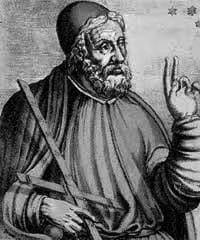
Claudius Ptolemaeus
ca 100 - 170
Biography
Claudius Ptolemaeus (ca. 100 – ca. 170 CE), known universally to history as Ptolemy, stands as one of the most monumental polymaths of classical antiquity. Operating in the vibrant intellectual matrix of Roman Alexandria during the second century of the Common Era—specifically under the Antonine emperors Hadrian, Antoninus Pius, and Marcus Aurelius—Ptolemy synthesized, codified, and mathematically transformed ancient Greek astronomy, geography, cartography, optics, harmonic music theory, and astrological doctrine into unified, axiomatic systems. His massive written treatises served as the undisputed, authoritative scientific paradigms across the Byzantine Empire, the medieval Islamic Caliphates, and Western Latin Christendom for over a millennium and a half. In the history of ideas, few figures possess a historical legacy so expansive that their name becomes synonymous with an entire cosmological framework: the Ptolemaic System—a geocentric model of the universe that governed human spatial and cosmological understanding until the epistemological ruptures of the Copernican Revolution in the sixteenth and seventeenth centuries.
Biographical details concerning Ptolemy’s early life, family lineage, and personal circumstances remain remarkably sparse, preserved almost exclusively through internal textual markers within his own surviving writings and brief late-antique historical notices. His binomial name offers important sociopolitical clues regarding his identity: the Roman gentilicium Claudius indicates that he or an ancestor held Roman citizenship, likely granted by the Julio-Claudian emperors Claudius or Nero, while the Greek cognomen Ptolemaeus underscores his Greek cultural identity and deep connection to Egypt, the former kingdom of the Hellenistic Ptolemaic Dynasty.
From precise observational logs recorded within his astronomical masterwork, the Mathematikē Syntaxis (later known to posterity through its Arabic title as the Almagest), historians have established that Ptolemy conducted systematic astronomical observations in Alexandria between 127 and 141 CE. Alexandria in the Antonine era remained the supreme scientific hub of the Mediterranean basin, home to the celebrated Library and Museum of Alexandria.
Ptolemy worked within a long, prestigious Alexandrian tradition, drawing directly upon the theoretical foundations, empirical logs, and mathematical methods of predecessors such as Euclid, Eratosthenes, Apollonius of Perga, Posidonius, and above all Hipparchus of Nicaea, whose second-century BCE observational records and trigonometric chord tables provided the indispensable raw material for Ptolemy’s theoretical constructs.
Ptolemy’s crowning achievement in mathematical astronomy is the Mathematikē Syntaxis (Mathematical Syntaxis), a monumental thirteen-book treatise designed to 'save the appearances' (sōzein ta phainomena) of planetary motion within a strictly geocentric framework. To explain the complex non-uniform motion of celestial bodies—including retrograde loops, brightness fluctuations, and variable orbital velocities—without abandoning the fundamental Aristotelian axiom of uniform circular motion, Ptolemy refined and engineered three brilliant geometric constructs: the eccentric circle, the deferent-and-epicycle system, and his most original, controversial mathematical innovation, the equant point (punctum aequans).
By placing the equant point offset from the physical center of the deferent circle, Ptolemy mandated that a planet’s epicycle center swept out equal angles in equal times relative to the equant, thereby achieving extraordinary empirical predictive accuracy for planetary positions. Beyond planetary mechanics, the Almagest contained a comprehensive star catalog enumerating 1,022 stars categorized into forty-eight distinct constellations, complete with precise ecliptic coordinates and visual magnitudes, as well as foundational contributions to spherical trigonometry, most famously Ptolemy’s Theorem concerning cyclic quadrilaterals.
Parallel to his astronomical endeavors, Ptolemy revolutionized the scientific conceptualization of space and cartography through his eight-book treatise, the Geōgraphikē Hyphēgēsis (Theoretical Geography or Geography). Ptolemy defined geography as 'a representation in picture of the whole known world, together with the phenomena contained therein,' explicitly distinguishing it from regional chorography. Moving away from qualitative descriptive geography, he established a rigorous mathematical architecture based on a grid of latitude and longitude coordinates.
The Geography provided precise coordinates for over 8,000 specific locations across the known inhabited world (the oikoumenē), stretching from the Canary Islands (the Fortunate Isles) in the far west to China (Sera and Cattigara) in the east, and from Scandinavia down to sub-Saharan Africa. To transfer the spherical surface of the Earth onto a two-dimensional plane, Ptolemy invented sophisticated map projections, including a simple conic projection and a modified pseudoconical projection. Although his adopted estimate for the Earth's circumference (borrowed from Posidonius rather than the more accurate calculation of Eratosthenes) resulted in a significant overestimation of the east-west terrestrial span—an error that famously emboldened Christopher Columbus late in the fifteenth century—the Geography established the scientific foundation for modern quantitative cartography.
Ptolemy’s intellectual inquiries encompassed the entire spectrum of imperial natural philosophy. In the Apotelesmatika, traditionally designated as the Tetrabiblos (Four Books), Ptolemy attempted to systemize astrology into an empirical, physical natural science rooted in Aristotelian physics. Unlike mystical celestial divination, Ptolemaic astrology interpreted planetary influences as physical mechanisms operating through primary qualities—heat, dryness, moisture, and cold—that exerted continuous material forces upon the sublunary sphere and human physiology. In his Optics, surviving largely through a medieval Latin rendition of a lost Arabic translation, Ptolemy conducted pioneering experimental studies on visual perception, mirror reflection (catoptrics), and atmospheric light refraction, compiling quantitative measurement tables for angles of refraction between air, water, and glass.
In the Harmonics, he developed a sophisticated mathematical theory of musical scales, seeking a philosophical synthesis between strict Pythagorean numerical abstraction and Aristoxenian empirical auditory validation. Finally, in his late physical cosmological work, the Planetary Hypotheses, Ptolemy transitioned from abstract geometric models to a concrete physical universe, conceiving the heavens as a series of nested physical crystalline spheres that completely filled celestial space without vacua.
The manuscript transmission and early modern printing history of Ptolemy’s corpus constitute a crucial chapter in European typographical culture and humanistic scholarship. While Ptolemaic texts were preserved, expanded, and critiqued in the Islamic world during the Middle Ages by scholars such as al-Battani, Ibn al-Haytham, and Nasir al-Din al-Tusi, and translated into Latin by Gerard of Cremona in Toledo in 1175, the advent of Renaissance printing elevated Ptolemy to the center of European print culture. The Geography enjoyed immediate typographic popularity: translated into Latin by Jacopo d'Angelo, it was first printed at Vicenza in 1475 (without maps), followed by the historical 1477 Bologna edition featuring the world's first engraved copperplate maps, and the celebrated 1478 Rome edition printed by Arnoldus Buckinck using plates prepared under Conrad Sweynheym.
The magnificent 1513 Strasbourg edition by Johann Schott, edited by Martin Waldseemüller, integrated Ptolemaic maps with twenty modern woodcut maps (tabulae novae). The Almagest saw its princeps Latin publication in Venice in 1515 by Johannes Liechtenstein (Gerard of Cremona's medieval text), followed by the elegant Renaissance Latin translation by George of Trebizond, edited by Luca Gaurico and published by Lucantonio Giunti in Venice in 1528. The editio princeps of the original Greek text of the Almagest was printed in Basel in 1538 by Johann Walder, edited by Simon Grynaeus and accompanied by the fourth-century commentaries of Theon of Alexandria. The Tetrabiblos had already been printed by Erhard Ratdolt in Venice in 1484, while its original Greek text was issued by Johann Oporinus in Basel in 1553.
The historiographical reception and scientific assessment of Ptolemy have undergone dramatic shifts over the centuries. For over thirteen hundred years, Ptolemaic astronomy was accepted as the definitive account of physical reality. However, the sixteenth-century scientific revolution initiated a process of relentless critique. Nicolaus Copernicus, in his De revolutionibus orbium coelestium (1543), while admiring Ptolemy's genius, rejected the equant point as a violation of uniform circular motion, ultimately replacing the geocentric framework with a heliocentric arrangement. Subsequently, Johannes Kepler utilized Tycho Brahe’s high-precision observational data to replace circular planetary orbits with ellipses, dissolving the Ptolemaic machinery entirely. In the nineteenth and twentieth centuries, historiographical debate turned toward Ptolemy’s observational integrity.
Astronomers such as Jean-Baptiste Joseph Delambre, and later Robert R. Newton in his polemical monograph The Crime of Claudius Ptolemy (1977), alleged that Ptolemy had fabricated observational data or unethically plagiarized the star catalog of Hipparchus. However, contemporary scholarship led by historians of science such as Otto Neugebauer, Gerald J. Toomer, Noel Swerdlow, Bernard R. Goldstein, and Alexander Jones has contextualized Ptolemy's methodology within ancient scientific norms, demonstrating that his parameter selections and mathematical smoothing were intended to reconcile discrete empirical observations into coherent, predictive theoretical models. Today, Claudius Ptolemaeus is recognized not as a fabricator, but as the supreme architect of classical mathematical science whose systematic vision framed human understanding of the cosmos for millennia.
Bibliography
Delambre, Jean-Baptiste Joseph. Histoire de l'astronomie ancienne. Vol. 2. Paris: Veuve Courcier, 1817, 1–462.
Boll, Franz. Studien über Claudius Ptolemäus: Ein Beitrag zur Geschichte der Griechischen Philosophie und Astrologie. Leipzig: B. G. Teubner, 1894, 66–254.
Peters, Christian Heinrich Friedrich, and Edward Ball Knobel. Ptolemy's Catalogue of Stars: A Revision of the Almagest. Washington, D.C.: Carnegie Institution of Washington, 1915, 1–107.
Duhem, Pierre. To Save the Phenomena: An Essay on the Idea of Physical Theory from Plato to Galileo. Translated by Edmund Leland and Curtis Papazian. Chicago: University of Chicago Press, 1969 [originally published in French, 1908], 5–24.
Pedersen, Olaf. A Survey of the Almagest. Odense: Odense University Press, 1974 [revised edition with annotation by Alexander Jones, Springer, 2010], 1–460.
Neugebauer, Otto. A History of Ancient Mathematical Astronomy. 3 vols. Berlin-Heidelberg-New York: Springer-Verlag, 1975, Vol. 1: 21–144.
Newton, Robert R. The Crime of Claudius Ptolemy. Baltimore: Johns Hopkins University Press, 1977, 1–411.
Toomer, Gerald J., trans. and ed. Ptolemy's Almagest. London: Duckworth / New York: Springer-Verlag, 1984, 1–640.
Grasshoff, Gerd. The History of Ptolemy's Star Catalogue. New York: Springer-Verlag, 1990, 1–258.
Taub, Liba Chaia. Ptolemy's Universe: The Natural Philosophical and Ethical Foundations of Ptolemy's Astronomy. Chicago: Open Court, 1993, 1–188.
Berggren, J. Lennart, and Alexander Jones. Ptolemy's Geography: An Annotated Translation of the Theoretical Chapters. Princeton: Princeton University Press, 2000, 1–150.
Duke, Dennis W. "The Accuracy of Ptolemy's Star Catalog." Journal for the History of Astronomy 33, no. 3 (2002): 189–212.
Gautier Dalché, Patrick. La Géographie de Ptolémée en Occident (IVe-XVIe siècle). Turnhout: Brepols, 2009, 15–312.
Jones, Alexander, ed. Ptolemy in Perspective: Use and Criticism of his Work from Antiquity to the Nineteenth Century. Archimedes, Vol. 23. Dordrecht: Springer, 2010, 1–230.
Fuldner, Urban. Ptolemaios als Geograph: Zur Methodik und Rezeption der Geographikē Hyphēgēsis. Berlin: De Gruyter, 2017, 45–128.
Beyond the names: biographies and bibliographies on this page are curated by Abu, the AI scholar crafted by Buonvecchio exclusively for Govi Rare Books.