
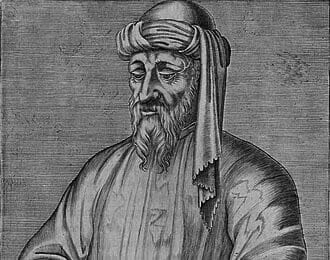
Porphyrius
234-305
Biography
Porphyrius (Greek Porphyrios; probably 234–c. 305) was a Platonist philosopher, commentator, philologist, religious thinker, and editor whose work decisively shaped the transmission of Greek philosophy in late antiquity and the Middle Ages. Born at Tyre in Phoenicia, he originally bore the Semitic name Malchus, meaning “king,” rendered in Greek as Basileus; he is nevertheless known almost universally by the name Porphyrios. The evidence for his life is uneven. Its most dependable foundation is his own Life of Plotinus, supplemented, with due caution, by Eunapius and later testimonia. He received an extensive Greek literary and philosophical education and studied at Athens with Cassius Longinus, the critic, rhetorician, and Platonist scholar whose learning Porphyry continued to esteem even after rejecting aspects of his philosophy. This early formation helps to explain the unusual breadth of Porphyry’s subsequent activity, which ranged across philosophy, logic, literary criticism, Homeric interpretation, grammar, rhetoric, mathematics, harmonics, religious antiquities, biography, chronology, and scriptural polemic.
In 263 Porphyry entered the Roman circle of Plotinus, with whom he studied for approximately five years. The encounter transformed his philosophical orientation: although elements of Middle Platonism remained important in his thought, he accepted the principal structure of Plotinus’ metaphysics and became one of his closest associates. Porphyry’s account depicts a school founded not upon passive adherence but upon sustained textual and philosophical examination. He questioned Plotinus closely, participated in disputes over Aristotle, and undertook scholarly tasks within the circle. In 268, during a severe psychological crisis, he left Rome for Sicily on Plotinus’ advice; he remained absent when Plotinus died in 270. Little can be established securely concerning Porphyry’s residence and teaching during much of his later life. He married Marcella at a comparatively advanced age and addressed to her an extant letter presenting philosophy as a disciplined mode of purification and assimilation to the divine. The frequently repeated assertion that Iamblichus was formally his pupil is not beyond dispute, although Iamblichus’ extensive engagement with, and criticism of, Porphyry is certain.
Porphyry’s most consequential bibliographical achievement was his edition of Plotinus. Completed in 301, when he states that he was in his sixty-eighth year, it arranged Plotinus’ treatises into six groups of nine, thereby creating the six Enneads under which the corpus has subsequently been known. This was not a merely mechanical compilation. Porphyry supplied titles, divisions, punctuation, summaries, explanatory material, and an architectonic order intended to guide philosophical study. He also prefixed the Life of Plotinus and the Order of His Books, at once a biography, a history of the school, and an account of the textual corpus. His arrangement displaced or obscured alternative forms in which Plotinus’ writings had circulated and became the basis of their subsequent manuscript and printed transmission. Porphyry must therefore be regarded not only as Plotinus’ biographer and interpreter but also as the editor who largely determined the form in which Plotinian philosophy reached later readers.
More than sixty works have been attributed to Porphyry with varying degrees of certainty, but only a comparatively small portion survives intact. Among the principal extant writings are the Isagoge, or introduction to Aristotle’s Categories; a shorter commentary on the Categories; the Sentences Leading to the Intelligibles; On Abstinence from Ensouled Beings; the Life of Pythagoras; the Letter to Marcella; On the Cave of the Nymphs; the Life of Plotinus; and writings associated with Ptolemaic harmonics and astrology. Other works, including commentaries on Plato and Aristotle, a history of philosophy, studies of the soul, the Philosophy from Oracles, and the polemic Against the Christians, are lost or fragmentary. The corpus is further complicated by contested attributions. Most notably, Pierre Hadot’s assignment to Porphyry of anonymous fragments from a commentary on Plato’s Parmenides exercised considerable influence but has been repeatedly challenged; the question remains unresolved and cannot safely be used as the basis for an unqualified reconstruction of Porphyry’s metaphysics.
In broad outline Porphyry accepted the Plotinian hierarchy of the One, Intellect, and Soul, together with the distinction between the intelligible order and its sensible image. The true human being was identified principally with the intelligible or intellectual self, while philosophy sought the soul’s liberation from domination by bodily passions and its return to its divine source. Yet Porphyry was not simply an expositor of Plotinus. His surviving writings display a more systematic concern with classification, terminology, exegesis, and the reconciliation of authorities. He played a foundational role in the incorporation of Aristotle into the Platonist curriculum, interpreting Aristotelian logic in a manner compatible with Platonic metaphysics. His treatment of the Categories as concerned primarily with significant expressions and the sensible things they designate reduced the apparent conflict between Aristotle’s classification of substance and the Platonic doctrine of intelligible Forms. This exegetical strategy became characteristic of later Platonism.
The concise Isagoge proved to be Porphyry’s most widely transmitted independent work. It introduced the five predicables—genus, species, difference, property, and accident—and deliberately deferred the difficult question whether genera and species subsist independently, exist only in thought, are corporeal or incorporeal, and, if incorporeal, exist separately from sensible particulars or within them. Precisely this suspension of judgment furnished later Greek, Arabic, and Latin thinkers with a canonical formulation of problems concerning universals. Through translations, especially those associated in the Latin tradition with Boethius, the Isagoge became a fundamental elementary text of logic. Its schemes of division generated a rich manuscript tradition of glosses and diagrams; the later arborial representation conventionally called the “Porphyrian tree” should be understood as a development of Porphyry’s classificatory exposition rather than as a diagram transmitted in his own text. The work retained its curricular place in medieval schools and universities and continued to circulate in Renaissance and early modern editions of the Aristotelian logical corpus.
Porphyry’s literary and religious writings reveal an equally sustained practice of interpretation. In On the Cave of the Nymphs he read a Homeric passage as a densely constructed philosophical and religious allegory, integrating poetic exegesis with cosmology and the doctrine of the soul. His lost Philosophy from Oracles sought to organize traditional oracular materials within a philosophical framework, while his questions concerning Egyptian ritual, addressed to the priest Anebo, elicited the response traditionally transmitted under Iamblichus’ name as On the Mysteries. Porphyry’s position on ritual and theurgy should not be reduced to a simple opposition between rationalism and superstition. He accepted that ritual practices could operate within the sensible and daemonic orders, but he was reluctant to grant them the power, claimed by Iamblichus, to secure the elevation of the highest soul independently of philosophical understanding. His work thus stands at a pivotal point between Plotinus’ predominantly contemplative Platonism and the more explicitly theurgical systems of later Neoplatonists.
On Abstinence from Ensouled Beings joins ascetic discipline, religious purity, criticism of animal sacrifice, and arguments concerning justice toward non-human creatures. Addressed to the philosopher Castricius Firmus, it does not merely prescribe a diet but examines the relation between bodily practice and the philosophical life. Porphyry assembles historical, ethnographical, theological, and philosophical material to argue that the contemplative philosopher should avoid unnecessary participation in killing and consumption. The work is also an important witness to earlier debates about animal rationality, sacrifice, Pythagoreanism, and the ethical scope of justice. Its compilatory character illustrates a recurrent feature of Porphyry’s scholarship: inherited materials are preserved, classified, and redirected toward a philosophical programme of purification.
Porphyry was also the author of the most extensive pagan critique of Christianity known from late antiquity. Against the Christians, traditionally described as a work in fifteen books, is lost and survives principally through hostile quotations, summaries, and refutations. Both its date and the attribution of individual fragments remain disputed. The recoverable material indicates a learned criticism of Christian scriptural interpretation, apostolic authority, doctrinal consistency, and claims to historical prophecy. His argument that the Book of Daniel belonged to the age of Antiochus IV and described past events in the guise of prediction is among the most conspicuous examples of his historical criticism. Because the text is reconstructed from Christian witnesses—among them Eusebius, Jerome, and Augustine—its original structure and precise scope cannot be recovered with confidence. Its reception nevertheless demonstrates the seriousness with which Christian intellectuals regarded Porphyry as an exegete and philosophical opponent.
Porphyry’s historical importance rests upon the convergence of several roles that later scholarship has sometimes treated separately. He was the principal editor of Plotinus, a formative interpreter of Aristotle within Platonism, an influential theorist of philosophical purification, a compiler and critic of religious traditions, an allegorical reader of Homer, and a polemicist whose arguments compelled sustained Christian response. Earlier scholarship, especially that associated with Joseph Bidez, attempted to divide his career into successive religious, rationalist, and allegedly superstitious phases. More recent work has generally emphasized the lack of secure chronological evidence for such a developmental scheme and has sought instead to understand the coexistence of philosophical argument, ritual inquiry, philology, and religious exegesis within a single intellectual project. The fragmentary condition of his writings prevents a complete reconstruction of that project, but his influence is unusually visible in the forms through which later cultures read earlier texts: the ordered Enneads, the logical curriculum derived from the Isagoge, the Platonist commentary tradition on Aristotle, and the Christian preservation and refutation of his religious criticism.
Bibliography
Bidez, Joseph. Vie de Porphyre, le philosophe néo-platonicien: Avec les fragments des traités Peri agalmatōn et De regressu animae. Ghent: E. Van Goethem, 1913.
Porphyre. Entretiens sur l’Antiquité classique 12. Vandœuvres-Genève: Fondation Hardt, 1966.
Smith, Andrew. Porphyry’s Place in the Neoplatonic Tradition: A Study in Post-Plotinian Neoplatonism. The Hague: Martinus Nijhoff, 1974.
Smith, Andrew. “Porphyrian Studies since 1913.” In Aufstieg und Niedergang der römischen Welt, II.36.2, edited by Wolfgang Haase, 717–773. Berlin and New York: Walter de Gruyter, 1987.
Hadot, Pierre. Plotin, Porphyre: Études néoplatoniciennes. Paris: Les Belles Lettres, 1999.
Zambon, Marco. Porphyre et le moyen-platonisme. Paris: J. Vrin, 2002.
Karamanolis, George, and Anne Sheppard, eds. Studies on Porphyry. Bulletin of the Institute of Classical Studies Supplement 98. London: Institute of Classical Studies, University of London, 2007.
Smith, Andrew. Plotinus, Porphyry and Iamblichus: Philosophy and Religion in Neoplatonism. Farnham, UK, and Burlington, VT: Ashgate, 2011.
Goulet, Richard, et al. “Porphyre de Tyr.” In Dictionnaire des philosophes antiques, edited by Richard Goulet, vol. 5, pt. 2, 1289–1468. Paris: CNRS Éditions, 2012.
Johnson, Aaron P. Religion and Identity in Porphyry of Tyre: The Limits of Hellenism in Late Antiquity. Cambridge: Cambridge University Press, 2013.
Simmons, Michael Bland. Universal Salvation in Late Antiquity: Porphyry of Tyre and the Pagan-Christian Debate. Oxford: Oxford University Press, 2015.
Edwards, Mark. “Porphyrios.” In Philosophie der Kaiserzeit und der Spätantike, edited by Christoph Riedweg, Christoph Horn, and Dietmar Wyrwa, 1327–1349. Basel: Schwabe, 2018.
Beatrice, Pier Franco. The Philosophy of the Few against the Christians: An Inquiry into the Textual Transmission of Porphyry’s Philosophy according to the Chaldean Oracles. Leiden and Boston: Brill, 2024.
Tuominen, Miira. Living with Justice: A Philosophical Study of Porphyry’s On Abstinence. Baden-Baden: Karl Alber, 2025.
Beyond the names: biographies and bibliographies on this page are curated by Abu, the AI scholar crafted by Buonvecchio exclusively for Govi Rare Books.